
A book, a monitor, a painting, or a museum are the supports used by Magali Lara in the retrospective exhibition Mi versión de los hechos, which opened on November 17 at UNAM’s Museo Universitario de Ciencias y Artes (MUCA). In this show, Lara constructs a single discourse in different times, formats, and supports. In Lara, the exhibition is an echo of the oeuvre, and the oeuvre is an echo of vital pulses. Since her earliest drawings in the 1970s, all the way to her most recent works in animation, Lara has been interested in constant, repetitive themes, since her new statements and apparently unuttered discourses appear through repetition.
Lara is an artist whose main interest focuses on the feeling that Being is formed by multiple layers of “I’s” that coexist in a single body and almost never perceive external experiences in the same way. In the series Alien, from 2002, her drawings grow like carnivorous plants while devouring the borders between human and animal, between what is foreign and what is one’s own, between the other and herself.
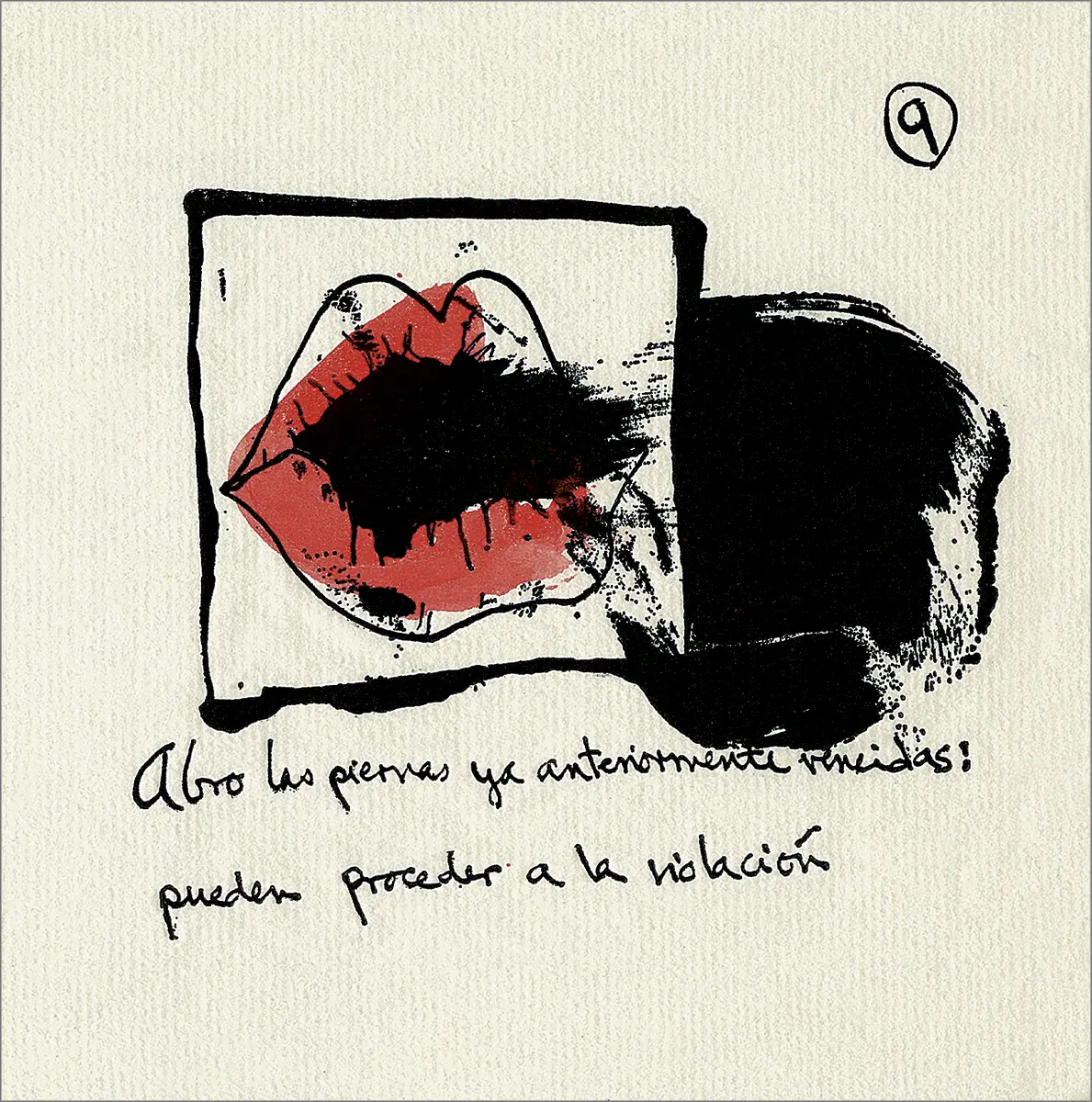
Lara’s work is evidently associated with the body, but not with the body as a whole or with a body entirely acknowledged as her own, but with visceral fragments that move, transform, and fuse with plants, internal liquids that flow into white spaces, alien to the human. An unknown body that expands and contracts, mimics, and mutates. Lara has never represented a nude figure in her paintings; what we find are rather representations of perceptions of the body, the “I”’s, own perceptions. A live corporeity, comprised of organs, sensations, traumas, thoughts, and fluids in constant movement. In one of her most recent series La piel después de los cuarenta, from 2004, Lara seems to have found a part of herself —of her own body— that does not appear in any of her previous series: a place, a circumstance that connects to the coming of old age or perhaps of death. In this series, the color black, with all its density, acquires a much greater presence than ever before, even if since her earliest drawings Lara has insistently worked with red and black against white backgrounds, where blood and mouth are the themes and suggest a different, more vital sexual force.
In Lara’s work, color, line, and word correspond to a semiotic idea, since in the work as a whole, there exist many spaces for personal interpretation. The texts that accompany her drawings are not flashes of a literal or explicative line of thought, but products of different logics that force viewers to interpret and imagine, but which, above all, connect them to their own life experiences from a place that cannot be easily rationalized. Lara forces viewers to produce their version of events, even to the point of reserving, within the exhibition, an empty room for visitors to write, draw, or talk about what has happened to them while exploring her works.
Another important topic in Lara’s work is the search for the hidden life of domestic objects. In this exhibition, the artist takes a bold step and transfers the drawing of an object to the object itself: irons that illuminate, toilet bowls-mirrors, chairs in many sizes, musical blenders. As if objects could be vulnerable or fragile, and as if in them a reading of the body could be deciphered.
Lara is equally interested in the territories of the book. In the book, we draw, we stain, we grope in the dark, from a logic that may perhaps be the logic of instinct, of our innermost realm. It seems that in the space of the book, Lara has been able to bring together her dual vocation as a poet and a painter, finding and enjoying the visual richness of the text and the narrative potential of the image. The book is a portable object that contains a time and a space that, while not unlimited, can nonetheless astonish our imagination with its sheer size and put us in mind of Borges, with his suggestion of the universe as a library.
In Magali Lara’s work, Femininity is not a political discourse but a search for languages and discourses that can be articulated on the basis of a different logic, with different experiences as their starting point. In her female writing, she articulates processes that are the inverse of those that are commonly associated with the notion of thinking. Lara does not rationalize her emotions; on the contrary, she “emotionalizes” her thoughts.
LARISA ESCOBEDO