
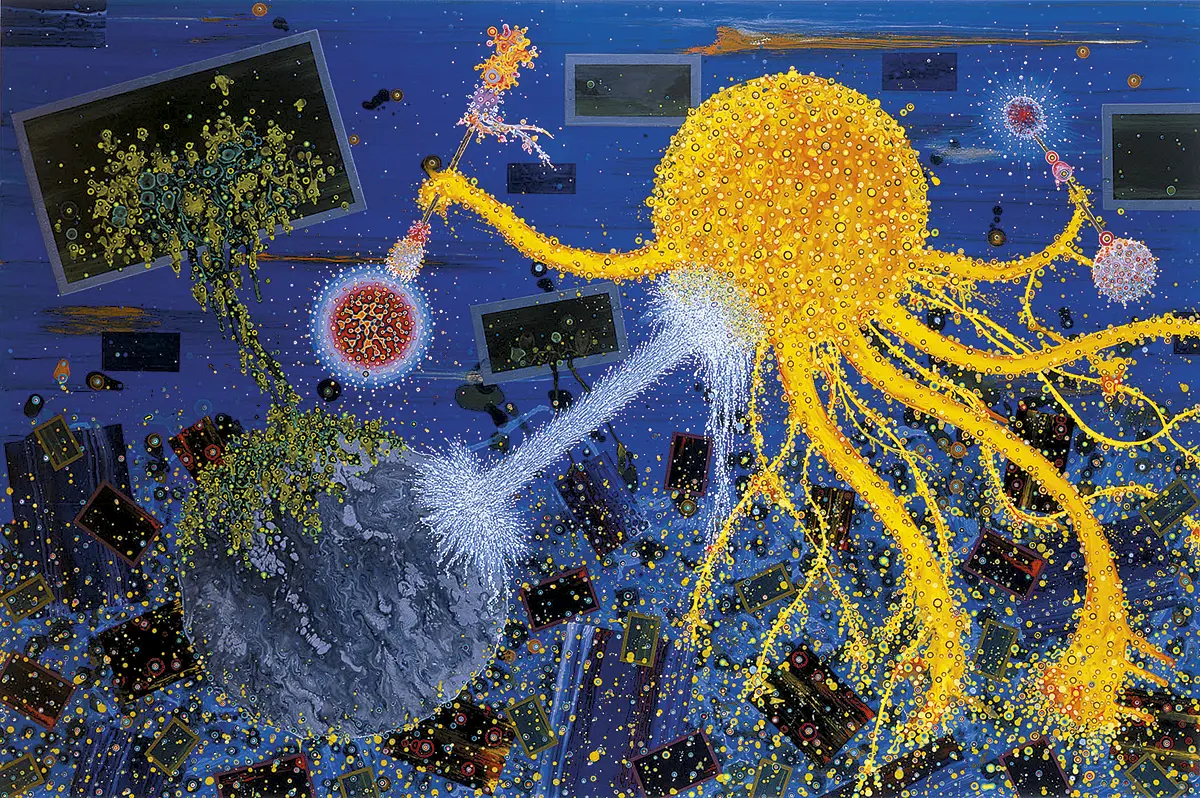
Nothing prepares one for the outlandish visual feast that Marcelo Pombo’s paintings bestow. From afar, one sees the representation of rudimentary forms such as a hill, a tree branch, or the illusion of rain. But, up close, that image disintegrates into a labyrinth reality in which enamel dots painted within dots within dots create the illusion of hundreds, if not thousands, of eyes that stare back at the viewer. While wryly critiquing the sport of voyeurism that has been intrinsic to painting for hundreds of years, the newest works simultaneously assess social obsessions with mass media imagery.
From the moment one steps into the gallery’s opening chamber, which features a suite of some eight or so works, the small Isla de moluscos (2004) beckons. Rendered in lustrous blue and silver tones, the work from afar subliminally promises the delight and refinement associated with viewing an Italian Renaissance painting. Coming closer, however, one quizzically sees a huddled group of primordial creatures that appear to crest a small earthen mound, as they appear to emerge from a glimmering sea. Unexpectedly, one notices that the small creatures collectively ogle back in ways that are unnerving, witty, and wry. Daring to linger, the viewer finds that it is not just the creatures that gaze into our space, but the internal eye-components of their constructed forms. Parodying assumptions that for centuries have privileged viewers by permitting them to look at something without being seen, Pombo’s paintings propose the possibility that painting and imagery in general are always a constructed interpretation of reality.
Indeed, many of Pombo’s newest works specifically query humanity’s growing acceptance of viewing and interpreting life through the scrim of mediated images that radiate from computers, televisions, cell phone pads, and movie screens. The memorable painting, Bodhisattva (2004), inventively presents a lounging robotic figure who serenely smiles at viewers as she lounges within an imaginary cityscape. It is doubtless intentional that Pombo’s languid figure recalls the innocent seductress of Balthus’ The Golden Days (Les Beaux Jours) of 1944-1946. Wryly and fittingly, Pombo chooses to characterize media technology as a seductive, mechanized femme fatale, interpreting the social construct of media as a seductive, passive persona who promises to confidentially share secrets in a discrete and private manner, though such promises are made ironically to everyone. While it seems from afar that this glowing Bodhisattva smiles in our direction, her sliver-moon eyes in actually glide past our shoulder unseeingly, until we zoom in to examine the eye-boggling substructure of those eyes. Promising to share the blue-blooded heritage that courses through her sparkling inner circuitry, she magically sits in the midst of a postmodern anywhere cityscape. Cool green and blue squares and rectangles form a constellation around the bodhisattva, denoting abstractly an array of downtown office buildings glimpsed as it were in a city come alive at dusk.
Provocatively reconsidering questions first raised in the 1960s by such artists as Nam June Paik and Lynn Chadwick, Pombo’s current paintings puissantly question global society’s obsessions with voyeuristic sight as a reliable source of knowledge. Presenting two dichotomous images simultaneously –one seen from afar and one seen up-close– his paintings whisper of truths that are simultaneously surreal, frightening, and wise.
COLLETTE CHATTOPADHYAY