
Formless forms
and chance as a regulatory principle
Between 1995 and 1997, Mauro Machado started to develop a group of paintings based on the effects of oxidation and physico-chemical decay, by dripping saline solutions of iron and copper, or inoculating the support of his canvases with washes of colonies of fungi. In these pieces, instability, transformation, a germinal chaos, disorder, and the accumulation of temporal and atmospheric residues are all inherent in the work and are not the result of a mode of specific constitution. These works display an absence of form, a negation of contrast between ground and figure, and an irregularity of definitive contours in a manner that is close to formlessness as magisterially defined by Rosalind Krauss and Yve-Alain Bois. 1
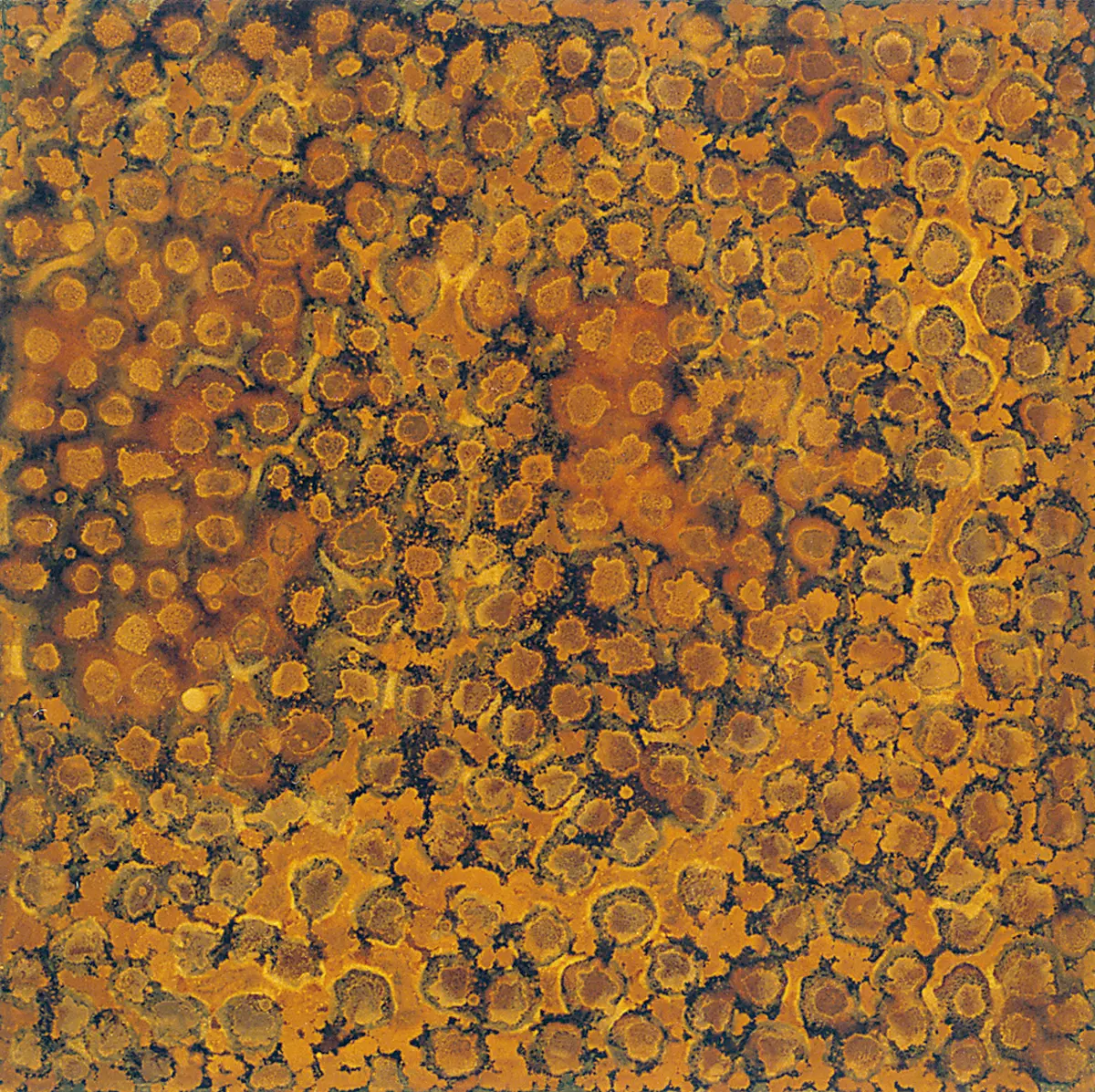
In a culture of replicas and clones, such as ours, the formless character of these works by Machado introduces the register of a repetition that produces a small difference; that is to say, a repetition understood as a universality of the singular, according to subtle diverging modifications.2 Such representation of extreme similitude or perfect equivalence, as in the cycle of paintings with fungi colonies, does not void the existence of a difference in degree or in nature between the works. Thus, on the level at which they operate, Machado’s works from this period are in sync with Gustav Metzger’s acid paintings, Kazuo Shiraga’s foot paintings, Ives Klein’s series of burnt blue monochromes and fire paintings, Alberto Burri’s plastic combustions, and Andy Warhol’s oxidation paintings.
In relation to this spirit of formlessness, in his 1978 book Stabilité structurelle et morphogénèse, mathematics logician René Thom had already referred to certain particular shapes that are, as a matter of principle, unstable, and the perception of which can move from the recognition of one entity to the next with the variation of just one parameter of the same shape. Thom adds that when verifying cases of this kind, we are not in the presence of orthodox shapes but of what he calls “shapes of the shapeless.”3 In that sense, Machado’s works from that period indulge in a marked de-figuration, or trans-figuration, where any range of configurations is void in the presence of the amorphous. These masses, voided by the same mechanism of amorphousness, produce a depth of field that is radically indistinct, as we can see in Earth. Une saison en enfer and Naturaleza de la existencia física, both from 1995. Depositing shapeless bodies of watery consistency in successive sediments and strata, to have them later dry up and solidify on the canvas, implies casting one’s lot with a planar abstraction in a magmatic vein made of blemishes and smudges, which allows Machado not only to negate the figure by means of its contrary—the stain or the trace—but also to neutralize it through the irruption of the formless and a surface accumulation that culminates in an unexpected horror vacui. The pieces read as monochrome walls that have lost, ex profeso, their eidetic value. Chance and time are responsible for this visual effect.
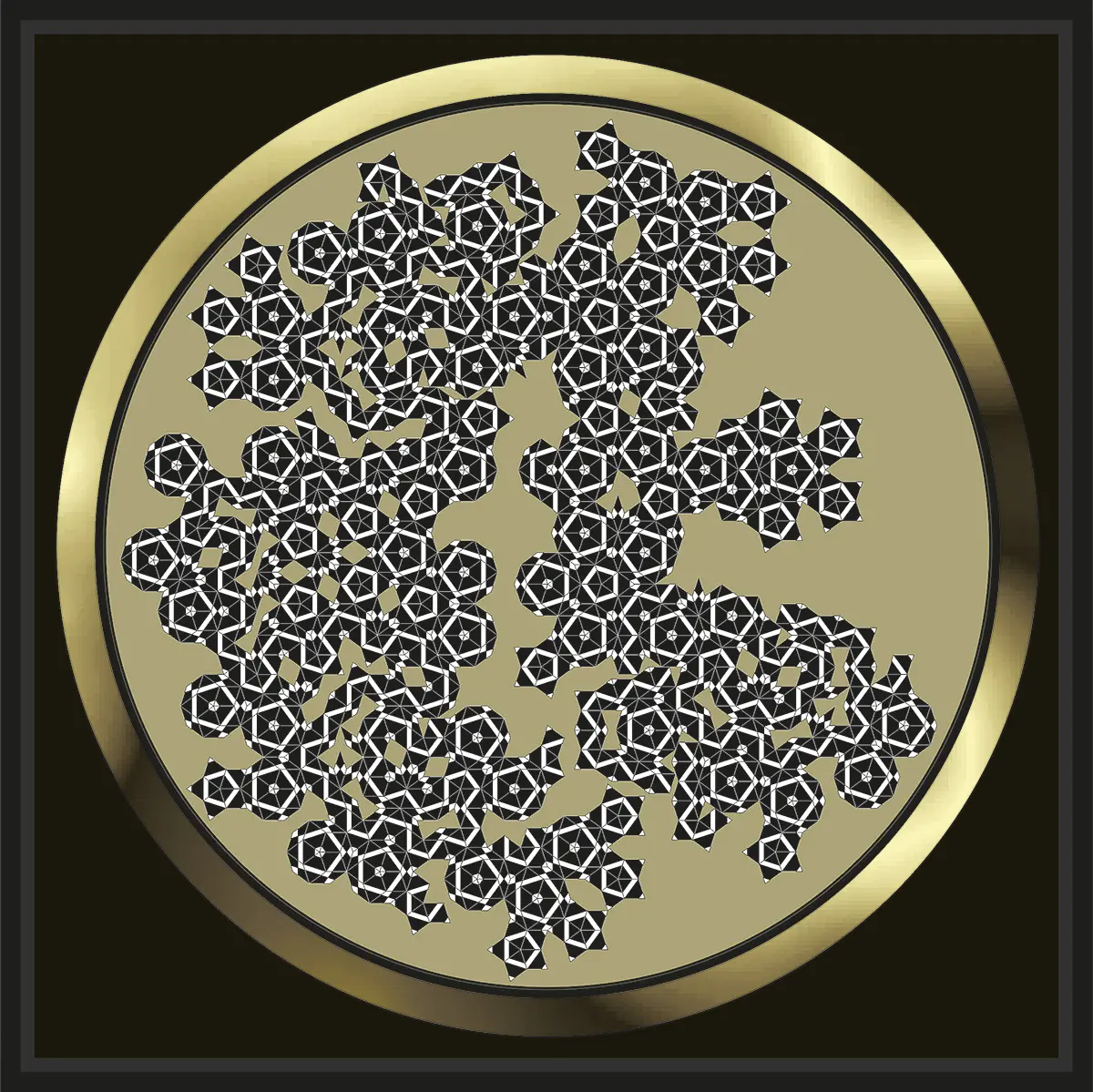
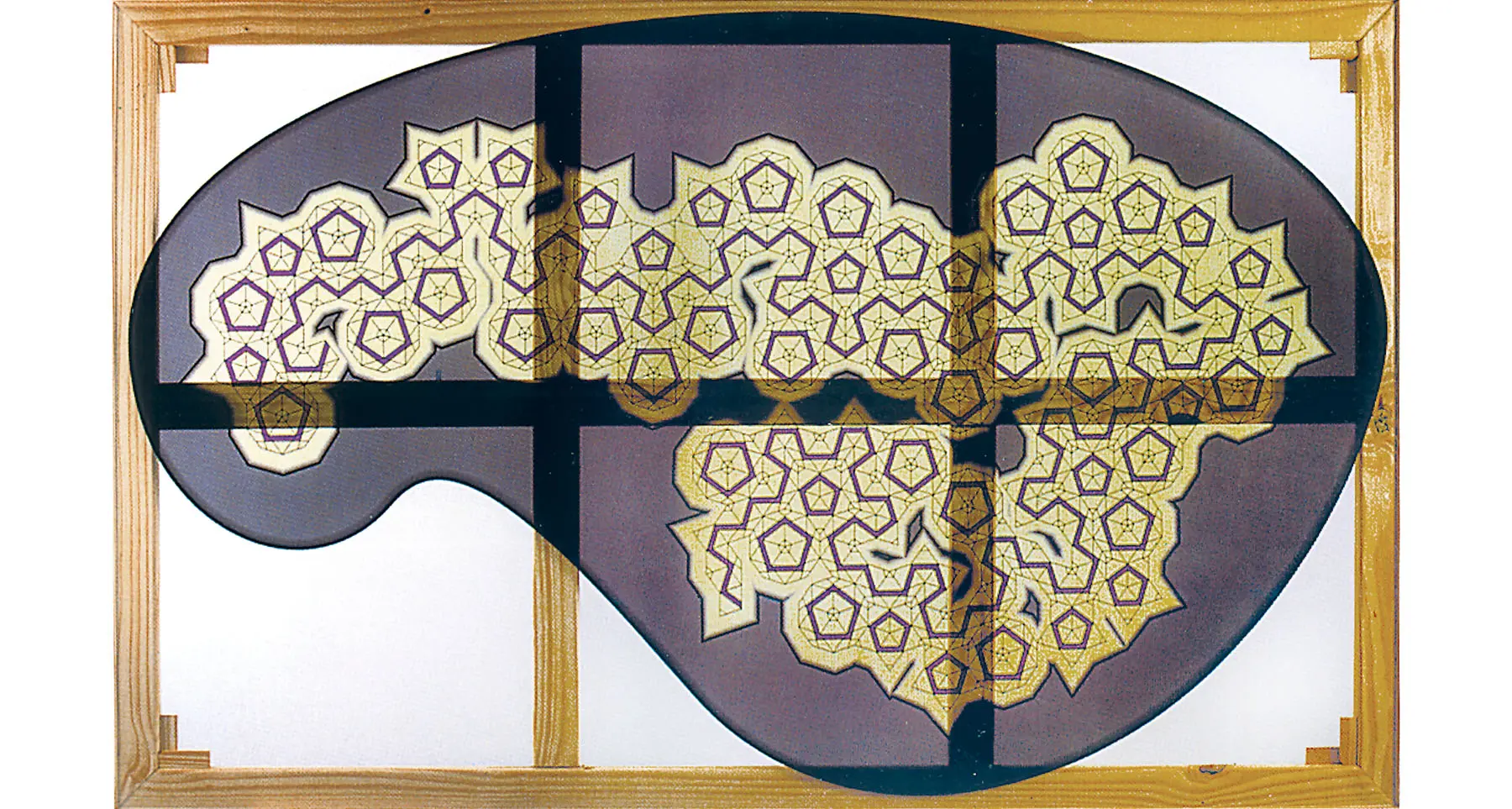
Later, starting in 1998, Machado abandoned his experimentation with the process of chemical oxidation and recovered for himself the purity of linear geometric structures. This shift or inflexion point in Machado’s poetics coincided with the introduction of structures or families of irregular networks and graphing non-periodic mosaics, in particular Penrose’s Mosaics, based on the aleatory linkage of pentagonal figures.4 These works have an ovoid, elliptical, or circular shape and propose a series of combinations of possible lines and dots, but that choice does not have an infinite continuity; instead, it is subjected to the very logic that regulates its structures. Here, Machado develops a combinatory art on polyester films that are mounted on bare frames; its prior scheme takes as a starting point successive designs of plots, line filigrees, and reticuli where logical chance combines with the recourse to the informational labyrinth that characterizes a PC. The highlights of this group of works that exhibit chaotic shapes from a non-Euclidean geometry are Conversaciones en el Café de la Ópera III, Colonia axiomática, and Decaimiento axiomático, all dated 1999. The first of these pieces displays a kind of circular molding ornament—a kind of tondo—inscribed on a gray square. Inside, we see a proliferating weaving whose unstable plotting represents, as an axiomatic model, the modes of social congregation, the fragmentation and disaggregation provoked by our unconnected way of life in today’s convulsive reality. The second piece presents a shapeless black surface, enigmatic and overpowering, containing a geometrically irregular yellow reticulation. Here, the artist manipulates the art of assemblage and the poetics of the object. Finally, the third piece, in an equally object-oriented matrix, plays with the counterpoint of positive and negative by duplicating an ovoid black shape as its ghost white counter-image. These pieces reproduce in aesthetic terms the beauty of certain fractal configurations, as described by Benoît Mandelbrot, who discovered them.5
The logic of a Babelian labyrinth
El fin es el principio, 2002–2003 is an itinerant, site-specific installation exhibited by Mauro Machado at the Museo Castagnino in Rosario (September 2002); at Diana Lowenstein Fine Arts in Miami (December 2002); and at G.R. N’Namdi Gallery in Detroit (March 2003). The project was redefined by modifications dictated by the topological characteristics of each of the three spaces. The artist intended to load and complicate these three different contexts with biomorphic references—allegories of nature—to effect a gradual passage of images and bodies to the internal architecture of the exhibition locales.
The environment comprised a walled-up labyrinth separated into closing sheets of glass and stainless steel, as well as paintings, drawings, photographs, and a significant number of expanded-field objects, or specific objects that simulated vague plant morphologies, in the manner of water lilies or hyacinths, with radial and star-shaped symmetry. This multiform corpus was placed in such a way as to invade the space and provoke an interesting counterpoint of visual contaminations, made dynamic by the serial modules of the glass and metal doors.
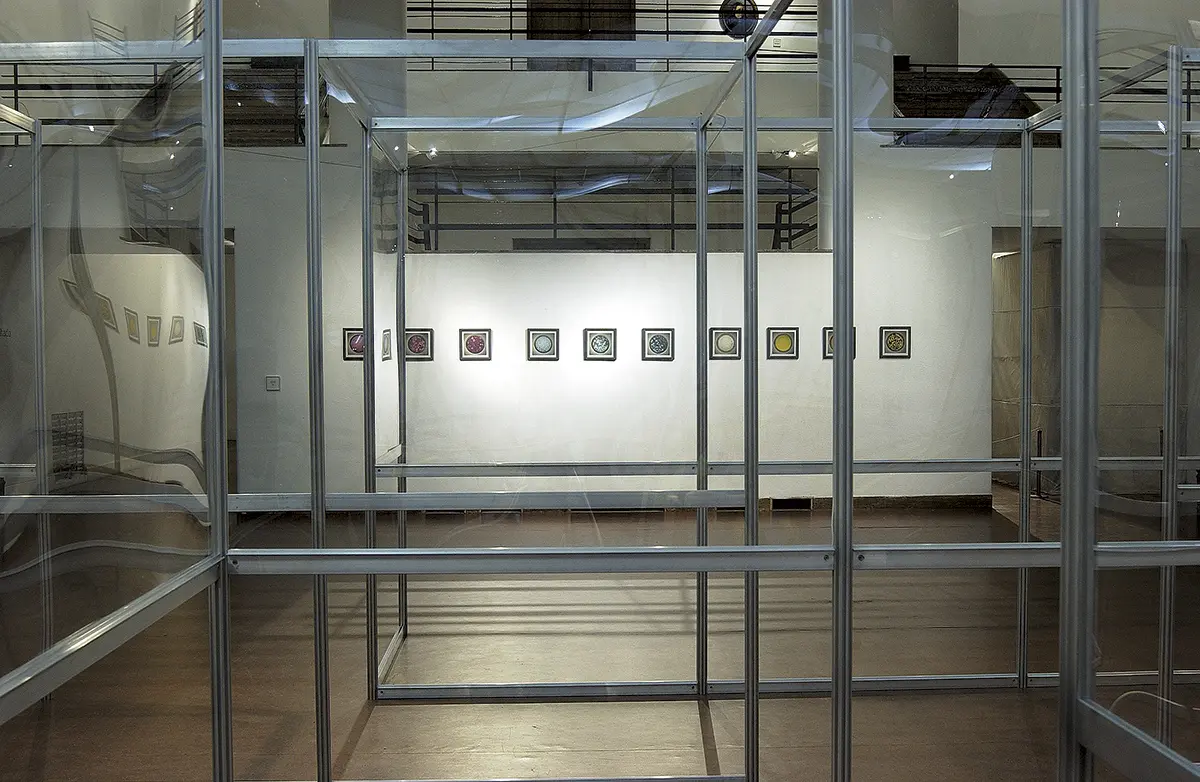
Machado’s spatial postulates fell under the conceptual umbrella of neo-minimalism, with its untamed aspiration to give the surrounding environment a new sensory intensity. The artist’s effort centered on thinking of the beginning as an end and playing with the reversibility of the circuit that took us through the environment. Of fundamental importance was his understanding of the specific location as a condition of possibility for the modification of the inner architectural skin of the museum and the two galleries, through the clarity and the rutilant effects produced by the mirrored glass. In this piece, Machado conceived the object’s self-representation as a rectangular glass parallelepiped whose sculptured, architectural character underscored distance and imposed a use/flow circulation value on the viewer. However, such a premeditated climax of the senses was consolidated thanks to the use of a rigorously ascetic system. To this the artist added an associative order dominated by metaphors of flux, travel, departure, displacement, and spatial drift, and in this context the central labyrinth became a veritable specular machine shooting flashes and sparkles all over the place. The polyhedron’s translucent body gave shape to an infinite range of adherent and distorted views, where, by the force of cloning and duplication, everything became a screen.
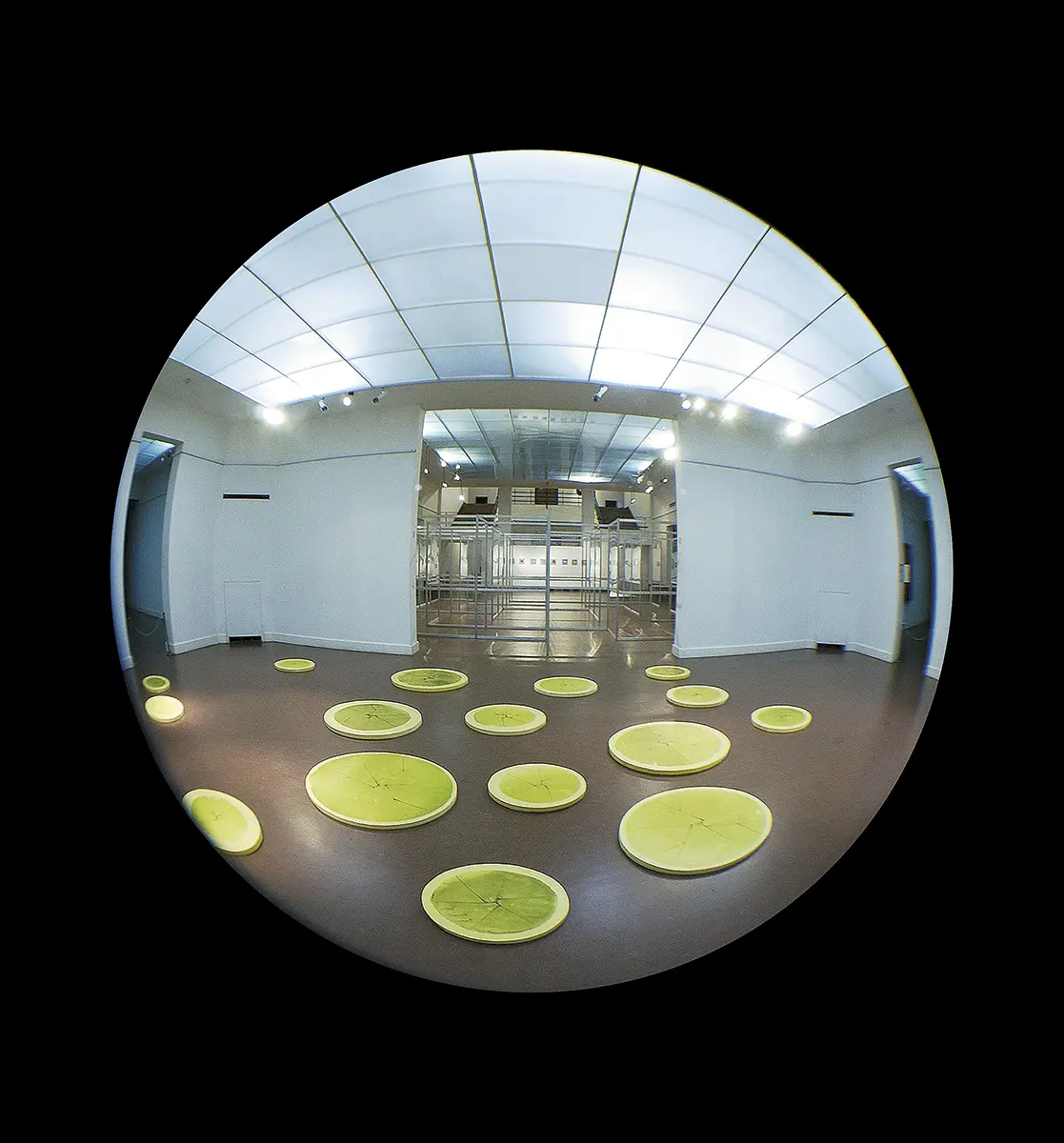
Special mention must be made of the fact that nowadays museum and gallery architecture is the reservoir on which these differences are deposited. The “disciplinarily” distinct epidermis of an encyclopedic museum like the one in Rosario is located at the antipodes of the minimalist cube of a contemporary art gallery. This is why, within the museum, Machado’s work exalted the depth of shadows and played at exacerbating the figurative contaminations of the surrounding space. In contrast, his spatial arrangements in Miami and Detroit attempted not only to intervene with the walls, the borders, the center, and the periphery of the respective galleries, but also to create a much more fluid and consolidated occupation of the exhibition areas. However, in the last two instances, the artist was not satisfied with subjecting himself to the orthodox dictates of the perfectly white minimalist cube of a contemporary art gallery. In fact, his idea was to invade and appropriate the whole space, generating “interesting places” with subtle inferences in order to demonstrate that the work is, before anything else, a logical paradox and, at the same time, a complication. With this kind of work, by attempting a passage-like structure that resembles the structure of lived experience, Machado tried to solve the contradiction implied by the real distance of time and space. His treatment of time, on the other hand, is always equivocal: chronological time alternates, in this case, with the absence of time—a frozen, suspended time—present in the mythical shape of the labyrinth. What is generated is a circularity of structures that self-destruct and self-generate reciprocally. From that spatial configuration containing its own double, we return to the configuration of which the whole unit is comprised. In this way, El fin es el principio is strongly marked by the tensions promoted between the work and the space with which it is entangled. As a result, Machado explored a varied spectrum of optical—in a gestalt matrix—psycho-physiological, and tactile sensations, by using a dispositif of continuities and discontinuities. His structures or primary forms were deployed serially, in cycles or families of works, which worked in open or closed groups according to the criteria for internal circulation adopted by the public. This is why this work is a veritable Babelian labyrinth. Here, the essence of the Babelian is the labyrinth’s architecture and its modular, unhinged, perturbed structure, which contradict the pure stereometric qualities so actively defended by the poetics of minimal art. The cube, as a synonym of vacuum, circumstantially inhabitable, underscores the richness of the multiple, the complex, and the differential. Indeed, Machado questioned the purism and formal asceticism of minimalism’s large-scale geometry. In this way, he was able to re-signify the object/labyrinth while preserving the playful, haphazard, functional character of the artifact/work of art. However, an optical distortion was created through crystals, the product of the regularity of the labyrinthine configuration, and spatial perception became a drift and a test and calculation for the viewer. Through this site-specific installation, Machado took away the status of space as an absolute, transforming it into a terrain where the viewer had to constantly find his or her point of reference and location.

It is also well known that knots, stranglings, agglomerations, and labyrinths are prevalent visual formulations in most of Machado’s works.
In the last two decades, both the knot and the labyrinth have appeared often in contemporary art, both as figures and as structures. Many artists have produced and continue to produce labyrinths as an art form. Good examples of this are Adrian Fischer, M.C. Escher, Randall Choate, Richard Fleischer, and Keith Haring, to name just a few. In the case of the use of configurations of knots, we can mention the work of Pierre Alechinsky, Christian Tobias, Oyvind Fahlstrom, and Saul Steimberg.6 In addition, the knot and the labyrinth are two structures of thought, and at the same time constitute the beginning of two specific kinds of mathematics. The first was proposed by Pierre Rosenstiehl, creator of two algorithmic systems for solving problems of labyrinth shapes: the theorems of Mad Ariadne and Wise Ariadne.7 The second kind we owe to several European mathematicians who were authors of numerous theories of knots. Nevertheless, knot and labyrinth are not only mathematical and informational models, but in the fields of epistemology and philosophy they are true cultural modelizations. For example, the rhizome, proposed by Gilles Deleuze and Félix Guatarri, is a labyrinthine, knotted tree opposed to “false” Porfirian trees.

Infiltration of the image’s post-photographic condition
The self-portraits in the series Las cuatro estaciones, dated 2000, are undoubtedly a post-conceptual recreation. In them, the artist confronts the counter-utopian gaze of our own knowledge. The photographs exhibit a simultaneity of tactics, interwoven languages, and resolutions, and superposed on them are a self-reflexive character, a redefined abstraction—valid for the support—and the gestural nature of an organic, ephemeral materiality taken to its zero degree. The analogical documentation and the post-photographic makeup of the natural elements manipulated in a Petri dish emerge a posteriori. Again, Machado subjects his cultures to the action of time and atmospheric effects, in the same way he did with his chemical oxidation and fungus paintings. But in the case of these four self-portraits, those parcels of living nature -entombed in round glass containers- are replaced by their photographic traces. Thanks to his use of a variety of framing, extreme enlargement, reduction, and flattening strategies, Machado’s post- photographic images are crisscrossed by an ironic unreality. This irony quotient is based in a photographically rooted hypersimulation. It is in such pieces and fragments of living reality that the flow of things, the metamorphosis and consummation of a non-present, is interpreted. This morbid beauty, injected with subtle convulsions, rests on those visions at a micro-scale, with monochrome propositions of flowerings and excrescences that float in blues, yellows, greens, and oranges, which seem to muddle our perception despite the vividness of their hues. In them, the strategy of the interval overtakes, by far, the purely retinal pleasures of the image, that is to say, its purely antithetical visual stratum. A marking of distance with the physicality of the image and the reclamation of a cerebral dimension of art are immediately evident in this group of works.

Machado’s most recent works have something of the Duchampian readymade about them, of an appropriationist resource, an intentional sacrifice of painting and photography taken to their limit and hybridized, where objectual reality and scientific reality meet. Since the beginnings of his career Machado has proven that his relationship to painting happens at the very limit of its convention. Highlighting the emergent capacity of the image, which changes incessantly, the artist represents various states of matter subjected to continuous rebirths and dissolutions.8
Lady Pink and Full Yellow are two photographic prints on matte paper, dated 2003, where the artist opted for the use of a loud palette of magentas, fuchsias, and cadmium yellows. Nonetheless, the showiness and chromatic splendor that these works possess allow Machado to continue with his investigation of the origin and foundation of life, that latent, pulsating humus he approaches again and again in order to explore the primary nature of things. To accomplish this, Machado uses a multiplicity of languages and representation mechanisms that carry him towards organic visions traced at the door of levity and dissemination.

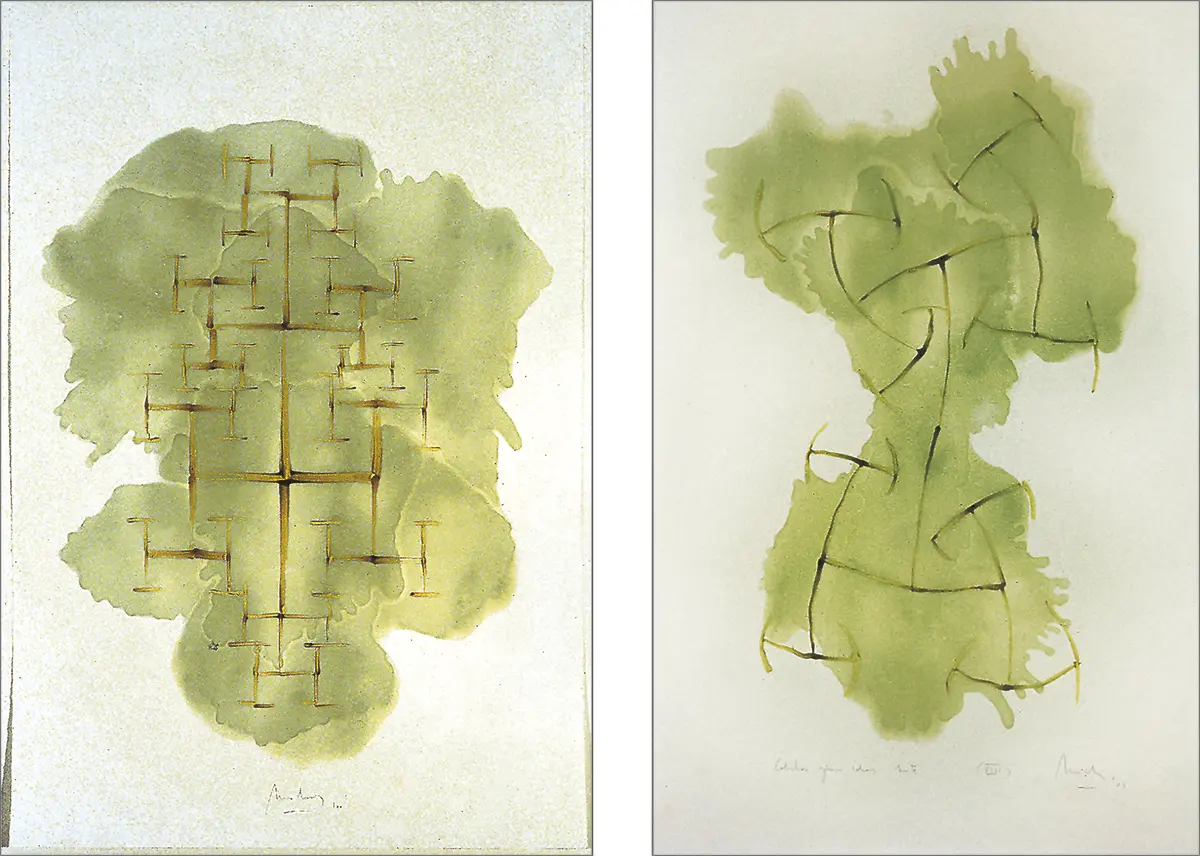
The lightness and souplesse of his watered-down tints acquire an exiguous corporeity in Colorless Green Ideas I and Colorless Green Ideas III, two mixed-technique works on paper, dated 2002 and acquired in early 2003 by the Detroit Art Institute. These works simulate very light plant leaves with irregular borders, like gauze veils, that threaten to dissolve as our gaze moves about them. Here, the artist displays his commitment to an aesthetic discourse of incompleteness, of the nakedness of the image, constitutive elements of simulated natural identities. It is in this conflict or line of tension, marked by its unfinished character as befits a universe made of substitutions, transpositions, and alternatives that Machado’s dissolution, mathematical formulas, and periodic destructions and reconfigurations of organic matter take place. This interstice is the domain chosen by Machado to deploy complexity and the enigma of diversity as thermometers of the contemporary.
Despite appearances, what interests Machado is not only an investigation of the status of the image as such, or the transformation of organic and inorganic matter, nor is it just the articulation of scientific or philosophical ideas or formulations related to chaos and catastrophe theory—so much in vogue nowadays—but rather, those questions capable of penetrating post-epochal singularities that exceed our reason.
NOTES
1. Rosalind Krauss and Yve-Alain Bois, “Base Materialism,” in Formless: A User’s Guide (Cambridge: The MIT Press, 1997), pp. 51–52.
2. Michel Foucault and Gilles Deleuze, Theatrum Philosophicum/Repetición y diferencia (Barcelona: Anagrama, 1995), p. 51.
3. René Thom, Stabilité structurelle et morphogénèse (Parisº: Denöel-Gonthier, 1978).
4. Carlos Basualdo, “La Pureza de la Descomposición,” in Mauro Machado: Obra Reciente, exhibition catalogue (Buenos Aires: Diana Lowenstein Ediciones, 1999), p. 12.
5. Benoît Mandelbrot, Les objets fractals (Paris : Flammarion, 1977).
6. Omar Calíbrese, Chaos and beauty. Immagini del neobarocco, Milano, Domus Academy Edizioni, Milano, 1991, p. 23.
7. Pierre Rosenstiehl, “Labirinto e Rete”, in Encyclopedia, Torino, Einaudi, 1980.
8. The artist interviewed by the author, September 2004.
* These images were photographed by Norberto Julio Puzzolo. All others by Gustavo Lowry.
CLAUDIA LAUDANNO
Doctor in Art History and Theory, Universidad de Buenos Aires. Arts editor, Diario Rosario/12.