
The Panamanian artist had her first Bogotá show between September 30 and November 30 at the Convenio Andrés Bello Cultural Center. The large paintings exhibited dealt with three main themes: still lifes, “lovers,” and parts of a “tribute to Michelangelo.” The still lifes: Estudio de bodegón, Sólo una pera, and Bodegón horizontal.”The lovers: Casa de Baccus, Disturbing angel, and Pareja de amantes, a frequent topic in the artist’s work, couples intertwined in the act of love, in a sensual, tender, loving, consoling, painful, anxious embrace. The “tribute to Michelangelo”: a triptych inspired by the “Slaves” at the Florence Academy, and La notte, which follows the similarly themed sculpture at the Medici Chapels, in San Lorenzo. These works are the result of the artist’s encounter, while in Florence, with Michelangelo’s oeuvre. Based on its formal relationships and the topic of sculpture, we can add to this group her Lanzador, inspired by Greek statuary, such as Myron’s Discus Thrower, and created in reference to the Athens 2004 Olympic Games.
The range of Olga Sinclair’s palette has become lighter since the 1980s, when it was centered around blues and purples; now it is dominated by ochres and earthen tones. It has also gained in gestural expression. Slowly and subtly, Olga Sinclair’s painting has transformed over time, having started with small formats representing the interior of female chambers, to arrive are large canvases that dominate their space. It has moved from soft, stump-painted pieces to powerful blotches and dynamic, expressive brushstrokes in works that are rich in matter applied with a large brush or a spatula. She now works on large plane backgrounds that are often traversed by horizontal and vertical lines, lines that segment those planes and emphasize the reticular spaces through chromatic variations or shifts that contribute a dramatic tension to the piece.
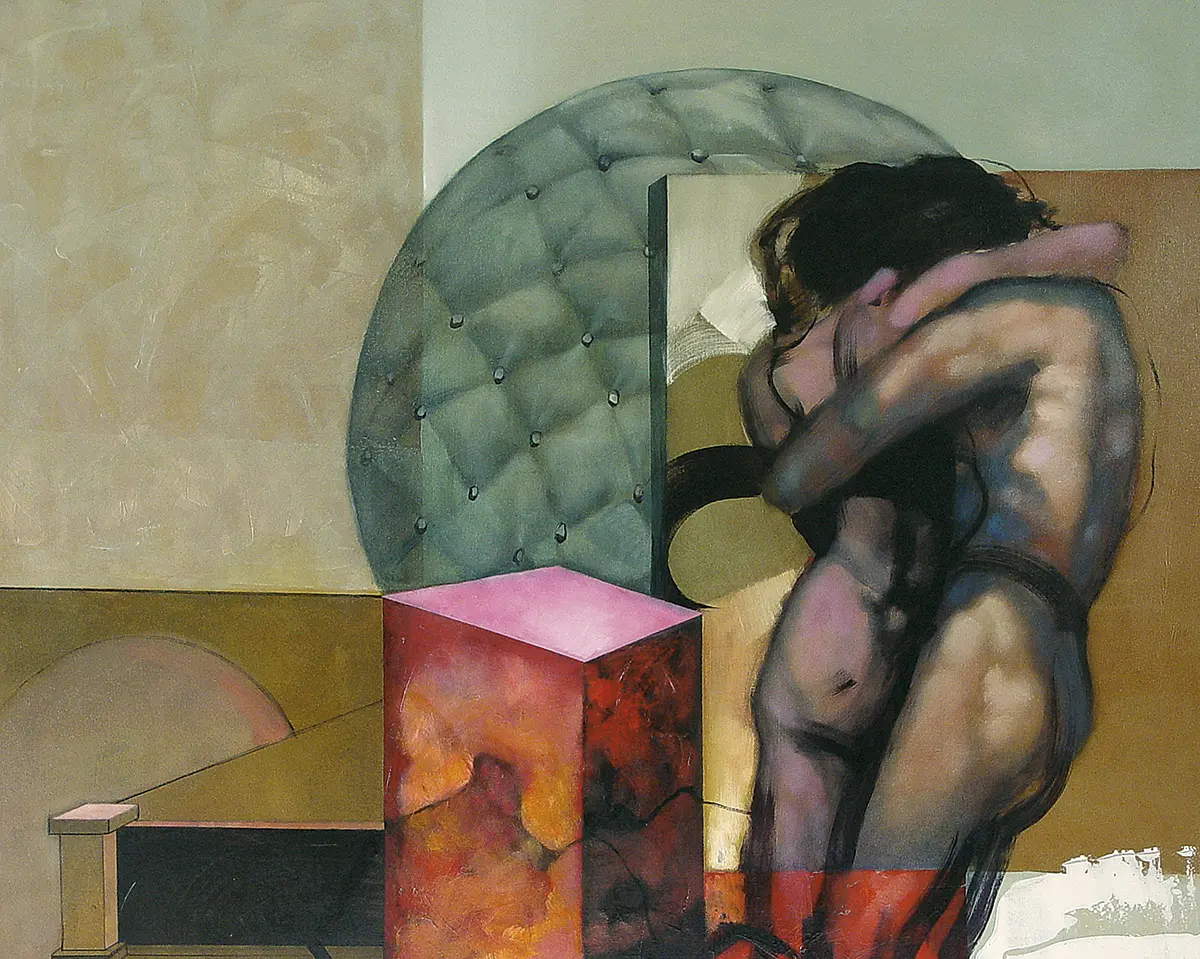
There has also been a shift in Olga Sinclair’s formal representation, her large-handed female figures, surrounded with everyday elements and stump-painted to make them soft. In her current work, exhibited in Bogotá, the development of these themes comes in figures that, compositionally, possess a classical centrality. The figures are developed against chromatic planes, which the artist transforms using successive layers of color. In other words, the artist builds her works from the background plane onwards, creating figures, adding rhythm as a function of form and expression through color, and through the expressiveness and gesturality of the brushstroke, applying in the end large strokes in a circular gesture that seals the work.
In contraposition to the dynamic tension of the planes and the centers, and to the gestural rhythm of the brush and the spatula, her works would seem to be serene and meditative. This effect is produced by the centralized handling of the composition and the enveloping, self-contained forms. Despite the expressiveness of her colors and her brushstrokes, the dramas she represents are introverted, treated as meditations or involutions of the pain of the soul. Her love scenes are not explosive or exuberant; they are intimate possessions or welcoming caresses that can also be painful and even bloody. Thus, the great conceptual empathy between Sinclair’s art and Michelangelo’s, since the latter’s work possesses the intense but contained interior worlds, characteristic of Mannerism, that announce what was to be the dynamic explosion of the Baroque. In those works that refer to romantic love, eroticism is in reality tenuous, complemented by formal suggestions, by different elements that comprise a thematic thread beyond the embrace of two, or three, naked bodies. The artist uses metaphors or symbols of the carnal union to complete a statement that perhaps her protagonists have left unfinished. When she deals with still lifes, these appear more dynamic and expressive, but they are faithful to the author and emphasize the characteristics of the genre, serene. Olga Sinclair paints external worlds that go from the quotidian and ritualistic aspects of nature, through the memory of what has been seen that made an impression, to the lovers, but always as a narrative or a chronicle more than in terms of confession, testimony, or revelation of personal interior universes. This relationship extends to the objects of her still lifes and to the sculptures as objects. Olga Sinclair paints themes that are dealt with by sculpture in three-dimensional pieces that, as such, change formally according to the angle from which they are observed. They are represented by Olga Sinclair in the capture of an instant of visual memory.
PEDRO QUEREJAZU LEYTON