
Paul Henry Ramirez presented his latest work in the solo exhibition In Fluent Form at the Mary Boone Gallery last October. The show consisted of eight large paintings in square formats populated with Ramirez’s now signature forms –curving lines and amorphous planes of solid bright colors against a clean white background. These visually striking paintings blur the boundaries between abstraction and representation. They further collapse binaries of line and color, form and formlessness, and eye and body, contributing to long-standing debates within the history of art.
In previous exhibitions, Ramirez’s paintings have not been bounded by the pictorial space; he has integrated them into their physical surroundings, creating a dynamic interplay between painting and architecture. Furthermore, as may be witnessed on the artist’s website (paulhenry ramirez.com), he has also included sculptural objects that reference the forms in his paintings. The exhibition at Mary Boone strictly consisted of easel paintings, leading one to wonder whether the choice was the artist’s or the gallery’s (in New York, Ramirez is traditionally represented by Caren Golden Fine Art). The end result was an interesting tension between the stark, gray architectural space and the colorful, playful forms that inhabit the paintings.
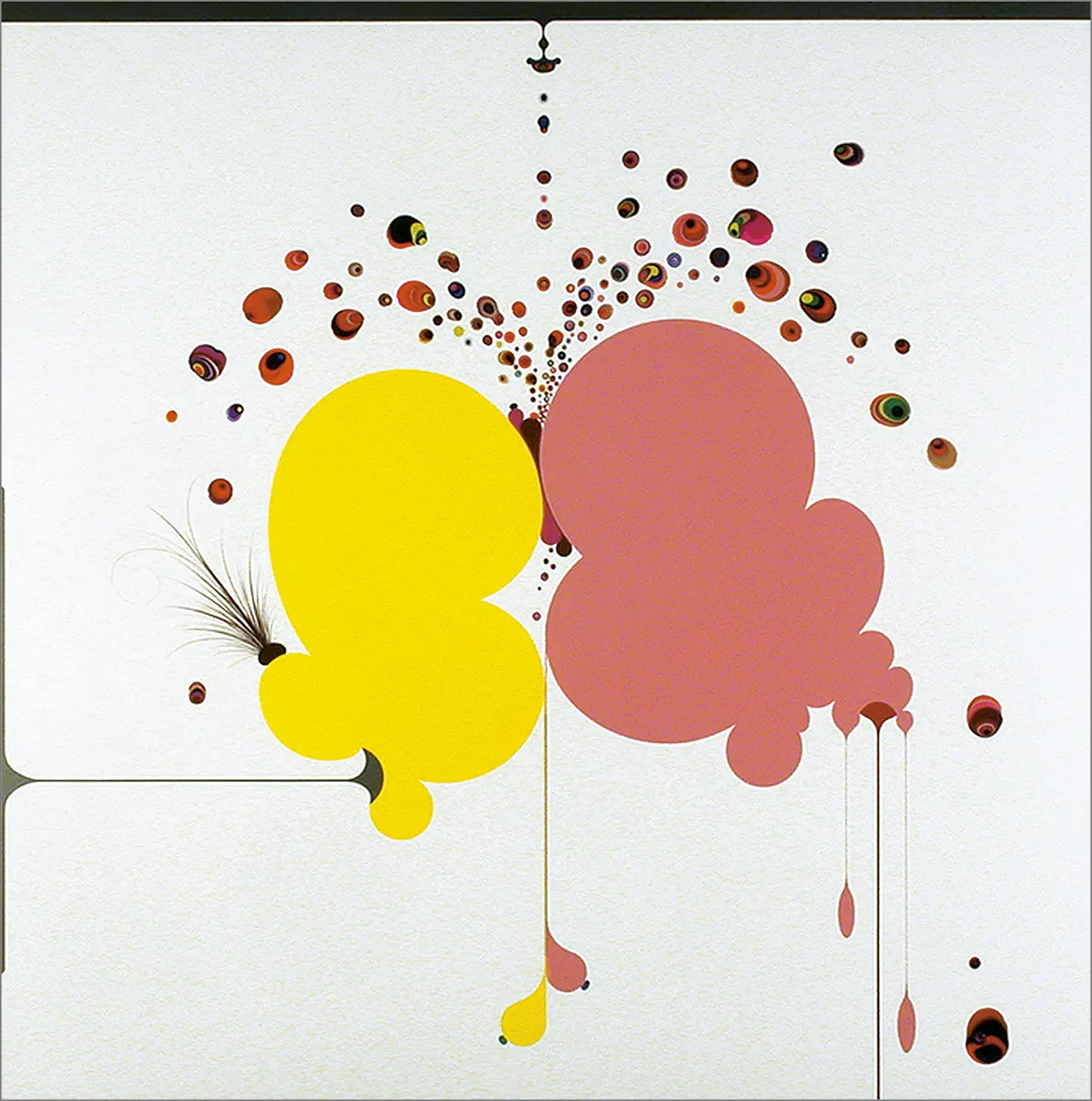
The paintings elicit multiple readings. In Fluent Form 4 is composed of two flat planes of color, yellow and pink, that meet in the central axis of the painting. Above them is a cluster of acrylic splotches in motley colors; by contrast, the edges of the painting are inhabited by rectilinear forms. The central blobs, for lack of a better term, resemble nothing as much as two scoops of ice cream, vanilla and strawberry, coming together under a rain of melted candy. Despite its childlike references, the canvas emanates a strange sensuality. Allusions to body parts, particularly sexual organs, abound in this and other paintings by Ramirez. The bodily dimension of this work might be interpreted as an ironic commentary on the aspirations of spirituality in many abstract paintings. Indeed, the painting’s flat planes would seem to reference modernist painting in general and abstraction in particular. However, beyond pure paint, the smooth surface resembles taut skin; the multicolored spots, thick and shiny, become like scabs suspended on the canvas.
The work of Ramirez has often been compared to Surrealism, and his forms certainly do recall the biomorphic abstractions of the Surrealist painters Joan Miró and Jean Arp. However, Ramirez’s paintings move beyond a purely formal resemblance to allude to the anti-humanist idea of the informe or formless first theorized by Georges Bataille in the 1920s, a concept that has been employed by the critic Rosalind Krauss to formulate a subversive counter-history of twentieth-century art, reading key movements and particularly Surrealism against the grain of traditional formalist narratives. Bataille’s notion, grounded on base materialism as opposed to the sublimated forms of high modernism, resonates with Ramirez’s references to the body and bodily processes. In In Fluent Form 5, planar rectangular structures, the building blocks of geometric abstraction, are contrasted to amorphous shapes that spill, squirt, and ooze over the painting’s surface as well as slight lines that coil around themselves like so much pubic hair.
Could Ramirez’s titles constitute a play on words to support such a claim? At first reading, the phrase “in fluent form” seems to reference the free-flowing forms that are the artist’s trademark. “Fluency” also points to mastery of language, and certainly Ramirez’s visual language has become instantly recognizable. Reading further, the first two words joined together create “influent,” alluding to the notion of influence, one of the essential precepts of art history. Influence creates a linear narrative in which an artist builds upon the forms of the past to make his or her own contribution to the canon. As has been amply theorized by Harold Bloom and other literary critics, tradition is created through the interplay of influence. Just as Ramirez is “influenced” by certain Surrealist painters, so too could his forms inspire future artists. However, the union of the first and third words to create “inform” subverts this notion, contrasting the traditional definition of information as enlightenment to the idea of a lack of form, anti-form, or Bataille’s informe. Such a reading would transform the first word of the title into a prefix denoting negativity and destabilize the entire phrase. Thus, “In Fluent” would become not-fluent, just as “form” would indicate its own opposite. Ultimately, could Ramirez’s paintings be proposing a similar against-the-grain reading of modernist art, refusing both sublimation and linear history, as do the texts of Rosalind Krauss?
Nothing is what it seems in the paintings of Paul Henry Ramirez. Forms that at first appear abstract court representation. The artist’s lighthearted, playful tone and compositional clarity belie a complex thought process, rife with interpretive possibilities but refusing to fix meaning.
TATIANA FLORES