
Impressions (and other images of memory) Rimer Cardillo’s quasi-retrospective show at the Samuel Dorsky Museum of Art in New Paltz mounts a discourse that, while acknowledging past ways of seeing, expresses itself in the language of a different modernity, one that emerged from the developments of a pervasive postmodernity. Cardillo knows of the end of Utopias; he is aware of the significance of latitudes, and practices a new-fashioned anthropology. As a mature artist, he does not focus unduly on those elements nor does he exploit them; rather, he elaborates on the tragedies of Latin America by following a trail of contradictions. Perhaps the first contradiction that needs to be pointed out in the case of this show is the fact that a printmaker expresses himself on paper, but by means of his "incisions,” he creates a path abounding in different natures, concepts, and materials. The artist operated in different territories, from objects to installations, from minute details and painstaking perfectionism to the salvaging of materials, creating new readings and new formats. And that, incidentally, is what it means to be an artist of the present.
Rimer Cardillo was born in Uruguay. He studied printmaking in his native country and later in Europe; since 1979, he has resided in New York City. Cardillo’s is not a dialogue for exiles; he has established a hierarchy of responsibilities that come from distance, understanding, and developing in his works situations of displacement and reconstruction. International acceptance of the existence of Latin American-ness has been a boomerang that few understand properly. We use the word “boomerang” in the previous sentence because it refers to a physical condition of complex movement that does not advance in a single exclusive direction, but turns on its own orbit and returns to its point of origin, until it takes off again, when it is thrown. Rimer Cardillo was not literally thrown from Uruguay, but his determination to leave, as well as his successive returns, were influenced by the many agents of social disturbance, the limitations, the risks to life, and the curtailed liberties. The political and social situation in Latin America has destroyed some utopias and worn others out. In the case of Cardillo, working from the margins of recognition and outside the marketing parameters in use is equivalent to having engaged in a different kind of struggle and assumed social and cultural responsibilities.
The current show makes clear that the artist keeps his distance from traditional metaphorical interpretations. His praxis of a detailed figurativism is not ignorant of synthetic processes; Cardillo is dedicated to aspects of the local that can at the same time be read universally. He is immersed in art and is also attracted to science; he works in very small sizes and also in a monumental scale. The show reveals a personal conceptualization of working on paper and of printing techniques, expressed in unique originals and in a few numbered originals in very small runs. Cardillo uses paper in an unorthodox manner. He expands the concept behind his printmaking technique in order to create new forms, new vectors, and latitudes that surpass the relationship ground/figure. In terms of the concept of “individual repetition” that characterizes printmaking, Cardillo practices it to bring the technique and the materials to frontiers that were rarely tread upon habitually.
Although two-dimensional works predominate in the show, there are reliefs resolved in intaglio and collage, as well as constructions and sculptures. By its deployment of technique, the show is a symphony of personal combinatories. Throughout the years, the artist has been transferring the concept of printmaking to different materials and aesthetic circumstances. By extension, he has “printed” exempt volumes on clay, on paper, on bronze. These resultants appear isolated as small satellites dispersed throughout the exhibition space, or as accumulations of the “tupí” order, or in installations like Charrúas and Montes criollos (1991), or in orderings filled with new meaning, as in Cupi degli Ucelli, 2001, at the Venice Biennale.
The amount and complexity of Cardillo’s work prove his concentration. Rimer Cardillo is not only a Uruguay-born artist; in the show, one perceives a spearhead uniting subtle aspects of Latin America. Interestingly, Cardillo works in the United States, although connected to the countryside —the campiña of his origins and the fields that surround New Palz. Nature and the organic element have been present since his earliest works, offering sociological, political, and personal meta-reading of migration. Impressions (and other images of memory) reveal the development of his post-conceptual practice on the basis of his everyday surroundings —as was also the case with, among others, Rufino Tamayo and Joaquín Torres-García. Rimer Cardillo is motivated by life in its many facets. Life is manifest in his insects, in forms that he understands as abstract, even if they allow cellular, generative, zygotic readings, creating personal iconographies with goldsmith-like precision and great creative freedom. Through incisive comments about perception and experience, his work brings together the indigenous and the scientific, nature and counterculture.
Mel C. Trager, director of the Dorsky Museum, says in the introduction to the show’s catalog: “The conceptual scaffolding that guides contemporary art programming at the Samuel Dorsky Museum of Art is rooted in the exploration of artists who find common elements between technical achievement and a challenge at the level of content.” A coincidence of objectives and results between the museum and the teacher/artist. The bilingual catalog includes a sequence of texts that study Cardillo’s work from the perspective of different specialists around themes that are essential to the artist, such as the autobiographical references by Uruguayan entomologist Carlos S. Carbonell; an essay by Karl Emil Willers, the show's curator; and an analysis (and dialog) by Arnd Schneider —with Chris Wright— and Cardillo.
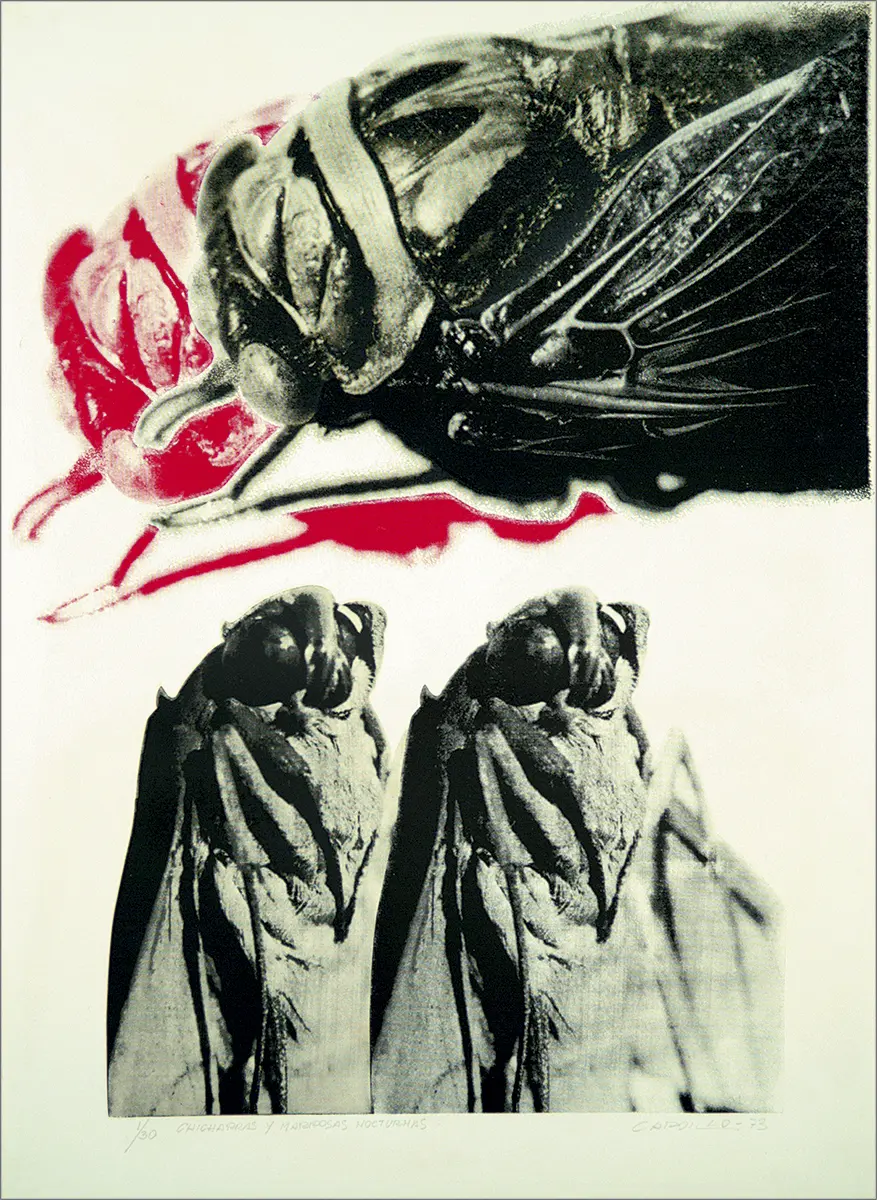
The show’s retrospective intention was in evidence since the start. One after one, some titled in Spanish and some in English, the parade of works included the Óvalos —a 1966 series of lithographs—, Chicharras and Mariposas nocturnas —silkscreens, 1973—, Insectos —drawings, 1973/1974—, Sublime orfebrería —one of several pieces boasting a masterful combination of printmaking techniques and a few found objects, 1978/1979— Baroque Suite —1980/1988— White Box, Ritual Box, and Collection Box (cigar boxes,) created between 1982 and 1985. From that same year are four monotypes in graphite and pastel titled Caribbean Rounds. Cardillo’s eight drawings/proposals for the New York Council of the Arts (1988,) his sculpture Memorial Diptych a year later, then his Latin American Memorial and other mixed-technique pieces, the Archeological Prints —photo-silkscreens, 1991/1992—, the eight silkscreens in São Paulo Biennale Project —1995—, and the xylographs of En la Estancia —1997/1998—. Closer to the present, the thirteen varnished bronzes titled Bronze Casts —1999/2001— and Birds from Gardiner —2003—, as well as twenty single-edition, multicolor photo-silkscreens, all tend to demonstrate that for Rimer Cardillo, printmaking is a verborrhagic medium. Although this is a long list, it does not cover the titles of all the series on exhibit here, and we must remember that there are several pieces in each series. This confirms the persistence of an indefatigable creator through highly demanding and original technical elaborations developed as vehicles for his anthropological and social concerns, referring to animal species and nourished by country traditions and deeply rooted in nature. Birds, animals, and insects are what capture the artist's imagination. From an elaborate collection of small boxes attached to a box/valise — which can be related to the ideas of exile, migration—travel—, we move on to large-format works on paper or combined with wood. This mention of the different formats in which the artist works points toward the all-encompassing character of his conceptualization and the elaborate resolution of his artistic enterprises. In many ways, printmaking is for Rimer Cardillo a tool for the development of humanistic concerns and cultural investigations.
GRACIELA KARTOFEL