
Santiago Sierra’s most recent action in Madrid consisted of the uninterrupted reading, over 120 hours, of an Arabic phone book at the Helga de Alvear gallery, which remained open while the performance took place. At first glance, it is yet another remunerated action, identical at bottom to his other actions of recent years, where he hired a group of Arab immigrants to do the reading. There is, in this piece, however, an element that points, albeit slightly, in a different direction: the phone book in question was found by Sierra himself in Israel, and it, in fact, includes only that country’s Arab residents. This fact gives a stronger political context to his piece, compared to his comment about labor market laws. The segregation implicit in such a phone book is reversed by its being read in Arabic to a Spanish-speaking audience that is automatically excluded from any possibility of understanding what it is hearing. To this we must add the absurdist character of the whole enterprise —a somewhat recurring element in Sierra’s work—, which nonetheless would seem to echo the uselessness of so many other political and military actions that occur in the context of the Arab-Israeli conflict.
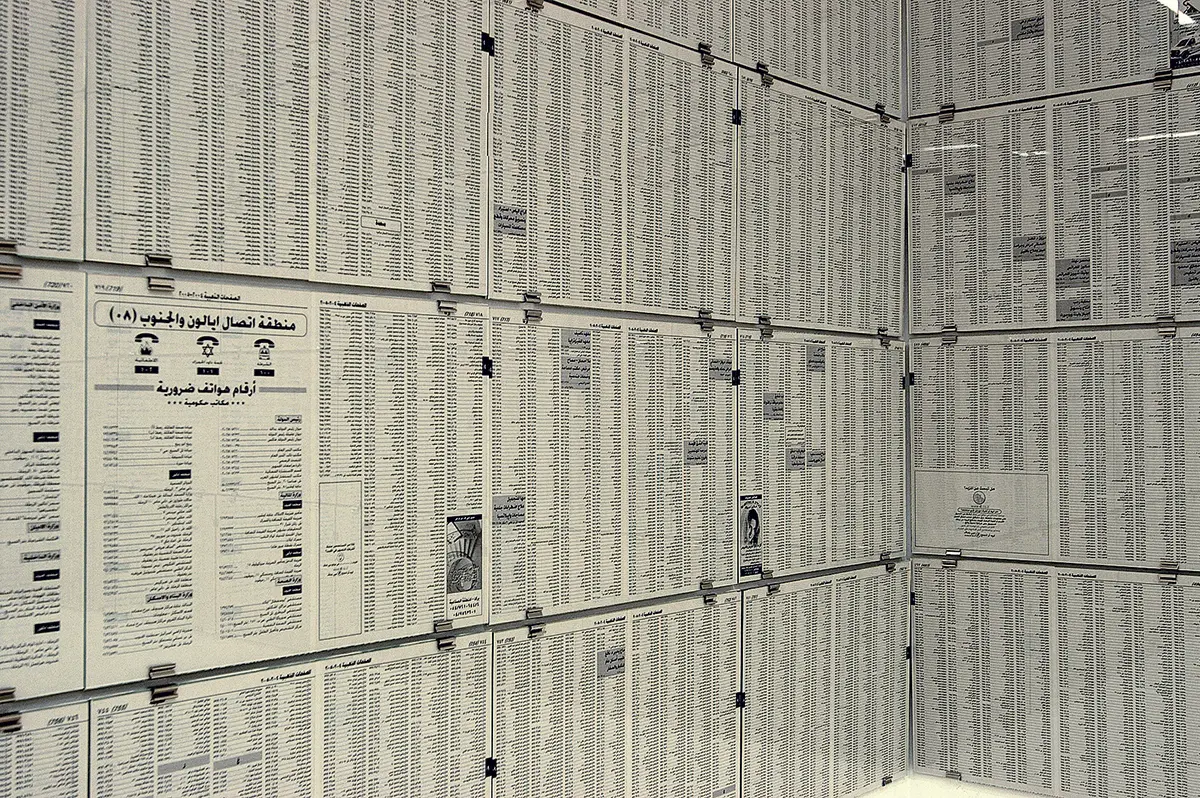
The montage of the event’s documentation, in an installation in the gallery’s main room, appears, on its part, as an important second part of the piece. Moving away from his usual documentary black and white photographs —more due to market demands than to aesthetic considerations, I suspect— Sierra has chosen on this occasion to frame the pages of the phone book and to cover the walls with them, in the manner of the conceptual art classics. The exclusion I mentioned earlier reappears as we are confronted with hundreds of pages that for us contain nothing but hieroglyphs or meaningless shapes. The explicit context of these pages is, however, highly suggestive, as it establishes the unsolvable distance between two cultures, two ways of life, and a reality that cannot be fully understood from the secure environment of an art gallery. Alongside these framed pages, Sierra has placed in the gallery speakers that broadcast in whole a recording of the reading. The repetitive sound, incomprehensible to us, becomes a kind of mantra that only changes when the reader changes. There is a significant hypnotic quality to this sound, which inevitably evokes a call to prayer. All these elements and clues serve to build a work of art that, although obvious to a degree, possesses connotations that are rather complex and assumes an ambiguous political position. For once, Sierra’s insistence in “showing reality as it is” (the laws of the market in the capitalist world; the situation of immigrants in Spain; the segregation of Arabs in Israel) becomes the key element to open possible readings within a work of art that unfolds over the other realities it touches: the segregation of Arabs in Spain itself, but also the many forms of exclusion that are reproduced in all facets of life and society. Starting with the art world.
The recycling of a document —the phone book— into a mural of signs or a mural of sound, which, thanks to our inability to understand it, acquires an almost religious aspect, is much more interesting than the remunerated act of reading, even if we consider the marathonic aspect of keeping a gallery open for 120 uninterrupted hours. It remains to be established whether that is what Sierra was looking for or if he just happened to find it.
ISSA Ma BENÍTEZ DUEÑAS