
The Grey Art Gallery
and the Paula Cooper Gallery in New York present a welcome overview of mostly
unknown work by former Gutai Group member Atsuko Tanaka.1 Tanaka is
particularly known for her 1956 dress made from colored light bulbs that blink
and turn off at random. A poignant image, it had the unfortunate effect of
condemning Tanaka to be viewed ever after as a one-work artist, a mistaken
image that is hardly contradicted by the lame pun used for the title of the
Grey Art Gallery exhibit: “Electrifying art.” In fact, that show, in its range
and depth, wonderfully demolishes the “one work” designation. Meanwhile, the
exhibition in The Paula Cooper Gallery complements and extends the history with
more contemporary works.
The Tanaka exhibition in the Grey Art Gallery covers the period from 1954 to 1968, concentrating on work produced shortly before she became a member of the Gutai Group and during the period when she belonged to it. Increasingly, the Gutai Group is gaining recognition for its role as a source of many of the ideas later explored by the Western avant-garde, a contribution unfortunately and unfairly ignored for decades by those writing about Western art. As an important member of Gutai, Tanaka’s work is better understood in the context of the group’s activities.
Tanaka, born in 1932, joined the Zero-kai (Zero Society), a group of cutting-edge artists that started in 1952, immediately after art school. She exhibited with them in 1954, the same year the Gutai Art Association was created under the leadership of JiroYoshihara (1904-72).2
Yoshihara, a well-established artist and businessman, was a good leader but a somewhat autocratic one, and half of the members left the group shortly after it began. The following year, to make up for the loss of members, Yoshihara invited Zero-kai to join Gutai. The merger was of historical importance. The Zero-kai group was talented, but not equipped to promote its artists the way Gutai was.3 Through the merger, Gutai gained several artists who strongly shaped its character, while these artists, in turn, gained major visibility. Among them, in addition to Tanaka, were, most notably, Akira Kanayama, Sabur Murakami, and Kazuo Shiraga.4
Yoshihara organized Gutai with the intent of renewing art by saving it from commerce and fetishism, and by allowing the material to express itself freely, unhindered by extraneous factors, non-material issues. The word Gutai was a composite of “gu” (tool) and “tai” (body). Yoshihara also took it as signifying “concreteness” and “embodiment.”5 In his Gutai Manifesto (1956), he denounced the way materials are “loaded with false significance by way of fraud, so that, instead of just presenting their own material, they take on the appearance of something else…the materials have been completely murdered and can no longer speak to us.” Consistently, Yoshihara added to this the caveat that nothing may be copied.
The work produced by Gutai, insofar as it followed Yoshihara’s thought, paralleled to a significant degree the agenda shared by European Informalism and U.S. Abstract Expressionism. However, in its deviations from that agenda, it went much further and prepared the ground for Fluxus and Conceptualism. As early as 1956, Murakami hung an empty frame from a tree and called it “All the Landscapes,” a piece that rightfully could have been claimed as Conceptual a decade later. Shiraga made paintings by dipping his feet in paint and then swinging from a rope over the canvas, anticipating Yves Klein’s paintings produced by dragging nude models covered in paint over the canvas. Shôzô Shimamoto created paintings using a cannon, preceded by half a decade, Nicki de Saint-Phalle’s device of shooting at pigment-filled balloons hung over the canvas. Akira Kanayama, prefiguring Jean Tinguely’s work, made drawings using remote-controlled toy cars.
Yoshihara was aware of aesthetic currents in the art centers. He saw Japan as located on the periphery and suffered from what could be called “center envy.” He admired the work of Jackson Pollock and George Mathieu, and respected Michel Tapié, who at the time was one of the most prominent theoreticians and a promoter of Informalism. Seeking recognition in the West, Yoshihara had his writings translated into English and made a point of distributing them internationally.
Many of the Gutai artists had experience teaching art to children, something they incorporated in several works, most particularly in those presented in two open-air exhibits, in 1956 and 1957, and in a “stage exhibition” in 1957. The title of the first of these exhibitions is indicative of the group’s spirit: “Experimental Outdoor Exhibition of Modern Art to Challenge the Midsummer Sun.”
French critic Michel Tapié “discovered” the work of the Gutai Group in 1958 and, finding their interests consistent with his own, introduced them to Europe and the U.S. as examples of “informalist art made in Japan.” The relation between Gutai and Tapié was symbiotic: the Japanese artists were interested in gaining access to the Western mainstream; Tapié was interested in padding his theories.
It is curious how, in spite of the groundbreaking works of both Zero-kai and Gutai, they were not fully acknowledged until the 1990s. Gutai’s first presence in the U.S. was with an exhibition in the Martha Jackson Gallery in New York in 1958 organized by Tapié. Although the exhibition received good reviews and traveled to Oakland, Houston and Minneapolis, it left no major traces. Simone Forti, the experimental dancer, was strongly influenced by them, but this is not widely known. She was married at the time to the artist Robert Morris, who may also have taken up some of their cues, though this is speculative and undocumented.6
The year after their inaugural show in New York, the Gutai group exhibited in Torino where they probably laid the ground work for the “Arte Povera” artists of the 1960s.7 In spite of Tapié’s promotion and abundant press, it took the 1993 Biennial of Venice to give them the credit they were due.8 Until then, in spite of strong reviews, their contributions were not internalized into international art history.
One of the explanations for the group’s long invisibility is the provincialism of the mainstream and its powerful instinct for self-protection. Another reason, however, may be an ambiguity in Yoshihara’s theories that he found necessary to maintain the group’s unity. While many of the Gutai members were interested in performance, Yoshihara’s thought and taste were still strongly rooted in painting (he defined art as mostly based on matter), and thus there was an underlying tension between the group’s leader and its other members, a topic covered well by curator Mizuho KatM in the catalogue for the Tanaka exhibit in the Grey Gallery.9 As KatM points out, for Yoshihara, matter was either present (“embodied’’) or expressed in gestures affecting it, which explains why Tapie found him important and useful. But these concerns were not identical to those of the other members of Gutai, whose work often ended up diverging from Yoshihara’s theories.
Given the provincialism that otherwise affected perceptions about art at the time Gutai became known in the U.S., it is refreshing to see that critics accepted the group with benevolence, if not full understanding. The first article about them to appear in the U.S. was published in The New York Times in 1957, on the occasion of one of their festivals in Japan. In this article, their work was described as “fantastic, almost beyond the realm of imagination; it is creative genius on ideas. It is all the stranger after centuries of discipline and stylization [in Japan].”10 Beyond that encomium, however, the article remains superficial in its discussion of the artists’ work. Gutai’s exhibit is merely depicted as playful and great fun, without any analysis of the theoretical implications of the work or its meaning for art beyond Japan’s borders. It was in the following year, in 1958, that Tapie’s Gutai exhibition took place in New York. Dore Ashton’s review of this exhibition for the New York Times is very friendly (“An ebullient, cheerfully aggressive collection of young people…”),11 but equally ignoring its significance. She underlines the role of Michel Tapié and how the work fits his definition of “art autre” or “informal art.” But, while she praises the performance aspect (“in the dramatic arts, its activities are truly revolutionary”), Ashton feels the painting part is uninteresting, a judgment that may say more about Tapie as curator than about the artists for whom painting was not a central activity. For Gutai, therefore, the show may actually have been a flop. In any case, they then disappeared from the U.S. art scene for the next seven years, until Allan Kaprow, in his influential book Assemblages, Environments and Happenings (1965) once again brought them to the fore, in this case emphasizing the performance aspects of their work over the painterly vestiges. Yet, this new reading of their work also failed to secure their reputation, which did not get firmly and finally established until the closing decade of the 20th century, with two thematic exhibitions—one about Japan (Japanese Art After 1945: Scream Against the Sky, 1994); and one about performances (Out of Action, 1998). It took another six years after that to individualize one of the Gutai artists with a full-blown exhibition. The Grey Art Gallery, which seems to have made it its mission to bring the work of important under-recognized artists to our attention, is to be thanked for this.
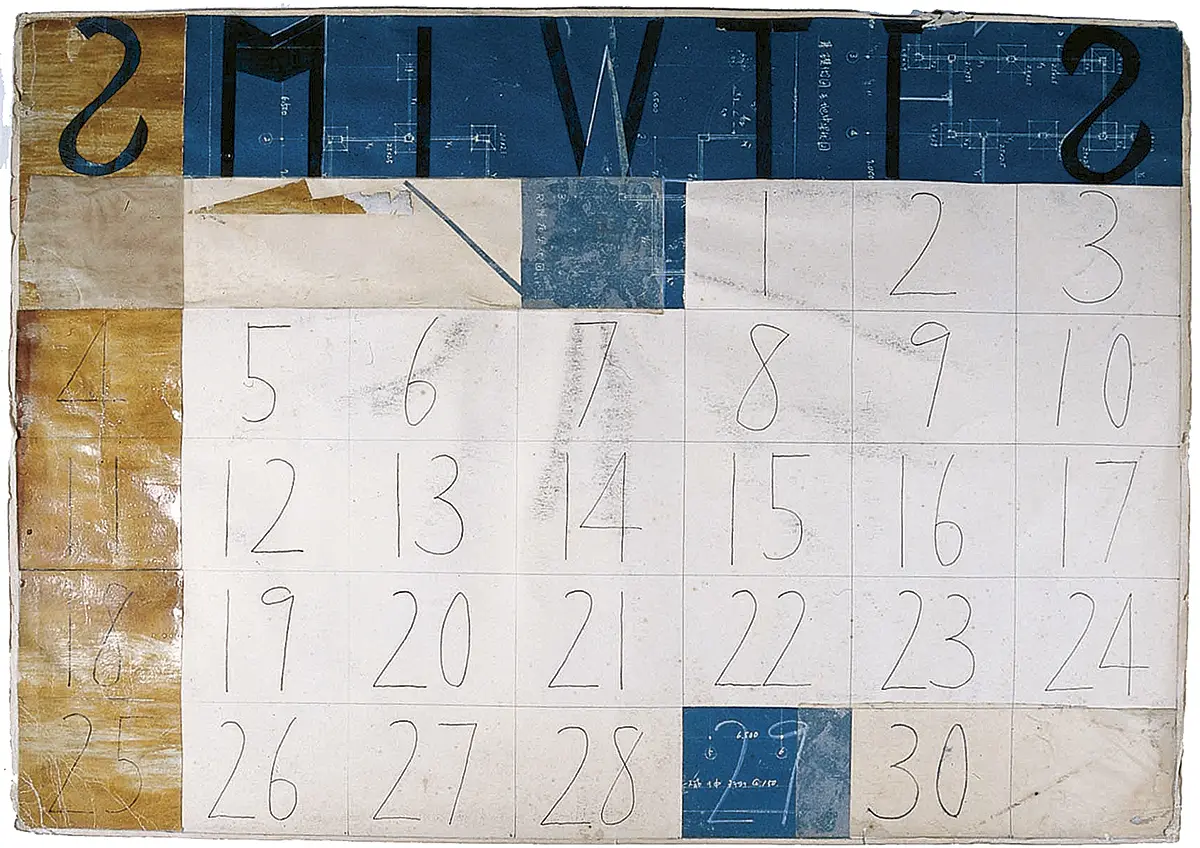
The earliest works of Tanaka (1953-54) are about numbers. She first uses calendar sheets and redraws the numbers trying tautologically to redraw time. Not unlike Jasper Johns number-paintings five years later, Tanaka’s numbers become estranged icons. They start as recreations of a calendar and then take off on their own, with a particular sense of tenderness and melancholy.12 In subsequent works of that period, the numbers are not written but rendered, carefully drawn and revitalized
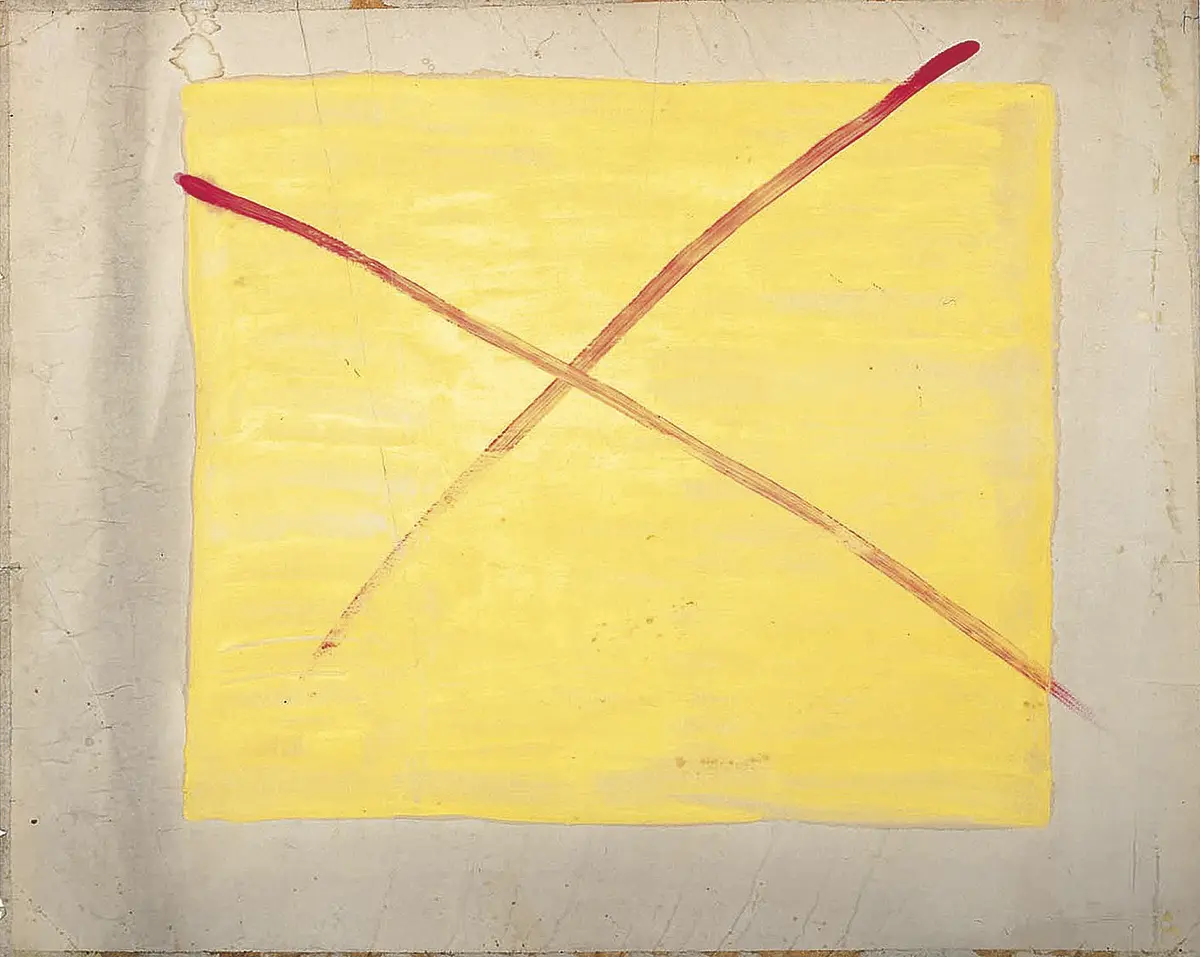
Tanaka’s more overtly radical streak becomes evident in her “Work (Bell)” piece (1955). Twenty electric doorbells are laid out in the space of the gallery and become activated when the viewer presses a button. The volume of each is different, the closer ones ringing louder, so that one has an aural sense of perspective, contradicting the visual space of the gallery. That same year Tanaka also introduced a critique of formalized art by hanging commercially died cotton in the place of paintings on the wall. In a more literal fashion, in 1956, she challenged abstract trends by painting pleasant canvases and then crossing them out. Whereas something similar was used by Tapies as a formal device to incorporate symbols into his textural setup, in Tanaka’s case it was an early sign of irreverence against taste and form, in this instance within painting.
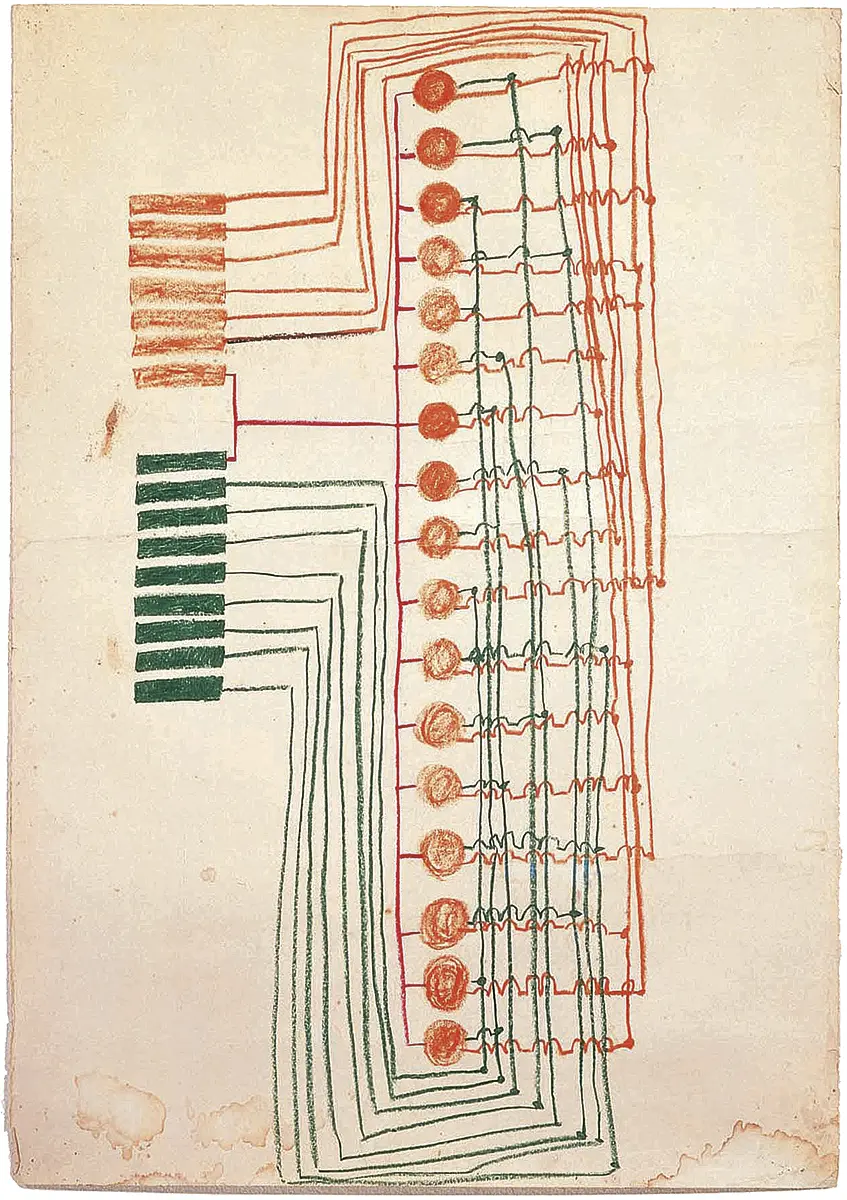
Tanaka’s process in this brief period from 1953 to 1955 culminates with her “Electric Dress.” Picking up in certain ways on her bell work, she leaves traditional media to immerse and wrap herself in “art.” The dress piece, usually interpreted as a reaction to technology, today seems more an extension of the possibilities of painting, in that what is “worn” is not just the dress, but actually the very process of ever-changing colors. A work in continual visual change, it seems to have had a profound effect on Tanaka, for in her future work she became preoccupied with drawings about electric circuits and luminous circles, abandoning earlier concepts in her work for the pursuit of shape and form.
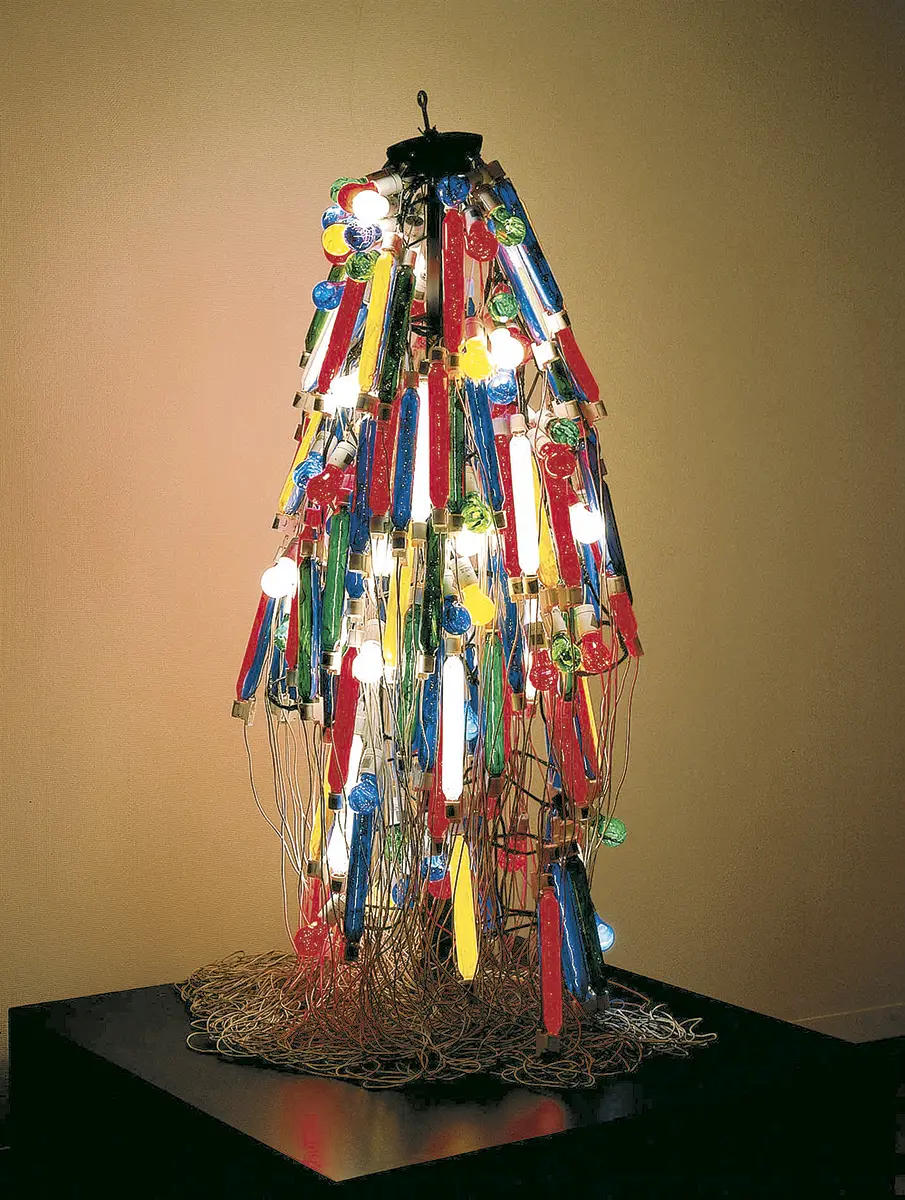
Her first step in this direction was to explore the aesthetics resulting from the circuits and structure with which she built her dress. The cable and wire lines create intricate suggestive patterns that hint at construction but also develop their own charm within the very ascetic approach she begins to use in them. The second step is connected with the blinking colored lights. These led Tanaka into a series of paintings she has been pursuing to this day in a most obsessive way. Enthralled by the look of the lights on her dress, Tanaka wrote: “What interested me most during the production was an unusual beauty created by the light bulbs arranged on the dresses . . .. It was a beauty that could not be made by human hands.”13
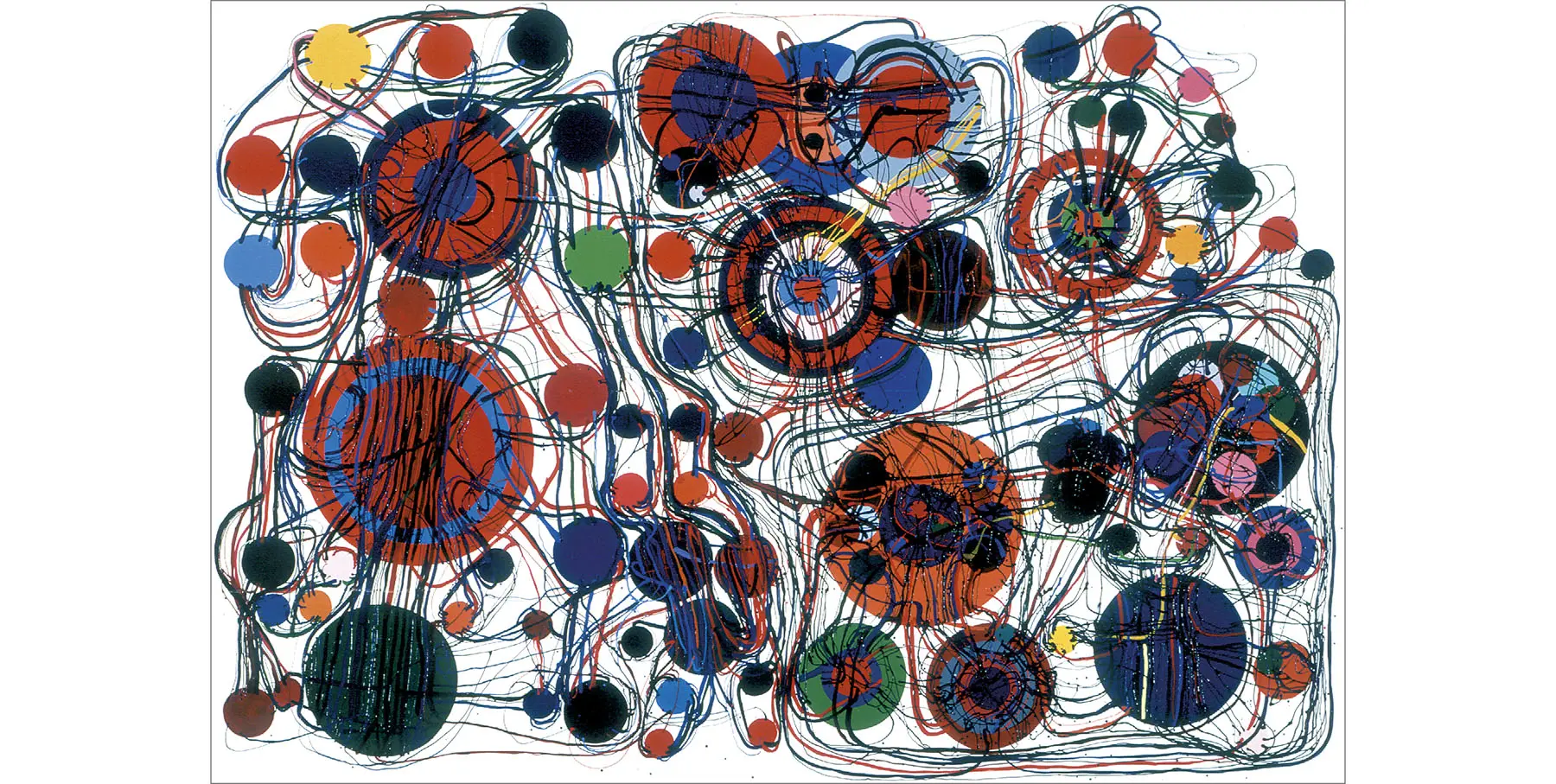
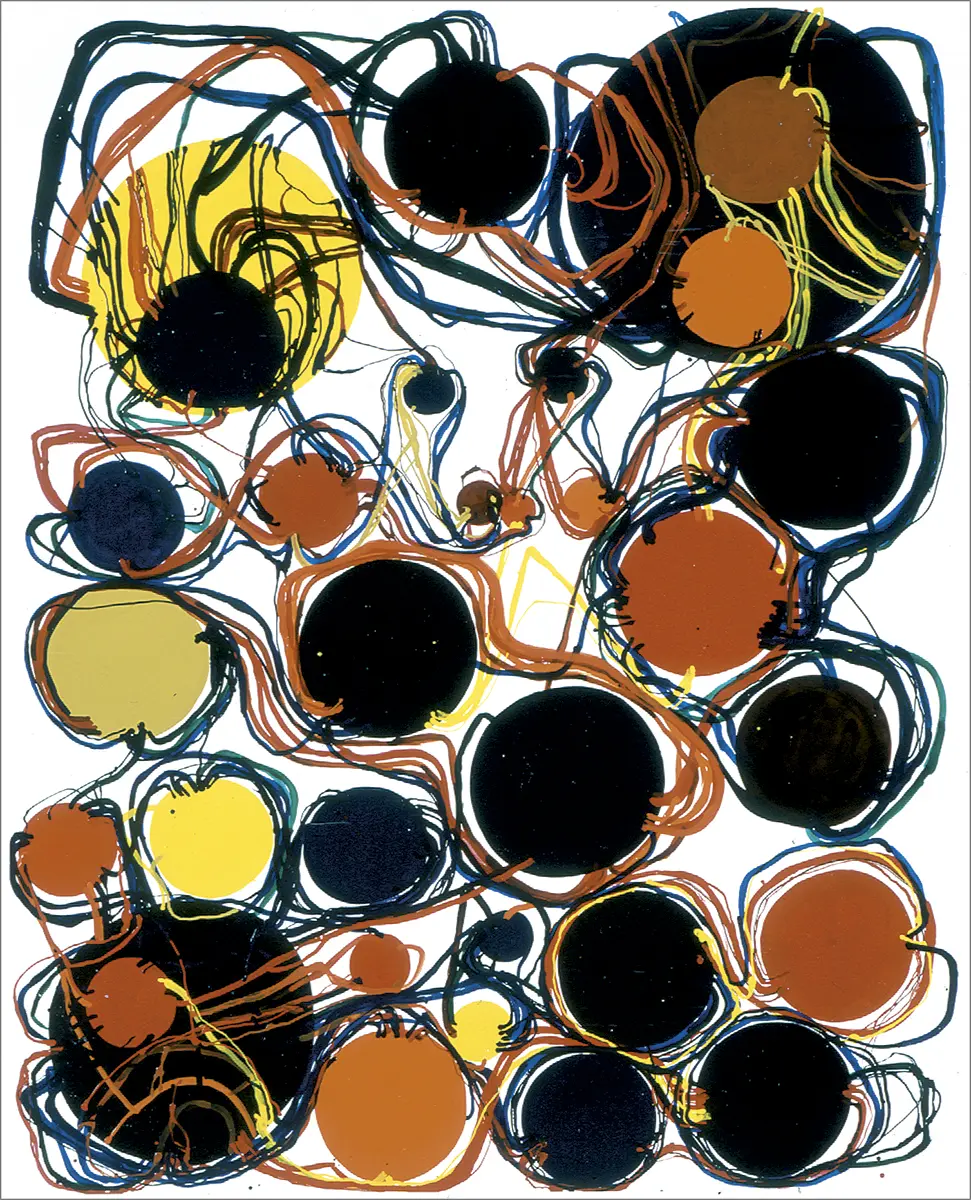
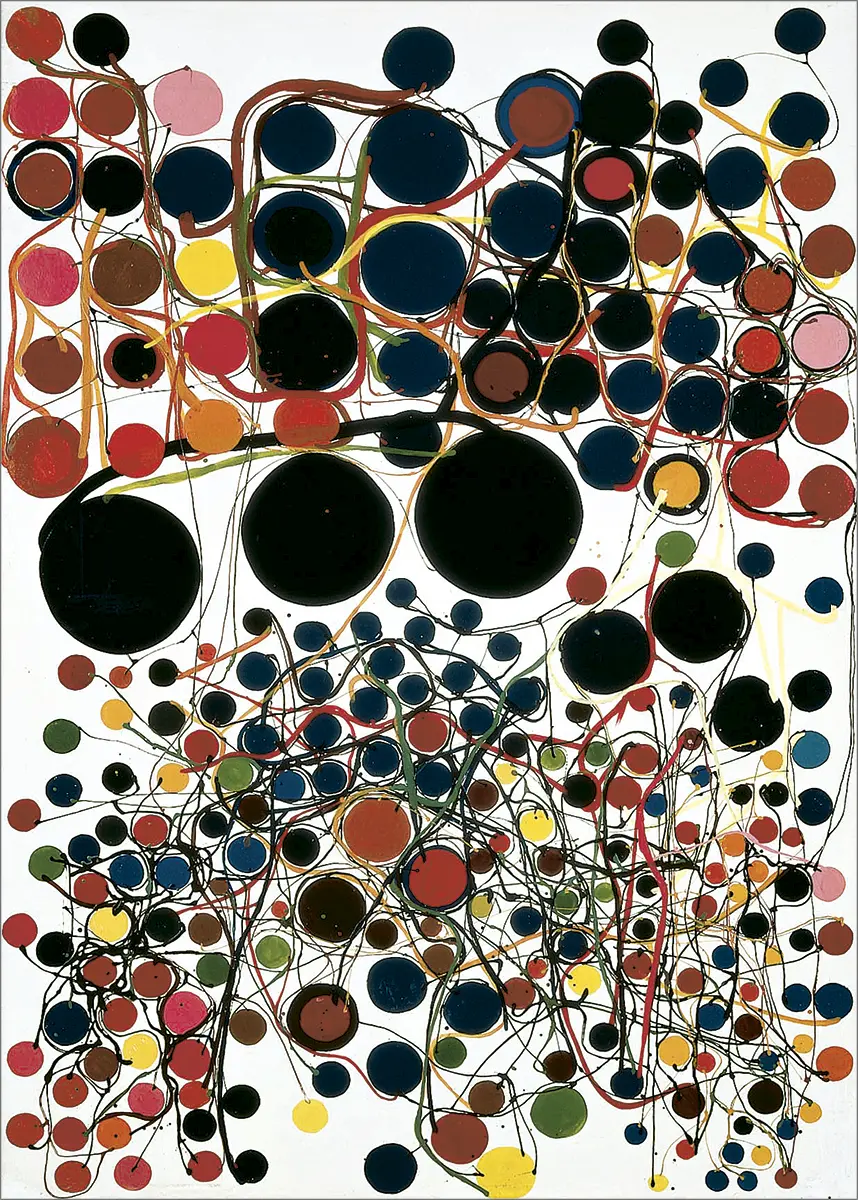
The result is puzzling. Tanaka’s early dazzling breakthroughs appear to have been confined to a span of no more than four years at the most. After that, as is evident from the works exhibited in the Paul Cooper Gallery, she seemingly turned into a painting-factory of colored circles and spots into which she projects a complex set of intuitions and ideas, some of them musical. However, the viewer is mostly excluded from this world and left facing a pretty and repetitive system of marks. Tanaka, in the midst of making her circle paintings, once wrote: “When I had no idea, I searched for something that nobody had ever done. It is not easy to invent.”14 The level of invention in this body of work is what remains elusive. Tanaka is not the kind of artist who falls into dead routines. She almost certainly derives a sense of renewal in each act of painting as if it were an act of meditation. However, the traces this leaves for us don’t help us to share her insights.
Round on Sand (1968), a movie showing her drawing her circles on the sand of a beach subject to erasure by the tide, seems to reflect much more accurately and modestly what Tanaka may be about. In this film, with its emphasis on the art process, her work is still within the Gutai frame of reference, less constrained by the associations that confine spirit in a gallery context.15 It’s disappointing to find that the Gutai spirit gets lost, or at least is much more difficult to communicate, when the process is frozen into her paintings. Nevertheless, Tanaka’s four amazing years make her acquaintance a memorable event.
NOTES
1. Grey Art Gallery, New York, 9.14 - 12.11.2004, The Morris and Helen Belkin Gallery, Vancouver, Canada, 1.21 - 3.20.2005. The Paula Cooper Gallery, 9.14 - 10.23.2004
2. The Gutai Group or Gutai Art Association (its original name) dissolved after the death of Yoshihara in 1972.
3. This interpretation is by art historian Reiko Tomii in a personal communication.
4. Akira Tatehata, “The eve of Gutai” in 1953:Shedding Light on Art in Japan, translated by Reiko Tomii, Tana Art University, Tokyo, 1997
5. The name Gutai was proposed by artist Shôzô Shimamoto. Akira Tate, op.cit
6. Forti was particularly influenced by Kazuo Shiraga and Saburo Murakami. At the time Shiraga “wrestled” with mud and hacked painted logs; Murakami was concerned with contextualization and, beyond his empty frame, exhibited a wooden box for people to sit or stand on and become de facto monuments (1956) and jumped through paper screens (1955).
7. It is interesting that the exhaustive chronology prepared for Germano Celant’s exhibition The Italian Metamorphosis, 1943-1968 (The Guggenheim Museum, NY, 1994) ignores the Gutai exhibit in Torino. Celant coined the term “arte povera” and gave theoretical cohesion to the group. Generated in Torino, their first exhibit as a group was in 1967. These possible influences were already pointed out in 1991 by art historian Barbara Bertozzi (Ming Tiampo), “Electrifying Painting,” in Atsuko Tanaka, Electrifying art 1954-1968 Atsuko Tanaka, The Morris and Helen Belkin Gallery and The Grey Art Gallery, Canada, 2004, p.76, n.18
8. In the U.S. there was an early-on famous failed attempt by Life Magazine which found the material artistically too scandalous to be published, and both a descriptive article about their show in Japan in 1957 and a review by Dore Ashton of the Martha Jackson exhibit in The New York Times in 1958, and their inclusion as important precedents in Allan Kaprow’s Assemblages, Environments and Happenings, in 1965).
9. Mizuho KatM, “Discursive Conundrums: Rereading the Work of Atsuko Tanaka,Ó Electrifying art 1954-1968, Atsuko Tanaka, pp.51-60
10. Ray Falk, “Japanese Innovators,ÓThe New York Times, 9.8.1957, p.D24.
11. Dore Ashton, “Art: Japan’s Gutai Group,Ó The New York Times, 9.25.1958, p.66
12. Tanaka made these drawings while being hospitalized, using them in calendar format to literally make time pass.
13. “Work 11: Stage Dress, 1957, Ó Atsuko Tanaka, p. 102. Translated by Reiko Tomii.
14. “Untitled Statement, 1964, Ó Atsuko Tanaka, p.104. Translated by Reiko Tomii.
15. Artist Louis Hock points out that the stick used by Tanaka to draw on the sand is an ice ax, a European tool that only recently had been imported to Japan and that here is something doubly out of context and adds a layer of mystery to the performance. (conversation with the autor)
*These images are a courtesy of Paula Cooper Gallery, New York. All others are a courtesy of Grey Art Gallery, New York.
LUIS CAMNITZER
Emeritus professor at the SUNY College, Old Westbury.