
Inventions: Recent Paintings by Caio Fonseca at the Corcoran Museum of Art in Washington, D.C. marks the artist’s first solo exhibition in a U.S. museum, even though his work is already a part of many major North American collections, including the Metropolitan Museum, the Brooklyn Museum, and the Hirshhorn Museum, among others.
Resolutely handmade, Fonseca’s work plays on tensions between expressiveness and restraint, and abstraction and representation. His paintings hint at improvisation but at the same time reference the predetermining nature of language. The work is inhabited by the play between these poles at every level of design and reception. For instance, non-representational shapes float across his compositions, but they are neither exactly geometric nor really organic; they are abstract, but situated in relation to the figurative. That the forms resist both the constraints of pure geometry and the undulating ambiguity associated with the organic is to Fonseca’s credit, and it prevents his paintings from looking dated or derivative. This is not to say that the paintings lack historical reference; his paintings seem to take cues from painters as diverse as Miró, Calder, and Mondrian, as well as from Matisse’s late cutouts. But they are also reminiscent of Max Ernst’s collages in the sense that Fonseca finds his forms by over-painting, that is, by covering up unnecessary information with flat strokes of solid color. Daniel Kunitz writes in the monograph Caio Fonseca: Paintings 1983–2003, published by the Institut Valencià d’Art Modern, “The paintings reveal themselves as a complex of layers and inversions: they’re made, not from the ground up, but up to the ground. He strips away inessentials to find unalloyed forms by a cumulative procedure, building up the layers. He eliminates by adding.” The result is that Fonseca’s surfaces, though legible and easy to absorb, are also complex, and because they reveal the process of their own making —we can see that an earlier history lies beneath the flat, plastic paint on top— the viewer is made aware that much is being concealed. This practice of editing mirrors the processes of language where legibility cannot exist without the suppression of information and the drawing of boundaries.
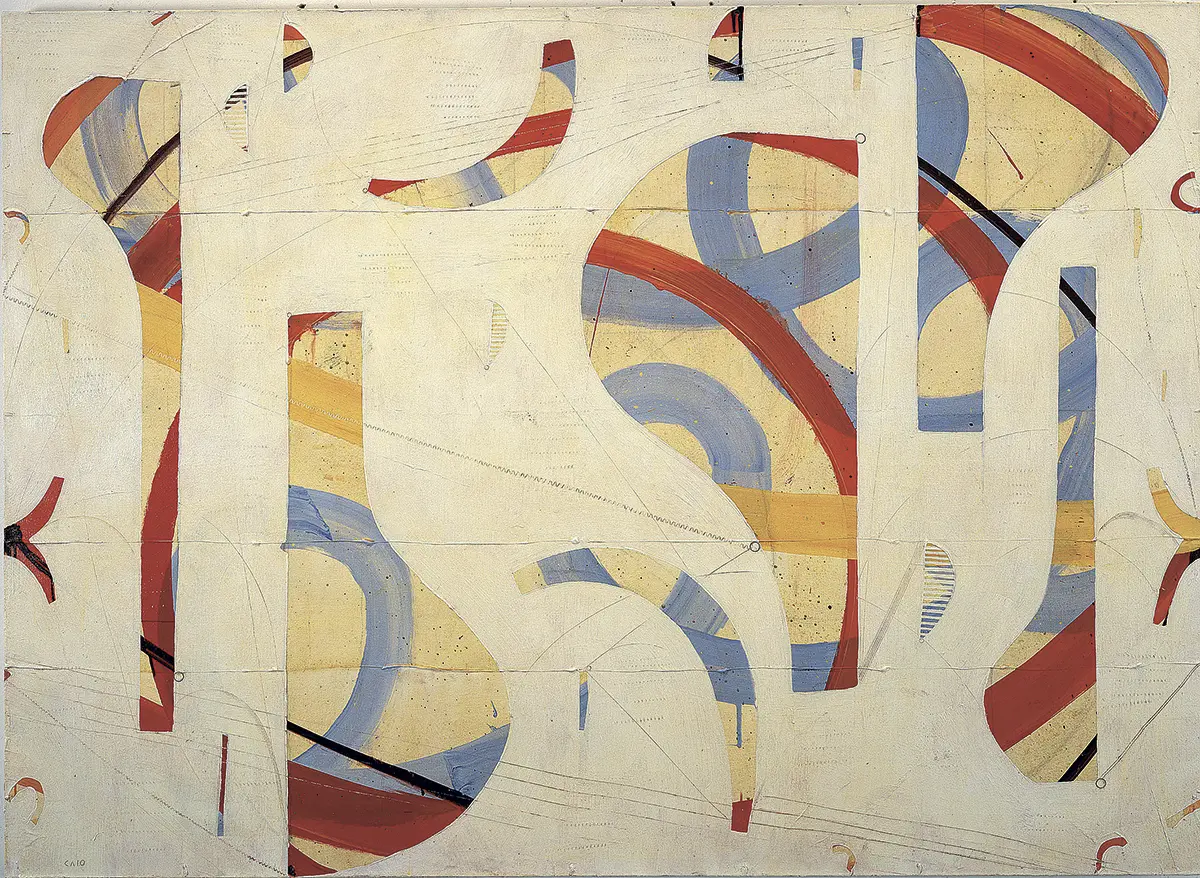
Incised lines —not unlike those in a Miró— that thread the abstracted shapes together also seem to reference language. Sometimes straight, sometimes zigzagged, they look as though they might have been drawn with the tip of an exacto knife or the handle of a paint brush. It is a gesture that signals writing much more than it does the painterly motion most often associated with the kinds of large abstract paintings Fonseca makes. In a work such as Pietrasanta Painting C03.55, 2003, these carved lines even seem to counteract the gestures contained in the curvilinear shapes; they come to function as a calligraphic device subject to the whim of the forms. Similarly, the artist’s method of dragging thickened paint horizontally from left to right across the canvas creates, on the surface of each work, raised lines of congealed paint that feel simultaneously restrained and emotive. They look at once like the thin blue lines on a sheet of notebook paper and the excess gush of paint that spills out from a loaded brush.
This shifting tension between representation and abstraction reflects Fonseca’s training. Born and raised in New York City, Fonseca left the United States in 1978 to study painting in Barcelona with Augusto Torres, the well-known modernist whose father, Joaquín Torres-García, had taught Fonseca’s father, the Uruguayan sculptor, Gonzalo Fonseca. He worked in Barcelona from 1978 until 1983, when he moved to Pietrasanta, Tuscany, where he still maintains a studio and works five months of the year. (The drawings and paintings in the Corcoran exhibition hail from both his New York and Pietrasanta studios.) Fonseca lived in Italy until 1989 and then in Paris for two years before returning to New York, and had a more traditional training than many of his American peers. When he returned to the United States in the early 1990s, the artist was still working in a representational manner, although he quickly shifted to an abstract mode.
Fonseca is an accomplished pianist and maintains there is a connection between his work and music—that his paintings are visual extemporizations of Baroque music. Although Kandinsky explored the relationship between music and abstract painting in his early improvisations, as did Mondrian at the end of his career with Broadway Boogie Woogie, the analogy, often repeated, feels slightly empty and ultimately doesn’t seem to clarify or offer much insight into the paintings. And herein lies my biggest problem with the exhibition: Fonseca’s paintings are, without a doubt, good, solid paintings that are easy to like. Verging on the decorative, they never succumb to that impulse entirely and provide just enough visual interest to keep the viewer engaged; it is a satisfying effect. But I couldn’t help leaving the exhibition, wondering if that is enough. Fonseca himself says, “There is nothing to say about my paintings except for painting itself,” a point which feels entirely true and that proves perhaps to be both a good and a bad thing.
TERRI WEISSMAN