
One characteristic feature of contemporary aesthetics in a post-modern vein is the infinite (sometimes fictitious) reinvention of the limits and borders that have perhaps served to fix very specific artistic ontologies and aesthetic languages, based on presumptive specificities of a technical or morphological kind. The most recent show of works by Mexican artist César Martínez, presented at the Centro Cultural Conde Duque of Madrid, Spain, is a loudly eloquent example of the process of dematerialization and vanishing that traditional art genres and the academic discourses built around them are undergoing today. Martínez’s inflatable sculptures, his body-sculptures, or his ghost-statues are, beyond the pertinence of any in-vogue term or taxonomy, escapes from a register, from a scheme of perception that opens in the notion of an expanded field. César Martínez’s works, concretely the sculptural installations exhibited here, filled with poetry and cultural/anthropological background, help illustrate the dire conflicts if modernity, of the crazy-quotidian that occurs when all that we thought solid melts into the air.
Any exploration of Martínez’s work, be it haphazard or premeditated, committed or simply hedonistic, presupposes the assumption of a reflexive state, a state that goes beyond amazement at the evanescence or the “un-lastingly present” of those bodies that aspire and exhale air pushed by a machine. By documenting this transcendent moment that summarizes the instant of the expansion of life and its thickness, by noting the frequency with which matter becomes embodied through respiration, César Martínez defies the fixed limits of sculpture in order to open up his understanding —as a genre— to a new dimension, one where the borders of the essentially sculptoric, in an strictly performative sense, are rendered relative. The latex skin of his bodies thus remains as the trace in which an aesthetic procedure, driven by the will to disarticulate binary schemata and antinomial polarities while holding on to them, is registered. These bodies exceed their physicality or their levity, bringing to the fore the verticality of sculpture, its habitual rictus. They challenge the legendary canon that governs their governing principles, toying with an often baffling cosmetic strategy. But the conceptual reach of this show is not limited to this kind of reflection in a self-referential vein or around the stolen functions of art. Their intentions achieve a higher level and circulate through the paths of contemporary culture’s bittersweet disenchantments, a culture that knows of chaos and the replacement of the human by the boundless production of images/simulacra and voracious fetishes.
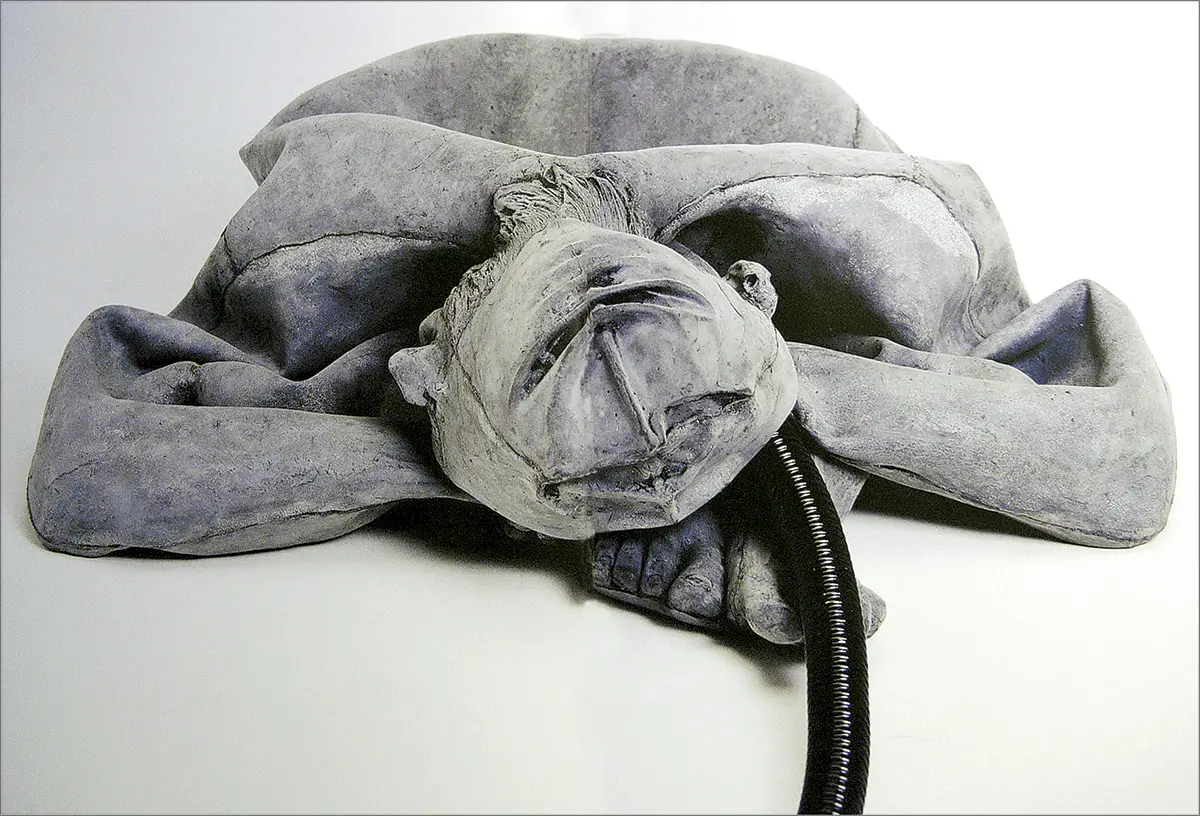
Given this, we can share the opinion of critic Juan Antonio Montiel, according to whom Martínez’s sculptures are able to materialize, through the cult of tropes, the air of our times, just as they made us aware of the breathing difficulties we are subjected to in a world dominated by a machine-caused asphyxia. In this sense, Martínez’s latex bodies are wrappers (a bit claustrophobic, one should think) that contain a fleeting moment in life. Air is in this way just another character in the show, almost a deluxe protagonist. As the artist himself puts it: “life is to sigh... air is the soul of emotion, the body of the soul, the insubstantial stuff of life.” The two rooms that comprise the show reveal its omniscient presence. Both in the room that displays bodies that inflate and deflate at 30-second intervals, where the “moment in life” we mentioned is retarded or expanded, and in the next room, where it is our turn to enter —in a metaphorical way— one of those bodies. In both rooms, the sensation of asphyxia is noticeable. The noise produced by the machines provides an almost clinical meaning that refers us not to a state of death, but to an instant of pure sublimated agony where tedium reigns as a symbolic figure.
On the day of the opening, visitors were treated to a performance in which they could eat a body made not of latex, but —with a certain complicit phonetic resonance in Spanish— chocolate. In this way, a mechanism of critique and observation was activated on the process of devouring ingestion of the human that occurs in the cannibalism practiced by the contemporary world. César Martínez’s invitation to tasting that exquisite corpse shared a questioning gaze that takes as its point of view another fleeting instant in which Man is transcended by his own animal humanity. Eating the other, the similar, in an act of involuntary cannibalism, has thus a background of critique of human social climbing and the illegitimacy of relativistic and democratizing discourses. A time of inspiration and ingestion, a time of levity and permanence, these appear to be the keys to an art that does not resist the gratuitous and does not abdicate in the face of current aesthetic complacency.
Sponsored by the Cultural Affairs Directorate of Mexico’s State Department, César Martínez’s show will travel through several European cities. After opening in Berlin, it is now in Madrid and will soon be in Italy, London, Ghent, and, probably, his inflatable sculptures will reach Romania and Ireland. The table is set; let it be then the time of degustation.
ANDRÉS ISAAC SANTANA