
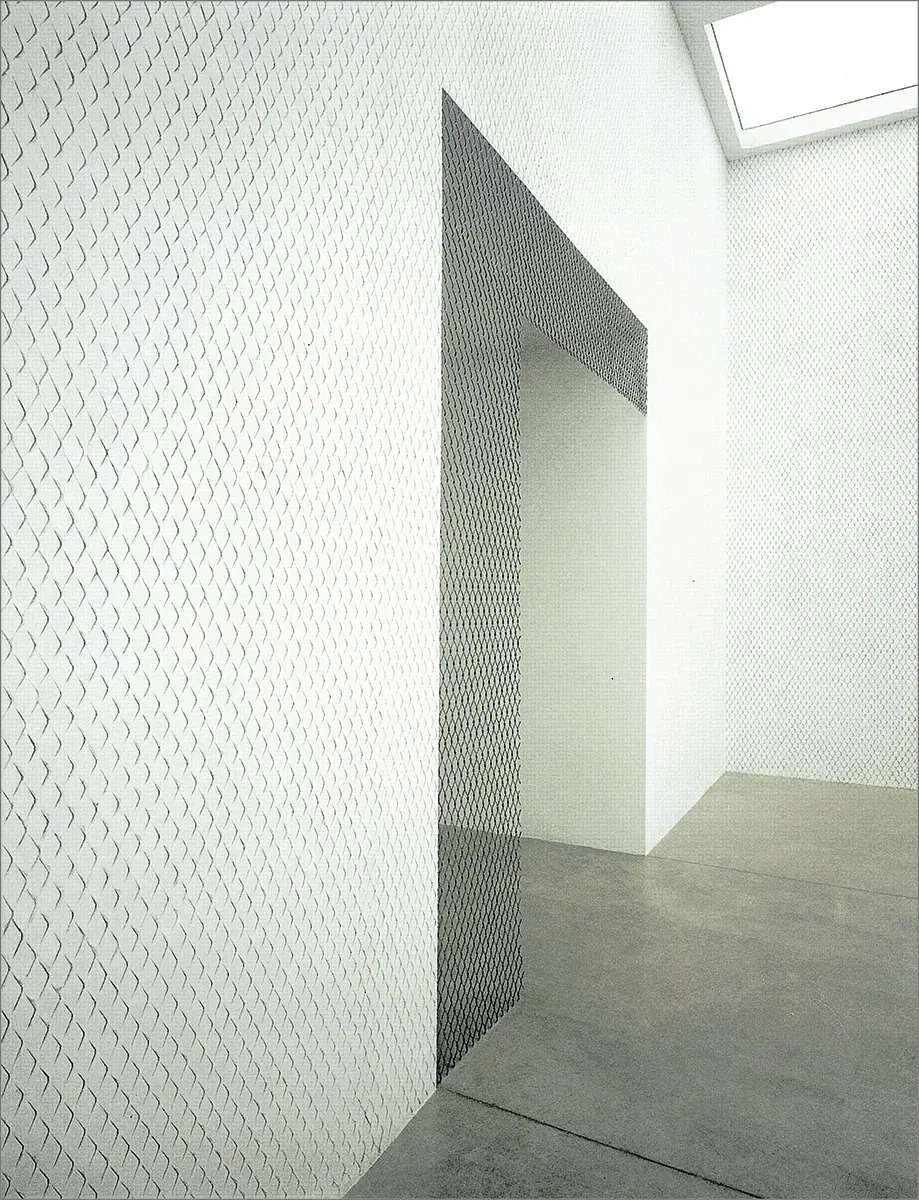
Plaster and metallic chain link fences are the two basic materials employed in the construction of Neither*. Meters and meters of these fences covered the walls of London’s White Cube gallery, emerging from layers of plaster or showing themselves as they are when they see them used in concentration camps, industrial security, or the demarcation of private spaces.
The idea of inclusion and exclusion suggested by the material provokes feelings of ambiguity, in a complex interplay of inside/outside explored by Salcedo. As often occurs with her, these works are the result of deep research into the mechanisms of power, of the use those who have it make of power, with the concentration camp as a clear example.
Taking as her central reference point the realities of Colombia, Salcedo connects the local with what happens in other spaces, in order to bring to light facts such as the existence, today, of concentration camps. They are a facet of life with which we coexist, getting used to them being a part of everyday life, against which nobody reacts, and which is thus allowed to pass.
Foucault has written, regarding the architecture of the panopticon that became a societal model, that we are faced with the problem of a permanent observation ordered by a dominant gaze with pretensions of universal visibility, supervised by a strict power.
The concentration camp fixes individuals to the places where they are interned, not due to what they have done, but due to what they are or what they think, and it becomes a useful political mechanism for those who possess power, as it is a place where the law does not operate. They ignore whether they will eventually be freed; they are made part of an interior space devoid of interiority, privacy disappears, and everyday life is subjected to the gaze of those who watch over, breaking their prisoners with those resources.
Neither seeks to articulate that horror by turning the work of art into an experience that does not involve the observation of events, as if one were attending some kind of spectacle, but instead, that apparently empty space reveals the impossibility of breaking free. The illusion of escape is just that, an illusion. Behind the fence is another fence, and behind that, there is a wall. Once again, the play of ambiguity is in the plastic handling of the topic; the visible material is white, but it covers a rusted fence.
The piece’s painstaking handiwork charges it with humanity, but the experience of the space that is constructed refers to repression, to a suspended time, the inhabitants of which can only wait in a kind of limbo where individuals assume, as a defense mechanism, roles in which they do not recognize themselves. Humiliation, frustration, and shame at having survived become part of the daily anxiety.
This particular temporal relationship between past and present is a central point of Salcedo’s work, because in a time of war, a large part of society revolves around moments of loss that link different temporalities. Thus, a constant relationship between art and history, and her works try to bring to the surface the need for a process of psychological resistance in the face of horrific events that occurred and continue to occur, and which end up being assumed as part of our everyday life.
Evidently, Salcedo does not believe in the artist’s creative freedom. The artist does not choose her topics; they impose on the artist inasmuch as her work starts from a series of real testimonies to which she strives to remain faithful. An installation like Neither indicates that Salcedo perhaps shares Primo Levy’s observation: “While understanding is impossible, knowing is necessary, and remembering is our duty.”
*This installation will be placed permanently in a specially built space in Belo Horizonte, Brazil.
IVONNE PINI