
The first impression offered by Impulsos, Ibrahim Miranda’s recent exhibition, was that of a large display screen recording the visual effect that results from unfragmenting all the information on a computer’s hard drive. In this case, the act of ordering what was dispersed, which occurred mainly at the level of the artist’s poetics and of his most sensitive and dear obsessions, was reinforced visually by the gallery’s large exterior windows.
Comprised of numerous segments (strips) of engravings and paintings on maps and also of tracings on vegetable paper, these “card catalogs” rearranged on the walls to cover them in their entirety, gave continuity to a topic that has been abundantly approached by Ibrahim Miranda, the topic of insularity. These pieces were a space where the instinctual became dominant as a reflection of the deepest affections of a spirituality forged in the abyss.
The support the artist has used for this type of work has been the pages of the 1970 Atlas Nacional de Cuba. Sometimes it's geographic (or physical) maps, sometimes it's demographic, economic, and politico-social maps that constitute the background for Miranda to recreate his figurations. It was in 1993, in amid incessant blackouts during the economic crisis of the so-called “special period,” that Ibrahim Miranda started using the country’s cartographic image in his series Noche insular, an action that later, under a variety of titles, he was to continue and alternate with other projects.
The dramatic quality we could in the past find in these works was emphasized by his use of dark inks to draw on the maps, sometimes India ink and sometimes mercurochrome (often found in a household’s first-aid kit thanks to its germ-killing and drying properties in the treatment of wounds), and figuration itself, in the case of his xylographies. Miranda started using color in 2000, while working in Lágrimas negras (xylography and serigraphy) at the GraphicstudioUDIO, in the United States, about the traumatic process of Cuban migration, mostly to Florida, and the painful consequences it has had for individuals on both sides. This piece was acquired by New York’s MoMA and the National Gallery in Washington, D.C.
Entering the rhythm posited by Impulsos, we were made to feel that there was a difference with the artist’s prior work, coming to us as it did as a song to the Island’s birth, to its very genesis. The gamut of serigraphic inks expanded into multiple red, orange, green, blue, yellow, and ochre shades. The island moved in a festive dance, the dance of its own origin; it was an animal possessing its own rhythm, flying, nomadic in the flow of many currents.
The small maps of Cuba and of fragments of Cuba, in large scale, were engraved and painted on, superimposed with images of the metaphorized island. The island transformed into zoomorphic bodies that traveled in pilgrimage and moved around like the natives, like the life of the nation. Island bodies resembling, in their many metamorphoses, a fern branch or a bird. Forms possessing their own means of locomotion, such as tentacles or cilia, or grasshopper legs. The island is a cell with multiple nuclei, woven like a fishing net, an island strung with islands, covered with eyes that look at us. The island is an animated being, with movements recreated in an atmosphere that borders on the splendor of discovery and the finding of multiple essences. Something mystical underlined the interior of all the fragments joined together by the artist. The hand of God was there, Adam and Eve, the crown of thorns, alongside a record—in the manner of a naturalist’s—of plants and animals of various kinds, along with instruments and symbols of a sacred origin.
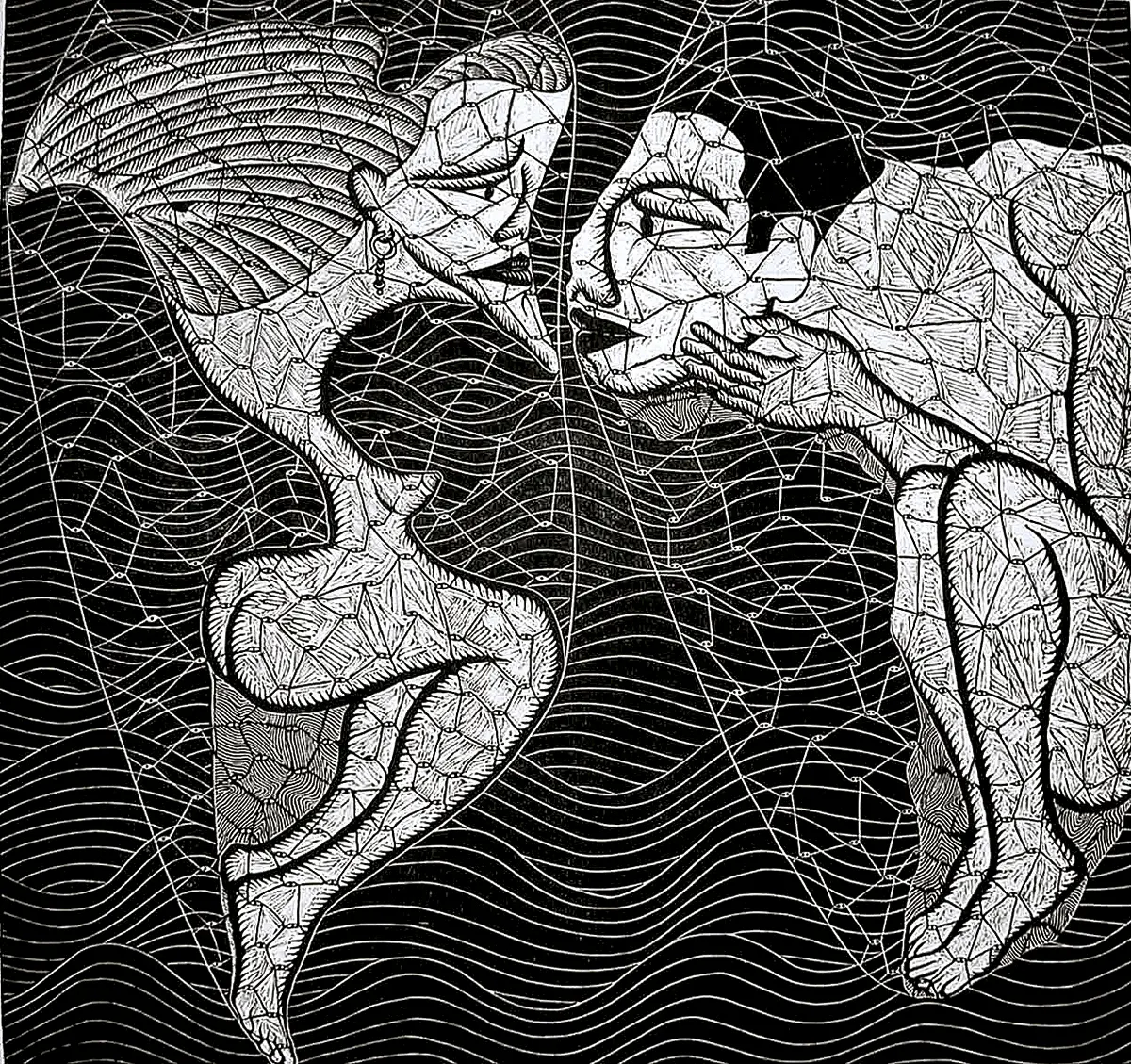
Without contradicting its atmosphere, the show included the xylographic trilogy that earned Miranda First Prize at the Encuentro de Grabado 2004, comprised of Los novios, El guardián, and El náufrago. The last two offered a sense of continuity, with all the gravity and drama that dominate Ibrahim Miranda’s discourse when dealing with visceral topics. One, the slayer that hovers over our nights, chasing away dreams, illusions; the other, the victim of who knows what circumstances, whose head and arms lie at the bottom of the sea, his remains fused to the body and the tentacles of a medusa. In Los novios, on the contrary, Miranda returns to the topic of maps, but the piece operated a singular metamorphosis. The procession was a surprising metaphor. The Americas as a whole formed the figure of the bride, while the groom was none other than a man in profile, delineated by the coastline of the African continent. In this ingenious way, Miranda assessed the martyrdoms of history, the brutal, merciless processes of hybridization and mestizaje; this was his eloquent way of expressing the expansion and intermixing of diverse spiritualities and religions that were forced to retreat into human memory, the sole treasure allowed to those who were taken from their native land with such unimaginable cruelty. This piece was something like the “frozen scene” of a noble act, an act much unlike what was to come afterwards, after the intervention of multiple powers, responsible in the end for the conquest and colonization and the current human composition of the lands that were called the “New World.”
A show like this offered a chance to reflect on a universe that is undoubtedly fragmented, yet kept together and connected by the impulses of a consciousness of being. It was not the cold review of a machine’s archive, but of human memory, its rationality, but also its warmth and tenderness. A tenderness that brings into contact different zones. Its virginal spaces, such as, in this case, those tracings on vegetable paper —of an immaculate whiteness— on which the animal-islands rested, with those very same islands moving in different scenarios amidst the various tonal interplays disseminated in each work. The red of the immutable, of the recurrent, the green regions of our spirit, places to which we come back often with one or another kind of yellow as a guide. Although the initial impression of Impulsos could be compared to an automatic process, there is a substantial difference between the digital processes that de-fragment without feeling, and the human soul, molded in the spiritual realm by unpredictable and recondite rhythms. A soul that considers, moves forward, compares, and relates on the basis of lived experiences, emotions, and above all, passion, is the material of Ibrahim Miranda’s fine work.
CARIDAD BLANCO