
Ignacio Esplá’s most recent one-man exhibition at Mateo Sariel Gallery had a significant title: Pretexts. It was an impressive show of paintings on canvas in which nature offered the artist the ideal pretext for the exploration of form and color, shadows and volume, as well as sensations both tropical and spiritual. The large format of his canvases with their broad areas of saturated color, together with the almost iconic interpretation of floral motifs, in an expressionist style, brought together an exhibition where the first impression was that of standing before an explosion of color.
Esplá’s recent works represent the culmination of a career that began three decades ago with completely abstract paintings in neutral tones. Over time and with the artist’s move from his native Spain to Latin America, those early non-figurative works gave way to interpretations of the outside world. More than any other contemporary artist in Panama, Esplá has painted the natural panorama of his adoptive country: expressive, imaginative, and colorful visions of trees, foliage, mountains, oceans, and distant horizons. Along the way, he has refined his compositions, reducing the number of elements within his landscapes, although not the size of his paintings. Throughout this synthetic process, his paintings have become increasingly sophisticated in character and execution, requiring fewer “pretexts” to such an extent that in this latest series, many compositions are based on single figures. The visual and psychic interaction arises from the fact that they represent flowers, stems, or buds, fragments of a botanical world, which Esplá raises to dramatic proportions.
It is not simply a matter of describing floral motifs but rather of creating paintings based on abstract structures, over which the artist applies pigment with a sense of freedom that is surely not gratuitous but rather the result of years of work and artistic exploration. The plants offer areas for placing lights or shadows within the compositional scheme. He then covers the surface with brushstrokes that bring the compositions to life, creating a sense of volume through the juxtaposition of contrasting tones and complementary colors. There is no black in his paintings where, in the best post-Impressionist tradition, even shadows are the product of color. His paintings are formidable, with close-ups of botanical elements, sensual forms, and impressive saturation of color.
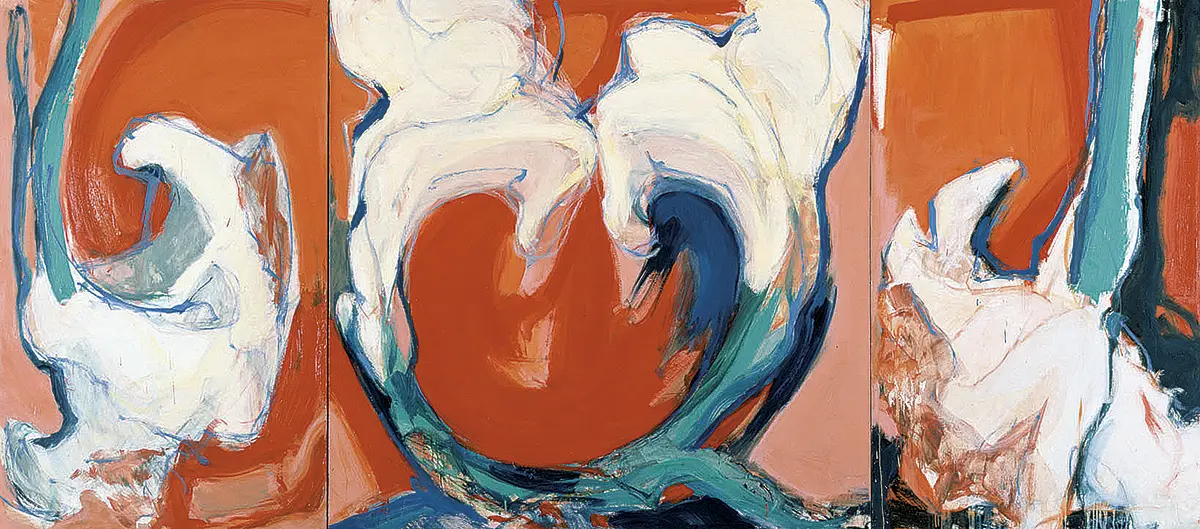
Some works, such as Lagoon, are polyptychs made up of several panels that allow the artist to amplify his radiant view of nature. Lagoon displays a connection with the artist’s earlier landscapes, energetic designs usually dominated by large tree trunks, in combination with abundant foliage that sometimes allowed a view of the horizon. In the triptych entitled Homage, Esplá has already moved on to a new stage: the panels are filled by four enormous white lilies with blue-green stems against a bright red background. As Angela de Picardi so accurately described it in the exhibition catalog, Homage shows how “through stylization the floral motif transforms itself into a perfect union of encompassing curves, in which the flowers crown a group of kinetic lines that speak of this new esthetic concept in Esplá’s oeuvre.” The artist achieves a daring balance between the dynamism of Abstract Expressionism and the realistic description of a botanical motif, which grants these paintings a place in the tradition of naturalist painting. We could describe them in almost contradictory terms, as naturalist abstractions or abstract-expressionist views of nature, or as images of tiny details that are simultaneously macroscopic interpretations of floral motifs.
In three paintings entitled Arch 1, 2, and 3, stems and flowers provide the way to achieve geometric schemes based on the interpretation of an arch within a rectangle. In one of them, the background resembles turbulent waters, over which we see a branch of red flowers —spots of color that look like birds of Paradise— that float over the deep blue like an endless arch. In other pieces, the titles denote the connection this artist feels with some of his famous predecessors, such as Matisse in the case of the painting entitled Henri, or of the famous Dutch abstractionist Piet Mondrian in Homage to P. Mondrian 1 and 2. In the first one, a two-and-a-half-meter-long horizontal painting, Esplá creates an enormous surface rich in modulations of red, on the sides of which he inserts some delicate flowering branches, with only a few strokes, that leave the middle of the composition open, inhabited only by color. One needs merely to remember paintings such as The Red Studio by Matisse to understand this manner of adjudicating the leading role to pure color. In the works that Esplá dedicates to Mondrian, monolithic lilies define the axis of compositions that are reminiscent of the many paintings of solitary flowers carried out by the famous Dutchman, which have been described as “flowers that display a sense of despair…that seem to personify a desire to deny time.”
When art is full of the dynamism of life, it also contains an element of tragedy: every living flower is bound to die. Just as we sensed metaphors for states of mind in Esplá’s earlier landscapes —for example, the manner in which a convoluted plant suggested a feeling of mental confusión— we now perceive an unprecedented breadth and vitality in his oeuvre. With their twisted branches or vertical stems, these flowers contain an irresistible inner strength, the natural impulse to grow, the flow of life. Although Esplá has always sought to paint in the most essential sense, and in spite of the fact that at first glance the flowers might seem to be a decorative subject or a pretext for engaging in the exercise of art, these recent works transcend natural appearances and offer us an experience not only of the senses but also of the soul.
MÓNICA E. KUPFER