
Coinciding with the publication of Orlando Martínez’s book Confidencias para los ojos: la escritura y la figura en la obra de José Antonio Suárez Londoño,1 an exhibition of prints by José Antonio Suárez was presented at the Pizano gallery in the National University Art Museum, gathering almost in full the graphic oeuvre of this Antioquia artist whose prints and drawings, always in small formats, are characterized by a painstaking, delicate technique.
The show began with Suárez's earliest prints (1979-1984), made during his period as a student in Switzerland, the only time he used experimental techniques that allowed chance to play a role. Later, his work was to use more traditional graphic-arts media: graver, ink, and etching, with which Suárez has created a highly diverse iconography that alludes to events from everyday life; often, a chronicle of his native city, Medellín, filters through to his images. Suárez draws painstakingly, with a vivid passion for details, animals, plants, faces, stamps, and a variety of objects that are meaningful to him and resist any attempt at classification. On occasion, he also pays explicit or “camouflaged” tribute to great figures in the history of art, such as Rembrandt, Goya, and Degas, to mention but a few.
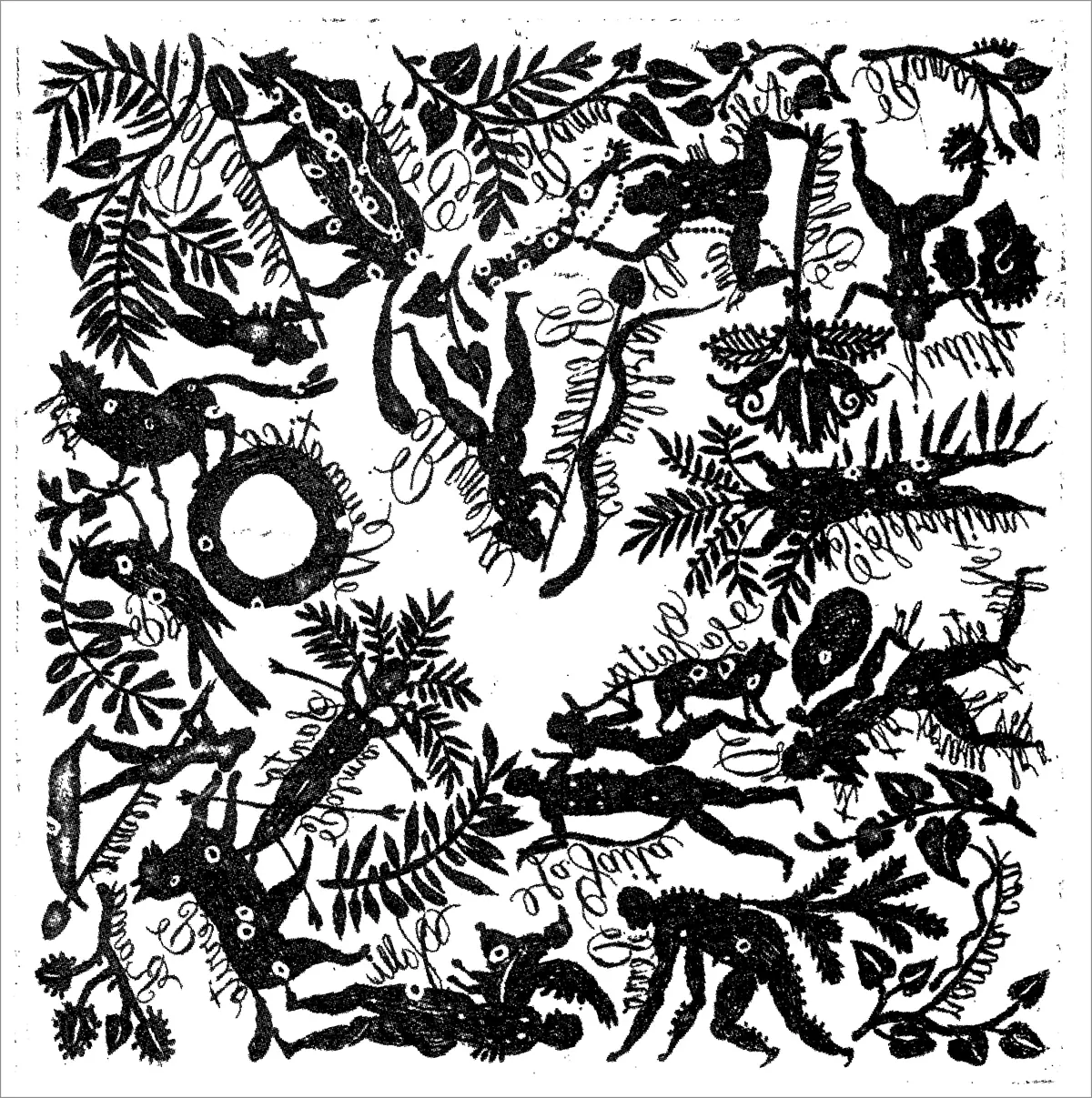
The book’s title, Confidencias para los ojos: la escritura y la figura en la obra de José Antonio Suárez Londoño, underscores two aspects of Suárez’s work: the intimate nature of his small images and the closeness between writing and figure.
Regarding writing, so often incorporated by Suárez into his images, the author writes: “Words and figures reach an agreement in José Antonio Suárez’s prints, where texts become textures and drawings are organized as characters, this is to say, where figures borrow the properties of letters and linguistic signs acquire plastic properties. Suárez turns the conventions of writing on their head and changes the bodies or objects he draws. In many of his plates, we can’t tell left from right, top from bottom. Often, his texts are illegible, forcing us to look at each letter carefully as we attempt to find their meaning, to discover after a pause that his words are not only to be read, that they are also to be seen, that they are plastic.”
And with respect to the intimate character of those small, seductive images inside which something obsessive lurks, Martínez says: “To look at Suárez’s prints is to peek inside an alien memory that may have some corners where we can identify fragments of our own memory. One wants to be alone with those images and have the pleasure of studying, watching, reading them; the act of secretly watching them enhances our perception... José Antonio Suárez’s work generates an unsettling kind of pleasure... It is something like the fear of getting caught reading somebody else’s correspondence, or like the sensation of sneaking a peek at the inscription or the notes on the margin of a book that is not ours. Curiosity is more powerful than fear.”
The show emphasized these features of Suárez’s work by displaying some of his pieces in small glass boxes that were tilted like the pages of a book on a lectern, while others were discreetly mounted on small wooden frames; the former and the latter ran along the walls of the longitudinal gallery.
Orlando Martínez's intention to not impose a reading, a discourse, on these images was fully accomplished. Observing this collection of prints, we realize that, indeed, Suárez does keep that proximity between writing and figure, and this in turn drives us to pay greater attention to the writing in his images, but these will always resist interpretation and classification. “Snooping around” the display boxes or approaching the framed images remains an astonishing experience that brings us closer to someone who insists on and patiently draws every day on small notebooks whose pages resemble those of a private diary, gathering impressions and various events that are highly significant for those who experience them.
Those “confessions for the eyes,” woven with fine line grids, capture and fix our gaze on these minute and detailed constructions inhabited by beings as diverse as those that inhabit the universe.
NOTE
1. Confidencias para los ojos: la escritura y la figura en la obra de José Antonio Suárez Londoño, by Orlando Martínez. Master's thesis in History and Theory of Art and Architecture, School of Art, National University of Colombia.
MARTA RODRÍGUEZ