
Thomas Cohn Gallery presented a mega-show with works by renowned Cuban artist José Bedia Valdés (Havana, 1959) comprised of unsettling “black” paintings of strong allegorical charge and ostensible pathos, and a series of drawings on amate paper, all of them in large formats and exhibited for the first time. The drawings, each 120 x 240 cm, were distributed in the gallery’s mezzanine, while the paintings occupied the ample first floor.
Bedia’s current figurativism accepts all kinds of changes and, at the same time, reveals an important shift in the artist’s career. It even anticipates the constructive and tectonic modifications that have long gestated in his work, as well as the ruins that emerge from his elegiac and neo-sublime visions, where the narrative strategy functions as an important formal and semantic indicator. In that sense, for years the artist has worked on a nomadic, fugitive realm, full of encounters and forsakings, of comings and goings.
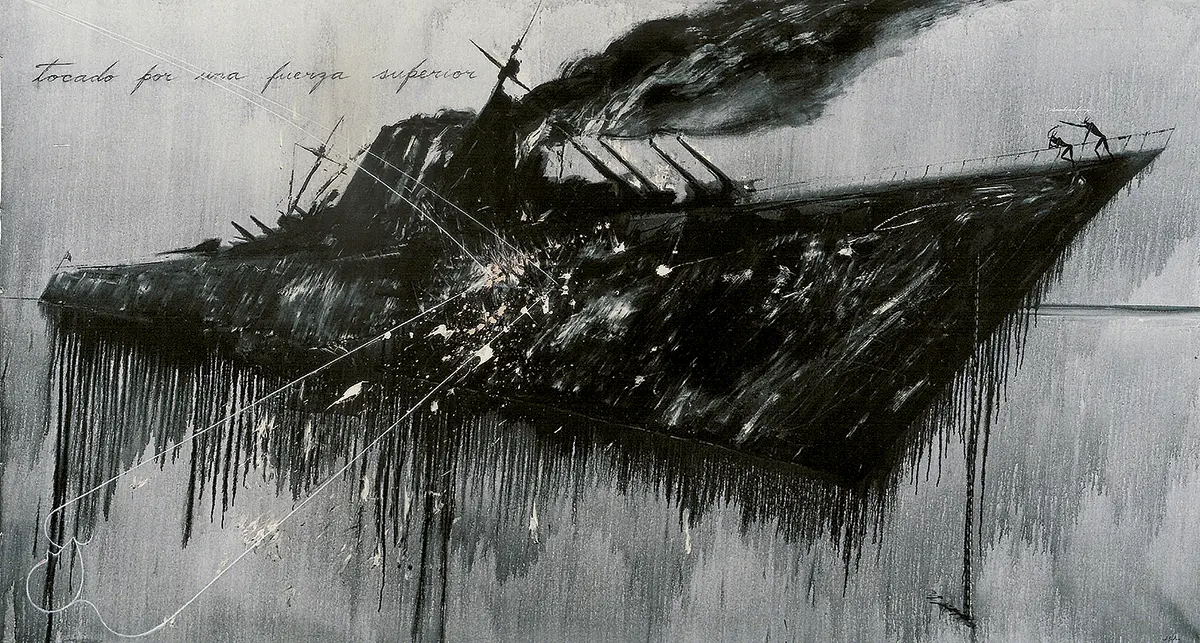
Paintings of the kind of Todo bajo control and Torre del silencio make evident the unsettling presence of imposing black architectures, which, like oversized effigies, invade frontally almost the whole surface of the painting in order to allude, in a metaphorical key, to migration, uprootedness, conflict, and the absurd, conceived as extreme feelings that are experienced by contemporary subjects. Absurd, more than celibate machines, gigantic buildings, and monolithic ships that go beyond painting and situate themselves at the threshold of the uncertain and the unsolvable.
In these new works, Bedia didn’t limit himself to painting the duration of the ill-fated, giving body to an astounding series of “images of after the thereafter,” but, rather, his iconographic repertoire was inscribed on a space of baroque and desolate theatricality. Like fossils or bones invaded by subtle glaucous veils, such somber images allowed viewers to confront vedutas of closed, oppressive, sealed locations, like Lebniz’s monad, conceived as a cage, cell, or sacristy without windows or openings to connect it with the outside.
For Bedia, the space of painting as a real two-dimensional entity goes beyond its own physicality; it possesses a temporal dimension that is cyclical in character. This is why we often find in his works a dialogical interplay between yesterday and today, between memory and the present, though an erotic and thanatic circle that refers, incessantly, to a kind of eternal return, in the same way the mythical structure functions. And in his most recent show, at Thomas Cohn Gallery, Bedia’s enormous paintings and drawings had that undeniably evocative added value. Such was the case of paintings like Tocado por una fuerza superior, 185 x 339 cm, and Héroe escarnecido, 185 x 259 cm, where the artist emphasized, with ironic and even humorous undertones, certain aspects of the ominous, the abject, and the sinister, understood as components of a prolonged catharsis, by means of impressive contrasts in full and abysmal blacks that were illuminated by accurate touches of iridescent whites. Amidst such background blackness and grayness, tiny larva-like characters came to life and survived, like insects, those images of the shipwreck and the witches’ Sabbath.
In this allegorical cycle of paintings, the Cuban artist masterfully alludes to the megalomechanic and technonuclear orgy, to the scourge of war, and the atmosphere of devastation that stalk us at a planetary scale.
On its part, the series of new pieces on amate paper played, overwhelmingly, all the notes that are characteristic of a master draftsman, with linear propositions of continued and clear tracings possessed of a strongly telluric, ceremonial, and syncretic consistency. Bedia’s drawings brought to the fore the singularity and the richness of his usual hybrid, proliferating iconography. Here Bedia recovered for himself all the ancestral substrata and vestiges of the inexhaustible Afro-Caribbean fantasy and tradition.
Monographic exhibitions of such characteristics are not all that common nowadays. With well-differentiated and complete bodies of work, this show at Thomas Cohn Gallery makes abundantly clear that the languages of both painting and drawing are a double path of experimentation for Bedia, making it possible to trace courses of parallel reading that are as all-encompassing and effective as the work demands. And this becomes a basic tool in our understanding of the changes, fluctuations, and substantial shifts operated in Bedia’s work of the last two years, confirming the centrality of his contribution to contemporary Latin American art.
CLAUDIA LAUDANNO