
As the opening of the São Paulo Biennial approached, marking the (most important) ephemeral movements in the Brazilian circuit, the emergence of curator Marcio Doctors’ project Respiração, inaugurated in September with an exhibition of works by José Damasceno, is commemorated. The project takes place at the Eva Klabin Foundation, in Rio de Janeiro, a city that Brazil’s most interesting artists call home but which nonetheless lacks any systematic institutional projects in contemporary art. The program consists of the development of site-specific works for the Foundation, a museum housing the Eva Klabin Collection, arranged by Klabin (1903-1991) in her own home. The collection comprises an impressive selection of furniture items and works of art; pieces ranging from antiquity to Impressionism are arranged in thematic galleries, in a kind of stage created by Klabin especially for them.
José Damasceno's concept for his show’s six works connects with the idea of a latent state of the image in the House. Cinematograma (all the works are dated 2004) as the show is titled, is a mechanism for the discovery of the possibilities of space and its pre-existing elements, activating its aesthetic, symbolic, and image-related charges.
Damasceno’s concerns are centered around the passage from the mental to the physical, creating systems of representation in which he operates through the interplay of dimension and scale, unit and whole, interior and exterior, order and chaos, idea and object. His drawings, sculptures, and installations are essentially turned towards the violence that exists at the passage between the artist’s imagination and the concretion of the work, widening this same passage for its reception by the viewer —always invited to reconstruct and mentally decipher the vision experience. Damasceno’s quest, not all that close to the neo-Concrete legacy, is linked to the 1970s work of Cildo Meireles, Waltercio Caldas, and Umberto Costa Barros.
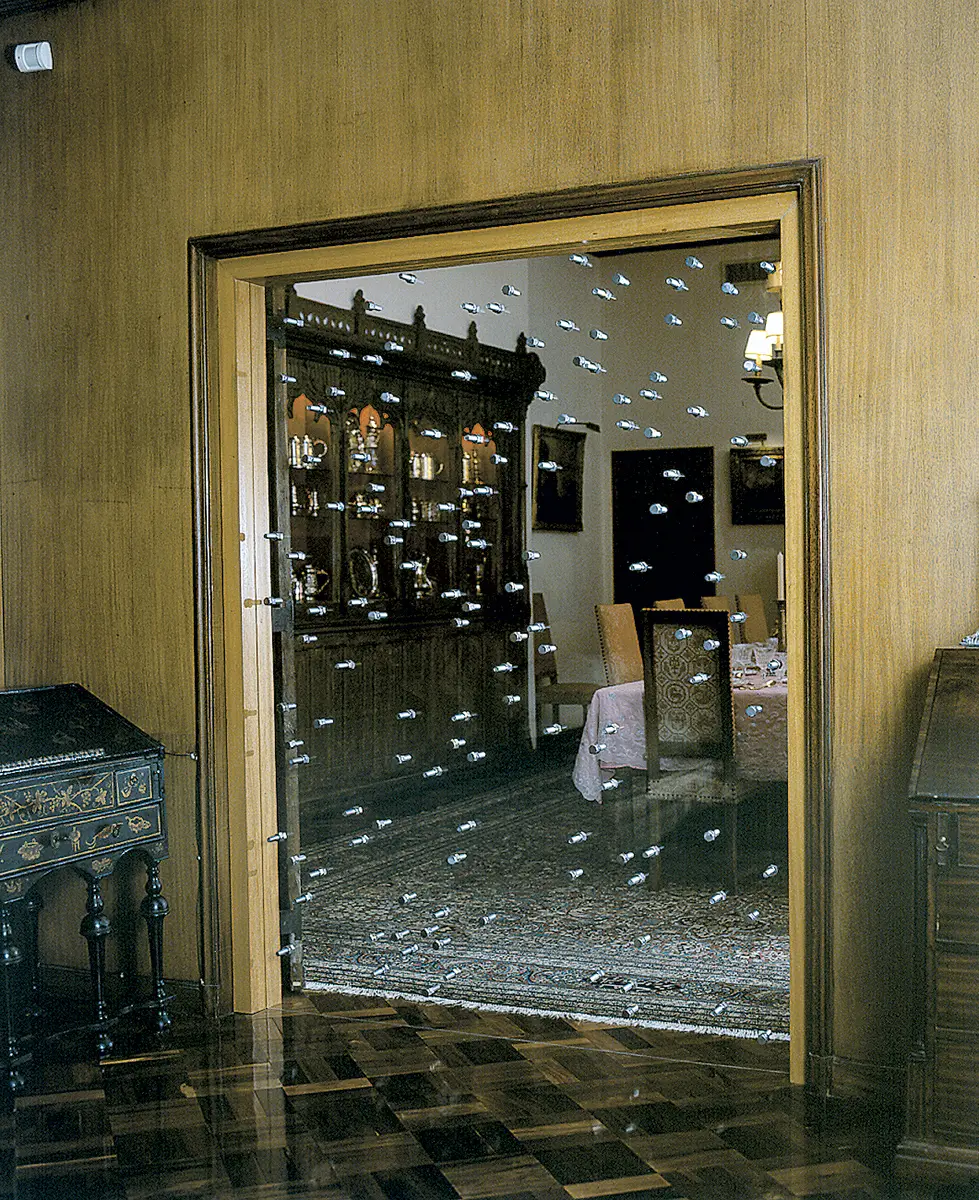
By conceptualizing the space at the Foundation as stills from a movie, Damasceno created subtle interventions that alter our perception of space and force viewers to reorganize their frame of reference as they move around the house. In that sense, the most emblematic piece is Interface Planar, an acrylic plate closing off the museum’s Renaissance Gallery (its Tintoretto and its Mabuse are left inside) and transforming it into a display case. On the acrylic, in a dotted line resembling a sewing pattern tensed by two rocks, one inside and the other outside, the artist drew the hall’s lower level. Inside the space, he placed small labels that, dividing it by dotted lines, suggest different decoupages. Our befuddlement comes from the contraposition of the representation created by the artist’s lens and the space’s strong pre-existing image. From the same family of works, Interface Quente blocks one of the entrances to the dining room, using yet another acrylic sheet with nuts and bolts tied to it in such a way that they alternate on each side. Almost like a pointillist design in the vacuum, the image fuses with and superimposes itself on the elements of the house, dividing the space and presenting itself for viewing from both sides.
In the first floor, too, two pieces occupy their exhibition niches, making reference to the chaos contained in the passage between visual and mental experiences and approaching the cult objects housed and exhibited in the museum. In Condensador Pictórico, inside the British Gallery, the artist fills one of these display cases with colored burlap, creating a kind of larval-state pictorial matter that fits its context surprisingly well and puts us in mind of abstract expressionism’s vibrant paintings, in contraposition to Sir Thomas Lawrence’s Portrait of Lady Williams, hung next to it. With ever more caustic humor, Psicoplasma is a strange bust in multicolored modeling clay. Placed on one of the selves, it refers to a children’s game, while the head of Apollo, a Third-to-First Century BCE Greco-Roman marble, rests in the next display case.
Organograma Manuscrito belongs to a series of drawings in which Damasceno creates, represents, and organizes space (paper or walls) with capillary, alveolar, and diagrammatic ramifications directed by and/or comprised of the words “yesterday,” “today,” and “tomorrow.” The organizational chart is born as a vine, with three slices at the foot of the stairs, done in small hand-written self-adhesive labels that ascend in circles to the second floor, where it once again divides into two new branches, some of which end behind a San Jerónimo Penitente from the Spanish Baroque. Undoubtedly, the most architectural piece in the exhibition, Audiçao, located in the Foundation’s small concert auditorium, has a different spirit. It uses pre-existing objects and achieves a strong dramatic accent thanks to them. A rope was tied to the leg of a grand piano, in the spectator box, and then hooked to the ceiling to support three chairs on the orchestra floor. Right there, we have matter’s power of suggestion. If all art is Man’s power of transformation over matter, here it is as if objects were animated and illustrated our most otiose imagination. Like the essence of a film.
RODRIGO MOURA