
Not taking into account the
geographically distant tsunami, until the fire in a discotheque —with its two
hundred young victims—, the center of all polemics and debates, analyses and
accusations, was monopolized in Argentina in late 2004 by León Ferrari. His
long-awaited retrospective at the Recoleta Cultural Center’s Cronopios gallery,
more than 1,500 square meters containing some 400 works created between 1954
and 2004, caused among us, and even beyond the country's borders, a hurricane
of solidarity with the artist, a veritable current of support with few local
precedents. It was a powerful response to the actions of an extremist Catholic
group known as Cristo Sacerdote, which, through legal actions, was able to close
down —for only seventeen days, because the decision was reversed on appeal— the
exhibition by the young master, as
the prolific artist, born in 1920 in Buenos Aires, is regarded by many.
The polemic exhibition, the result of a deep labor of research by historian Andrea Giunta, was offensive to the most retrograde wing of the Church; yet it was a must for the local artistic and intellectual community, and at least a curiosity for a mass public that is scarcely familiar with contemporary art.
The fact that a single show was able to capture so much attention was an achievement of the excellent montage —a constant in all large exhibitions at the Recoleta center— and the felicitous selection of works. The prominent coverage by the mass media, of course, also played a role, focusing around the political repercussions of a case of ecclesiastic/judicial censorship against a civic/governmental initiative (the Center belongs to the city government.) “Censorship against free expression” was the leit-motif of the debate, a difficult-to-ignore dichotomy in a society as highly mobilized as post-2001 Argentinean society.
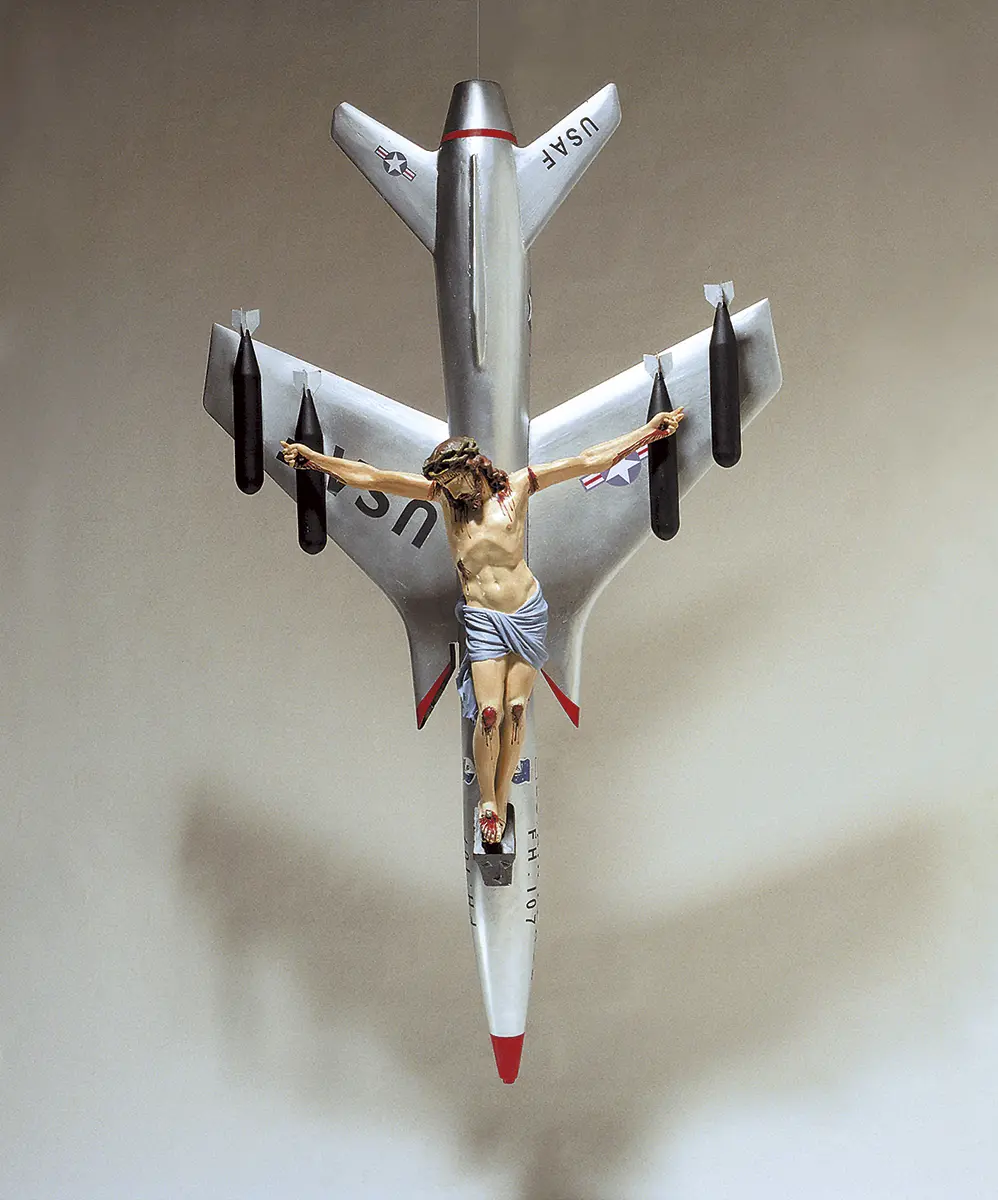
A good portion of Ferrari’s work, recognized internationally and considered an essential component of Latin American political conceptualism, is devoted to the defense of the deep ethical convictions, in a humanistic tenor, that the artist has promoted with tenacity and coherence since his beginnings. Although the issue of religion is central for Ferrari —the idea of Hell, according to his ultra-critical point of view, is an apology for the punishment and torture of those who are different—, the targets of his indignation are plentiful. They go from the Crusades to the US’s war in Iraq, and include Argentinean and Latin American dictatorships, specific cases of discrimination, ideological persecution, or any other attack on human rights. This is to say, although the first to be offended was the Catholic Church —particularly retrograde in Argentina, where it carries a long pedigree of complicities that are difficult to ascribe to Christian piety—, such a violent reaction to Ferrari’s work could have come from the armed forces or the US embassy, or from any institution or individual named in the numerous pieces that denounce abuses of power.
Beyond all those pieces that, with varying degrees of success, make irony of the contradictions and aberrations of Catholicism, and beyond their predictable inverse—works broken by bigots who attacked the show in its first days—, Ferrari’s retrospective covers different lines of work as well, displayed on a variety of supports and materials. Engravings, paintings, collages, assemblages, objects built using recognizable kitschy knick-knacks: the universe of this curious, experimental artist includes so many formats that the review is fascinating even for those who approach it with reticence.
Giunta’s impeccable work, reinforced by an excellent catalog, co-produced by the Recoleta center and MALBA (which simultaneously exhibited the Artefactos para dibujar sonidos,), undoubtedly helps illuminate these 50 years of tireless effort. The papers written especially for this long-awaited book are by Brazilian specialist Aracy Amaral —who knows very well Ferrari’s conceptual period, when the artist was exiled in Sao Paulo, between 1976 and 1991—, Luis Camnitzer, Néstor García Canclini, and Luis Felipe Noé; the latter develops an agile review of Ferrari’s interests through a revealing conversation with his friend and colleague. On her part, Giunta, the driving force behind the project, offers a panoramic text articulating Ferrari’s life and work, boldly confronting even the most questionable aspects of his style, such as its repetitive character and its literalness. “In their excess, both traits constitute,” Giunta observes, “intentional rhetorical features.” But alongside the literalness of meaning in many of Ferrari’s works, Giunta points out the importance of that sector of his production in which the artist leaves aside all references and generates pure forms, images not concerned with their ability to communicate messages; several of these pieces are in the exhibition and they underscore the frank freedom of an artist who is not conditioned by what is expected of him by either his defenders or his detractors.
Adding to the excellent selection, montage, and catalog, it is important to mention the recovery of works of capital importance from the 1960s —valuable in the context of Ferrari’s work and trailblazing for local contemporary art—, such as the celebrated and monumental La civilización occidental y cristiana (1966,) an object in plastic, plaster, and oil that also generated great conflict in its time, especially due to its perspective on the US’s invasion of Vietnam. The intervening newspaper photographs, drawings, calligrams, mannequins, and cages with little plastic animals coexist in this journey covering five decades of obsessive labor beyond the reach of vogues and markets.
EVA GRINSTEIN