
Casa Lamm presented Uno, an exhibition of 15 toys or dolls and four sketches by Havana artist Leslie Sardiñas, regarded as the enfant terrible of contemporary Cuban Painting.
In an article commenting on the occasion when Sardiñas presented the King and Queen of Spain with some of his works as a gift, Armas Marcelo compares the artist to Peter Pan and relates his characters to those of Carroll and Swift. Yet, Alice would most likely have preferred the Queen to play with the characters in Uno. Because what is put in play here is our head. Instead of Lilliputians, here we find a series of polymorphous perverses, dwarfs that refuse to grow like Grass’ Oskar, melancholy if not tragic clowns in the manner of Böll’s, and, in sum, a collection of frightfully deformed characters whose expression reminds us of broken china dolls, or perhaps the protagonists of Japanese manga comics, and even some kiddie-porn illustrations.
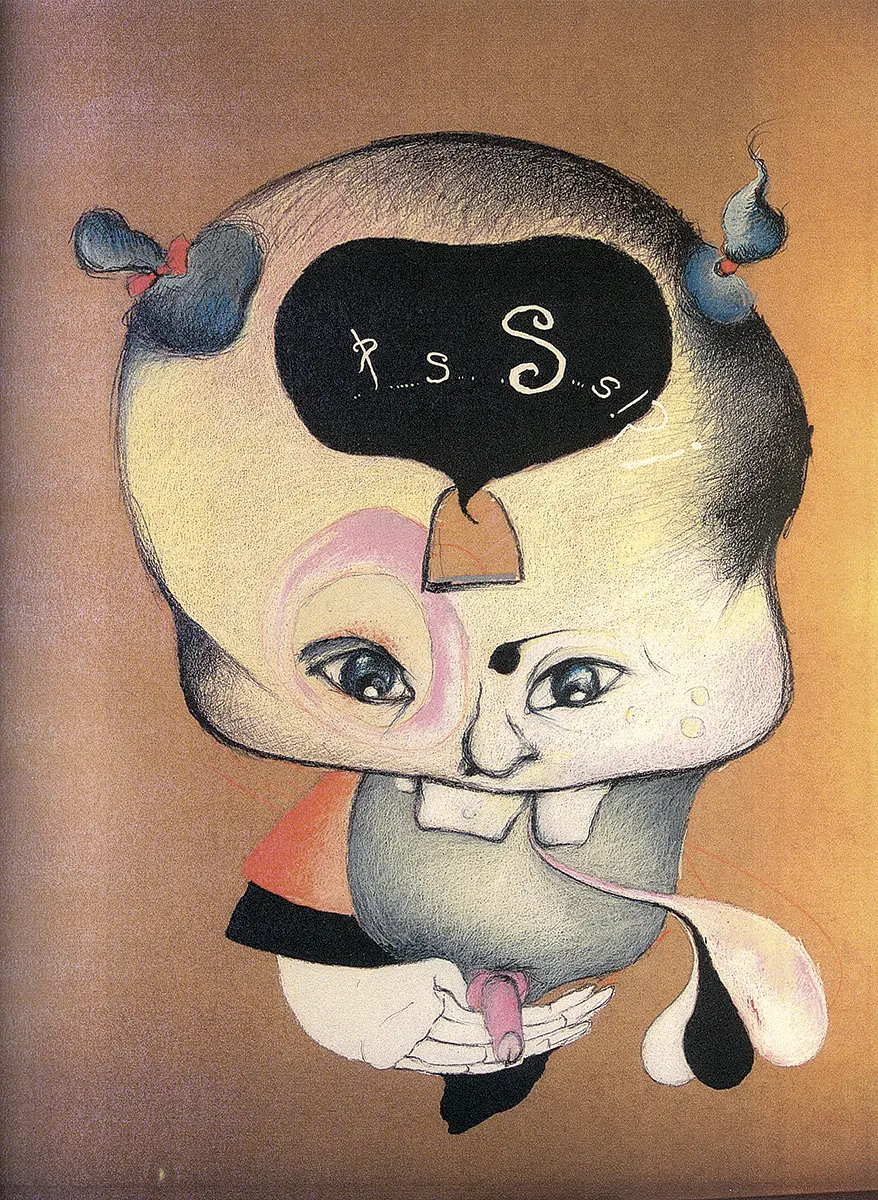
Thus, this is not a magic realism of the kind that characterizes the latest Cuban art, but a series of critical and truly marvelous works, a gallery of freaks that speak to our prurient instinct and whose appeal poses an aesthetic challenge, while relentlessly frustrating the viewer who seeks in Uno any complacent images.
In my view, one of Sardiñas achievements is in his characters’ eyes. In that sense, we are thankful to the artist for having taken drawing as his starting point: he reveals himself to be a masterful draftsman. Who but a true illustrator would be capable of animating the gazes that are trained on us from those paintings where solitary figures seem to justify the title of the show: one is the first item in a list, and here the solitary I dominates the composition; one is also the pronoun we use to speak in impersonal terms, and the objects of our potential ridicule become subjects thanks to the complicit wink and the resolute, direct attitude that characterize them.
Leslie Sardiñas’ painting displays virtues that are rather infrequent among contemporary artists. Uno represents a mental asylum that refers to reality, to its absurdist demented obverse, more than to dream-like worlds. As we have said, Sardiñas’ dolls are solitary figures, with unhinged, anomalous, twisted expressions that, nonetheless, leave no room for sadness; perhaps they call us to play in full knowledge of our unredeemable cruelty, assuming the mystery of our violent nature: there is that knowing expression of frankly malevolent mischief, as in the bruised eye if Toy # 3. Now, among the most unsettling figures are Toy # 7 and Toy # 8, with their pupils of mismatched colors and expressions that are centered around # 7’s Machiavellian and # 8’s drooping eyebrows; the intriguing quality of these faces is reinforced by the fact that the prematurely grown-up characters are dressed as schoolgirls, resembling strippers, unlike what happens with # 13’s barely noticeable smile, with a closed eyelid and a clearly Japanese face or with the naked torso and the high heels of # 14, in a kind of joyful sexual ambivalence —we could well be put in mind of the Dutch display. Well-read as Sardiñas is, I wonder whether he was trying to flesh out the devil from The Master and Margarita, and whether the toothpicks that protrude from # 13’s bloody mouth are in reality fangs...
In any event, Uno is a collection of androgynous characters, of ambivalences that challenge our expectations and mock the nonsense of some values in an inversion of childhood and of the imagination, a caricature of innocence or of that we understand as innocence, in the face of the cruel ridicule we are wont to subject ourselves to, jesters in the carnival that every city holds in its core.
MAYRA INZUNZA