
It was a selection of the studies and projects that have passed from the hands of the artist to the hands of her heirs, as well as some pieces from private collections.
Felipe Scovino, the curator of the Associação Cultural O Mundo de Lygia Clark —founded and headed by Álvaro Clark, the artist’s son— was responsible for the selection of works and signed the text in the show’s bilingual catalog. The catalog was designed by Álvaro’s daughter, Alessandra Clark, also in charge of the show’s design. As a designer, Alessandra works on the idealization and production of decorative or utilitarian objects inspired by her grandmother’s art.
Undoubtedly, Lygia Clark’s thought and the experimental character of her explorations are often betrayed by the historical and market value reached by her works and the decurrent conservation efforts regarding them. Her oeuvre —based on the search for new relationships between the object proposed by the artist and the subject who interacts with and adds meaning to it— does not adapt easily to the exhibition patterns still in use in museums and galleries. In this case, meanwhile, such shifts went well beyond that. Starting in the late 1960s, Clark firmly refused to exhibit her work.
The Associação Cultural O Mundo de Lygia Clark is one of those institutions that help convince us that copyright should not be inheritable. And this show confirmed it. First of all, by taking advantage of the presence of international museum curators and private collectors at the Biennial in order to put out for sale, for instance, projects in paper for her Bichos, with penciled notes that reflected the artist’s rain of thought as she structured her research.
Meanwhile, one piece grabbed the attention of the attentive and the curious. Outside the main exhibition area, a shiny wooden box held a paper roll like the ones used in a supermarket cash register, a small pair of scissors, and a glue tube. The kit included everything necessary to reproduce, in the home of the fetishistic buyer, Caminhando (1963), an experience in which Clark made a paper Möbius strip and cut it by walking inside and out the continuous surface with the scissors. The kit, developed by the family, is a way of commercializing the work that does not take into account the fact that a part of the experience is for us to watch the transformation of common materials found in many homes or schools into something revelatory, by means of gestures that are far from specialized.
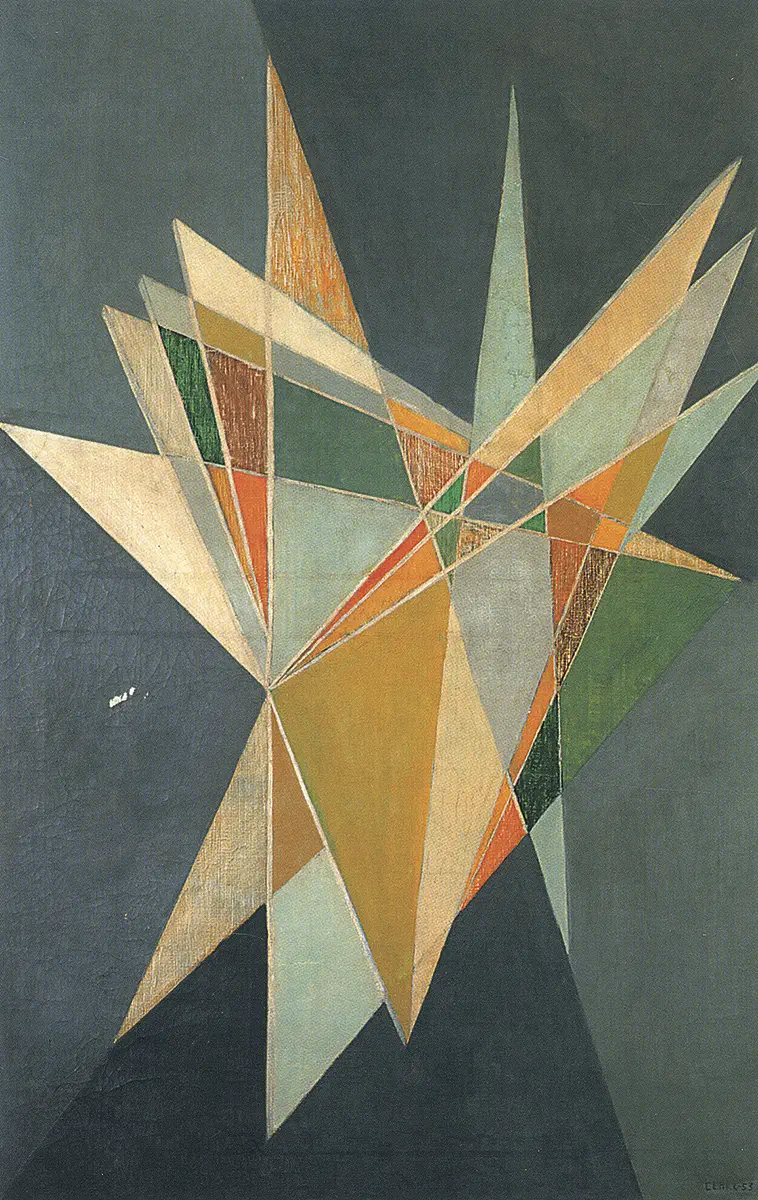
Despite it all, the luminous fragments of Lygia Clark’s writings reproduced in the catalog, some pieces and approaches presented in the show, and never-before-seen works, added value to the exhibition. Clark’s oil Composiçao no. 2 (1954,) for instance, was presented alongside the study that originated it, a 1953 gouache. The study revealed a change in color in a small area, initially painted in red and then covered in green, the latter being Clark’s choice in the final piece. The passage of time mixed the colors and revealed the artist’s hesitations, part of the building process behind a work of art.
Clark’s object Maquete para interior, shown here in a display case, has the ability of transporting the viewer to the interior of a painting. Representing a room where walls and doors are covered in the characteristic shapes and colors of concretista paintings, the object becomes a space that we can enter in our imagination, like we tend to do with architectural models. Another display case held a series of Estruturas de caixas de fósforos (1964). Following a simple grouping principle with variations of openness and color, the artist transformed a kitchen implement into a unit of visual thought and experimentation. Once again, her precise gesture reveals the potency of the objects around us.
These and other pieces presented at the show nourish us with the comforting sensation that, when powerful, it overcomes all other powers that attempt to control it.
CARLA ZACCAGNINI