
The one-person exhibition of work by Marcela Gómez at the Denys Puech Museum in Rodez (a lively city in southwest France with one of the most unusual fortified Roman-Gothic cathedrals) comprised a group of pieces created between 1999 and 2004. In this ample, majestic, light-filled neo-classical building, the Argentine-born artist (Rosario, 1963) had at her disposal a space formed by three successive large, open volumes, the central one of which ended in a high translucent glass window. It offered the artist so many challenges: a space to be interrogated, a light to play with and compose, and an unobstructed perspective one needed to know how to traverse and utilize. For many years, Marcela Gómez has been devoted to precisely these problems: bringing life to space, designing and constructing so that even a vacuum acquires shape and existence, and turning transparency into a visualization of a sensory relationship with the world. These concerns, which are both aesthetic and existential, corroborate the question that lies at the center of Gómez’s work, which she explains in the following terms:1 How is a work of art born, how does it begin, how does it appear?
Such is the dilemma posed by the “interplay” of the real and the virtual, volume and vacuum, movement and stasis, matter and poetry. The exhibition would account for all this. Gómez’s oeuvre, which uses a large variety of materials (iron, rubber, feathers, branches, and resins) and different techniques (welding, electricity, photography, video, and sound), may seem rather eclectic. In truth, each piece, each incursion into matter, serves the dissonant harmony of a single purpose nourished by a long-standing reflection about the importance of the chosen material and the meaning that is attributed to it. Indeed, for Marcela Gómez, the decision to work with a variety of materials involves her responsibility to meaning, well beyond technical changes. “What matters,” she says, “is above all the story we want to tell.”
In the north gallery, under the glass window, we find ourselves before a veritable forest of rubber threads that extend from the ceiling to the floor (we could say they go from heaven to Earth, or from Earth to heaven) and are tied to a geometric structure of rope that simulates the shadow projected on the floor by the “lines” of this design in space. Preceded by her 1999 Autorretratos, in which she was already playing with the tension-projection of a geometric resin element that was attached to the wall—the large Proyecciones No. 3, 2004 (iron and rubber: 550 x 1000 x 650 cm) is an impressive group, a physical incursion into immateriality, very close to the sensation created by the kinetic volumes of Jesús Soto that he called Penetrables. What characterizes Marcela Gómez’s sculpture and brings it closer to the work of kinetic artists is its capacity to “float” in space while preserving the “structuring” aspect of space.
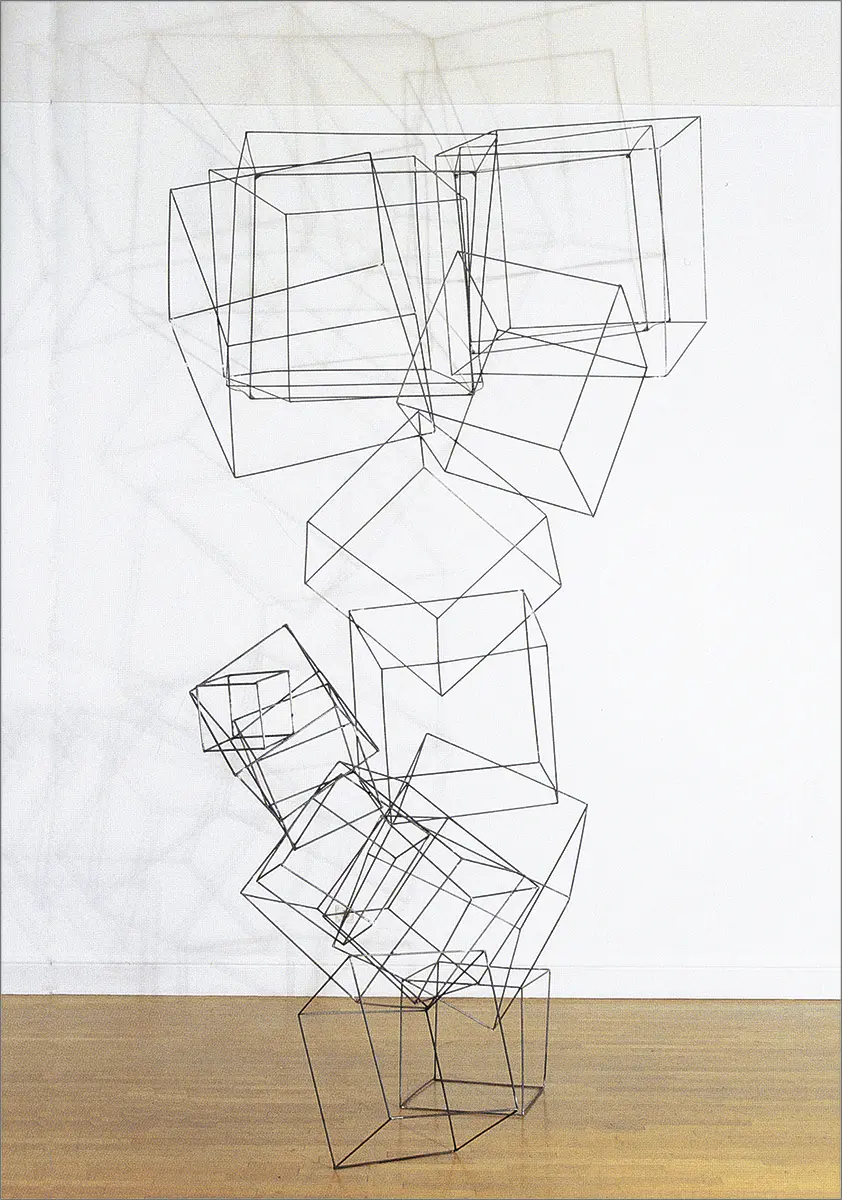
Three pieces in the south gallery are displayed on the floor. Columnas, 1999 (iron, resin, and branches: 250 x 200 x 300 cm) is a superposition of translucent cubes in neutral resin that incorporate the whole length of a tree branch. The installation titled Corpus, 1999 (nylon thread, feathers, sound and electricity: 550 x 180 x 180 cm) comprises a circular mass of feathers, some of which fly in a whirlwind while others are tied to invisible threads that hang from the ceiling. The sound emanating from this white volume is the sound of a beating heart that goes faster and faster, overcoming the whisper of the wind. Finally, we find Cascada, 2004, an extraordinary sculpture (iron: 400 x 190 x 350 cm) designed especially for the site and created during Gómez’s first artist-in-residence stint at the Rodez museum. In this piece, the 4-meter-high network of iron lines that trace curves inside curves is a form of balance within unbalance, a kind of geometric calligraphy in the form of an unending turn that launches into the vacuum and overtakes it. It is at once a technical feat and an aesthetic challenge, and beyond its identification with a (virtual) post-cubist composition, “Cascada is primarily a “poetic space proposal,” to use philosopher Gaston Bachelard’s terms. At the same time, the incorporation of natural elements that has been present for several years in Gómez’s work appears in this exhibition under a new guise with five Bodegones or Naturalezas muertas, 2004 (light boxes: 35 x 35 x 15 cm) showing lighted photographs of leaves, branches, roots, and flowers.
It is mainly with her installation El interior está al interior del interior, 2001–2004 (iron, wood, and optical instruments mounted on rods at eye level: 15 x 15 x 130 cm) that Marcela Gómez enters into a deeper dialogue with the viewer. Viewers are invited not to penetrate the vacuum, but to peek into a box where they can individually find the mise-en-abyme (or mirror-effect) that Gómez so appreciates, where each viewer is the intimate voyeur of the artist’s images and her everyday objects (chair, bedroom, etc.). With the two videos Vientos, 2003 (1min. 50 sec.) and Mamá, me caigo, 2004 (1min. 30 sec., with a text by Argentinean poet Guillermo Daghero), she continues along the path of wondering about the fragility of all certitudes, be they psychological or emotional.
The exhibition catalogue includes a three-part interview with Marcela by art critic and Dominican priest Jean-Pierre Brice Olivier. It is a fascinating dialogue that takes place in three different locations (the artist’s workshop, a Parisian dock near Brice Olivier’s old gallery, and the hall of Brother Renaud at the Saint Domingue convent) and explains Gómez’s particularly sensible trajectory. There the artist expresses, with rare sincerity, the essence of her motivations and her creative process: “I believe that the only way not to get lost is to follow the path of the heart,”2 evoking Oscar Wilde by adding that she would like to be what she is able to become, forever inscribing doubt and hope at the heart of her work.
NOTES
1. Interview with Jean-Pierre Brice, exhibition catalogue of “Ingravideces,” Denys Puech Museum, Rodez, 2004.
2. Ibid.
CHRISTINE FRÈROT