
When talking or writing
about the painter and draftsman Marcelo Pogolotti (Havana, 1902–1988), it is
commonplace to point out, among his historical achievements, his having been
one of the main figures of the island’s early artistic avant-garde and the sole
representative of Futurism in Cuba. But, of what Futurism? Reporting from Paris
in an article that appeared in the Cuban magazine Social in 1931, Alejo Carpentier wrote: “Pogolotti arrived in the
Italian Futurist circles already a mature artist. They had very little to teach
him. Marinetti’s impact on his spirit was, at best, the simple—albeit valuable—effect of giving Pogolotti confidence in his own personality. Because the
painter’s current work is the logical coronation of his previous efforts...”1.
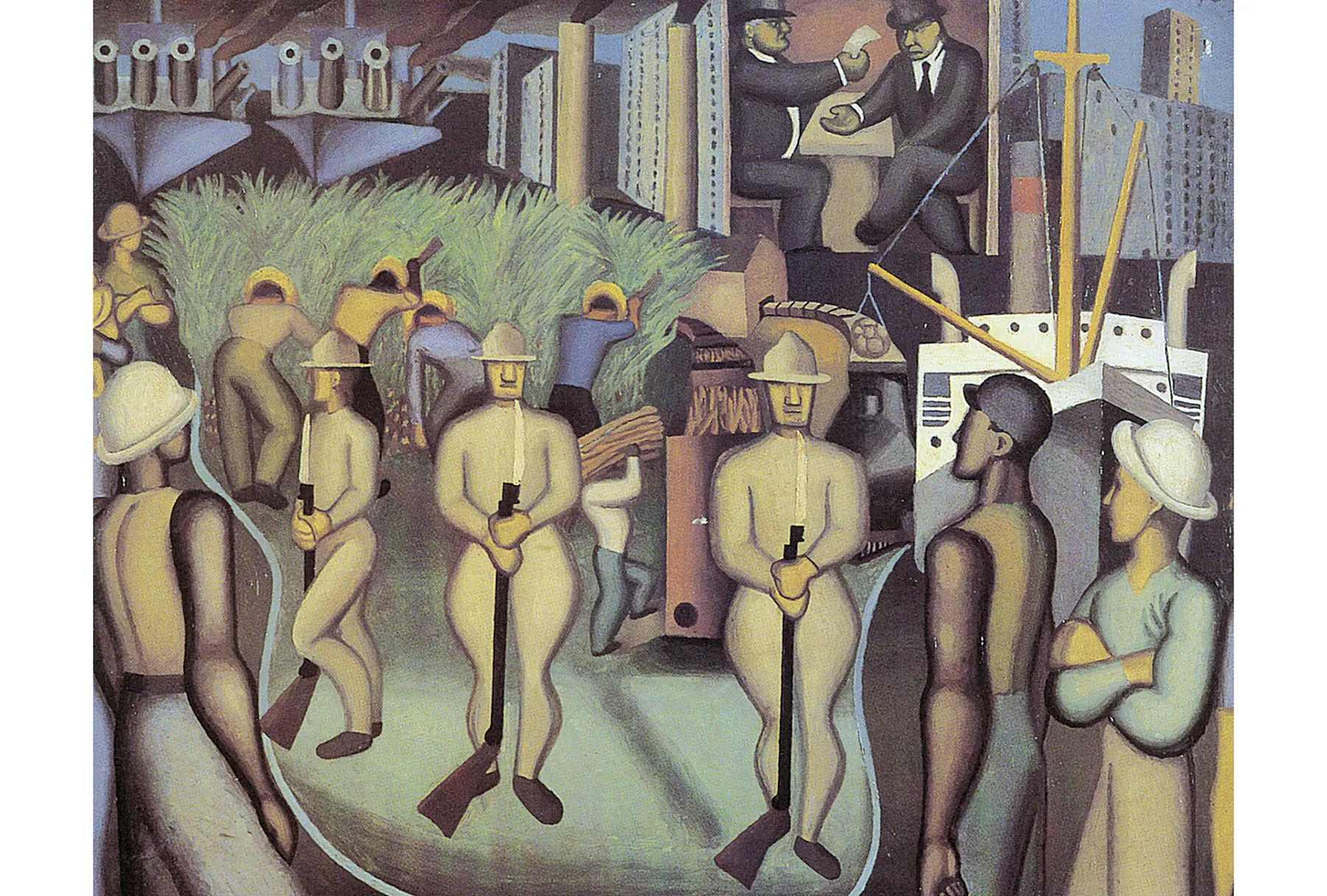
Indeed, an artist like Pogolotti, sensitive to the changes occurring at that moment in history, could not have remained untouched by the industrial revolution: he had been doing a machine-focused type of painting since at least three years earlier, starting in Paris and continuing in Italy, his father’s native country where one of the artist’s aunts still lived (cara Mañatín). It was through this aunt that Pogolotti met Pitigrilli, the satirical writer, who in turn introduced him to Fillía, secretary of the Futurist collective in Turin. After seeing the Cuban’s works, Fillía invited Pogolotti to join the group, with the approval of F. T. Marinetti. At the time, an exhibition was being organized in the Italian city of Cuneo (to be held in 1931), and from that moment on, Pogolotti’s works were to travel as part of the group shows presented by the Futurists throughout Italy.2 Marinetti wrote: “Pogolotti shows... his paintings resolved through the introduction of different materials, which are fully aware of the Futurist sensibility and reveal a highly refined painterly temperament.”3
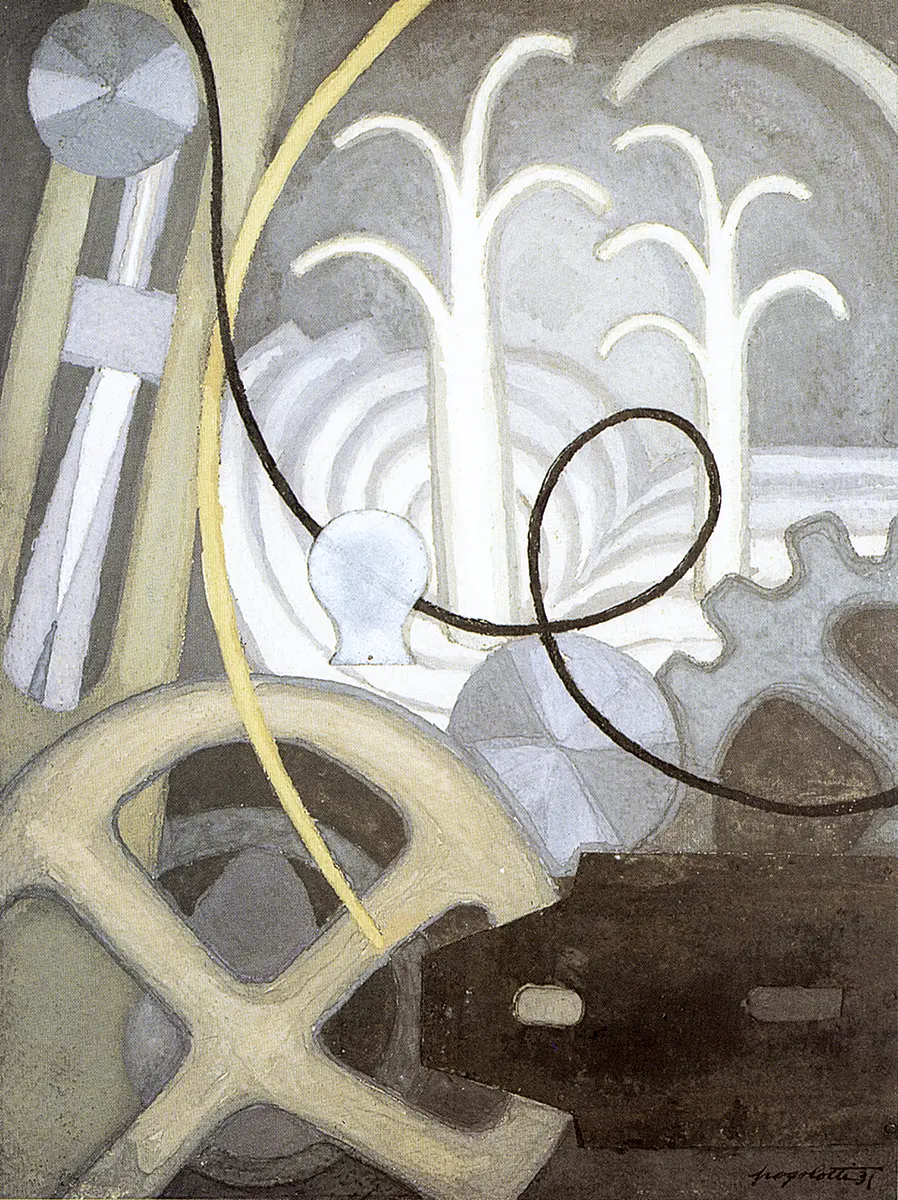
Such works as Campos magnéticos (Magnetic Fields) and El hombre de hierro (The Iron Man), both from 1931, are paintings with metallic applications created in Pogolotti’s aunt’s house, in Turin. There, before meeting Pitigrilli, Pogolotti had continued with his attempts to increasingly stylize the machine, achieving transparencies, textural effects, and special grays through the use of metals. These metallic collages were “something never before attempted.”4
But already in 1922, in the Manifesto dell’arte meccanica, three early members of the Italian Futurist movement, Prampolini, Pannaggi and Paladini, had expressed principles that were compatible with those applied by Pogolotti in the two pieces mentioned above, and even in some later ones. “We feel mechanically. We feel ourselves to have been built in iron. We [are] also machines, we [are] also mechanized... Today, all human drama develops from the machine and in the machine. We, the Futurists, want: 1) to capture the machine’s spirit and not its external form, creating compositions that use any expressive medium and also true mechanical elements; 2) to coordinate these expressive media and mechanical elements through an original lyrical law and not through an apprehended scientific law; and, 3) to understand as the essence of the machine its forces, its rhythms, and the infinite number of analogies it suggests...”5
At that time, however, Pogolotti was studying engineering at the Rensselaer Institute in Troy, New York. Before arriving in Europe in 1928 and painting plantations, boilers, and black people at work (paintings he was not entirely satisfied with), Pogolotti had drawn many buildings and urban spaces of Old Havana with linear virtuosity; his art (also in the landscape genre) was influenced by post-impressionism and had Fauvist undertones.
He must have seen works by the Belgian Futurist Flouquet, who had recently exhibited his work in Havana. But, according to Pogolotti’s autobiography Del barro y las voces (From Mud and the Voices), what put him in synch with the dynamism and the distilled form that characterized mechanicist aesthetics was Ozenfant’s essay, “Art.”
And although Pogolotti was an avid reader and always tried to be updated, the artistic school led by Ozenfant (Purism) along with the second Italian Futurism had already confronted “the formulations of ‘mechanical art’ since the beginning and through a good part of the 1920s.”6
Purism, like Futurism, magnified the machine as a model of its “idea,” albeit by virtue of its being free of useless accessories, of all that was non-functional.7 The two movements also shared a taste for analogies. Some of these analogies did not convince Pogolotti (like the one suggested by Ozenfant between a female figure in profile and Rio de Janeiro’s Sugar Loaf), but in El hombre de hierro he seemed to suggest visual (and conceptual) analogies between men and machines, on the basis of formal correspondences (curved lines), texture (metallic), and color (gray.)
At any rate, Pogolotti was not to be an orthodox representative or a lasting follower of Purism, with which he was not entirely satisfied. Despite his admiration for Ozenfant’s learning and philosophical mind, their exchanges did nothing but increase the Cuban artist’s reservations; Pogolotti could never understand how it was possible for his French counterpart to reconcile Platonic ideals and their eternal values with the dynamism of the modern world.
What remains beyond doubt is that it was with Futurism that Pogolotti explored aeropainting and sacred art.
The “Breath of the Poetic”
On the basis of their cult of the machine (of airplanes, specifically), the Turin Futurists attempted to express through aeropainting an “undiscovered dimension” in the era’s visual environment.
In the Manifesto that appears in the catalog for the Savona show of 1931, the signers considered this style of painting a “beautiful abstract synthesis of a new Grand Art” and, among other things, declared that the perspectives suggested by an airplane’s flight were an entirely new reality, one whose elements were in permanent motion. This involved forfeiting details in favor of the synthesis and transfiguration of all that was gleaned from above, a vantage. Where the landscape’s forms appeared flattened and dispersed. The resulting work of art, then, should be multi-centered and it should arrive at a “new supra-terrestrial visual spirituality.”
But not every aeropainter thought along the same lines. Fillìa, Prampolini, Diulgheroff, Oriani, and Munari were interested in projecting their art into “cosmic spatiality, sidereal encounters, the origin of cosmogonic processes parallel to the primacy of human organisms; with proximity to the area of influence of Surrealism... Meanwhile, Dottori is interested in a planetary vision from above. Equally individual are Rosso’s or Peschi’s “aerosculpture” solutions. For Tato, Ambrosi, Andreoni, Di Bosso, Crali, Korompay the issue is, on the contrary, documenting the dynamism of the view from an airplane in acrobatic evolutions...”.8
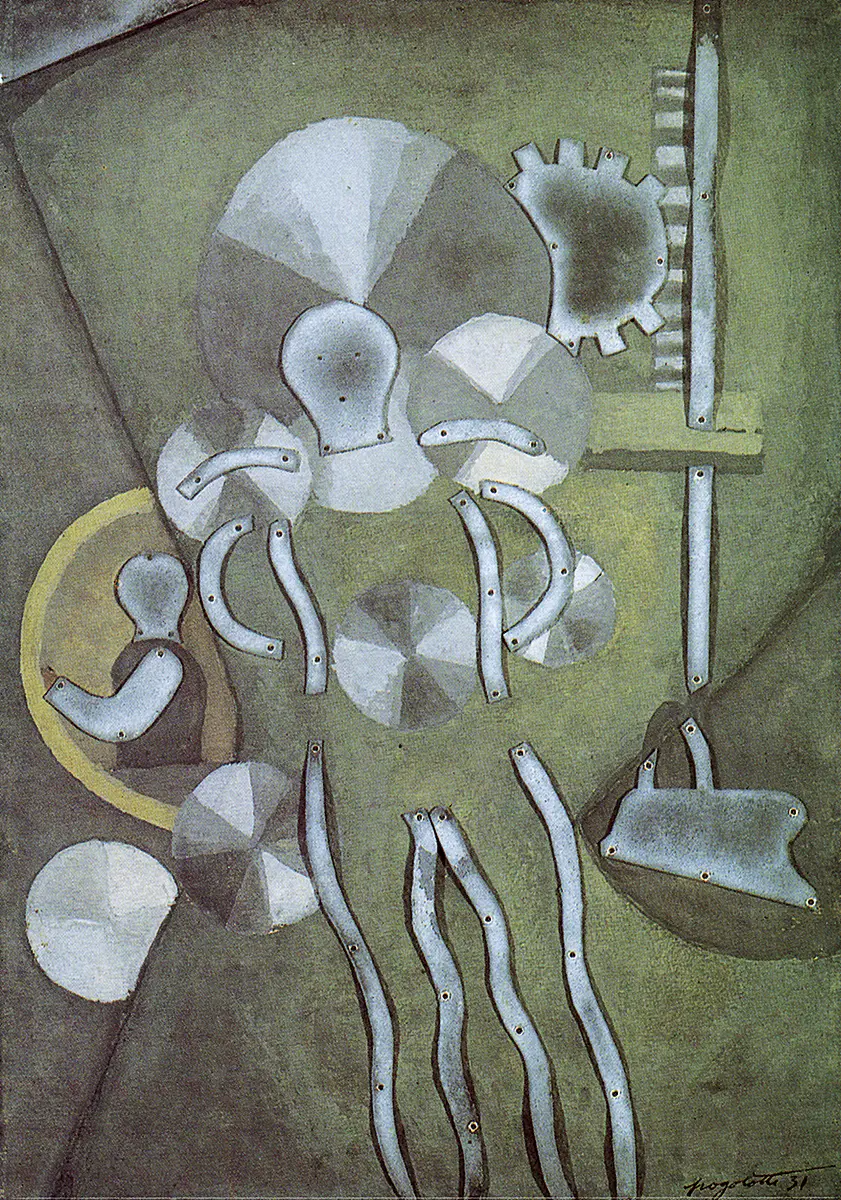
Unlike most of them, Pogolotti was not among the signers of the Manifesto dell’aeropintura. Yet it is known he did work along those lines. A perfect example is his canvas Aeropintura (Aeropainting, c. 1931). This oil’s sinuous linearity, its intervisuality or optical superimposition of planes, its rather embryonic shapes, and its supra-terrestrial perspectivism link it especially to works created by the Italian artists Fillía, Oriani, and Alimandi that same year, which were exhibited alongside Pogolotti’s own compositions.9 Similarly, the use of various tones of ochre and green also inscribe this piece by Pogolotti within the framework established by the a manifesto, which considers “green tones + brown tones + the atmosphere’s pristine blues” a continuous gradation of colors.
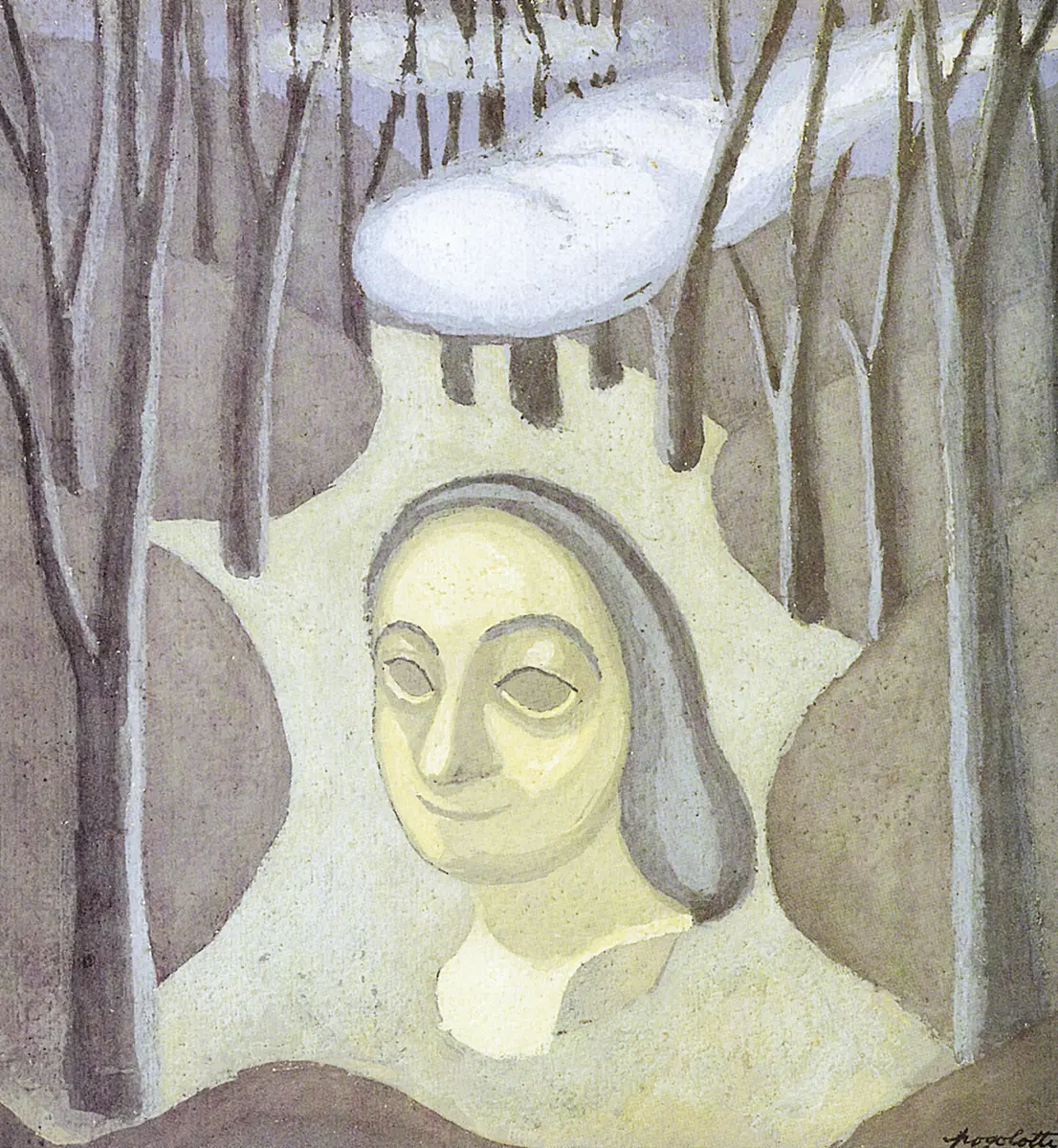
Inspired by these enigmatic shapes that were halfway between Surrealism and abstraction, in his article in the journal Social Carpentier refers to the “great breath of the poetic” in Pogolotti’s then-recent works, noting that the artist’s “mechanical mode” had given way to shapes that related harmoniously yet were devoid of “evident graphic meaning,” on the basis of which Pogolotti had composed “plastic worlds with imaginary elements” that Carpentier compared, in their spirit, to Masson’s “arabesques,” Simá’s “mysterious splotches,” and Roux’s “unknown objects.”10
Carpentier even related Pogolotti’s Morada interior (Inner Housing), to the visual poetry of a Surrealist like Max Ernst, and his assessment was not too wide off the mark. Pogolotti himself would later refer explicitly to his initial incursions into surrealism and into the abstract tendency (in the sense of purifying synthesis) to move towards aeropainting.
Futurist Sacred Art
Pogolotti was not among those who signed the Manifesto dell’Arte Sacra Futurista, nevertheless, Marinetti mentions him in that text in a list of the movement’s painters whose Futurist sacred works “are equally meaningful.”
A number of pencil-and crayon-on-paper drawings serve to illustrate Pogolotti’s incursion into this mode of expression. In one of them, titled En busca de un dios (In Search for a God, 1930), a group of human beings, among whom a few bourgeois are visible, claim before a triad (or trinity) suspended from the sky and formed by a priest with a cross, a king with a crown, and a medieval knight with a sword. Another drawing, undated, shows, seen from a above, two typical capitalists who grab a winged worker in the street. And a third drawing, El dueño de la ciudad (The Owner of the City), represents a walled city whose air space is dominated by a figure holding a key, dressed in religious attire while wearing the traditional top hat of the era’s high bourgeoisie. Several chimneys spout smoke beneath him.
By their topic and the treatment they give it, these drawings can be thought of as examples of Futurist sacred art. Yet they possess a satirical edge directed against the bourgeoisie. Rooted as they are in earth-bound problems, they distance Pogolotti from the mystical (escapist) spirit that dominated the Futurist group and bring him closer to the line begun by the Nuestro tiempo (Our Time) series. Pogolotti even used an aerial perspective as much as an earth-bound one, noticeable in the first drawing mentioned above.
On the other hand, according to Mario De Micheli, these Futurists also “turned their backs on visual dynamism in order to deal with synthetic Cubism and Constructivism.” It is true that the tendency to create compositions based on criss-crossing planes, generalized among the aeropainters and practiced by Nicolaj Diulgheroff (heavily influenced, in turn, by the graphic arts), link this second generation with the Russian Constructivists. But, unlike Cubism and Constructivism (resistant to the literary), Futurism between the wars (in its sacred art mode) was generous in allegories and symbols, sought a certain transcendence through spirituality, and attempted to “conjugate Modernity’s axiology with the iconic-religious tradition.”
Outlying from the “Second Futurism”
At the same time, aeropainting (and even Futurist sacred art, which incorporates formal principles from the former) demonstrates a will to continue the dynamic assumptions of the “first Futurism.”
They did not undervalue the momentary, the fleeting reference; like Boccioni, they tried to compress every register of time, place, shape, and color and tone in order to create a certain “eternity of impression.” And despite their attempt to capture the instant in its continuity through the superposition of planes, lines, colors, and such, they were unable to express it in forms as dynamic as Boccioni’s, who sought to “give the idea of vibration (Impressionist dynamism) and the idea of volume (Cubist stasis) a singular, integral, and dynamic form.”11 Some of the images captured by the Futurist aeropainters, on the other hand, seem frozen, forms suspended in a vacuum. They wanted to transcribe visual and tactile perceptions from angles and movements facilitated by the machine itself (the airplane), and to rationalize them at the same time.
Pogolotti perceived in Futurism a lack of deep social content. He also felt the movement to be near exhaustion. Pogolotti, who had come into the movement’s orbit after 1929,12 saw the beginning of the end of the “second Futurism” (a characterization made by Mario de Micheli, who also defined the years between 1920 and 1928 as the period of greatest development).
In late 1932, Pogolotti spent some time in Turin, where he continued meeting with the Futurists. The Cuban painter was included in several group exhibitions that year, both in France (Laxer-Normand Gallery, Paris) and in Italy (Turin and Rome.) At the Rome show, devoted to aeropainting and to Futurist Sacred Art, two pieces by Pogolotti were presented, which, judging by their titles Composition, must have been abstractions selected due to their visual affinity to aeropainting.
Pogolotti had agreed to keep taking part in shows organized by Fillìa on the condition that the exhibitions were not presented as Fascist. But Fillìa, who was also a painter and “apolitical,” wasn’t concerned by the Futurist’s declared Fascist affiliation in a political or ideological sense, since he saw in Mussolini’s support a way to expand and strengthen the artistic movement. So, he continued to include pieces by the Cuban artist in the shows he “curated.”
That same year of 1932, Pogolotti was forced to leave Italy, due to problems caused between him and the Fascist authorities by a number of drawings from the Nuestro tiempo series, which he had shown to members of the opposition. Thus, his relationship with the Futurists continued solely through the shows in which he was a participant even a l’insaputa, without foreknowledge, since these were mostly itinerant exhibitions.
Seven Decades Later
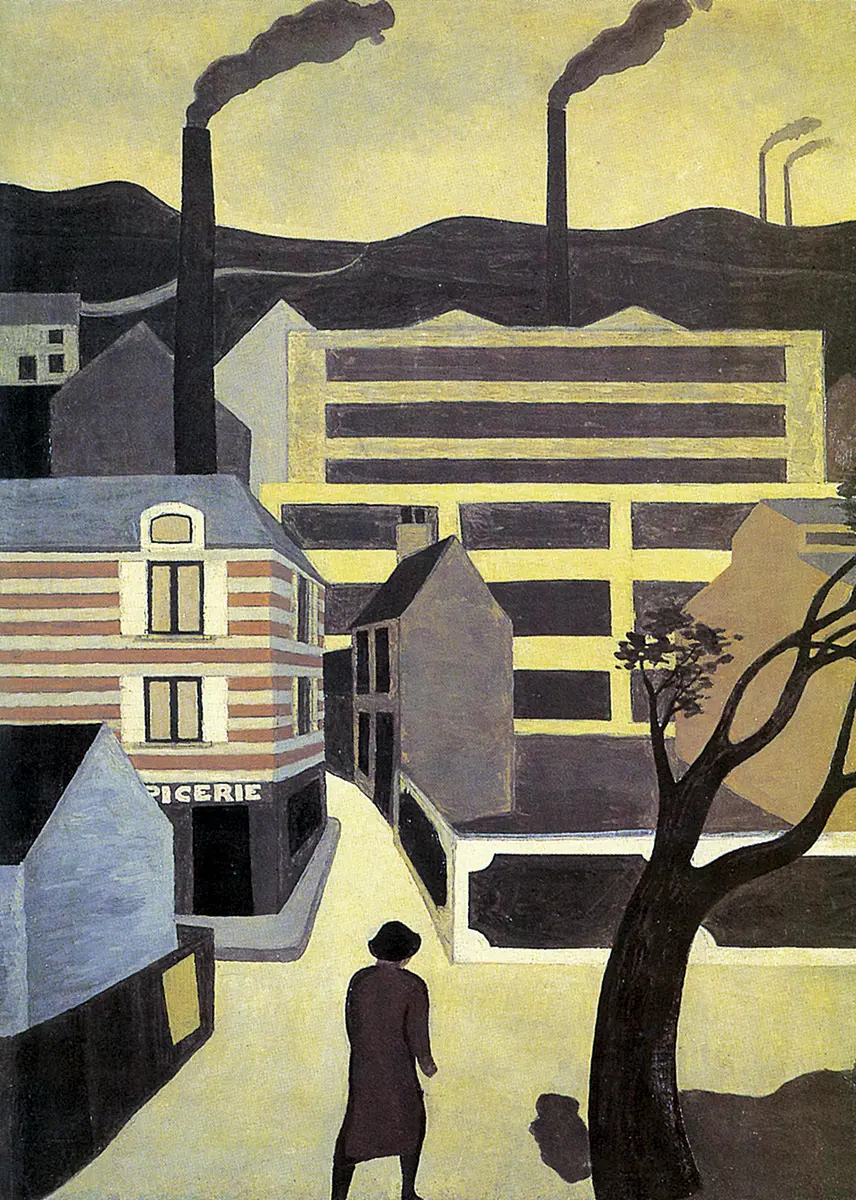
The year of 1934 marked the definitive break with the Italians. In Paris, Pogolotti became close to the Revolutionary Writers and Artists Association, led by Louis Aragon. He showed his works alongside theirs on a couple of occasions, without abandoning the formal achievements of Futurism. He kept painting factories and machinery, now incorporating the “human pulse” of work and of the class struggle, expressed in relationships of dominance, subordination, and symbiosis between those machines and human subjects, and in the tension of diagonal lines. With his compositions based on multiple and fragmented images of a social phenomenon, Pogolotti in some ways carried forward the Futurist ideals of a “visual complex” and of visual dynamism.
But after painting his canvas Encuentro de dos épocas (Encounter of Two Époques, 1939), Pogolotti lost his vision entirely. He returned to Cuba around 1939, and for the 100th anniversary of his birth in 2002, this artist once again met some of those Futurists in an exhibition held from October 25 to December 31 of that year at the Museo Nacional de Bellas Artes (MNBA), in Havana.
This show was a good opportunity to frame and compare the work of the sole Cuban representative of Futurism with that of his Italian counterparts Fillìa, Prampolini, Farfa, and the Bulgarian Diulgheroff.
Enrico Prampolini (1894–1956) was a theorist and promoter of aeropainting, and his work has striking visual similarities to Pogolotti’s in terms of its superposition of colors and of ambiguous, nebulous shapes that come close to abstraction. The same can be said of Il marinaio, 1929, one of the pieces by Nicolaj Diulgheroff shown at the exhibition. With its Cubism, its predominance of grays and cold colors, a certain fragmentation of the human body, and its surreal atmosphere that picks up echoes from the subconscious, this painting relates to Pogolotti’s works such as Sonia, Love, and others not included in the show. Several of Pogolotti’s post-1931 canvases can be linked to Color Factory, 1928 of Farfa (1881–1954) thanks to their geometric conceptualization of buildings and their linear perspective projection. But it is undoubtedly with the works of Fillìa that the Cuban’s creations present the clearest parallels, both in terms of aeropainting and in their representations of architecture. The influence is even felt in Pogolotti’s incursions into Sacred Art.
Although modest in scope, the MNBA show —organized with the support of the Italian Embassy in Cuba, the Piamonte Region, and other institutions— was an important cultural event: for the first time ever the works of Futurists belonging to the movement that originated in Italy could be seen “live” in Cuba. To a degree, the exhibition also corrected the “inexplicable omission in the Futurist show” held in Venice in 1986, which reviewed various incarnations of the movement and even included “artists who had never participated in the visual principles internationalized by that contemporary cultural current,”13 but chose to exclude the works of an artist with such clearly Futurist credentials as Marcelo Pogolotti.
At the same time, the MNBA show, titled Marcelo Pogolotti: A Cuban Painter with the Italian Futurists, was also an homage to Alejo Carpentier, whose 1931 article, “A Cuban Painter with the Italian Futurists: Marcelo Pogolotti,” gave early legitimacy to the “painter with the most progressive techniques and ideas coming out of our country up to that point,” and whose work speaks more than ever to the contradictions of a world increasingly more technological.
NOTES
1. Alejo Carpentier, "Marcelo Pogolotti: un pintor cubano con los futuristas italianos," In: Crónicas, Havana, 1975, p. 28.
2. Marcelo Pogolotti, Del barro y las voces, Havana, 1982, p. 269. The works must not have been the same, since in the 1933 show (Aeropittura ed arte sacra futuriste) Pogolotti presented two pieces titled Composizione. Also, in 1932 he exhibited alongside the Futurists and outside Italy (at the Laxer-Norand Gallery, in Paris.)
3. “Óptica de críticos”, In: Social Magazine, Havana, August 1947, p. 27.
4. Marcelo Pogolotti, Op.cit, . Havana, 1982, p. 268.
5. Futurismo 1909-1944 catalog, Rome, 2001, p. 554.
6. Ibid. p. 319.
7. Diccionario universal del arte y de los artistas. Estilos y tendencias en el arte occidental, Barcelona, Edit. Gustavo Gili, 1969, pp. 241-242.
8. Futurismo 1909-1944 catalog, p. 360.
9. Cf. the 1932 Rome show. By the way, the Savona catalog links two works by Pogolotti with the title of Composición. Nevertheless, in the illustrations for the same catalog, we find Los campos magnéticos.
10. Alejo Carpentier, op. cit., pp. 229-230.
11. Mario de Micheli, op. cit., p. 291.
12. There is no certainty regarding this. Some authors, such as Marinello and Cossio del Pomar, among others, think it was in 1929 that Pogolotti first came in contact with the Italian Futurists. However, Pogolotti mentions the year 1931.
13. Manuel López Oliva, “Una omisión inexplicable en la muestra futurística”, In: Granma, Havana, July 28, 1986, first edition, p. 3.
*All works illustrating this article belong to the Collection of Museo Nacional de Bellas Artes, Cuba.
ISRAEL CASTELLANOS LEÓN
Cuban art critic, curator, and journalist. His master’s thesis in Art History was on Marcelo Pogolotti.