
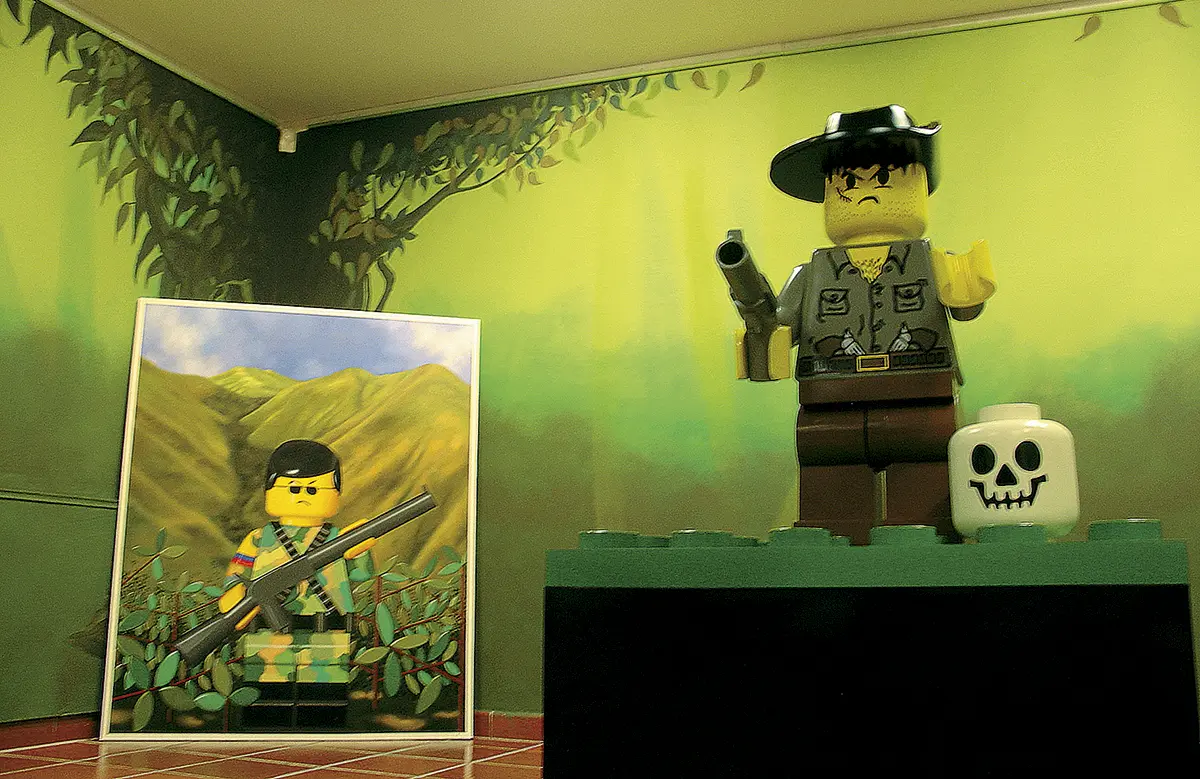
The imperative Play well!, a slogan of the Danish company Lego, is the starting point for Colombia Land, Nadín Ospina’s most recent work, presented in late 2004 at the Universidad de Salamanca Cultural Center, in Bogotá. Ospina’s work is a study of the game Lego Adventure, whose characters are recognizable as belonging to the violent imaginary that characterizes the Latin American region. For example, one of the dolls in the game carried a bag filled with bombs, guns, and knives, and another one had a scar across his face, like a stereotypical hit man. The context in which the adventure took place referred to the exotic rainforest area of a country that, though unnamed, could easily pass for any in the region. The game’s main objective is to conquer, build, and unbuild; this is to say, to create or recreate a world that responds in principle to everyday or historical roles, such as the role of a medieval knight, an astronaut, an engineer, or a submarine, but which on this occasion embodies violence in the so-called third world.
A possible reading of this innocently perverse version of a construction game based on interlocking plastic blocks would specifically imply, however, the transference of a conflict to some place in Latin America. Little dolls that seem to represent an indigenous person, a thug, a stereotypical hoodlum: everything is ready to begin the uncertain, pre-codified adventure, thanks both to the Lego slogan and to the negative characteristics displayed by the protagonists.
Nadín Ospina takes part in the game, but he changes its rules. For Ospina, Lego “threw the first stone,” once again reformulating the question of perversity: who is the perverse one, the toy maker or the artist? This question was already there in El ojo del tigre, a show at the Bogotá Museum of Modern Art in 2003, where Ospina presented a series based on characters from The Simpsons and Disney, and on the issue of East/West transculturation. His works possess a high dose of irony about cultural impositions, inverting and subverting as it does the gaze of relationships as they exist in our society, and generating a synchronic shift by the fusion of ancestral elements and contemporary images.
Initially, the characters in Colombia Land were created using the same technique of Ospina’s previous works. The artist, however, decided to change the procedure and include new characters, new landscapes, and new referents that allude directly to Colombia and allow him to play an adventure game in the midst of a real conflict. His protagonists are military personnel or guerrillas carrying, as an insignia, Colombia’s flag, and dressed in the uniform of the Colombian Armed Forces, even though its use may be ambiguous.
The geography where Ospina locates this game corresponds to the San Agustín mountains and the poppy fields there. The game will take place in these locations, responding to the preconception of a wild and/or paradisiacal territory, that deeply rooted European prejudice that derives from the Conquest period and ends up in games such as Lego’s or on the cover of a magazine like the issue of National Geographic that circulated last year with the headline: “Colombia, cocaine country,” which showed a female guerrilla carrying a rifle. This kind of propaganda is revisited by Ospina in his design for the show’s catalog, which follows the magazine’s graphic parameters, and also in one of the game pieces.
In this way, Latin America is conceived as an ambiguous place that represents, on the one hand, the imaginary of exuberant lands reminiscent of a lost paradise, full of mulatas, and on the other hand, an ephemeral gaze where geography can change, appear, and disappear at the whim of each player.
The show was distributed in two spaces. The first gallery included characters from the new game, some reproduced in an analogous fashion to the original ceramic pieces, like some of Ospina’s previous works. In the second gallery, we found a complete change of materials: the new Lego figures were reproduced in industrial resins, at different scales, resembling the original game more closely. These pieces came with a series of paintings of the game’s figures, restating the three-dimensional images and creating the atmosphere of a small adventure park. At the center, a rainforest curtain and a larger-scale piece invited viewers to become participants in the game.
We can see then that these works by Ospina reveal and denounce symbolic constructions that are made of any given culture, specifically in Colombia, on the basis of real or distorted stereotypical images that are transmitted by the media and persist in the collective memory and the imagination of toy makers. Such are precisely the images the artist questions and resignifies: Play well, in Colombia Land as well!
MARÍA ELVIRA ARDILA