
Mexico City’s OMR gallery presented an exhibition of recent works by Canada-based Mexican artist Rafael Lozano-Hemmer (Mexico City, 1967). The show included five distinctly different pieces, some of them exhibited for the first time. Lozano-Hemmer considers himself an “electronic artist” and offers a brief explanation for each of his pieces in the informational notes found in the gallery.
Caguamas sinápticas, 2004 (Synaptic caguamas, Subsculpture 4) is a succession of thirty “caguama”-sized beer bottles placed horizontally on a wooden table. Each bottle is driven by a motor controlled by neural simulation algorithms; its opacity may be seen as referring to the enigmatic character of the mind. Thus, like the representation of a mental state, the bottles move on the table using a peculiar system: their rotation changes at random, and they intermittently point at, align with, and oppose each other. The piece is an attempt to represent the chaos of thought and the way in which abstraction can contain a certain order.
Circuito cerrado, 2004 includes two surveillance cameras with microwave receptors that point toward a space named Circuito Cerrado. This space is, in turn, defined on the walls and floor by a yellow ribbon on which the inscription circuito cerrado is printed. There are also two monitors showing the video captured by the surveillance camera; put another way, these images represent an irruption into, or a transgression of, that closed circuit. This installation can also be interpreted as the impossibility of leaving behind conventional limitations and the perennial pain of being constantly observed: images as a framework of decrepitude.
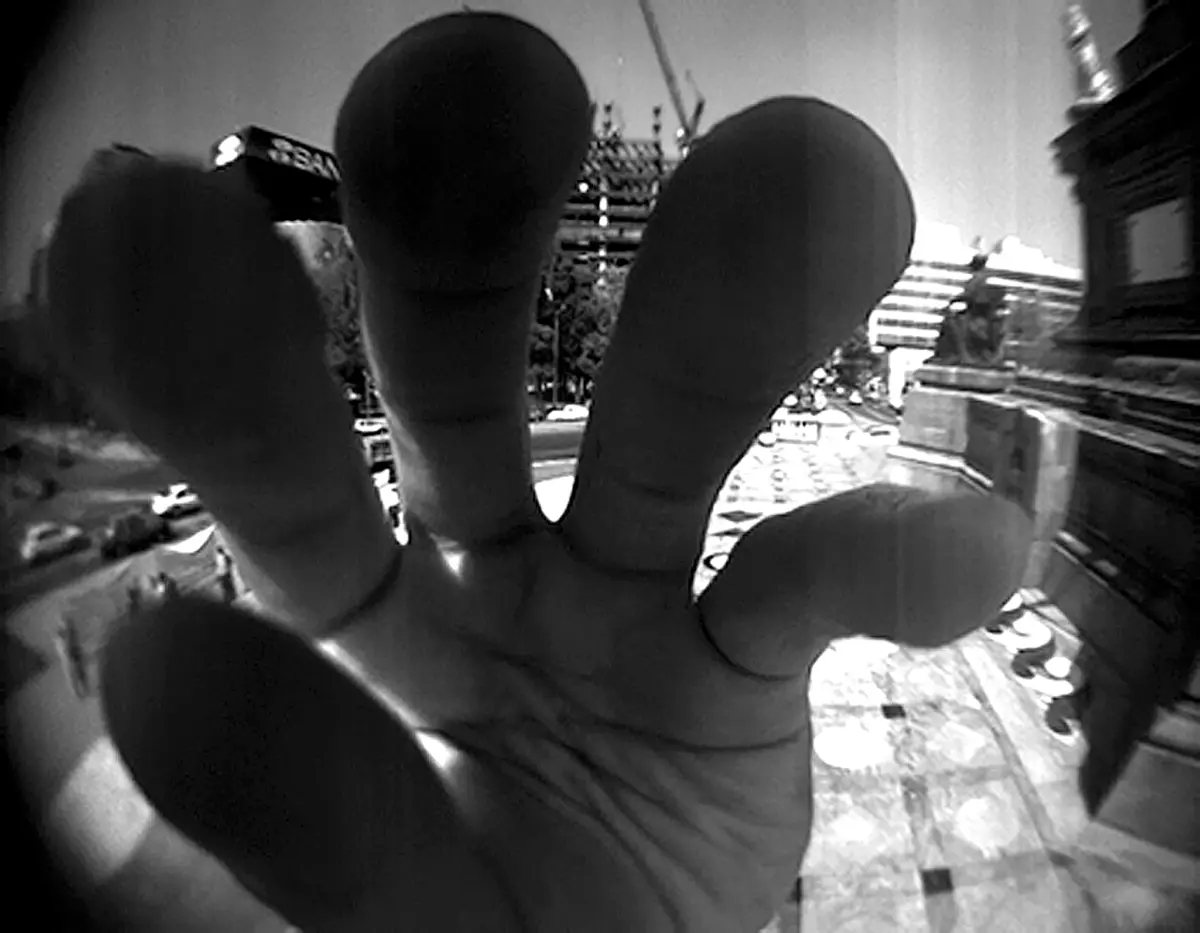
The collection Basado en hechos reales is a series of photographs based on images taken by surveillance cameras in different points of Mexico City. All the photographs capture the moment in which an “anonymous” hand adjusts the surveillance camera in some way. The videos were taken in locations ranging from the Universidad Iberoamericana to the Santa Fe area, with Reforma or Plaza Meave in between. They are DVDs and C-prints, and the dimensions of the photographs are 100 by 120 centimeters. The videos from which the images are taken are also shown: the shutter at the service of random movements.
The single, somewhat older work by Lozano-Hemmer on view here was Tensión superficial. It presents the image of an eye (in variable sizes) on a plasma screen attached to a computer and a night vision camera. It is perhaps the only piece that does not sit harmoniously in the show.
Lozano-Hemmer’s most ambitious project may be Standards y doble standards, 2004 (Standards and Double Standards, Subsculpture 3), a sequence of ten belts, each fastened and suspended horizontally in the air by threads that are almost imperceptible. Attached to each belt buckle is a movement sensor; when the sensor detects any motion in the room, the buckle points toward the source. This occurs thanks to a system of motors located in the upper part of the gallery. The artist’s explanation of the piece is: “a robotic installation with 10 suspended belts, computerized surveillance system, and contagion algorithms.” Lozano-Hemmer claims that he chose belts because they are “the fetish of paternal authority.” When there are too many objects in motion in the room, the belts acquire a chaotic, anarchic modulation, similar to the way in which contemporary societies function. The oscillations and the directions of the belts are detailed on a screen, and the result is truly disconcerting.
CARLOS ANTONIO DE LA SIERRA