
Román Vitali (Rosario, 1969) presented Brumas, his most recent individual thematic exhibition, comprised of specific objects and microinstallations of a clear figurative and narrative character, where the resource of allegory worked as the communicating thread. In that sense, his current sculpture/objects are loaded with complex connotations referred to the absurdity, the lack of certitude with which we traverse contemporary life, and the search for a de-multiplied “I,” an overextended, fragmented, and polarized subjectivity. The new cycle of works we generated followed a slow, painstaking, voluptuous tempo. Moreover, when it comes to contemplating these works in their construction, assemblage, and final installation process, and intelligent and accurate interplay between perception, an appeal to touch, a fabulistic narrative, and other components in a self-referential vein, are more than minor details. For the conception of such a trajectory of allegorical, conclusive gestures, comprised of pieces that weave between themselves a unifying associative chain, Vitali made use of his singular culture of the object, governed by internal orders, rhythms, and intertwinings. His spatial poetics combined, in equal parts, the anthropomorphic, the organic, and the natural, elements that interlocked on the basis of a baroquizing geometry. Indeed, the artist proposed a new aesthetics for a time of existential precariousness, exploring in depth the marks of disease and latent danger, but from a position that could be read as a whole, as a labyrinthine design, where a strange form of humor and irony came to the fore and marked, in parallel, a certain distance regarding the aforementioned topics.
Vitali’s sculptures and objects allude to an intimate space full of micro-stories and fables, immersed in a fantasy-and-reality universe. A world that folds over the eyes of the artist, one that doubles in the viewer’s attentive gaze. The underlying sensuality and the cutting beauty in this range of works gain a kind of non-logical identity, entangled in dichotomies that are not placed there merely for pleasure. And the reference to a post-organic body, this is to say, of a prosthetic nature, makes its presence felt again and again as a symbolic and/or allegorical correlative to various interconnected narrations. However, the thematic axis —the shadows— is related to spaces of visual perception, of obfuscation of the gaze, blind spots, veiled zones, and intriguing shadowy atmospheres. The exhibition’s articulating nucleus —according to Vitali— “was also a metaphor for the way in which we relate to a vision of things around us, and that goes beyond my own personal situation, the analogies that can be established, or the difficulties we may face in order to see around us.” And he adds: “My way of posing the issue was centered around how one works starting with reality, and how one arrives at a metaphor from that reality from one’s own vision, since I am interested in underlining that there can exist a large distance between the real, the symbolic, and the imaginary, a relationship postulated by Lacan.”
The first work in the series was Pueblo Vitali, a luminous micro-installation and objectual model comprised of six childlike houses, with different floor plans and in different colors, displaying interconnected fiber optic filaments that were lit at each end, the whole forming a mid-scale dreamlike townlet. The piece’s chromatic decision had to do with each one of the houses where the artists have lived and live. The fiber optic filaments went in and out in a single chromatic, objectual, and luminescent circuit, but also in a single plot of connections and interrelations between the houses. For Vitali, this plural, branched-out structure meant a timeless cross-section, as if all his Lilliputian houses were working in unison, and the pedestal in each one of them displayed a different perimeter skirting, according to each floor plan. Continuing with Brumas’s fictive and autobiographical narrative, the multicolored hamlet ended in an artificial dry forest, a dark and impenetrable forest formed by three trees with a perfectly rectilinear geometry, stiff and hard.
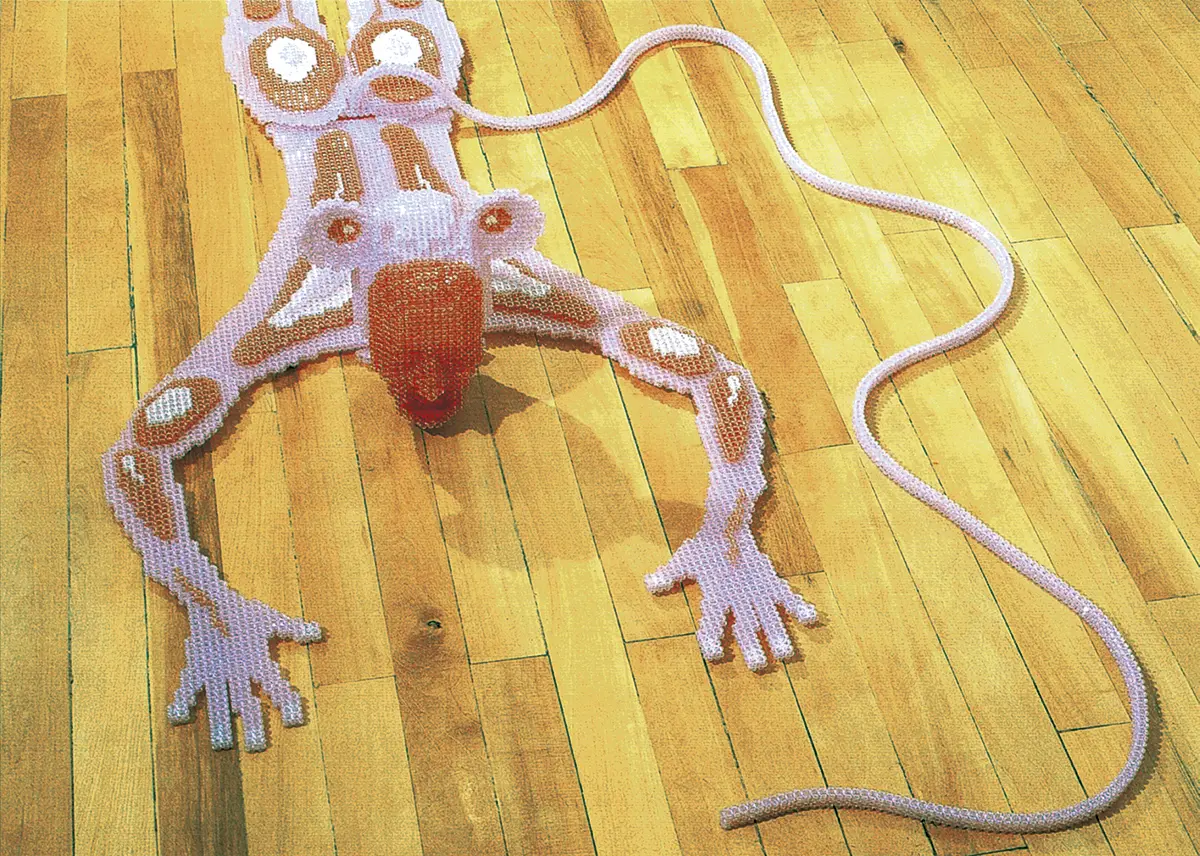
Vitali’s installation art appears as a “disturbance” through which relationships between human bodies and machines are metonymically filtered. At bottom, it is a post-Romantic vindication of Schellingean “fright.” The forest was completed by a fenced garden with some twenty flowers, some erect, others withered, fallen, and rotting. From this pseudo-natural environment, there emerged a half-human, half-animal character, nothing more than an anthropomorphic pink panther arranged on one of the gallery’s walls, painted in green, of course, in the manner of a hunting trophy, as though it were a leopard skin. The piece, titled …y eso que le dijeron, una y mil veces, que no jugara en el bosque, reworked the allegorical narrative of a human being who disguised himself as a panther in order to play in the forest and ended up being hunted, thus emphasizing the problem of camouflage and the topic of tragic fate, which turns an apparently playful, fun action into a tragic event.
The system of objects built by Vitali in this show emphasized a fusion of artistic, conceptual, and lived-experience horizons. And in some cases, the life worlds are not separate from the artist’s creative experience, but give rise to a permanent pole of aesthetic attraction for a public anxious to explore and interact with his works. This implies that the border or demarcatory line separating art from life is only an imaginary, unreal, virtual distance. The expansion of the sculptoric, objectual, and installatory domain proposes, in these pieces, a return to the plethoric condition of the work of art and to its well-known signifying potency.
For instance, that plus of aesthetic enjoyment and fruition was emphasized in Vestuario, a design of luminescent clothes —i.e., a veritable suit of lights— made with superimposed acrylic beads, like a flexible weaving, simulating the folds of the outfit in use, which resembled Vitali’s old childhood clown costume, with a dual sensorial reading. Hung from a clothes hanger, the object oozed its specific: artistic status, since it could not be confused with a thing, much less with a tool. From its front, optical lenses peeked out to amplify the artist’s own blue eyes, inscribed in the outfit, while in the back, those bead-eyes took part in the same surface homologization.
Finally, the show included, among other pieces of interest, two abstract landscapes that formed a single work, titled Campo visual. The landscapes corresponded to a campimetry of the artist’s eyes. This is an ophthalmologic exam used to measure a person’s field of vision. Here, Vitali made aesthetic use of images provided by high technology. In this way, color-coding the degree of digital information in a reading of his own eyes —expressed in the medical exams as a range of grays— the artist created geometric landscapes, using juxtaposed layers of bead weavings as though they were plateaus. The result was a pixelization of two landscapes from the Pampas.
CLAUDIA LAUDANNO