
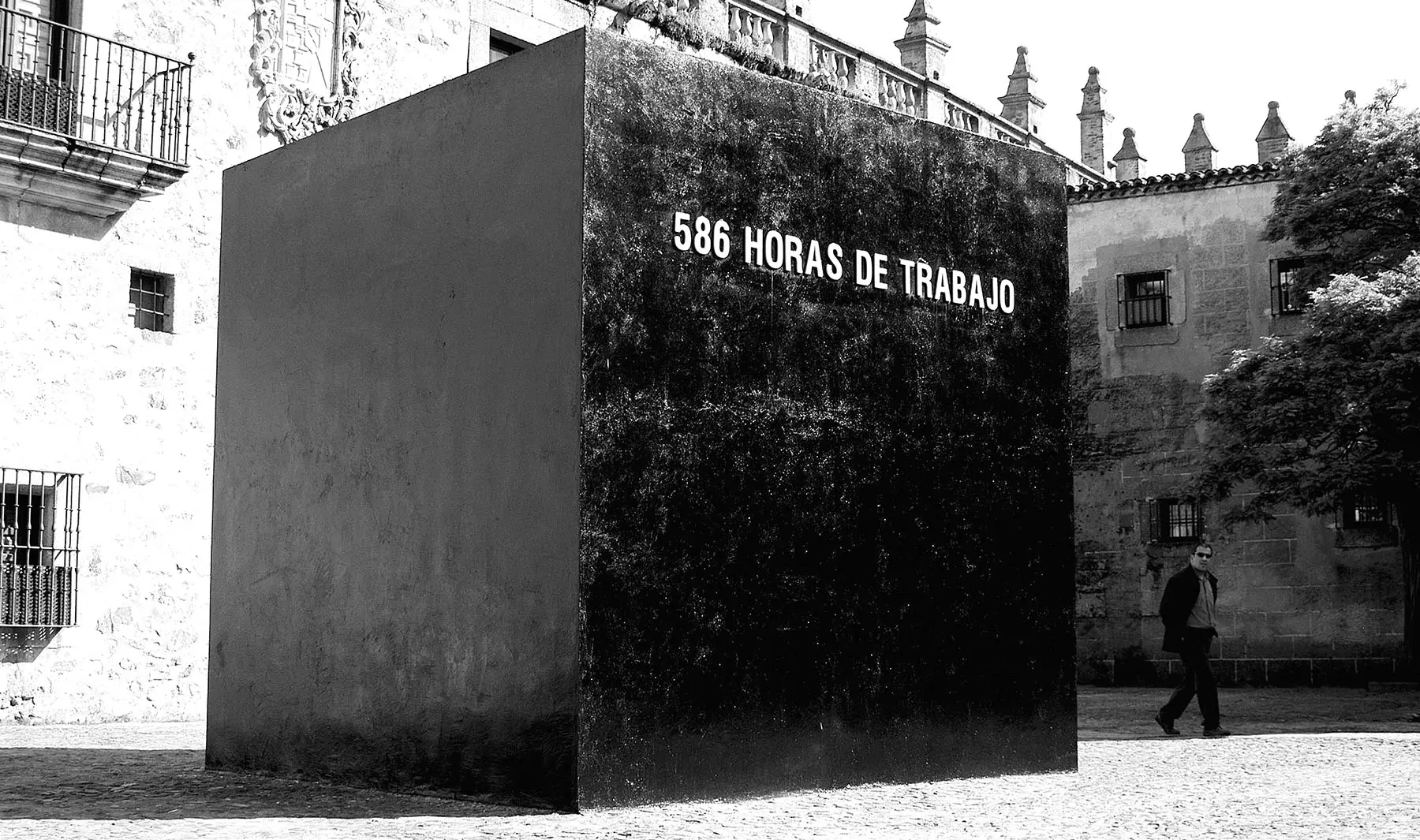
Last April at the Plaza de las Veletas in Cáceres, Santiago Sierra presented a piece that most revealed the general meaning of his work and the context that stimulates him and provides him with a place. It was succinctly titled 586 horas de trabajo1 and it comprised a large black cube covered in asphalt, placed at the historic center of Extremadura. But the history Sierra wanted to evoke was not the history of that city, the region that spawned Hernán Cortés and Francisco Pizarro, as well as so many other Conquerors of the Americas. No, Sierra preferred to use the occasion to create a resounding monument to the exhaustion or death of capitalism’s penultimate phase, its Fordist phase. Sierra is an artist of the here and now, and when offered the chance of acting on a privileged historical locus, he chose, rather than celebrating or repudiating its beginnings, to bring to the fore its contemporary consequences, condensed in a highly critical phase and saturated with conflict and extreme political and social tensions. This is the period that, early on, Jean-François Lyotard called postmodern, a term that was to prove so successful it is now commonplace. Yet there are those like Italy’s Toni Negri and Paolo Virno, who prefer to call it post-Fordist2, to better emphasize the fact that the key to the many transformations that occurred in the world after the Vietnam War have been the radical changes effected in the realm of work. Globalization is the more recent name, but the truth is that none of the features that purportedly define the globalized world would be possible without the exhaustion of Fordism as a dominant model of social organization.
Fordism implied, first, a central economic role for Big Industry, with its thousands of workers together in each factory, disciplined and connected to their machines by a Taylorian assembly line that imposed its timing and made each movement more productive and profitable. It also implied a level of strategic agreement between businesses and unions, which is what gave big industry currency as a social paradigm. In fact, during its period of hegemony, Fordism was necessarily paired with a work ethic to which both bosses and workers adhered, as did the citizenry at large, and defined the valuing of work as the sole medium of personal and collective salvation, as well as its glorification of individual freedom and responsibility. This in no way contradicts civic and work discipline.
This model was literally blown to smithereens in the 1980s, giving way to our contemporary world riddled with uncertainty, relativism, and dramatic conflicts. Certainly, this is not the place for even an inadequate summary of these uncertainties and conflicts, but let me mention those that seem to concern Sierra directly. I’ll start by underscoring the fact that his Cáceres piece is directly related to the crisis of the Law of Value, which characterizes post-Fordism. Marx had already thought this crisis was a distinct possibility implicit in the normal functioning of capitalism, but it effectively only came to pass in the 1980s–1990s, when globalization—understood as the unrestricted freedom of financial capital to move around the world at Will—made it perfectly clear that capitalism’s most dynamic nucleus had detached entirely from the old law according to which the value of any commodity fully depends on the number of hours of socially necessary labor invested in its production. The number “586” incorporated in the title of Sierra’s piece corresponds to the number of hours it took to build it. And if Sierra had that black cube made and then named it so succinctly, it was because he intended to commemorate the Law of Value at the precise moment of its demise, showing at the same time, and in the body of the monument itself, the effects of such demise. In fact, the monument’s value is less than its construction cost, because it is not any old commodity but a work of art and, like all works of art, its value can be much higher or much lower than its costs determined only in terms of the labor time invested in its production.
For Sierra, the Cáceres monument closes a long cycle of projects devoted to making visible the abstract and hidden elements of salaried labor. In Cáceres, it was the Law of Value, an abstraction by means of a cube, itself another abstraction. In many previous works, this making visible of the abstractions that govern the realm of labor was achieved through actions or performances in which the workers themselves were protagonists, especially those belonging to strata whose exponential growth appears to be directly linked to globalization: Third World immigrants to the First World, independent workers, the long-term unemployed, and, in general, all of those subjected to a regime of temporary and unstable work outside or on the margins of the large industrial factories, unions, and pro-labor regulations set up in its day by Fordist society. The thinkers in the Chainworkers organization3 group all these categories under the common name of precharged, to underscore the fact that what they have in common is not only the permanent rotation of their members through the widest variety of jobs and the most unusual workplaces, but also a shared state of existential, vital precariousness that appears to be irreducible. The Precariat—say the Chainworkers—is no longer and will never be like the industrial proletariat in Fordist society. Neither their psyches nor their bodies, neither their desires nor their demands could ever be those of their Fordist counterparts. Nor can their morality be the same.
This Precariat is the dark underside of a globalization that celebrates as a miracle the worldwide establishment of informational networks such as have allowed the movement of capital to reach unprecedented speeds. Capital circulates faster than ever now; so does the labor force, but where the former finds openness and cooperation, the latter finds nothing but barriers and compartmentalization, and—what is perhaps offensive in our society of the spectacle—a media “invisibility,” something that Santiago Sierra has systematically opposed by presenting works that decidedly involve the precarious ones and bring them to public light.
Sierra’s first intervention in that direction occurred at Museo Tamayo in Mexico City in October of 1999; it involved gathering 465 temporary laborers in the museum’s Hall 7, where they stood for three and a half hours with their backs to the door during the inauguration of what was supposed to be an art exhibition. For this piece, Sierra asked a company that specialized in hiring temporary workers for “465 Mexican citizens, male, 30-40 years old, 160-170 cm in height, of mixed Amerindian and Caucasian race.”4 Sierra wanted to fill the room entirely with this precise number of people, blocking the public from entering and forcing them to accept as a work of art the passive exhibition of a group of workers who often, like hostesses or waiters at cocktail receptions, go unnoticed. He no doubt achieved his goals, though most of those in attendance never learned that the company Sierra hired attempted to pass as temporary workers 150 high-school students, along with their teacher, who were lured to the museum under the pretense of attending a theater function.
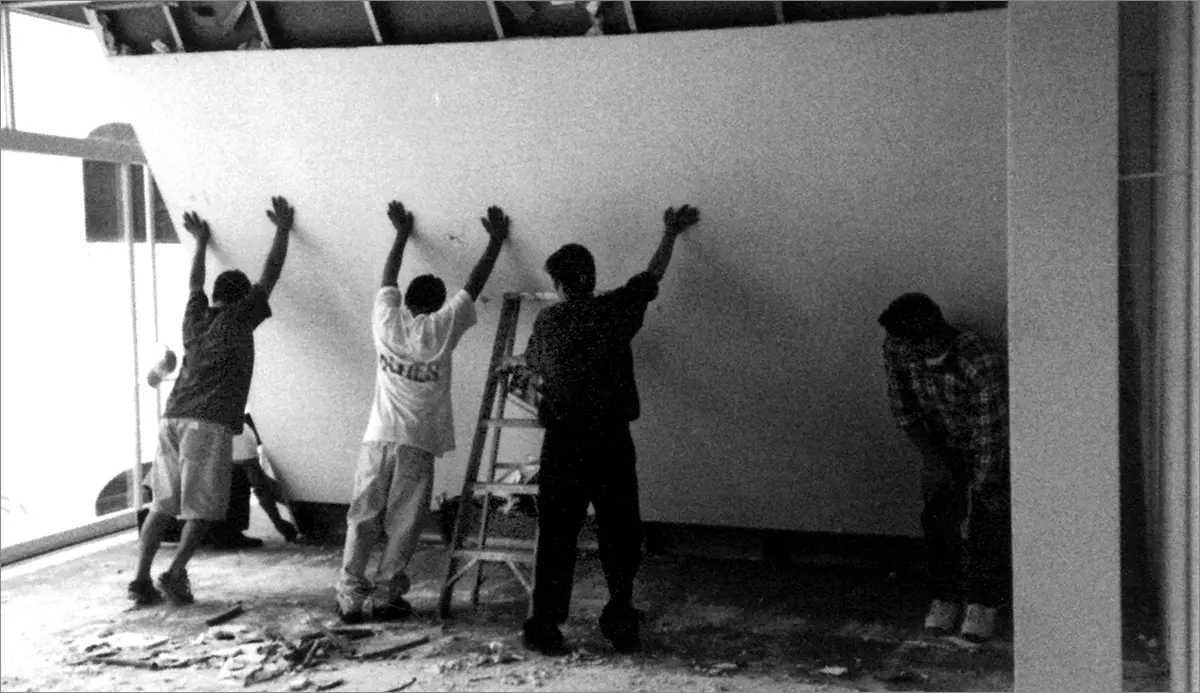
Since then, Sierra has employed temporary workers time and again in a variety of very different projects, for instance: in his occupation of the Pancho Fierro Gallery, in Lima, Peru, with 460 people paid at 30 soles per hour, in August 2001; or in 68 people paid to remain blocking the access to a museum, at the Museum of Contemporary Art in Pusan, Korea, in October 2000. One must also cite pieces in which the role of the workers has gone beyond the silent and passive occupation of spaces devoted to art, as happened at Museo Tamayo. Such is the case, for example, with 24 blocks of concrete constantly moved by paid workers, an action held in July 1999 at ACE Gallery in Los Angeles; or of 3 cubes with sides measuring 100 cm each, and moved 700 cm, which involved six Albanian refugees without work permits and was presented at the Sankt Gallen, Switzerland’s Kunsthalle; and in one of his most arduous pieces, The wall of a gallery pulled out, inclined 60 degrees from the ground and sustained by 5 people, presented at Galería Acceso A in Mexico City, in April 2000 for five days, involving laborers working four hours a day.
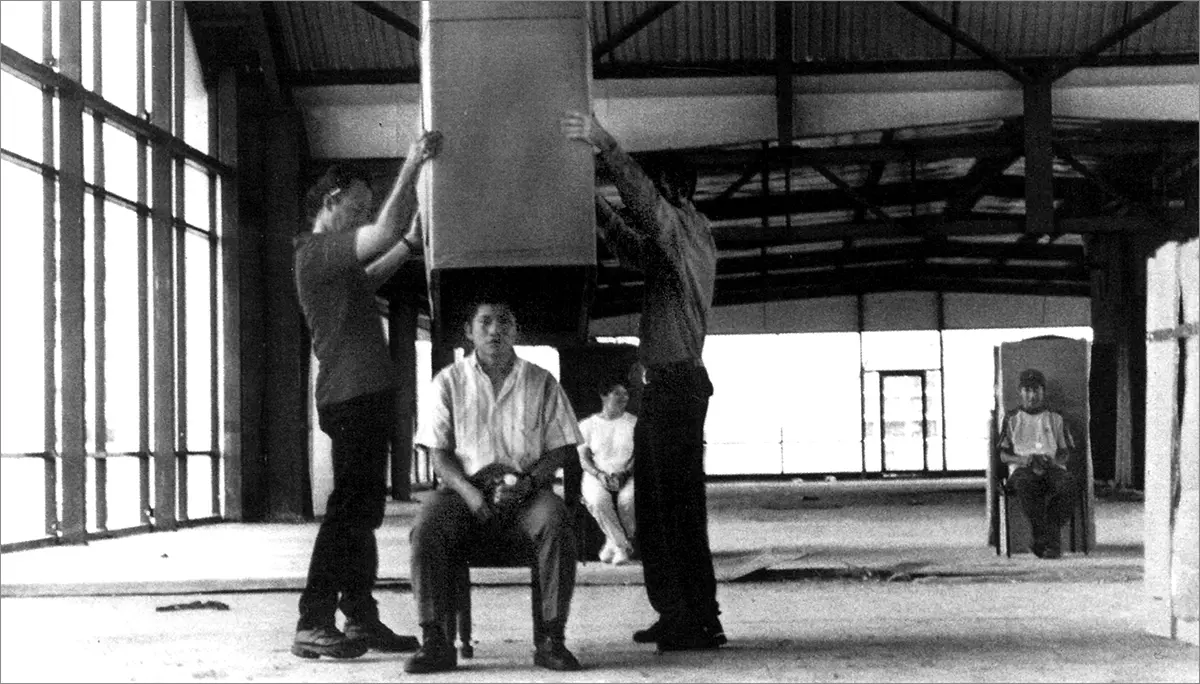
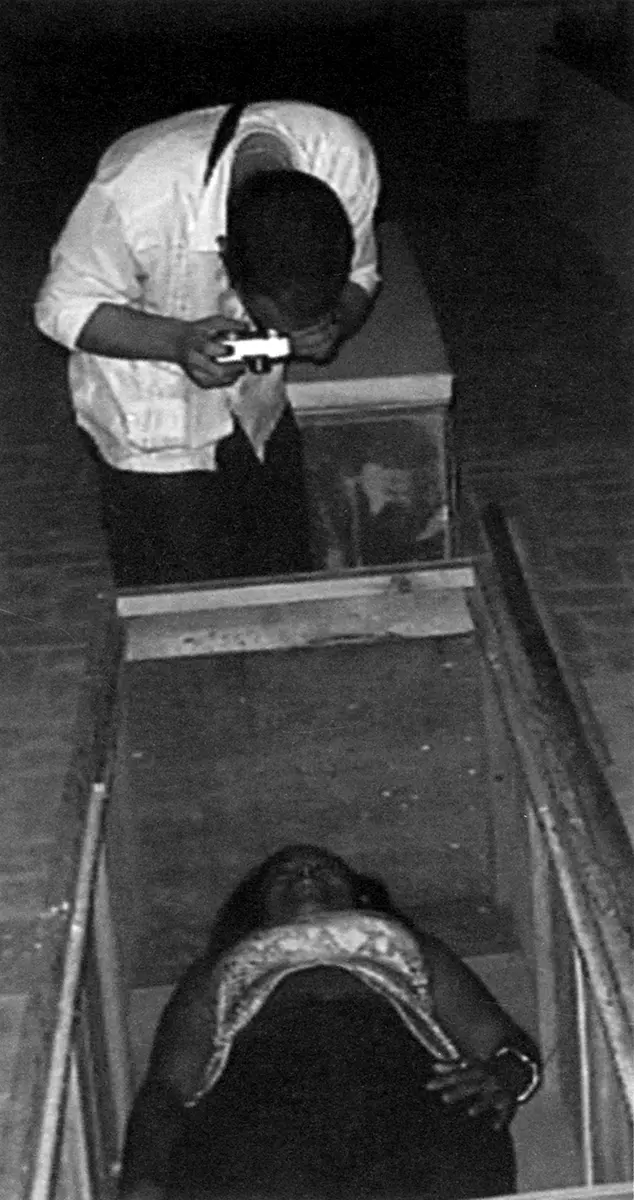
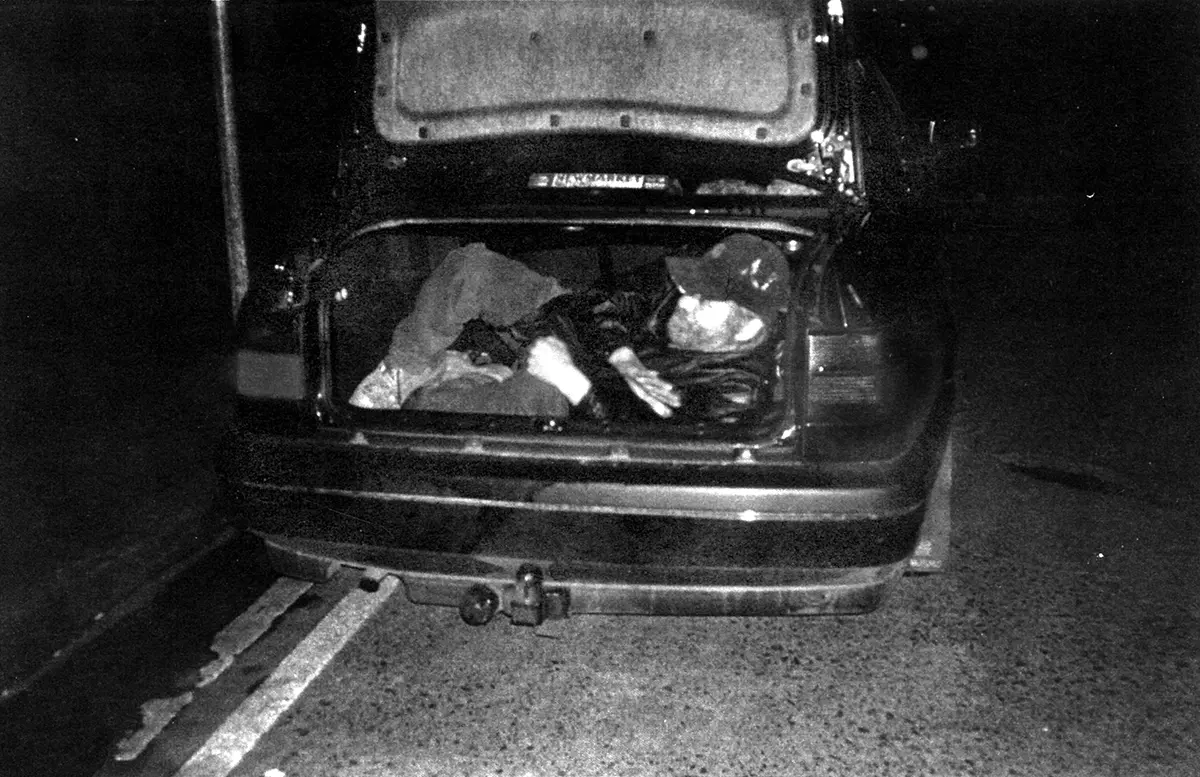
These kinds of works, like the previous ones with purely passive contractors, are characterized by the fact that the workers involved in them are brought to public light, even in those cases where all that is left of their presence and their efforts are the messy remains of their passing through a gallery, or perhaps just some empty bottles and leftover food. That is what happened for the first time with 8 people paid to remain inside cardboard boxes, a project at the G & T Building in Guatemala City, in August 1999. There, eight temporary workers sat in eight chairs, and a cardboard box large enough to cover them entirely was lowered on each of them. When the public entered the gallery, all they could see were the cardboard boxes arranged at regular intervals, as in any minimalist piece. This hiding of workers was repeated by Sierra in other works, among them Workers unable to receive payment, paid to remain inside cardboard boxes, presented by Berlin’s Kunst Werke gallery in September 2000; and Person paid to remain inside the trunk of a car, presented in March 2000 during the opening of the 4th Eva, a biennial exhibition in Limerick, Ireland. On that occasion, an anonymous worker received the equivalent of US$40 in exchange for remaining locked inside the trunk of a car parked behind the door to the Biennial’s main location during however many hours its opening lasted. We can also mention 3 3 people paid to lay still inside 3 boxes during a party, at the opening of the Havana Biennial in 2000 on the roof of a private house in the Cuban capital. The three workers in this case were three prostitutes, and the party of the title was in honor of artists, art critics, and curators attending the Biennial, who drank their cocktails sitting on the boxes, without realizing they contained human beings.
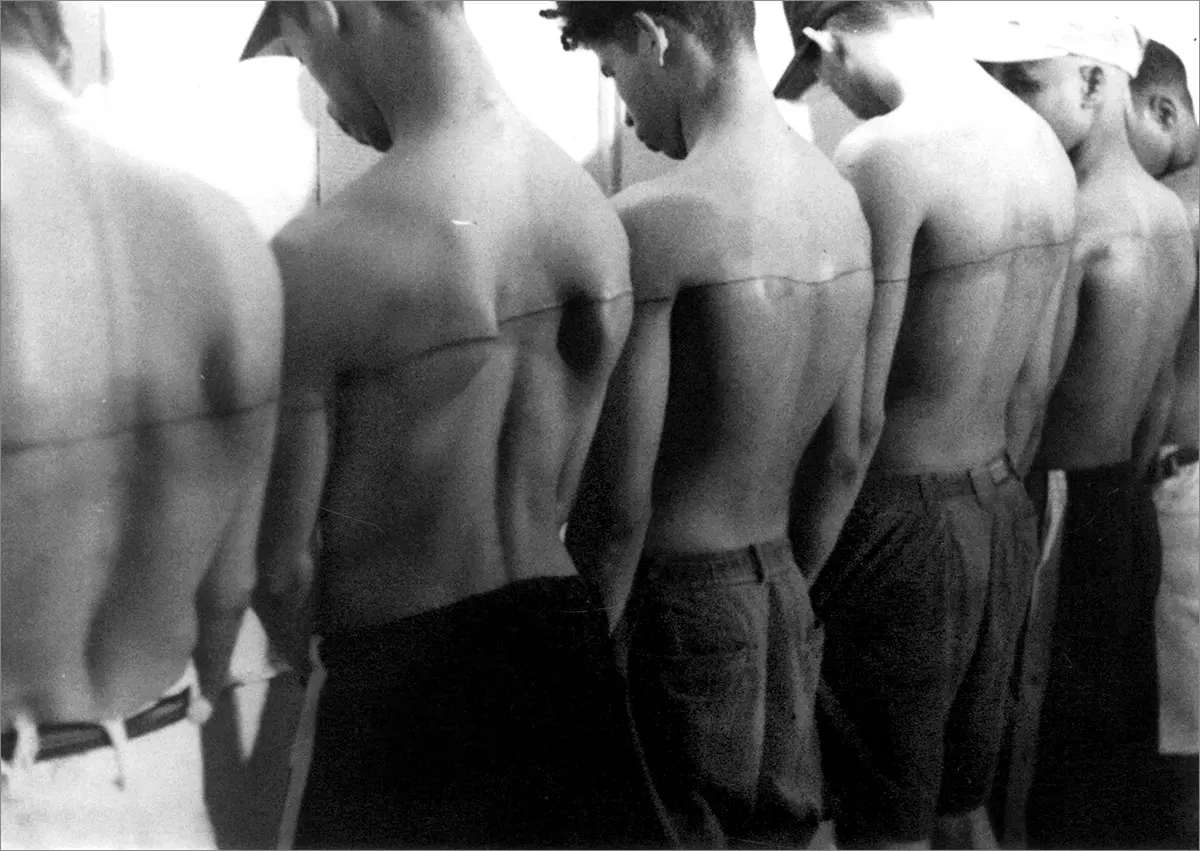
However, the opposition between those works where the workers are visible and those where they are not is neutralized by Sierra’s decision to use both direct and indirect means to carry out his project of revealing some of the essential aspects of human labor in late capitalism. Among those aspects, a central feature is the diminishment or outright suppression of skills such as knowledge and mastery of a craft, manual dexterity, and the intelligent use of memory and imagination when fulfilling a given task. None of these features of human labor are demanded of the workers Sierra employs. The only thing he asks of them is that they are entirely available and willing to do or have done to them what the artist designs. From silently blocking an exhibition hall to listening to lectures on Polish history by college professors at a Warsaw gallery, including receiving a permanent tattoo in their back in exchange for a heroin fix, standing in line facing a wall and dressed only in their underwear, or masturbating in front of a video camera.5 The only thing that remains in place after all these reductions is each worker’s psychophysical limits, and the incontestable evidence of the fact that human labor, stripped of its effective attributes, is reduced to the purely abstract possibility of doing something somewhere under someone’s direction. Sierra’s reduction also makes clear that under these conditions work is nothing but an activity oriented towards a goal without end, towards teleology without telos, and consequently capable of establishing and maintaining a certain hylomorphism with the artistic activity, which, according to Kantian aesthetics, is also oriented towards an end without purpose. In this context, the equation “work is art and art is work,” which could summarize the nature of Sierra’s artistic strategy, acquires new and surprising meanings given the under-the-surface solidarity between its two terms, in the same way in which it remains unattended to by those who labor to underscore the differences between one term and the other—that is to say, between art and work.
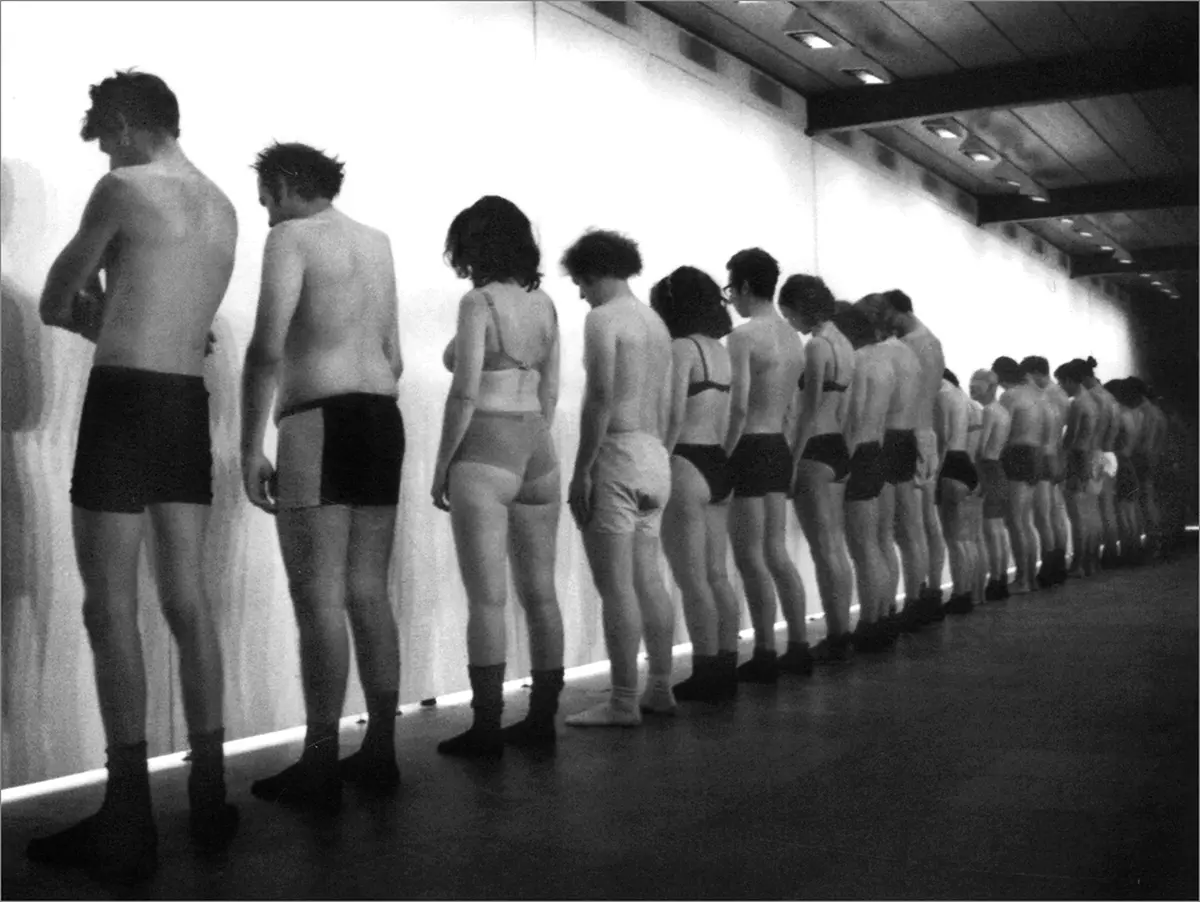
At the same time, Sierra emphasizes even more the hidden links between art and work by deliberately highlighting the aesthetic dimension of the role played by the workers both within and outside the scene in which he involves them. Confronted with any of Sierra’s works, it is pertinent to wonder whether those who take part in them continue to be mere workers or have become, wittingly or not, artists—or actors. And the truth, the paradoxical truth, is that these workers displayed by Sierra, whether they show themselves or hide, whether they remain still or move large cement blocks around, are still workers. They are, in other words, people willing to do whatever it is that those paying them demand, and to do it independently of whether they find meaning in their own actions or not. In fact, many of the things Sierra asks his workers to do are so nonsensical or shocking that they inevitably provoke in the public and even in the workers themselves questions about work and its usefulness. Work considered from a social point of view as a series of productive activities is always useful because it guarantees society’s survival through the production of goods to meet the needs of its members, needs that, as Marx wrote in the first page of Capital, can emerge in their stomachs as much as in their brains. And work considered from an individual point of view is usually useful, because it ensures the worker’s survival. Each worker involved in one of Sierra’s pieces knows perfectly well that what he is doing is a job, because the payment received will help him meet his living expenses, even if only for a couple of days. Yet he is uncertain whether what he is doing is work, what with all the imprisonment in cardboard boxes or the gratuitous hair dying the artist demands; this doesn’t resemble work, as it doesn’t fit with what the worker himself considers useful work. Obviously, there is always a chance that the worker will first believe that what Sierra does is art and then accept his own role as something akin to what a movie extra does, like native Americans in a traditional western or the legions of soldiers in a war film, without worrying in the least about his talent as an actor or about the main character’s performance, the script, or the film’s ultimate meaning. But even satisfying these requirements, a worker who takes part in one of Sierra’s pieces is a worker more due to his availability and his willingness to work than to his believing that what he does is in effect work. In truth, Sierra has been able to have his workers act as workers without believing they are at work.
This paradox of the worker who doesn’t work, staged by Sierra, undoubtedly relates to the paradox of someone who acts without being an actor. It relates, in other words, to the core of one of the most successful television formulas of the last decade, one that is highly symptomatic of the expansion of the society of the spectacle during the same period. I am talking about the show Big Brother, produced originally in The Netherlands before extending to the rest of the world and becoming immensely popular under different names and with local variations. The key to this multifaceted formula resides in the gathering of run-of-the-mill people, people with no acting experience or training, and having them interpret their own lives within a closed space and in front of TV cameras. Posited in this way, “interpretation” nevertheless has more to do with Allan Kaprow’s happenings than with what would normally occur in a theater, where actors adopt the personality, style, and mannerisms of a character who is distinct from themselves, and equipped with that living mask they will play their role in a plot that has been previously determined by an author. In Kaprow’s performances, especially in 12 chairs, viewers doubling as involuntary protagonists did whatever they wanted or were able to do in a situation that forced them to act without giving them any direction as to how to do it. This is what happens to the participants in Big Brother, who art aware of the fact that although they may eat, wash, argue, or make furtive love, just like they would in their own homes, they are constantly being recorded, and consequently, what they are doing is acting. Only they don’t have a script or any other guidelines in order to do what they do, in order to act like they act, with the exception of the generic demand, introduced in the show’s most recent versions, that they must compete among themselves to win the favor of an audience that will decide, through a vote, who remains in the show and who leaves.
The society of the spectacle rears its head here. In its irrepressible expansion, it has ended up colonizing everyday life in a very different way than Fordist society did. The latter took over life through the home-appliance revolution and the imposition of titanic notions of beauty, hygiene, and comfort, and by securing a place for the TV receiver at the center of what were still homes. Post-Fordist society, however, has taken a quantum leap forward, transforming run-of-the-mill everyday life into the protagonist of prime-time television. Everyday life, like the Buddha in a famous Nan June Paik piece, watches itself on a TV screen.
Sierra’s works of course are not strangers to this media phenomenon. It can even be said that what Sierra has done is, in the last instance, nothing but annex the realm of work to the realm of the spectacle. Ultimately, the workers in his pieces are as much actors as the youngsters and ambitious adults in Big Brother: actors who are not actors, workers who don’t work. However, in ethical terms there is one crucial difference. In Big Brother, morality and ethics confront each other. Morality—understood as a set of habits and customs, a given way of life—is confronted in this show with various kinds of ethical demands, from those that require respect for standards of prudence and decency, to those that are willing to subvert existing customs profoundly in order to subject them to their own conceptions and interests. I mentioned earlier the introduction of an ethics of individual competition in the most recent versions of the show. Now I am talking about an ethics of transparency, of total visibility, the ethics of the Panoptic, which demands that even the most hidden aspect of personal or social life be brought into public light or subjected to the surveillance of the camera.
Sierra is not a stranger to this last demand. On the contrary, he tries to satisfy it in areas where normally it would back out to reveal the prudishness at the core of its immodesty. The powerful glare of TV reflectors always leaves those who handle the camera, dictate the focus, the frame, and the edited sequence in the shadows. Obviously, I am not referring to the cameramen. It is the directors of the media scene who often confine the realms of work and workers to the always peripheral block of documentary shows. Workers jump to the first page or are portrayed in close-up only for the coverage of disasters such as Chornobyl in the Ukraine, or Bhopal in India, or more recently, the tragedies of hundreds of Mexican immigrants dying of exhaustion and dehydration in the deserts of California or Arizona or Maghrebi and Sub-Saharan immigrants drowning in the Strait of Gibraltar.
Sierra acts openly against the invisibility of workers in the media, but he does so following tactics that are inevitably irritating to the bien pensant, and not only because a portion of these tactics derive from his conviction that scandal and provocation are the most efficient means to gain access to the media. He proved this with his intervention in the Spanish Pavilion at the 2003 Venice Biennale, where, in addition to sealing off the main access to the pavilion with a rough cement-block wall, he barred from entry all those who could not produce proof of Spanish citizenship. No, beyond such provocations remains the highly irritating fact that Sierra’s workers often engage in humiliating or morally questionable activities, such as masturbating in front of the camera, or being tattooed in exchange for a heroin fix (specifically, drug-addicted prostitutes accepted a permanent tattoo on their backs in exchange for heroin). These possibilities were of course implicit in the conditions of modern salaried workers, but were blocked by Fordist society’s work ethic, which strongly opposed occupations that offended human dignity. Sierra has unblocked that situation. He tells us in his art that what is onerous, what is terrible, what is truly questionable is not pornography or prostitution and proposes the much more general and wide-ranging fact that men and women are willing to do whatever is asked of them, not just in exchange for a salary, as normally assumed, but because they have no other option if they want to survive. Here, in this inescapable issue, is where Sierra wants to establish a truly tragic ethics.
NOTES
1. Technical information about the pieces cited in this article can be found in www.santiago-sierra.com
2. Paolo Virno, Virtuosismo y revolución (Madrid: La Marca, 2003).
3. See www.chainworkers.com.
4. Santiago Sierra (Ministry of Foreign Relations of Spain, 2003), p. 69. Catalogue published on the occasion of Sierra’s participation in the 50th Venice Biennale.
5. I am referring, in the same order as their listing in the paragraph, to the following pieces or actions: Concentración de trabajadores indocumentados, BF 15 Gallery, FIAC, Paris, September 1999; Historia de la Galería Foksal enseñada a un desempleado ucraniano, Foksal Gallery Foundation, Warsaw, Poland, February 2002; Línea de 160 cm. tatuada sobre 4 personas, El Gallo Arte Contemporáneo, Salamanca, Spain, December 2000; and 10 personas remuneradas para masturbarse, Tejadillo Street, Havana, Cuba, November 2000.
CARLOS JIMÉNEZ
Writer, art critic, and independent curator. Jiménez is the author of Extraños en el paraíso, Ojeadas al arte de los 80, 1993; and Los rostros de Medusa. Estudios sobre la retórica fotográfica, 2003.