
Yoan Capote’s artistic propositions are often forceful. At his first show at New York’s George Adams Gallery, I was impressed by the degree of maturity his work had reached. Yoan is a young sculptor who assimilates the best modern and contemporary sculpture and creates works that imply more than the formal mastery and craftsmanship required by bronze, marble, and wood; the concept behind each of his sculptures is fully validated by the concerns that move contemporary artists.
Capote studied at Havana’s Instituto Superior de Arte, where he was part of a group of students working under the mentorship of René Francisco, which came to be known as DUPP, for “Desde una pragmática pedagógica” (“From a pedagogical pragmatics”). Undoubtedly, the conceptual education that characterized this group influenced the way in which the aesthetic of each one of its members developed later and the way in which their work is conceived. Imbibed in the latest contemporary art and guided by one of the smartest Cuban artists of the 1980s, Yoan and his brother, Iván, began creating collaborative pieces where, in a way, one brother’s proposal complemented the other’s: they worked simultaneously on a single topic, each dealing with one aspect of it.
Yoan Capote's first personal show was Tracc Bakk Track, at Havana’s Centro de Arte 23 y 12 —to which I was closely associated— gathered works built to function like slot machines, bologna dispensers, or beverage vending units, made with discarded materials. Besides the interplay it proposed with the machines as such, setting up these kinds of artifacts in Havana in the late 1990s, with products inside to boot, was in itself a provocative proposition. By creating functioning machines, Yoan invited the public to interact with his work, exploring values that lie beyond the intrinsically visual, such as taste, smell, and sound.
Much more solid today, but still developing the same discourse, Capote shows a series of pieces that speak of his concerns as an artist, a man, and a Cuban citizen. In the center of the gallery, his piece Stress comprises four blocks joined through a cord or zipper. Stress’s impressive representational strength establishes an equivalence between its own precise outline and a mood or state of mind. One can’t remain indifferent to this piece, feeling through it the state in which stress leaves us, the heaviness that falls on the body, the forceful and even unconscious grinding of teeth.
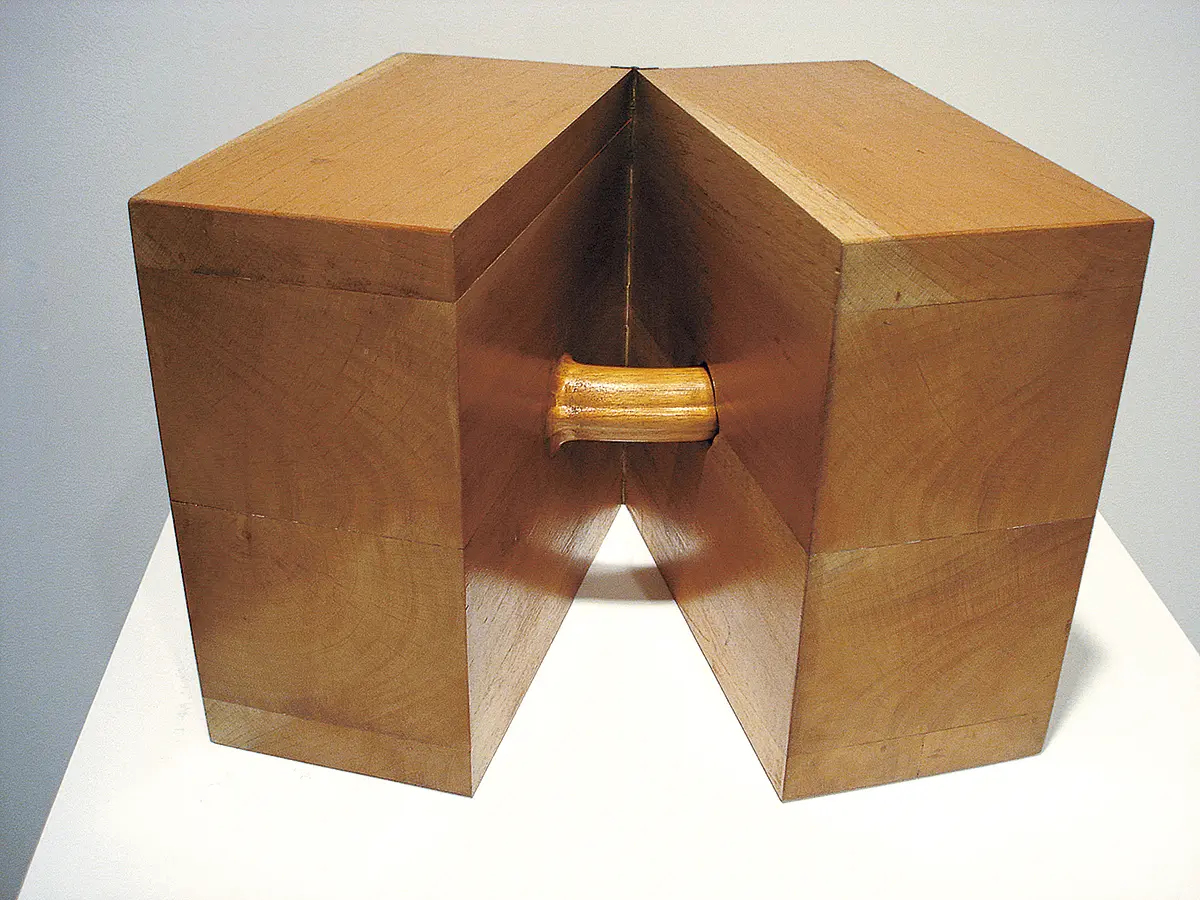
Another work of extraordinary expressive force is In-Love, inspired by the work of Brancusi. Done in wood, it comprises two cubes connected by a trunk that represents a penis. The piece, conceived to open and close, shows a fertile act of love very poetically. In these two abstraction-imbued pieces, Capote displays great visual elegance, reinforced by his use of materials such as wood.
Casados alludes to marriage, symbolized by two shoes, a man’s and a woman’s, that are conjoined, lose their individual shape temporarily, and reach a common point. Casados speaks of the couple’s unity, of the mutual identification its two members achieve, of the two individual “I's " that are lost in order to become one. A version of the same work shows two men’s shoes, shifting the topic to homosexual relationships.
With works like Racional and Nostalgia, Capote reasserts himself as a master of form and concept. The former is a perfectly sculpted male torso, where the center of the composition is occupied by a brain, replacing the penis, toying with the somewhat feminist idea that men think with their genitals. Both the torso and the brain display Capote’s formal mastery. Nostalgia, on its part, explores the feelings of the migrant, of those who carry their life and their home inside a suitcase. Yoan used his own travel bag for this piece, and inside, as a symbol of home, he placed a brick wall. With great economy of means, Capote shows that he can achieve great conceptual density with just a few elements.
Undoubtedly, Yoan Capote’s work uses particulars that border on and play with the field of form and intellect, in order to revalue the concept of sculpture.
MARISOL MARTELL