In his most recent show at Ruth Benzacar Gallery, Alejandro Puente demonstrates his renewed creative abilities.
Without losing a bit of coherence —an heroic feat with today’s long operative periods—, we have found him in the territory of what critic Aldo Pellegrini has called sensible geometry; of those sculptures that so surprised Romero Brest (“an art piece that resembles a painting and is not a painting, that resembles an object and is not an object”); of works that gained independence from the wall in his earliest shows in the United States, in 1968; of the programmed color systems in his participation in Information (MoMA, 1970) and the reticules he presented upon his return in Buenos Aires.
No less coherent has been his works linked to ancient Latin American civilizations, where the artist articulated a quest for and an affirmation of a regional identity deepened, on the one hand, in the textiles and their signs with indigenous symbolic charges, and, on the other, in architecture, the original meaning of its elements and the abstraction of its outlines and plans.
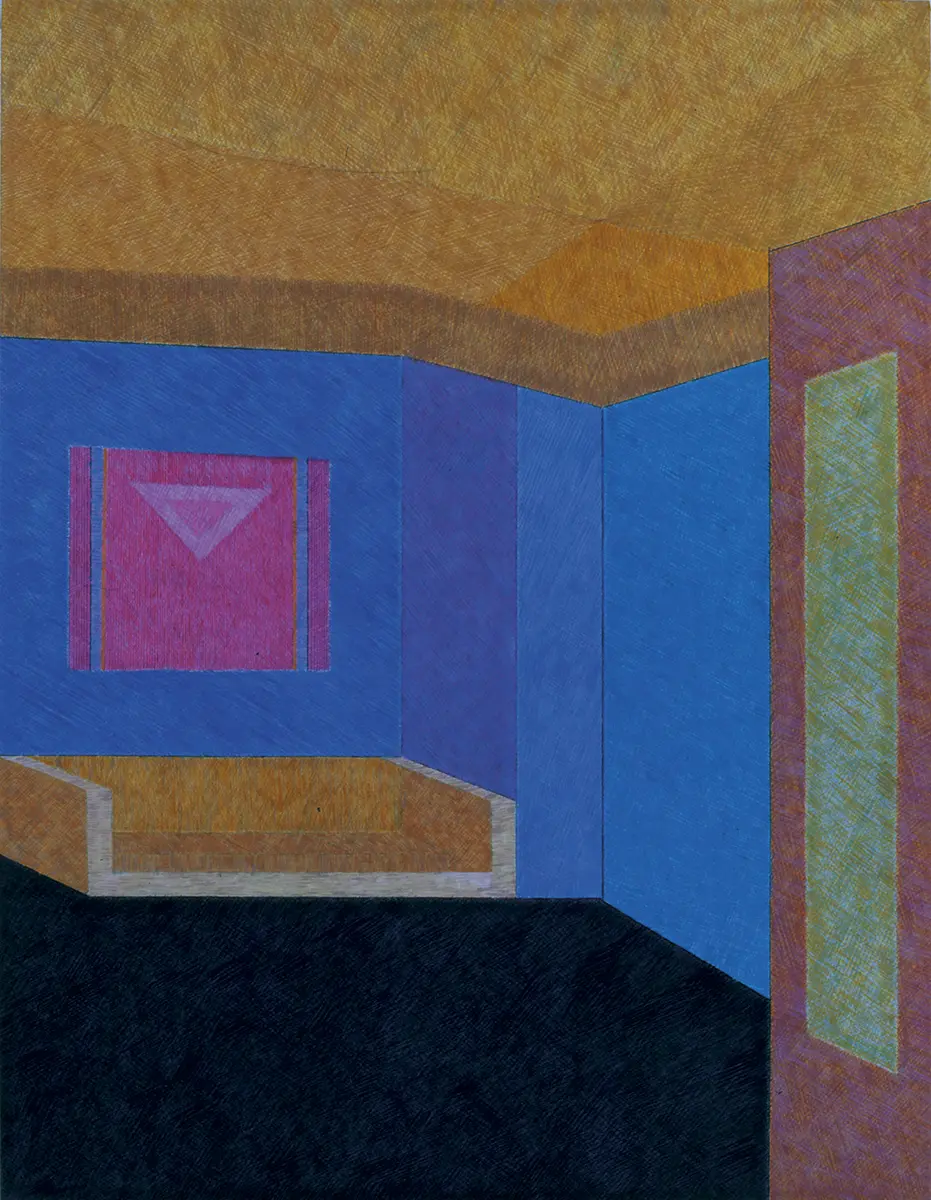
The use of architecture in this current work: frontispieces, floor plans, plan-governed, severe and schematic construction details, reneges of its bareness and of its solidity as an entity and as a referent.
These new airs of visual play allow for the permanence of his distinctive features —a constructive spirit and an absolute mastery of color—, imbued now with a renewed mobility.
The fact is that, at this point, our artist finds great joy in ambiguity. His works, with cropped frames, polygonal and projected, or symmetrical, sometimes in looser and more arbitrary shapes, sometimes contained within a black plane inside traditional coordinates, describe representations of architectural interiors that are full of vicissitudes.
In the artist’s own words, these playful representations of interior sites have been used with the intention of widening the gaze in the development of his work.
The works reiterate each other, without repeating themselves, through those inclusions or by changing the background paintings —which become a vision en abîme— or through changes in color or through a sneaking in of impossible perspectives.
At a certain point, the articulation of space in Andean cultures was the object of his explorations; it seems that in those cultures, an equivalent of the function that the Renaissance’s system of perspective had for the west was achieved using the coordinates of plot and warp in weaving.
What his most recent work brings forth is once again this interest in the representation of space, with a new turn of the screw.
No longer the active plans linked to pre-Columbian civilizations, but a return to Western perspective systems in order to play with them with ironic and joyful wisdom.
“Now,” Puente says, “I use perspectives that could be called illusory since they lack scientific rigor; I don’t deploy exclusively a regular isometrics, but a deformed perspective, created by the confluence of the works’ own sides and corners. My intention is to use isometric projections as means to describe three-dimensional objects in bidimensional terms.”
If these pieces are disconcerting it is also because Puente’s work retains its well-known affirmative serenity and its seduction of colors is handled with supreme skill, in the midst of which there appear the pirouettes and ambivalences of spatial indicators.
The parietal grids, the scratchings, the columns, the handling of angles, the system of proportions —these are all resources to bring us towards a playful ambiguity of enormous visual and conceptual potency.
Puente posits, in terms that are his own, the uncertainty and the overwhelming multiplicity of the contemporary experience. To that end he gives autonomy to details and fragments, placing them outside any rigidly unitary ordering of the real. And also to that end, he establishes a looser articulation of the parts, one that changes according to the orientation of our perception and our cognitive interpretation.
Puente’s códice drawings are counter-architectures, a kind of narrative where perspectives are the characters.
The text for this interesting catalog for Alejandro Puente’s show was written by Rafael Cippolini.
NELLY PERAZZO