
Mexico City’s Museo de Arte Moderno presented, last November through March, a traveling retrospective of works by Colombian artist Ana Mercedes Hoyos, which is now at Monterrey’s Museo de Arte Contemporáneo and will travel in July to Bogotá’s Museo de Arte Moderno. The show presents a selection of Hoyos’ work over the past 36 years, starting with some examples of her earliest series of Ventanas and Atmósferas, through her research of still lifes in the history of painting, her tribute to Van Gogh in Girasoles (1984), her tributes to Caravaggio and Lichtenstein, and ending with her song to Colombian negritude.
This show makes clear the way in which Hoyos has, in her career, treated different movements, from Pop to abstraction, to arrive at a painting that cannot be classified within any given school, having developed an eminently personal language. Thus, the show takes its viewers on a chronological tour of Hoyos’ work, walking from figuration to pure abstraction, and to pure abstraction to a process that advances —astonishingly— piece by piece towards an explosion of color and music, where the gaze comes ever closer to life itself.
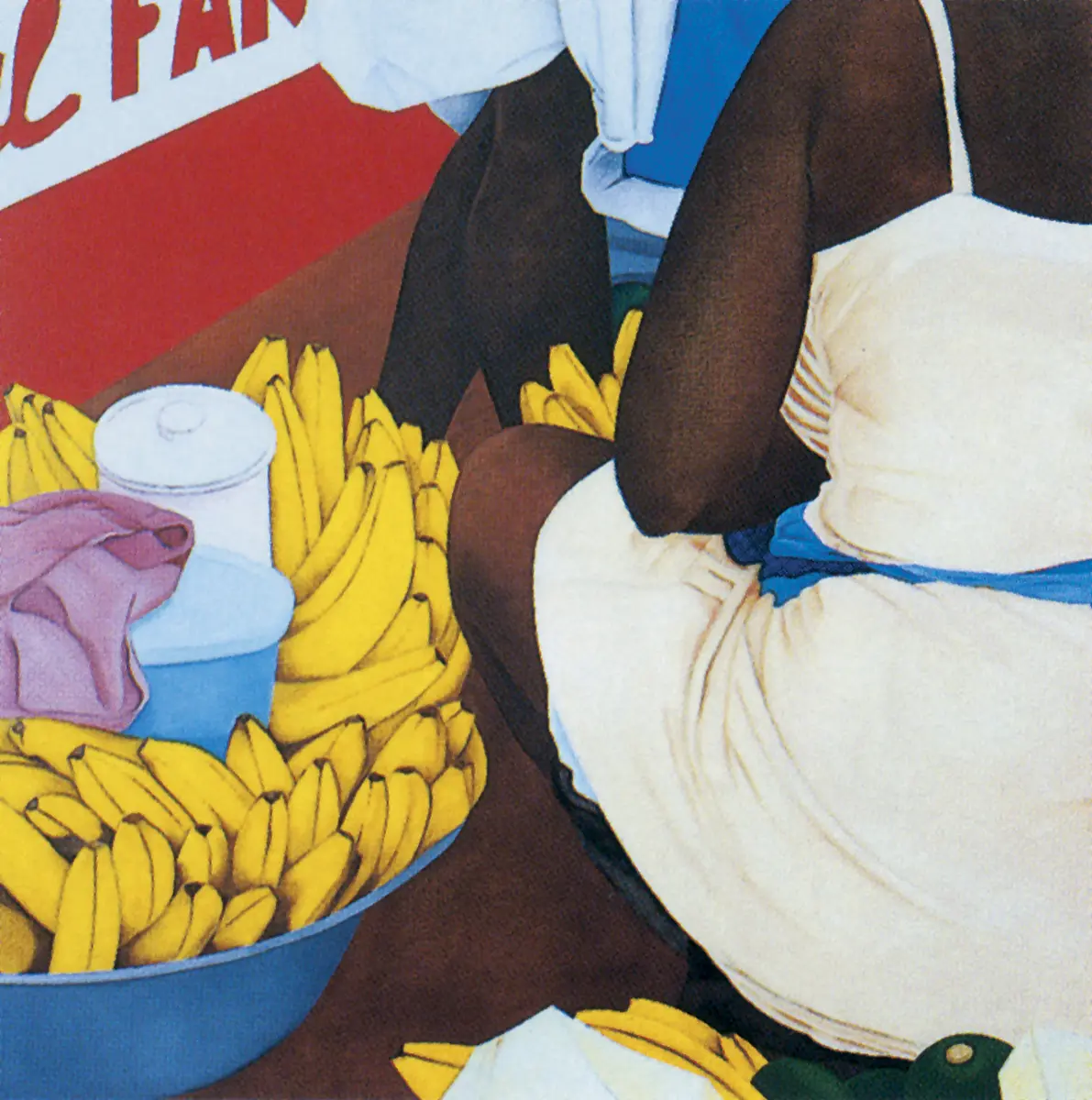
Starting in the 1990s, Hoyos’ work is a meditation on the influence of the photographic gaze on contemporary painting, but from an aesthetic that is closer to David Hockney’s Pop than to any photo, or hyper-realist investigation. Realist draftsmanship coexists in the work of this Colombian artist with a discreet geometrization of forms and a general flattening of the landscape through color planes cropped as in Matisse’s collages, for instance in her portrait Julia (1995), which achieves an image that moves between graphic design, painting, and photography.
In her most recent period, Hoyos not only has discovered a new way of dealing with the pictorial problems she is interested in, but she has also found, in the topic of Colombia’s multiculturalism, a direct link to the history of a region, Latin America, that has always denied its African influences, but which in the context of the globalized era is starting to understand itself as a racial mosaic full of cultural possibilities. The artist has focused on portraying life in the San Basilio palenque, Fiesta de San Basilio I (1994), an Afro-Colombian and mestizo town near the city of Cartagena that was settled by fugitive slaves and is considered one of the first free towns in the Americas, which remained for a long time in a state of civil resistance with the fugitive-slave guerrillas that over the course of history became a legend and a reason for pride for Colombians of African descent, as can be seen even today in the calm, confident, proud gaze of its people, for example in Zenaida marina (1995). In this way, Hoyos understands herself as an artist interested in the social realities of her community and the specificity of its problems in the globalizing context of the current era. However, her gaze remains within a certain framework, which may be anthropological, but within which she leaves aside any pamphleteering or dogmatizing gesture.
LARISA ESCOBEDO