
One of the best exhibitions of Latin American paintings in New York during the past fall season was at Robert Miller's gallery where the well-known Nicaraguan artist, Armando Morales had an exhibition of his recent work. This comprehensive exhibition marked a comeback to the city, where his work had not been seen in decades in an exhibit of similar proportions, and certainly never with the quality and importance of the works shown here.
In a city that favors minimalist art and has come to expect the aesthetics of colorlessness, or the simplicity of dark solid basic colors as the presumed normal standards for serious contemporary art production, and where installations and photography have taken over a large portion of most gallery offerings, the Morales exhibition was an oasis of quality painting, the likes of which is rarely produced by a living artist.
A triumph of the exhibit was the series of landscapes filled with the heavy vegetation of the tropical rainforests. These pictures are signature works by the artist, as recognizable in his work as Campbell’s soup cans are for Warhol.
The selection of landscapes at Robert Miller was absolutely spectacular in the scope and the quality that pervaded every single one of the canvases. Even the small-format works were able to convey the density of the ocean of green that makes up the uncharted territory of the tropics. The paintings take on a renewed poignancy when one understands the problems of conservation in the Amazon and other green zones of the continent, which are constantly menaced by the growing population encroaching upon this paradise with dangerous speed, like parasites set to destroy forbidden ripe fruit. Some paintings of the rain forests, such as Rápido, El Peinado include tiny naked human figures that are dwarfed by the majesty of the jungle, as if the artist wanted to take us back to a time when the ecological balance was the opposite of our present era, and where man, rather than his environment, was in a fragile position of survival.
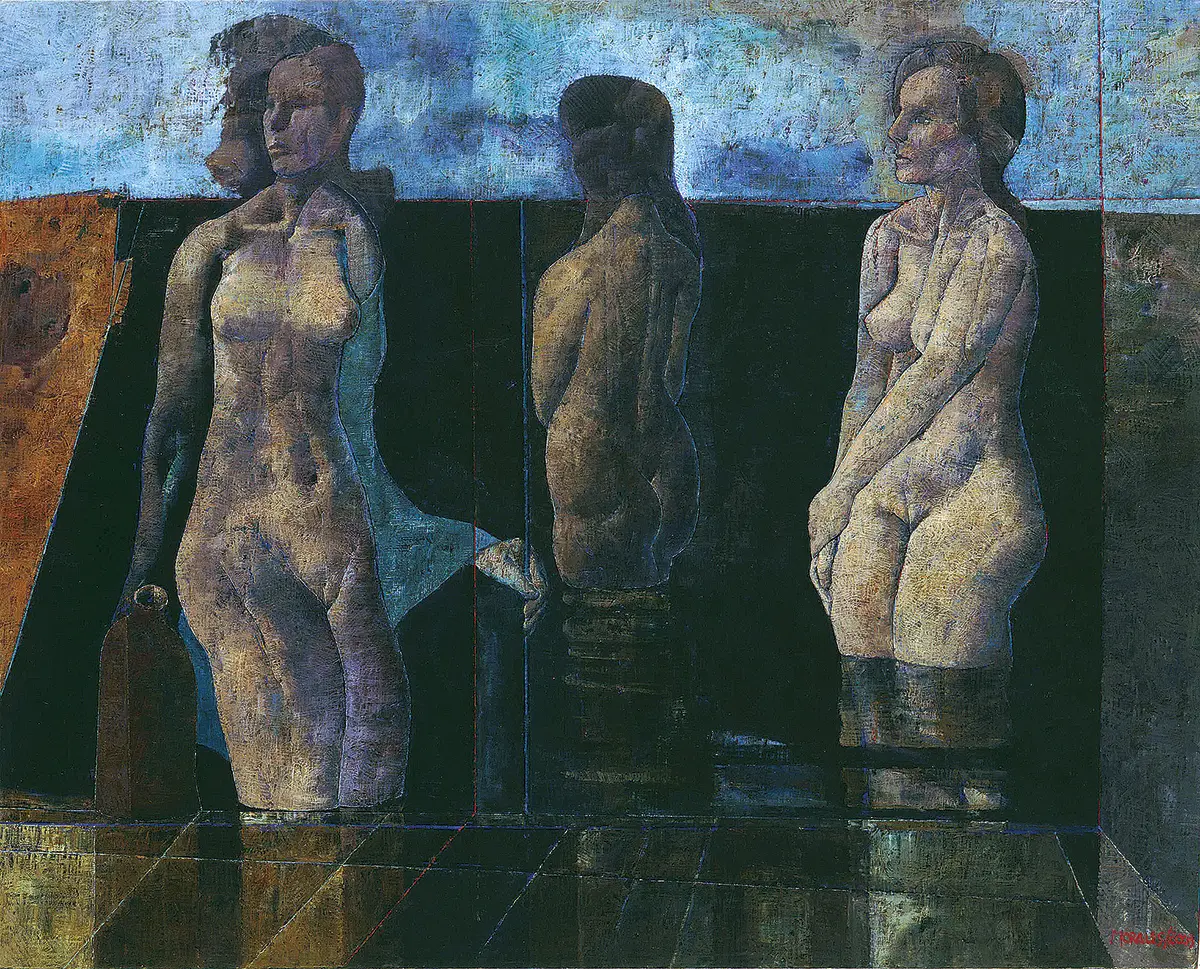
Morales also showed a wide selection of his female nude studies. These beautiful and strong-bodied Amazon figures are reclining, bathing, or have been transformed into caryatids for a fountain square that has an atmosphere reminiscent of de Chirico’s piazzas. They seem to be in a harmonious dialogue with their environment, and whether urban or bucolic, they project a serenity that makes them more like ancient nymphs or goddesses than modern women. These strong yet graceful figures seem totally removed from contemporary anxiety and own the space around them with the authority and comfort of beings that have been there before the surroundings existed and will be there still once the present is transformed. Woman awakening is a good example of this. In this picture the naked body of a reclining woman covers the entire picture plane; the receding horizon with a mysterious, squared ground opens into a huge abyss. It all adds to the dimensional weight and power of the figure and gives the impression that we are intruding upon the sleep of a giant fertility goddess, a daughter of Titans who, upon awakening, will be totally comfortable within the immense realm of space around her. What looks like an abyss behind her may turn out to be simply a pool for her bath.
There was also a very large bullfight painting in the exhibit with a very impressive play of light reminiscent of the work of the Spanish Old Masters, as well as some equally captivating still lives; both themes are very much rooted in the Spanish and Latin American classical tradition. A surprise in the exhibit was an unusual religious painting: a very large Annunciation of the Virgin. In this depiction of a time-honored subject, Morales portrays the angel as an otherworldly shadow that interrupts the chores of a peasant girl in the fields. The sacred and the profane meet in the most natural manner, as if the greatest miracle were an everyday occurrence. The same may be said to sum up the entire exhibit and the work of Morales.
ALBERTO BARRAL