
Overture
After the success of their first exhibition, La Mirada, which in 2002 presented in Zurich a selection of Latin American contemporary photography, Daros has now embarked on a two-part show featuring ten major Colombian artists.
The exhibition Cantos/Cuentos Colombianos demonstrates an insightful attitude to collecting, in particular, contemporary art from Colombia, and in general, from a continent that has been for the most part excluded from the international collectors’ imagination until very recently. Hans-Michael Herzog, the curator of the exhibitions and responsible for the acquisitions which today constitute Daros-Latinamerica reaching nearly 80 artists from several countries, visited studios and selected the works that make up this exhibition. He also conducted in-depth conversations with the ten Colombian artists represented in Cantos/Cuentos Colombianos, which resulted in a series of in-focus records of life experiences, reflections around art, and the socio-political landscape of their country, all included in the catalog. This very thorough account provides a deep insight into one of the most vibrant art scenes at the moment: that one which has been developing for more than ten years in Colombia.
The first part of the exhibition, which opened on October 29th, presented the work of Fernando Arias, Juan Manuel Echavarría, Rosemberg Sandoval, Oswaldo Maciá, Nadín Ospina, Miguel Ángel Rojas and José Alejandro Restrepo. The second part opened on January 28th with works by María Fernanda Cardoso, Doris Salcedo, Óscar Muñoz, Juan Manuel Echavarría, Rosemberg Sandoval, and Oswaldo Maciá and included a symposium that gathered four relevant Colombian specialists in socio-political issues with the intention to provide a suitable platform for debate on the Colombian situation, after 50 years of armed conflict.
The two inaugural nights welcomed a large number of visitors who were introduced to the ideas contained in each artist’s practice by the curator himself. One wonders what reception this exhibition will have among the wider Zurich population and what kind of resonances the issues explored by the exhibition and the symposium will produce in the locality. The efforts made by Daros in the direction of contextualizing the artworks are evident. The illuminating one-day symposium and catalog, an impeccable 400-page publication, bear witness to such endeavor.
Canto I: on muses, birds, and funerary chanting
Three of the artists present in the first part of the exhibition employ sound as material in very distinctive types of work: Oswaldo Maciá, José Alejandro Restrepo, and Juan Manuel Echavarría.
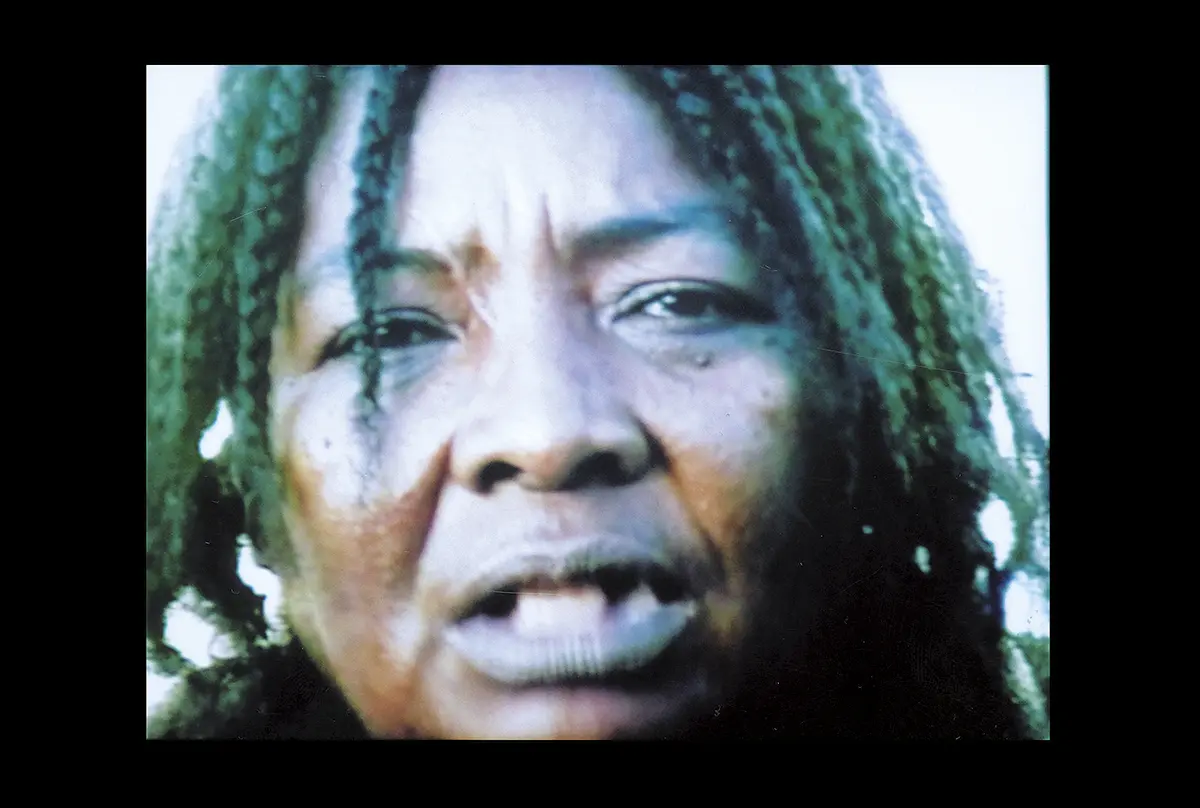
As one entered the exhibition, the chants from Juan Manuel Echavarría’s video work Bocas de Ceniza haunted the spectator. The video recordings are extremely sober: framed by the video screen, without background information providing further narratives, the faces filmed in close-up sing responsos, funerary songs.
“Exodus in Colombia is massive. There is no respect for children or the elderly”
The song of Luzmila Palacio, a neighbor of Juradó, Chocó, illustrates the scars left by the longstanding war on individual lives. These chronicles of massacres and consequent displacements remind us of oral African traditions brought to Colombia by the slaves whose descendants, having escaped the plantations, settled on the Pacific coast. Dos Hermanos is the tale of two survivors of a massacre, sung in the style of vallenatos and charged with a deep religious overtone that somehow seems to act as a shock absorber of the incredible sadness exuded by their testimonies. Echavarría’s recordings somehow bring echoes of the research undertaken by Cuban ethnographer Lydia Cabrera, whom, in the 1950’s recorded secretive Santería priests, descendants of Nigerian Yoruba slaves, evoking orishas through ceremonial songs. Echavarría’s recordings of ordinary people’s grief provide a compelling and necessary recollection of the destructive power of war and lives testimony of the voices and faces of those who would remain, otherwise, dumb and invisible in Colombian society.
I found an interesting parallel in the working methods of José Alejandro Restrepo and Oswaldo Maciá, both deeply concerned with taxonomy and classification. The subject matter explored by each of them is though very different: this might relate to the fact that Restrepo is based in Colombia and Maciá in London since 1990.
These artists operate as anthropologists or archivists of images and sounds, revealing a highly erudite method that seems to take inspiration from the work undertaken by explorers who, between the 18th and the 19th centuries, traveled to Colombian territories with the intention of chartering the new land and cataloging the multiple wonders they encountered. Restrepo in particular finds inspiration in the investigations of Humboldt and Bonpland who employed artists, some of them local, to illustrate the fauna and flora discovered in their expeditions. But he also reflects on the fact that their acquired knowledge was put at the service of the economic and political expansion of colonial powers. Taxonomy and classification fascinate Restrepo in a sense that reveals not only the will to understand reality but also to possess it, therefore highlighting these branches of knowledge in their intrinsic relation to power structures.
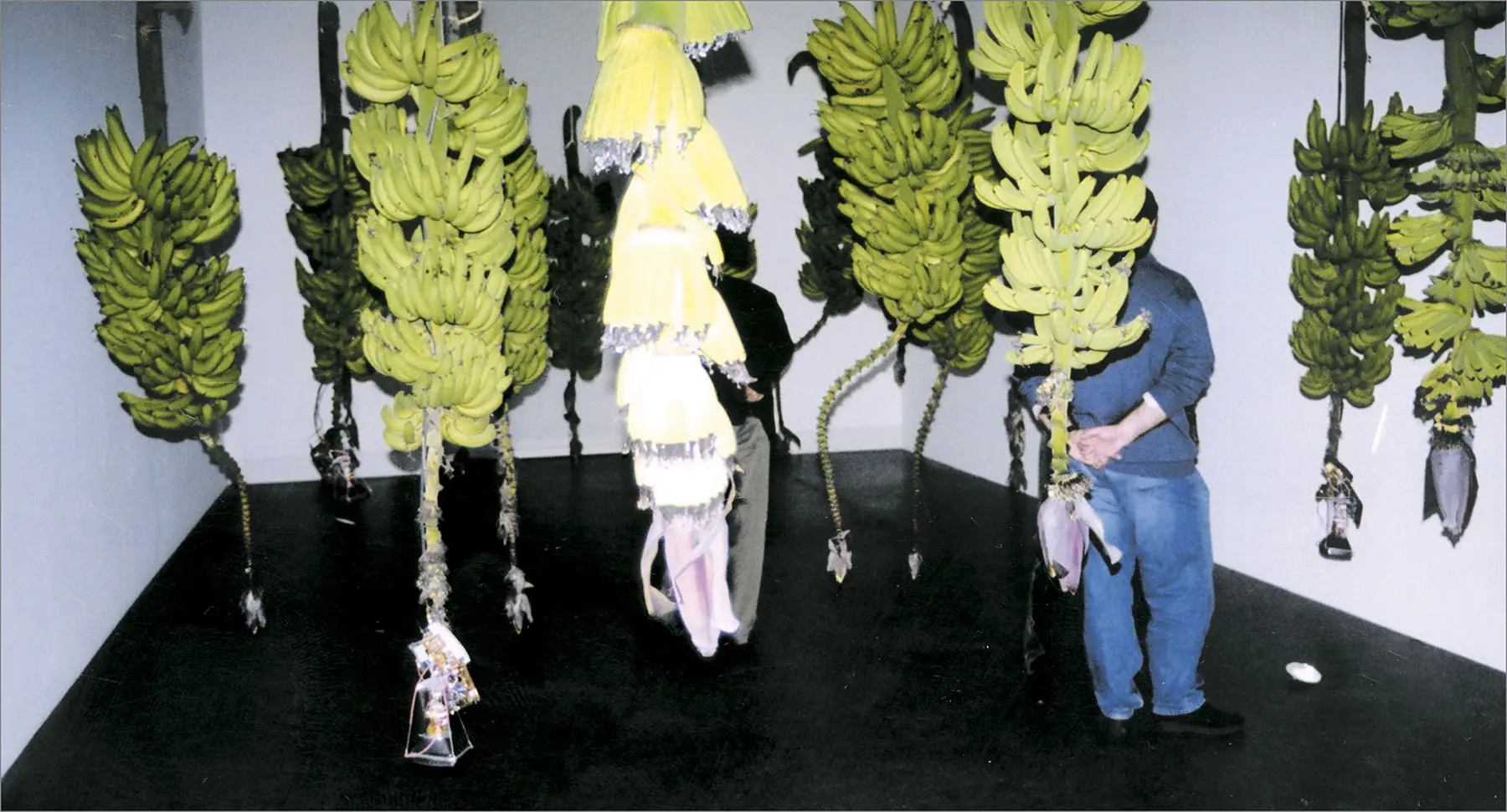
There were four installations by José Alejandro Restrepo in the exhibition: Song of Death, 1999; Humboldt’s Crocodile is Not Hegel’s Crocodile, Musa Paradisíaca, and An Eye for a Tooth, all from 1994. Among them, Musa Paradisíaca is the most impressive, since it combines the artist’s multilayered interests from biology to anthropology, economics, and politics, emphasizing the socio-political consequences of the exploitation of banana plantations by foreign companies in Colombia. Departing from a 19th-century engraving by French artist Charles Safray bearing the title, Musa Paradisíaca is an extremely appealing, multi-sensorial installation. The room is hung with banana bunches upside down like corpses in a darkened room. Small video projections are randomly delivered from inside these vegetal sculptures onto circular mirrors below. But one can only see the projections coming in close proximity to the tree, therefore immersed in the smell that day by day grows in intensity as the plants start to degrade in the gallery space. The mirrors capture images edited by Restrepo both from TV news broadcasts and video footage composed in an allegorical manner: the staging of Adam and Eve's scenes performed by two actors in a banana plantation evokes exotic fantasies of earthly paradise. In turn, the archival footage from TV news narrates the multiple massacres suffered by banana plantation workers in the 1980s and 1990s. Restrepo summarizes the conflict by applying a ‘bi focal’ gaze to his subject matter: the anthropologist gaze and the socio-political commentary fuse at once, providing the piece with a rich conceptual structure.
Miguel Ángel Rojas presented his legendary works made with coca leaves and minuscule photographic prints to compose images that highlight his interest in power relations.
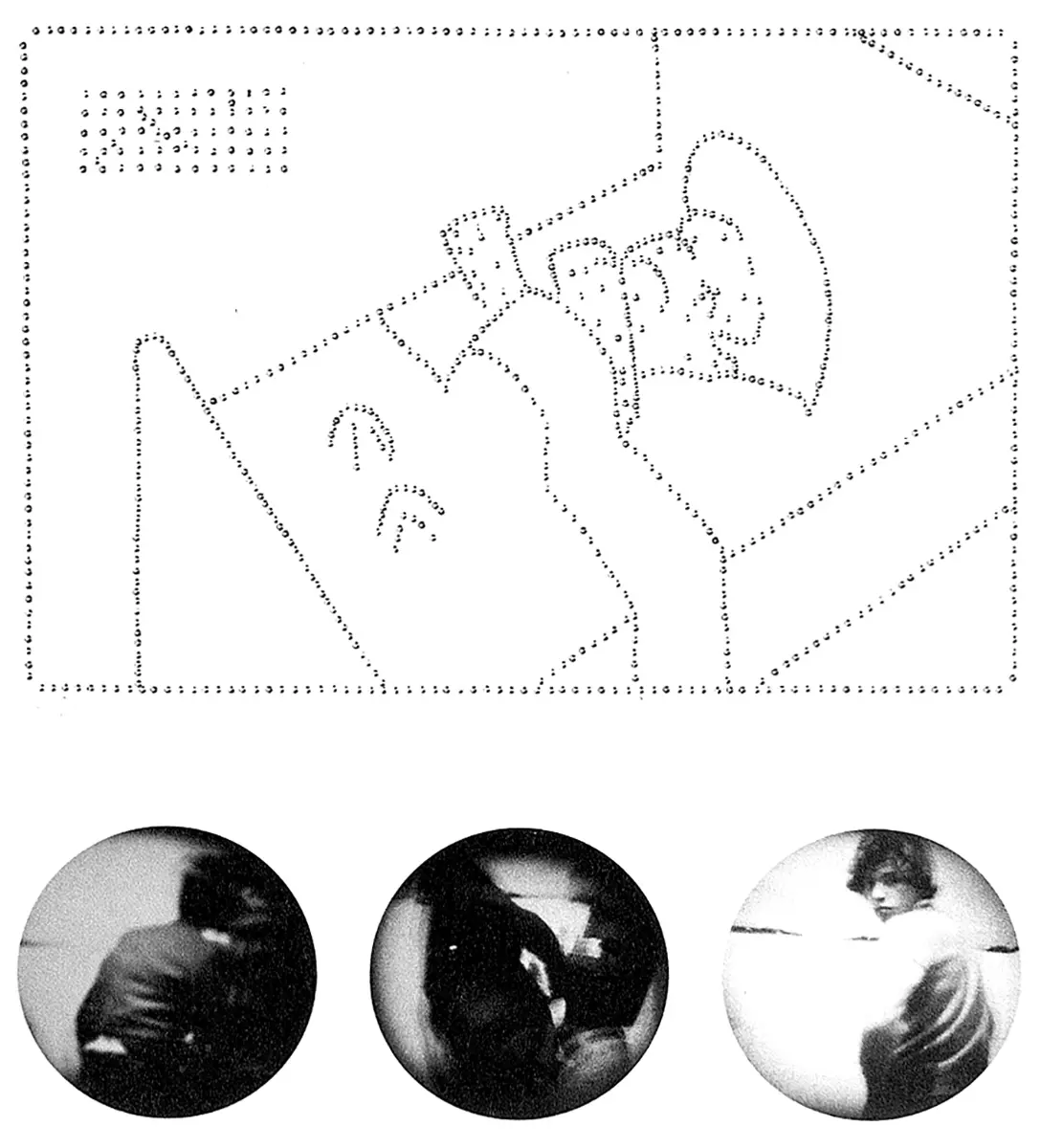
In Nowadays, a semantic turn of Hamilton’s iconic pop collage Just What Is It that Makes Today’s Home so Different, so Appealing?, Rojas attempts to denounce the negative impact of drug consumption in the developed world over the perpetuation of the wars produced by such demand in developing countries, like Colombia. His series of wall drawings Paquita Buys an Icecream, 1979-1997, are a witty elaboration of voyeurism and more obliquely seem to reflect on the tragedy of HIV epidemics among the gay community, all depicted in a pop style that borrows from the aesthetics of comic strips. The construction of these mural drawings made of numerous reduced photographs depicting clandestine gay encounters epitomizes Rojas’ personal working methods as that of the meticulous artisan who makes use of fragments and simulation to convey powerful political statements.

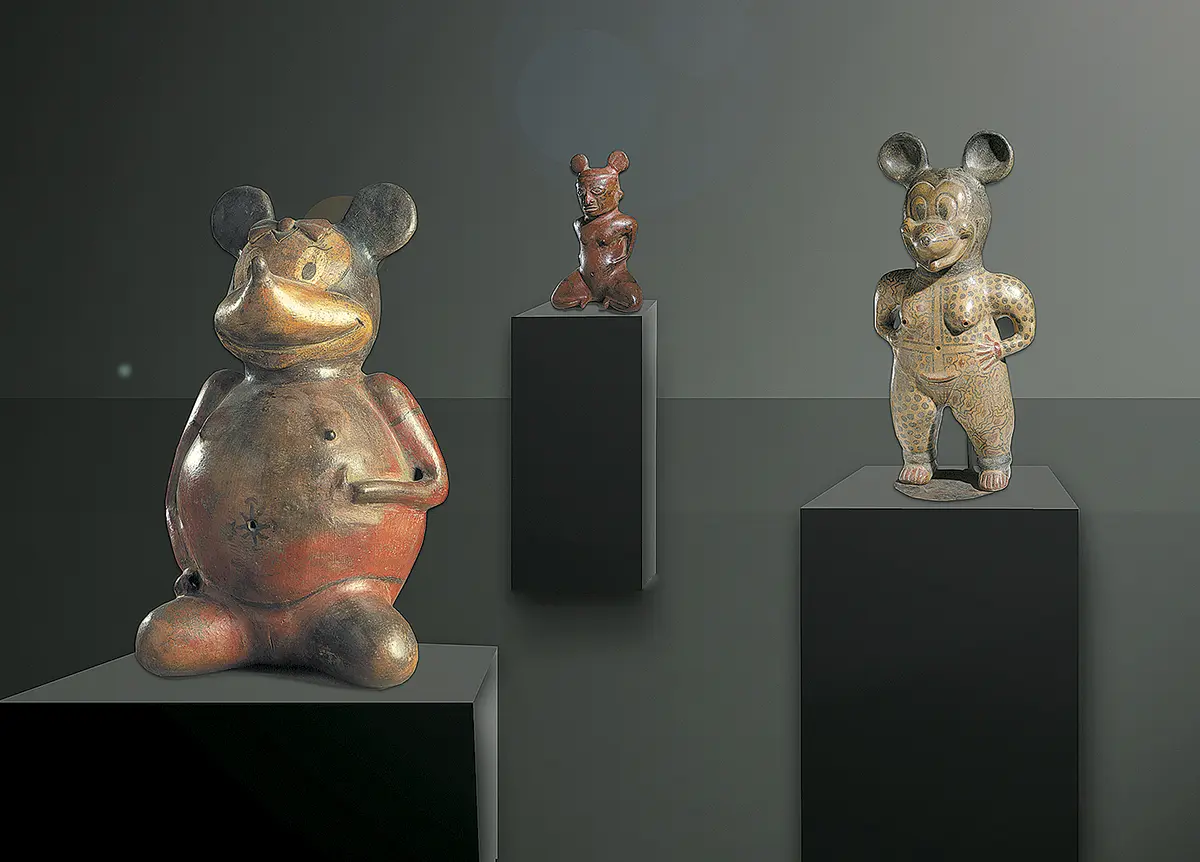
Nadín Ospina’s works —a symbiosis between elements of pre-hispanic cultures and images of North American mass culture— occupied the first room of the exhibition as a staging of the sacrosanct blacked-out display of a respectable museum showing exotic antiquities. Pre-Columbian ceramics commissioned by the artist to artisans in Costa Rica and Colombia were shown among other works such as stone carvings of members of the Simpson family and gold jewelry. Ospina has been challenging our perception of the power and aura evoked by pre-Columbian treasures for many years and his room in the exhibition Cantos/Cuentos effortlessly encouraged such associations.
The work of London-based Fernando Arias deploys a constant change in the use of materials and procedures. His reflection on the tragedy of his people and the banality of the art world is well summarised by the selection. His natural talent for phrasing manifests in a clever use of puns. This complements the use of his body and his engagement with social issues. In Crisis we see the artist’s profile cast in bronze replacing the effigy that traditionally lies at the center of the emblem of Christie’s auction house. With this piece, he satirizes his recurrent disappointment with the structures of art questioning its power of reach and remarking on the predominance of narcissism. The use of puns also emerges from the specially commissioned work Paz Aporte (A contribution to Peace), an edition produced by Daros in 2004 which consists of the white forgery of a Colombian passport where the emblem has been manipulated to sport an oversized bullet on its center. With this intervention, violence and war are turned into the seal of the identity of Colombia, which much too often represents a burden for those who carry the document around international borders. His ‘bitter-wit’ reaches its splendor in the photograph ¿Quién da más? / Do we have another bidder? 1997, which shows a tattoo of Arias’ signature engraved on his loin. As the tattooed piece of skin was subsequently offered in the auction, the action document summarises an attempt to disclose the effects of the art market’s manipulation over the artists’ own flesh, implying pain and dependence. The exclusion of Latin American art from the traditional canon is the subject of La historia de Arias, 1998, an object made by screwing close Sir Gombrich’s The Story of Art and transforming it into a plinth to hold an appendix, printed in the same style as the bible of European art historians: the appendix is no more and no less than a catalog of Arias’ works up to 1998. Lego Coffin (Homage to the Children of the Drug War), 2000, is a sculptural monument to the victims of the war made of Lego pieces composing the colors of the Colombian flag and following the dimensions of his body. The work is a clever but disturbing conceptual marriage of a children’s game and the effects of a dark, unavoidable fate.
Canto II: Shading light over the elusive nature of memory
Memory and the impossibility of permanence were poetically explored by the series of works by Óscar Muñoz in the exhibition. Departing from photographs of anonymous people, the artist deconstructs the images by subjecting them to physical forces.
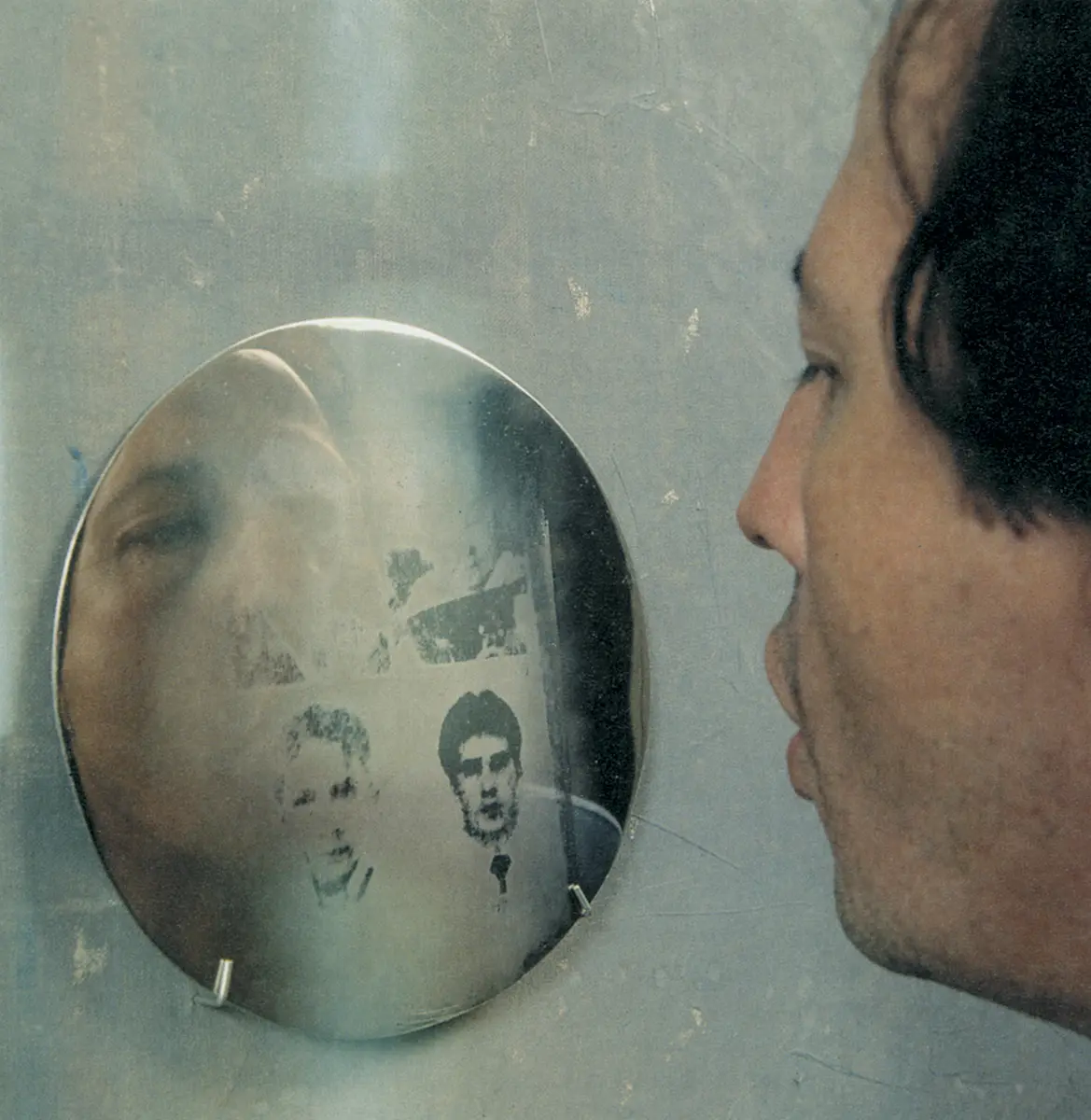
Re/trato/ I Re/Treat, 2003 is a video recording of the artist’s hand drawing a face with water on the pavement. The action functions as a reminder of the impermanence of images and the elusiveness of time: as the brush completes one feature the rest of the image starts to vanish. The hopeless effort to complete the image enhanced in turn by the loop of the projection, works seamlessly as a metaphor for a Sisyphean activity. In Biografías/ Biographies 2, 3, and 6, another video recording of 2003, three charcoal powder drawings are subject to the action of centrifuge forces. The three portraits laid on a water-filled basin by silk-screening charcoal powder on the surface, descend to the bottom as water drags the charcoal down the pipe. A back loop miraculously brings them back to the surface, where they only remain for a few seconds. The reference to anonymous people links Muñoz’s pieces to other works in the exhibition, but here, the faces of unknown citizens excavated from image banks are subject to artificial processes of disintegration. The artist’s techniques somehow pervert photography and drawing’s main purpose: the recording of a second to turn it into an eternal trace. This sense of lightness and impermanence is also conveyed in his most notorious piece, Aliento (Breath). Here the polished surface of stainless steel disks acts as an anti-mirror: the silk-screened images become only activated by the breath of the spectator, disappearing after a few seconds to give way to the viewer’s reflection. Presence and absence are linked by the action of breathing over the image, as a powerful metaphor for the source of life. These works employ supports that deny the possibility of fixation, operating in an opposite direction of all art disciplines, and surpassing them.
In the central space, four works by
Australian-based María Fernanda Cardoso make use of dead invertebrates and
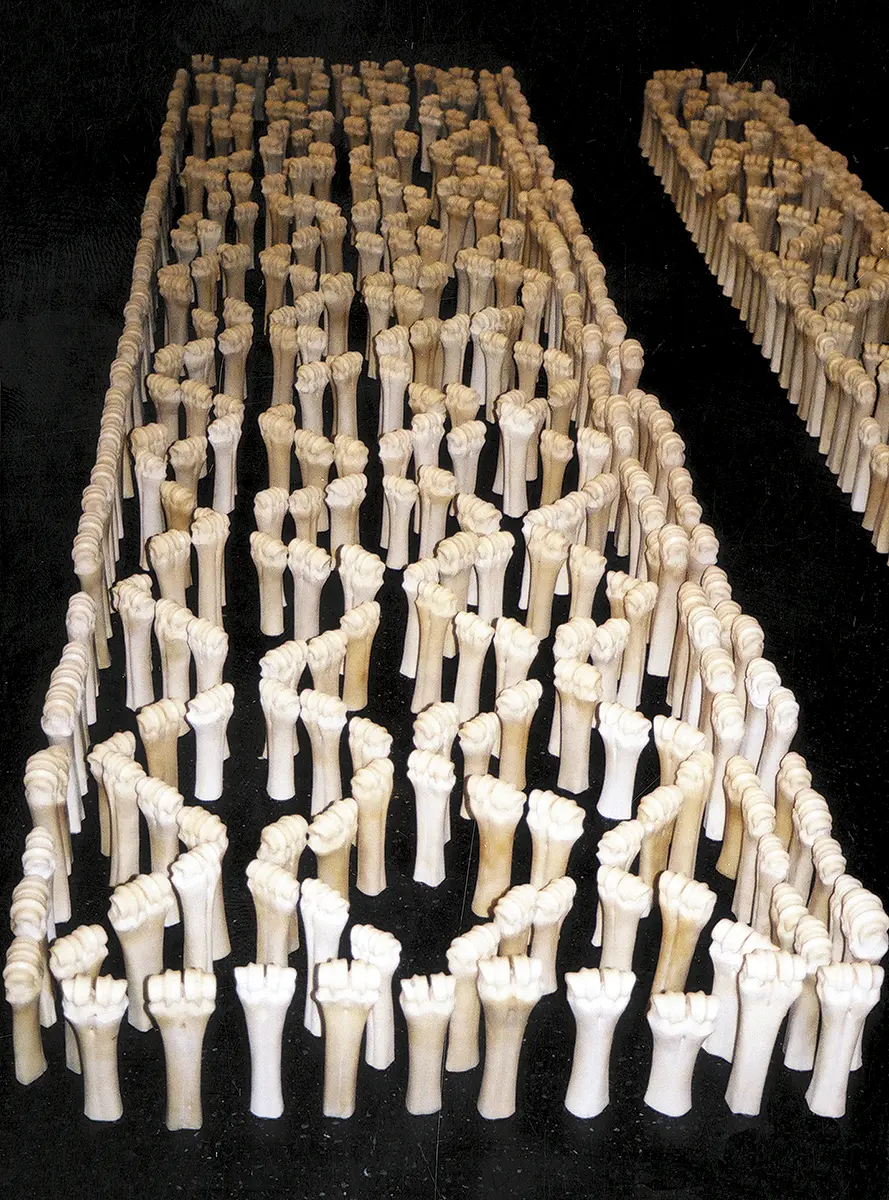
bones to create an aesthetic of artificialness and eerie alienation. The large American Marble, a minimalist floor piece
made of 202 cattle bones, and the more subtle Crown for a Chibcha Princess made of a line of inserted lizards in
a metal rod provoke simultaneously a sense of disgust and marvel. Her
installation of 150 preserved piranhas obtained from a souvenir shop named Amazonas was perhaps less effective
conceptually but worked well as an ‘artificial’ barrier in the middle of the
room where it seemed to flow to nowhere, frozen in its own death.
Marginal heroes and indigents
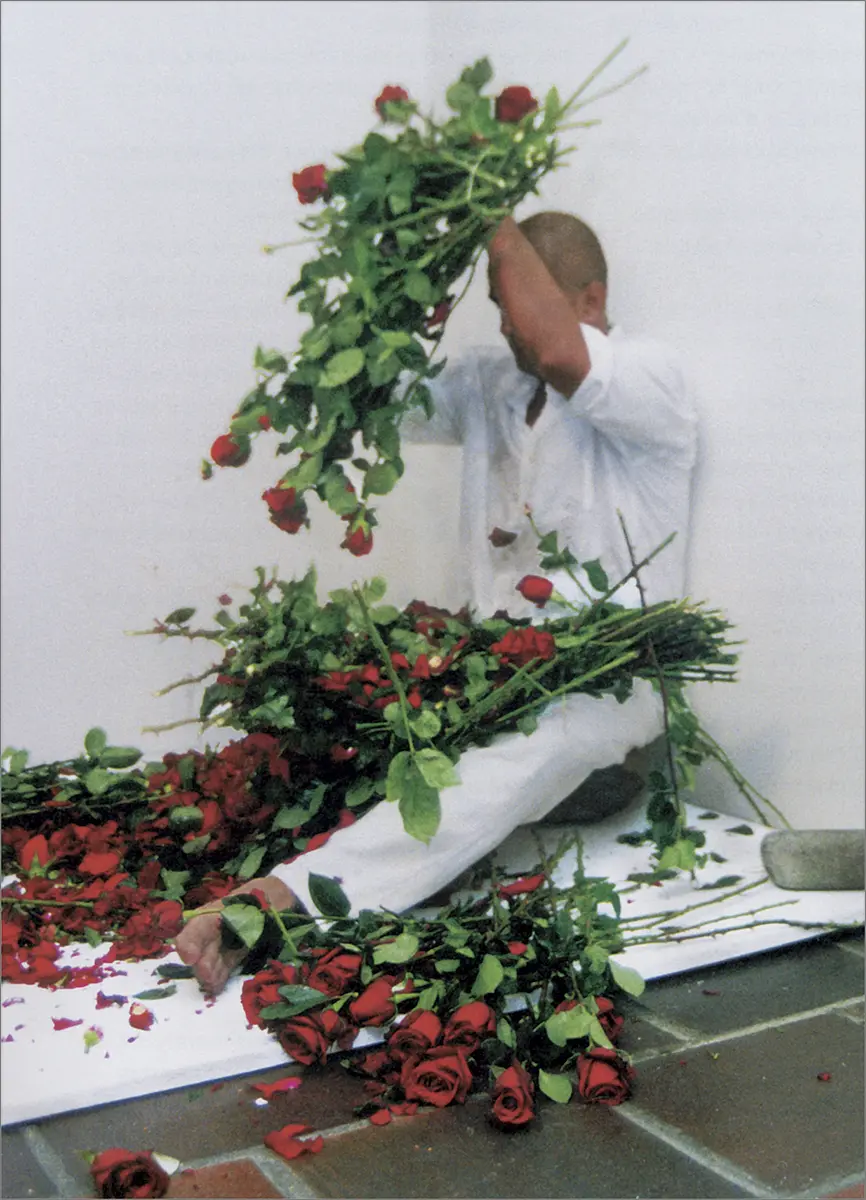
In view of the references to anonymous lives in the work of Muñoz, Echavarría, and Rojas, the same thinking could be applied to the pieces made by Rosemberg Sandoval, whose performances highlight the utilitarian brutality of society and the disregard for its outcasts. For over twenty years, Sandoval has worked with bodily materials such as guts, blood, and hair of dead bodies bringing to the surface the pain of invisible members of society. His choice of materials reminds us of the interest in primeval forces, violence, and discourses of uprooted identities found in Ana Mendieta’s early work, and his references to the marginal heroic in Helio Oiticica’s immersion in the underworld. The works in the exhibition range from black and white photographs documenting the actions on March 12, 1982; Individual Actions, 1983; Caquetá and Symptom of 1984 to two video recordings of the performance Filth, 1999, where we see the artist using indigents as pigment to create a mural painting and Baby Street, where the artist is shown cleaning the body of the indigent and hanging the dirt-covered cloth in the gallery. Employing Povera aesthetics to highly theatrical-anarchic actions, Rosemberg Sandoval induces a displacement of the object of indifference to the center of spectacle in the realm of the museum.
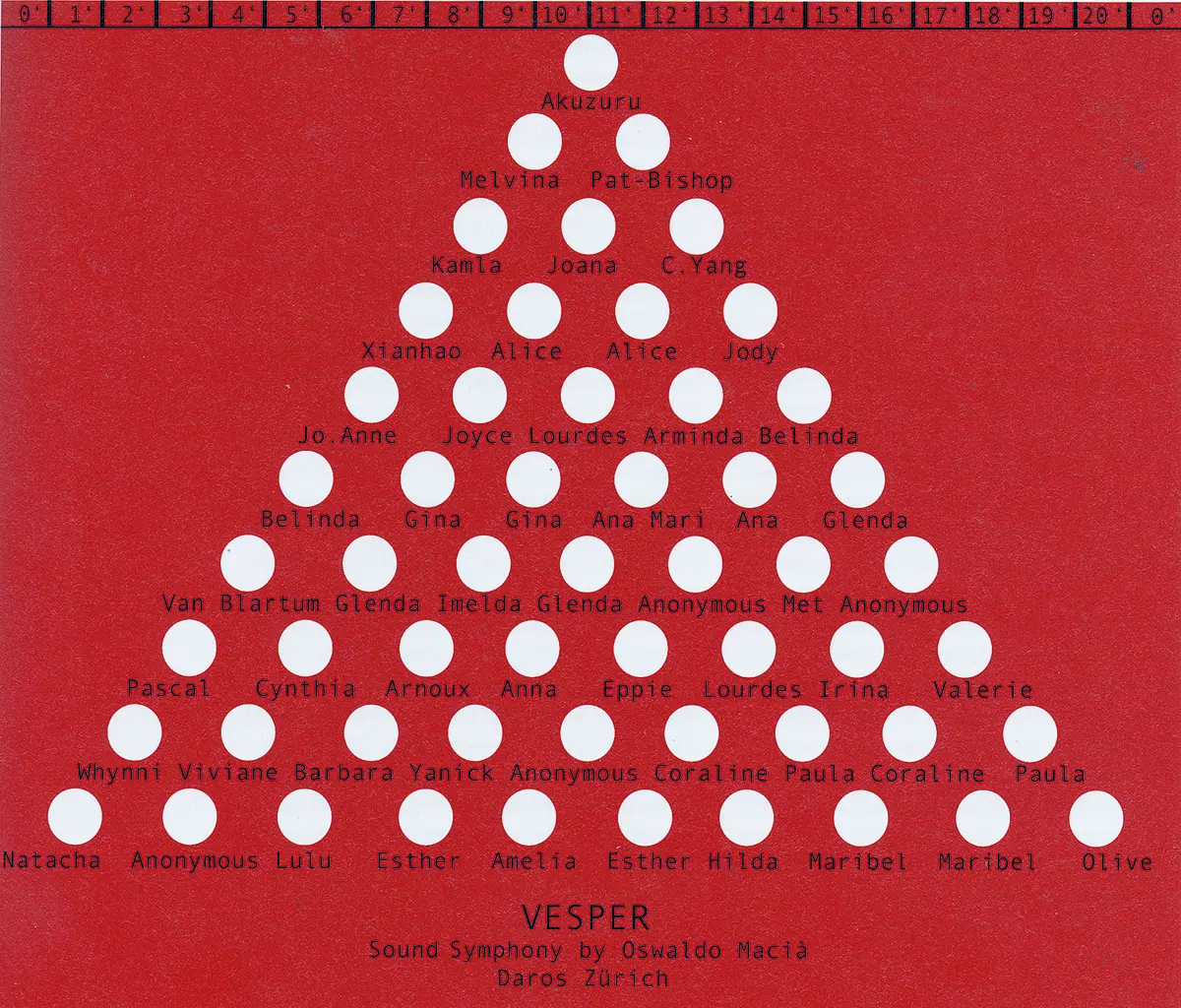
The invisible members of society or its victims are also at the center of the works of Oswaldo Maciá and Doris Salcedo. Maciá presented two sound installations, one of which Vesper, 2000, is a 20-minute symphonic piece made up of female recollections recovered by the artist in different cities of the Caribbean. According to Maciá, Vesper traces its’ origins back to Greek tragedy and the role of the female chorus serving as both interpreter and narrator of the drama unfolding on the stage. The recollections are the result of the women responding in seven original languages to the question: ‘What is your most cherished memory?’ The final work is an arrangement of 55 different voices in an antiphonal manner. Walking around the installation one could not help but detach oneself from the meaning of the individual stories and experience the intermingling and waving of the colorful sonic threads in the space. His older installation Something is going on above my head, which takes the form of a symphony of birds’ songs, conceived in 1995 and completed in 1999, departs from a number of recordings rescued from sound archives around the world and arranged to obey to the physical structure of the symphonic orchestra.
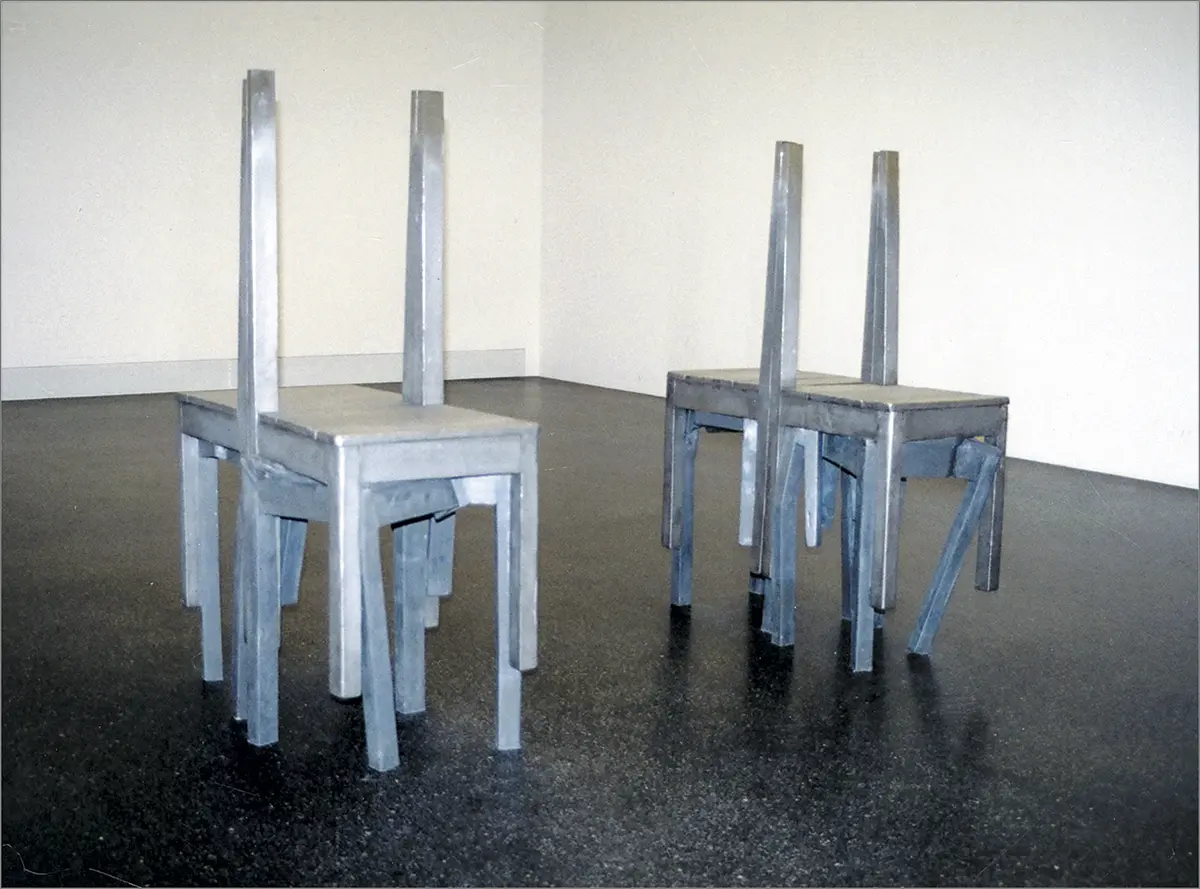
Internationally acclaimed sculptor Doris
Salcedo could resume better than no other artist in the exhibition the proverb:
‘at home saints never perform miracles’ as her work has not been seen in
Colombia for over ten years. Her disarmingly lyrical pieces range from intimate
sculptures to grandiose public installations to always retain the measure of
the human body. Two sculptures made from chairs, from the series November 6th are part of an
important series of works made as a memorial to the massacre of the Palace of
Justice. In Zurich the two pieces were elegantly displayed in the first room of
the exhibition, standing at a distance from one another in a silent dialogue that
conveyed with precision Salcedo’s ultimate intention of ‘highlighting absence’.
The artist delighted the attendees of the symposium with a short and illuminating
account of her solid artistic practice, focused on the fragility of life, and
the representation of the void left by those tragic heroes who are the victims
of violence around the globe. In her incapacity to find materials to work from
in the crime scene, the date and title of the series: November 6th became the only trace left by the event in
the collective memory. The Palace of Justice was torn down and replaced by a
new building, after it was occupied in November 1985, by guerrilla members who
kidnapped judges and administrative personnel. While the army tried to liberate
them, the building caught fire and hundreds died, including civil workers,
judges, and guerrilleros. Among the
images shown were views of her public installation commissioned for the 8th
Istanbul biennial in 2003, a piece that magnificently summarized the need to
remember the individual on a monumental scale.
*Photos: León Birbragher.
GABRIELA SALGADO
Curator of Latin American art.