
It is not often that the main exhibition area at Casa de América, the Pabellón de Caballerizas, is devoted to a single artist. This three-story building with a basement, while not of monumental proportions, does have a presence.
When the individual show of works by Carlos Amorales, slated to occupy the space in its entirety, was first announced, I didn’t foresee the artist’s skill in taking over, spatially and normatively, such a complex space.
The show’s title, Why fear the future?, works as a communicating thread while at the same time covering the variety of interpretations unraveled by this large installation, and it is difficult to recount the latter without describing with some precision the path proposed by Amorales. The show starts on the pavilion’s lower floor, with an animated video where a series of black dots accumulate against a white background to form an image similar to Rorschach’s blots. Those abstract images are given by psychologists for their patients to interpret. No explanation is forthcoming, and we follow that image to the ground floor, divided in two. In the smallest of the two areas, we find a room entirely covered with painted paper on which we can see the outline of enormous birds, occupying one after another almost all the white space. In the center, there was a white separating panel on which the artist has drawn, a set of lines seemingly taken from a comic strip explosion. Behind the panel, a wooden table and two wooden chairs, and on the chair a deck of cards with a series of drawings, also in black and white, some vaguely familiar, some incomprehensible. In fact, it is the stage for a highly abstract Tarot reading. In the next room, on an impeccably white wall, there is a series of more than 400 small, black and white digital drawings —some vaguely familiar— individually framed and displayed in series in three lines around the walls. Here we find images that resemble those from the deck, some are the same and some relate to the video with the blots.
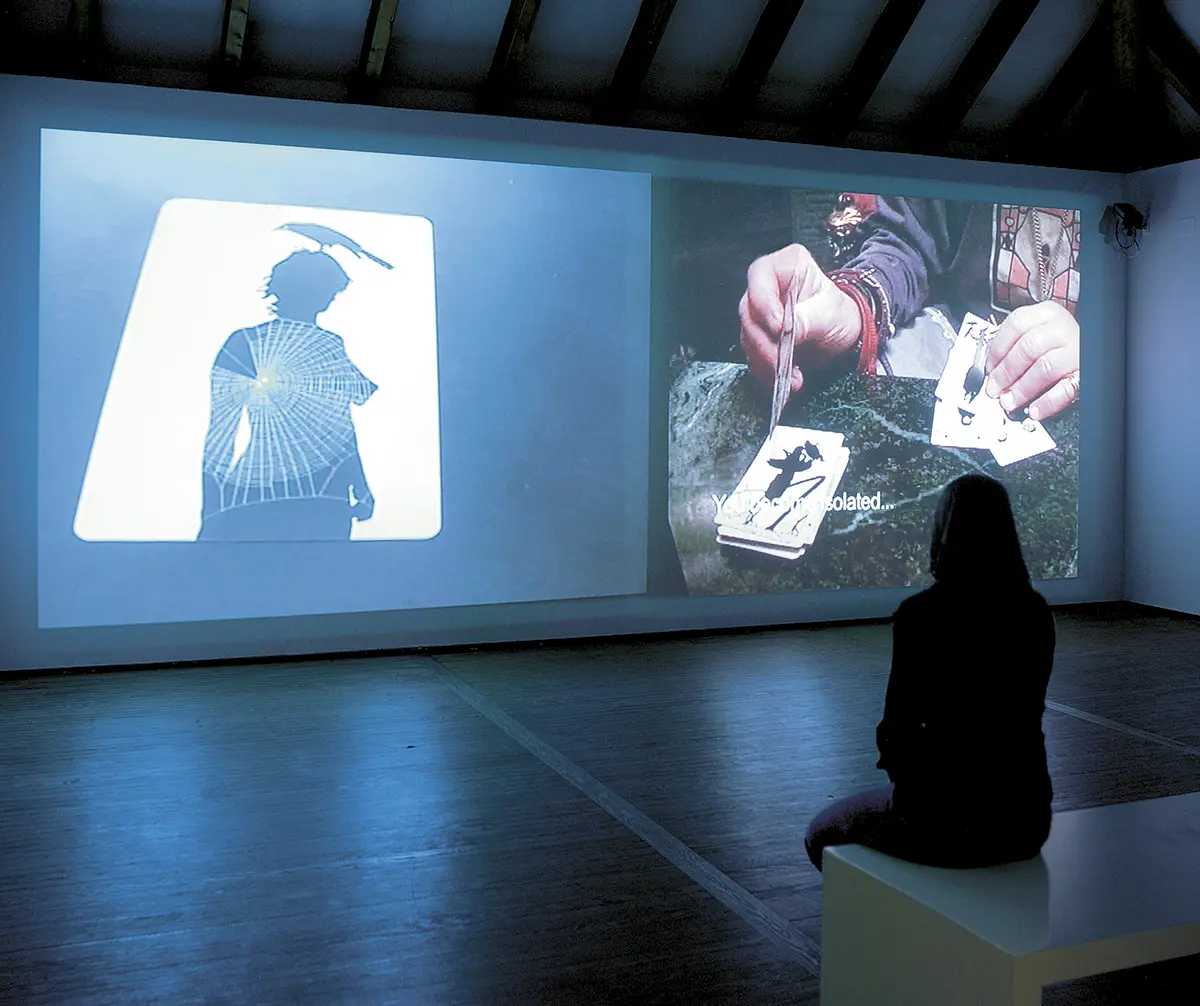
In truth, what we are faced with is Carlos Amorales’ visual repertoire, from which the artist has created the whole of his work in recent years: planes, birds, outlines of characters, animals, and masks... many of these images appear in other pieces or refer to them. What is common to all of them —as well as those he includes in his tarot and the installation with the separating panel— is the hermetic element. Amorales creates a piece that by force of aesthetic simplification, black outlines devoid of “detail,” characters and animals that seem imagined, abstractions that are closer to the realm of signage than to naturalistic representation, and there is the example of the fighter character he has built- wraps itself in mystery and does not lend itself to easy deciphering. Those familiar with Amorales’ work through the fragments he has presented in different contexts, will be surprised to find here, suddenly, what appears to be a whole story, a perfectly interconnected universe that we had only seen in sections before. This perception, however, is rather more intuitive than rational. And this is precisely what we verify on the third floor, where we are welcomed by a split video screen where various Tarot readers —we can only see their hands and the cards they throw— interpret the deck designed by Amorales.
Indeed, this whole story the artist showed us previously still needs interpretation. Here Amorales plays with the very hermetic nature of his images and responds —apparently— to the show’s title: why fear the future? There is an interesting interplay of ambiguity in the fact that he presents us with the different interpretations of the different card readers. If up to this point this universe displayed by Amorales seemed to possess a secret meaning, suddenly it seems that such meaning ultimately depends on our subjective interpretation. Here Amorales’ drawings and his deck of cards become a metaphor for the world and everything that surrounds us: it is up to us to interpret it and give it meaning. Everything can mean anything. The show’s ascending narrative thread is impeccable and becomes a series of revelations that are unveiled at the right moment, with the right means: let’s not forget that this show includes installations, drawings, and video. And at the precise moment we believe we have understood it all, Amorales literally breaks the interpretive apparatus he had built already since those old Rorschach drawings: the last room is traversed by a screen placed diagonally. Frontally we encounter an animation piece created once again with some of the now-familiar drawings. At the pace set by a very beautiful musical composition, we witness the apparition of flocks of birds, planes, and a howling wolf-dog, the only thing moving these images is the piano chords, and at a given moment everything explodes, the white background, the images, everything disappears to start again. From the back —and only the truly curious would have noticed this— the screen shows the piano player as he plays the accompanying tune. Amorales’s world turns to this person’s music, the piano player fully absorbed in his performance and oblivious of the universe Amorales has set in motion.
The feeling this show leaves in us is difficult to describe: the poetic, metaphoric, and visual charge woven by Amorales is within reach of very few artists, and at the same time it rejects spectacle and technological pretensions. On the contrary, this is an intimate show from which we emerge knowing that something has been revealed to us, although we may never know exactly what. And that is OK.
ISSA MARÍA BENÍTEZ DUEÑAS