
There are certain Argentinean artists whose names are landmarks in the local and Latin American scene of the second half of the Twentieth Century. They are Juan Carlos Distéfano, Víctor Grippo, Luis Benedit, Alberto Heredia, León Ferrari, Edgardo Vigo.
A presentation of their works in a single exhibition constitutes, in and of itself, a true event. When you add to that the fact that these artists are represented here by emblematic pieces, such as Grippo’s famous acrylic potatoes, Procedimiento II by Distéfano, or Ferrari’s La civilización occidental y Cristiana, among others, it is easy to see why the show presented by Telefónica in Buenos Aires holds the highest interest.
This is a new version of an exhibition held in November of 2003 in the galleries of Sotheby’s New York for the international scene, with a representative selection of contemporary Argentinean art, organized by the Arte BA foundation.
The curator in both cases is Mercedes Casanegra, current President of the Argentinean Art Critics Association.
The present show has added a number of artists who for a variety of reasons were not in New York.
By Juan Carlos Distéfano, the curator has selected a series of drawings and sculptures in reinforced polyester and epoxy created between 1972 and 1974, influenced by the violations of human rights that shook Argentina’s political life in those years.
Distéfano’s drawings have always featured the highest quality of craftsmanship in the service of a heart-rending, but well-controlled, expressionism.
On this occasion the presence of Argentinean draftsmanship, marked by Distéfano’s pieces, exhibited alongside Benedit’s and Ferrari’s, each with their distinguishing characteristics, is notable.
Distéfano’s sculptures —always figurative— are executed with painstaking and dazzling techniques, which brings to each piece a particular expressive density. It is difficult to imagine El mudo or the already mentioned Procedimiento, which alludes to specific forms of torture, without those material and construction resources that have gained Distéfano the exceptional place he holds in contemporary sculpture.
His empathy towards human beings suffering from political persecution makes deformity, transparencies, and acid colors eloquent means for his denunciation and his protests.
If Distéfano retained in his works a certain classicism of the figure, Alberto Heredia (1924-2000) has taken his protest works to the border of absurdity and anti-art. Exhibited here are works from his series Las lenguas and Los amordazamientos, and El ángel and El caballo de la masacre date also from the 1972-1975 period and attest to his desperate critique and his passionate argument against violence exercised from a position of power.
His materials are rags, glue-soaked pieces of cloth, cardboard, wire, and discarded materials that give his works superlative expressionism.
In the same vein of anti-art or the use of resources from Dadaist iconoclasm are the works of Edgardo Vigo (1928-1997), a River Plate artist of great originality.
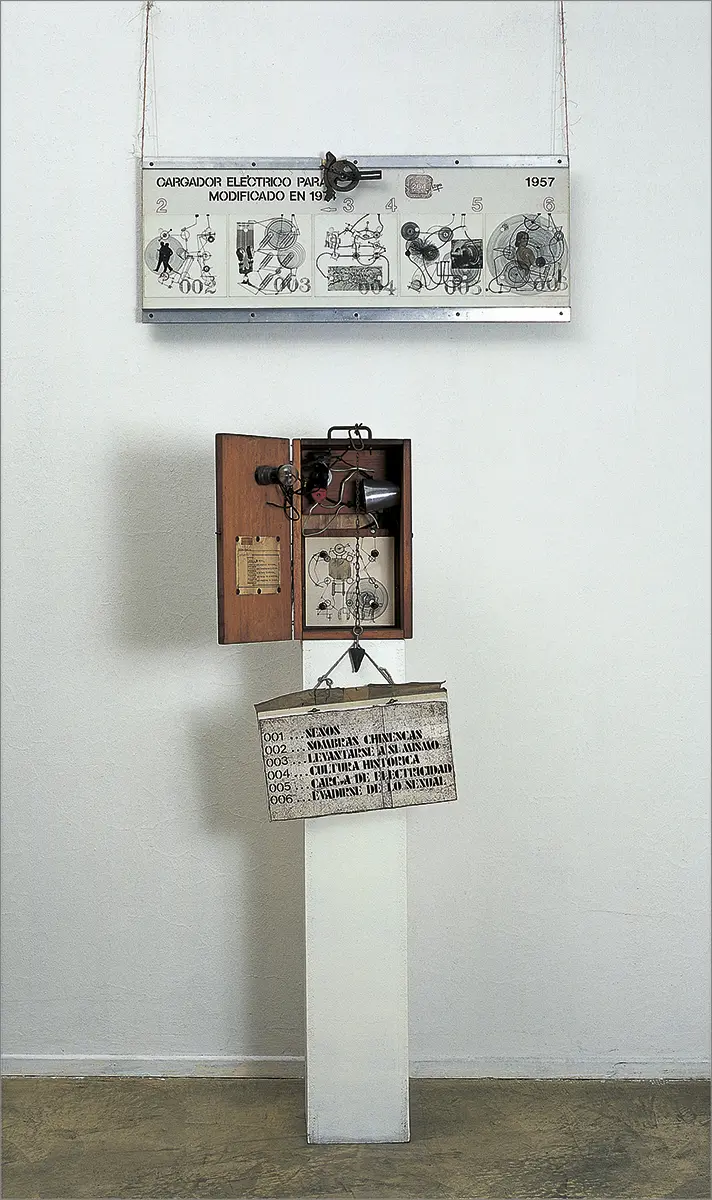
Selected of Vigo’s for this show are some examples of his postal art, as well as his Tapón del Río de la Plata, which refers to the incisive irony of his conceptualism, Cargador Eléctrico and Curso acelerado para adquirir nivel de latinoamericano culto (1972-1973), where the use of photographs, cups, cans, pieces of paper and thread, etc., reaches paroxysm.
His entity as an artist can be linked both to Duchamp, through the allusion to machines with a parodical meaning, and to Marcel Broodthaers, in terms of how certain topics are framed: the role of mass media, of the institution of art, or the conditions of urban life.
As Casanegra points out, one feature of Vigo’s development was his versatility, in the positive sense of the term, as he worked in printmaking, concrete poetry, conceptual signalings, postal art, and the search for an exit from the international circuit by taking over the street, which he termed “the stage for current art.”
León Ferrari (1920) has been a promoter and protagonist of exhibitions, cultural events, and political actions from the 1960s to this day. His critique of Christianity has generated vividly controversial events, as happened with his recent show at Recoleta Cultural Center. For this occasion, the curators have selected, alongside Ferrari’s crucified Christ, several paintings, ink-on-paper works of the 1960s, which constitute one of the most interesting facets of his work. These are pieces of writing where image and meaning are linked, determining an exploration of the potential of the graphic arts.
These works resulted both in the early use of photocopies, heliographic and Letraset figures and in artist books with drawings and postal art.
Alongside the artists mentioned, the efforts of Grippo (1936-2002) and Benedit (1937) would seem to belong to the second veneer on which this show focuses. Indeed, the title is El silencio y la violencia because, as Mercedes Casanegra explains, it identifies as silence the conceptualism or neo-conceptualism that emerged in Argentine in the late 1960s, and as violence the “various ways to engage the subject of violence primordially in terms of its relationship with Argentinean history.”
Vida, muerte y resurrección (1980), one of Grippo’s works on exhibit here, consists of five geometric leaden bodies filled with black beans that in their natural germination process have exploded their containers. Beans, like potatoes, which this artist has used in several installations, are for him symbols of Latin America’s strength and of its life forces. In the majority of his works, he uses, in striking new ways, the intersection of nature, technology, and science.
His other work on exhibit here is Analogía IV, which dates from 1972 and displayed a symbolic opposition of materials (the real potato, the acrylic potato; natural food, artifice) that acquired a metaphorical character. In turn, the table introduced one of the constant elements in his work, where the human presence in the strain of the quotidian, the value of human action, is exalted in aesthetic and ethical terms.
Benedit is another magnificent example of Argentinean conceptual art of the early 1970s. During that period he created highly original pieces related to the investigation of social behavior on the basis of animal models. Pecera para peces tropicales (1970) and Gota de agua (1971), shown here alongside their preparatory sketches and drawings, attest to that order of interests.
Benedit set up veritable laboratories or scientific observatories in order to make objective metaphors of reflections about social behavior, about the relationship nature-technology-science that was beginning to reach previously unimagined proportions.
The boxes exhibited by Caja de maíz (1978) show Benedict in a different facet of his work, which has extended over the years: the Argentinean countryside and different aspects of rural life.
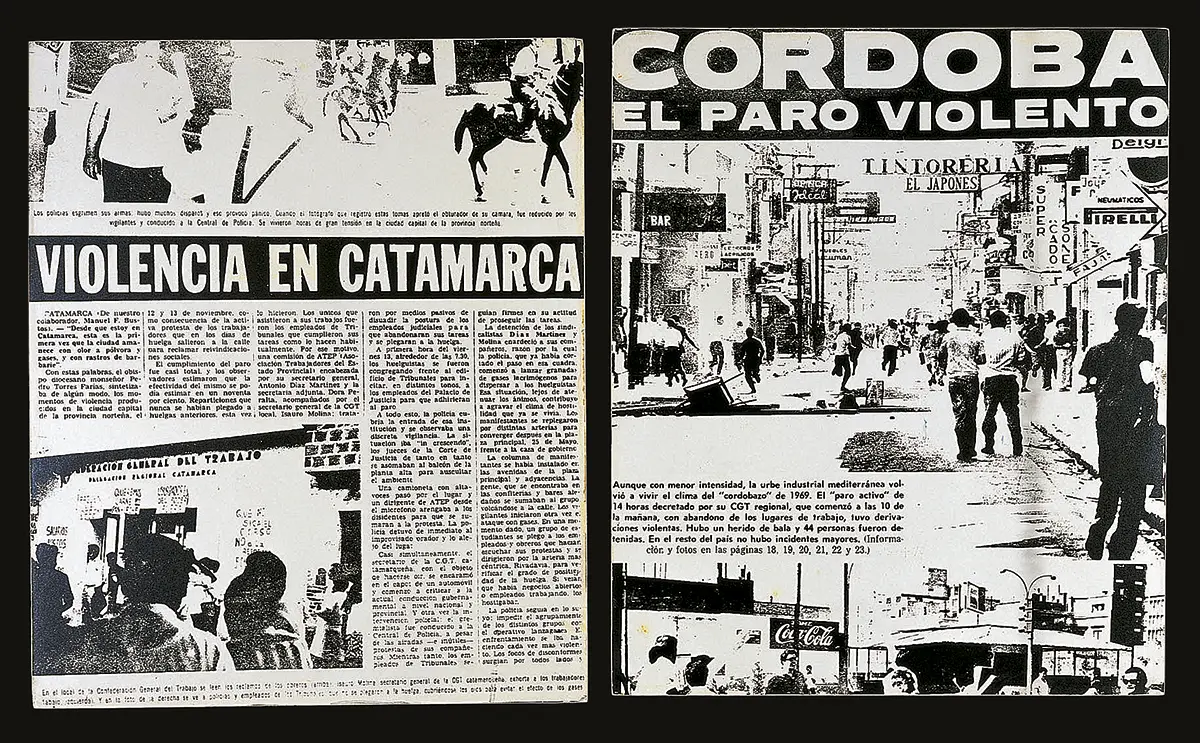
Juan Carlos Romero (1931) is another artist who has focused on the subject of violence from a variety of angles and always with exasperation.
In his catalog he has tells us that “Violence is everywhere, omnipresent and multiform: brutal, open, subtle, insidious, concealed, rationalized, scientific, condensed, solidified, consolidated, anonymous, abstract, irresponsible.”
With interventions in the urban space, using photographs, publications, “exhibitions-books,” postal art, graphic arts, and other media, Romero always brings to the forefront denunciations, unveilings, and questionings of political and military abuses.
He also defends cultural and ecological preservation. He understands his artistic protagonism as a community commitment possessing vibrant emotional content.
Other artists, more or less removed, in generational terms, from those mentioned, such as Norberto Gómez (1941), Oscar Bony (1941-2002); Liliana Porter (1941), and Horacio Zabala (1943), are also represented.
Norberto Gómez figures in this show with his 1977-1983 sculptures in pigmented polyester resin, alluding to viscera, bones, to flesh exacerbated in its materiality.
If we are perturbed by the violently explicit manner of these works representing fragmented human beings or animals, we are also touched by the reference to torture, death, violence, and suffering.
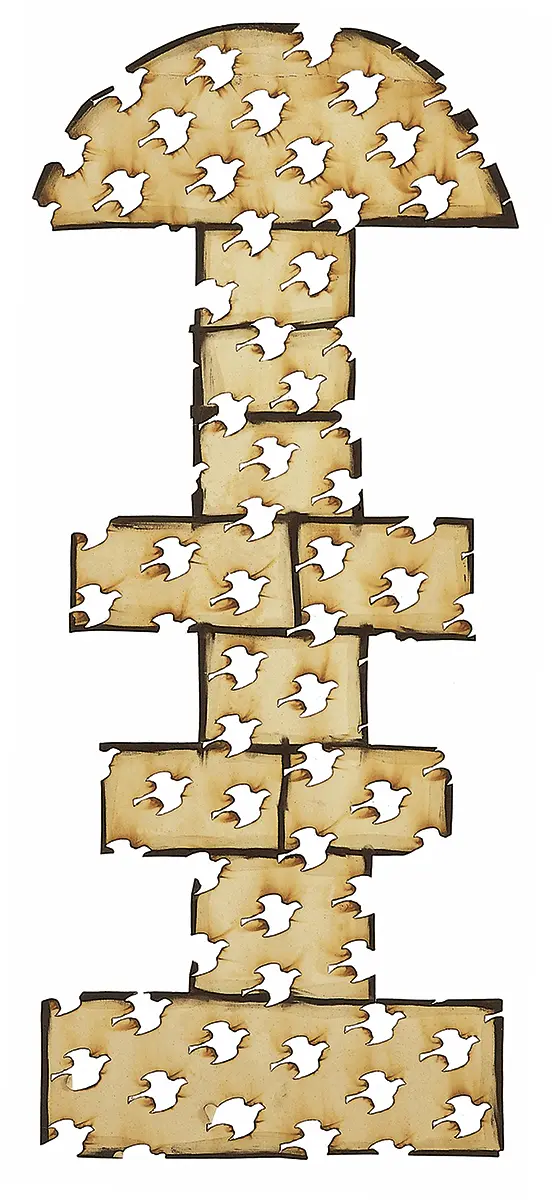
Oscar Bony’s works exhibited here are from the 1993-1998 period and comprise records of the impact of firearms upon a variety of supports. Another form of violence is practiced on self-portraits, frontal or turned, or against landscapes. Bony lived outside Argentina between 1977 and 1988.
As Casanegra puts it, “Bony did not feel comfortable in complacent postmodernity and in an end-of-century that did not bring about a radical cultural change. His references to Duchamp, Fontana, and Magritte alluded to the modernity of lost or forgotten utopias. Among baroque plays of lights and shadows, he almost seemed to have opted for his own demise.”
Experimental graphics, unconventional collage, photography, and video are some of the paths traveled by Liliana Porter in her constant investigation of media. Exhibited in this show are Sin título con libros and Sin título con fuego, both from 1989, and Barco, marinero, pintura, noche, dated 1986 and on loan from the Museo Nacional de Bellas Artes collection.
These works are emblematic of Porter’s conceptualism, where meditations about reality and illusion, the passage of time, and perception are incorporated into very subtle games. They stand before the viewer as veritable challenges to discover their own system of meanings, which never possess an assertive character but are instead filled with eloquent ambiguities loaded with humor and poetry.
From his earliest apparitions in group shows, Horacio Zabala distinguished himself by the theoretical-reflective and the political content of his works. Imbued with the same spirit of protest, veiled only by the use of a language that comes from his background as an architect, this show includes Proyectos para una arquitectura carcelaria (1973 and 1974), which incorporates a pre-project for an underground prison for Buenos Aires, another for a prison atop columns for the Cordoba sierras, and another for a floating prison for the River Plate.
A discourse about repression acquires a superlative dimension through these pieces, so unadorned and rigorous.
Later Zabala went into exile and lived in Rome, Vienna, and Geneva; he gained a foothold in the international circuit and returned to Argentina in 1986.
In 2003 the Recoleta Cultural Center, in Buenos Aires, organized an exhibition titled El laboratorio de Roberto Elía (1969-2003), curated by Mercedes Casanegra. This show presented the variety of supports and techniques that Roberto Elía (1950) has employed in order to give shape to a universe entirely of his own. On this occasion, two early-1970s burnt papers are exhibited, alongside two 1990s installations, La mesa and El pincel de fuego, tables with objects that also recur throughout his work.
An artist of subtle insinuations and veiled suggestions, Elía achieves conceptualism that is traversed by a very unique sensibility.
Several works by Gabriela Sacco (1956) are also exhibited, done using a technique that has been the object of exploration by this artist: Bocanadas, heliography on a spoon, and the series Cuerpo a cuerpo, heliography on wood, both from the 1990s. Also on exhibit is an installation comprised of 14 acrylic fragments, printed in photo-serigraphy, rigs to hang them up, and lights.
These works use as a resource for historical press photographs with images of urban violence.
Rounding up this exhibition are works by Jorge Macchi and Cristina Piffer. Macchi, born in 1963, is one of the emergent figures in Argentinean art, having already achieved national and international recognition.
By Macchi’s we have Rascacielos, a 2001 paper-on-wood collage created using funeral notices carved in such a way as to leave only the religious symbol and the frame that determines the constructive structure, with a connotation of extreme fragility. Interestingly this work was conceived before 9/11.
A set of issues also related to the precariousness of existence and to chance is what we find in Accidente en Rotterdam (1996-1998), a series of photographs also exhibited here.
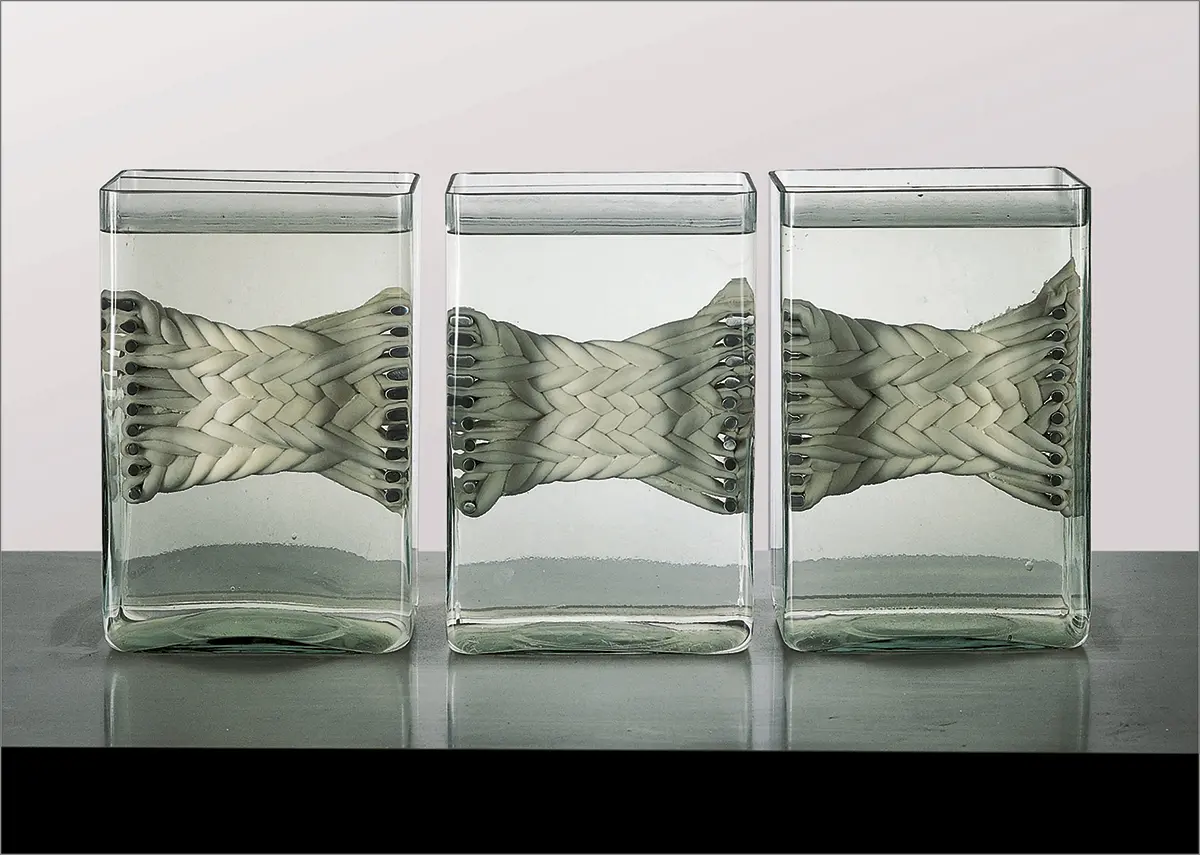
Cristina Piffer is an architect who embarked in the 1980s on a course of study on visual theory and practice. Her works, of almost exasperating materiality, use (in the case of her Entripados) braided cow’s intestines preserved in water and formaldehyde inside glass-and-iron boxes. In other instances she mixes cow’s grease and paraffin inside a cover of polyester resin, giving it the appearance of marble topping iron tables, on which we can read texts referring to bloody episodes from Argentina’s Twentieth Century history.
That material opposition between the visceral character and her neat containers is a vivid shock for the viewer, and it occurs also at the level of the piece’s deepest meaning, alluding to that homo hominis lupus in the national and universal realms.
The artists selected by Mercedes Casanegra give shape to an exhibition articulated around two subjects of interest: violence and conceptualism.
While there are artists whose actions in the 1970s became emblematic of the attitude many of them developed in regards to cruel political events, the show also presents an extension over time of those tendencies to the first years of the current century, as Argentina reaches 20 years of democratic restoration.
What in the beginning was the testimony of a “heroic site of resistance,” in the majority of later artists' works synchronously with an interest in the body that register in Western art as a whole.
The selection of the otherwise excellent catalog texts can be misleading. Oscar Terán’s “Cultura y política en la década de 1970” and Daniel Link’s “Los setenta: crisis de la literatura y algunos nombres propios” seem to narrow the focus and the deciphering of the artists exhibited, who describe a wider, more multifaceted spectrum.
NELLY PERAZZO