For eight hours in
1962, Christo (Christo Javacheff, in civilian life) blocked the Paris Rue
Visconti with 240 empty oil barrels. It was a direct intervention in the public
space and was widely recognized as an explicit protest against the Berlin Wall
and the Iron Curtain. The artist is better known, however, for his pieces based
on wrapping, a method he first began to explore in 1958, applying it to objects
of modest size, such as chairs, tables, and motorbikes. The inspiration for
this approach can be traced to Man Ray’s classic piece, The Enigma of Isidore Ducasse (1920),1 which consisted
of a roped package that seemed to contain a sewing machine and, in appearance,
is very much related to Christo’s work. The point was underscored in the
landmark catalog of The Museum of Modern Art’s 1968 exhibition, Dada, Surrealism and Their Heritage, in
which Christo’s Package on a Wheelbarrow
(1963) is reproduced next to Man Ray’s Enigma.
From smaller, more manageable objects, Christo moved on in 1964–65, to the
fabrication of entire storefronts with the windows covered with fabric or
paper. It was a variation on his wrapping technique in which the viewer could
discern a mysterious lit space behind the wrapping, but had no clue as to what
might be in the “store.” Throughout his work in those years, Christo could be
understood to be infusing a surrealist sensibility into Pop Art, investing
everyday life with a poetical dimension absent in most Pop art. His was to be a
long trajectory that by 2004, in a project for the Charles Schultz Museum,
included Snoopy’s doghouse—an endearing, possibly self-mocking piece.
Christo’s focus on wrapping continued through the 1970s and 1980s with intensity and expansiveness that seemed to have but one logical conclusion: the wrapping of the world.2 Hints of such a vision are detectable as early as 1961 in Christo’s photomontages, and indeed many of his later most famous wrapping projects had roots in the 1960s. In the case of the wrapping of the Kunsthalle in Bern in 1968, Christo’s reputation was sufficiently well established that the project was carried out in the same year he proposed it. More characteristic, however, has been a long period of gestation and negotiation.
Although wrapping is Christo’s trademark, he did not confine himself to that methodology. Running Fence in 1976 involved 30 miles of a fence made out of fabric. Three years later Valley Curtain closed a valley in Rifle, Colorado. In 1991, the Umbrellas project comprised 3100 opened umbrellas installed both in Ibaraki, Japan, and north of Los Angeles, California.
And now, finally, The Gates. Christo’s original proposal to the city of New York for The Gates installation was made in 1980. It took a quarter-century of battling bureaucracies for it to become a reality, and during that time not much seems to have changed in the project. It was always intended to cover 23 miles of paths in Central Park and to be removed after 14 days, and it was always clear that the costs of the project would be born by Christo and his wife Jeanne-Claude, not by the city.3
In all of Christo’s public works, there is a play with the absurd. Historically, national monuments were used to convey a direct message about a nation and its heroes, which was useful for advancing the legitimacy of a political regime. Christo, like Claes Oldenburg, can be credited with working against this self-serving political didacticism. And unlike Richard Serra, whose public works are irritatingly serious, both Christo and Oldenburg deliberately introduce a playful note into the public spectacles they construct. While the ultimate function of the public sculpture has not disappeared, the artists succeeded in having governments accept a degree of absurdity to promote their image. Christo in particular (and his wife and collaborator Jeanne-Claude, who has co-signed the projects since 1994) have been successful in persuading public authorities to accept the idea that there is nothing to lose and perhaps something to gain by a public project that involves unconventional iconography with a touch of the absurd.
Like many other artists, Christo’s speculations about public art remained more or less on the drawing board in the early 1960s. They were theoretical ideas without the apparent intention or even practical possibility of being realized. The significance of this can be seen more clearly in light of a statement made by Oldenburg in the mid-1960s that “the monuments should exist in the imagination. Otherwise, people will pass by one of them and say, ‘Oh, that’s just a 50-foot puppy dog made of concrete.’”4 Both Oldenburg and Christo, however, ended up building their ideas.5
One can see how this happened in Oldenburg’s case, for a fascination with scale had long been an intrinsic part of his approach to the creation of Pop icons. The jump from gigantism in the gallery space to enormity on the plaza was a logical, and perhaps inexorable, progression of ideas in his career.
Christo’s progression to the monumental in the public arena seems to have happened differently. In his case, a striking qualitative leap took place in his work during the late 1960s. Perhaps he didn’t surprise himself; perhaps his photomontages were always intended as blueprints for projects he wanted and intended to build. But the change in his work involved much more than a switch from modest conceptual projects to mega-constructions (albeit reversible ones); he literally leaped into a new way of approaching art, embracing spectacle as the goal and function of the creative process. Looking back on things Christo had said earlier about his work, it appeared he was moving toward a negation of his own principles. In 1968 I heard Christo give a speech in which he affirmed that his passion was drawing and that he didn’t care very much whether his proposals were ever carried out. He said the only reason he pursued actual construction was to publicize his drawings and prints in order to secure their sale. At the time this sounded somewhat cynical; it was also humorous, however, and well within the rules of institutional critique then espoused all over the place by conceptualist artists. Christo was inviting us to see his aim as the exposure of the dynamics of capitalism, a self-mocking use of the tools of capitalist culture in order to critique them. But as Christo’s massive projects were built, momentum was established in his creative process that seems to have driven him to embrace spectacle for its own sake. The spectacular, rather than mysterious speculations, became his signature. For this reason, in the presence of Christo’s projects, one remembers Oldenburg’s statement of 1966 and ponders what may have been lost in transition.
Both Christo and Oldenburg are master draftsmen with a distinctive way of drawing that reflects their personalities, yet does so without interfering in any way with the information they want to convey or the effect they want to achieve. That combination of individuality and clarity helps to explain why they are notable examples of the drawing tradition of the twentieth century.
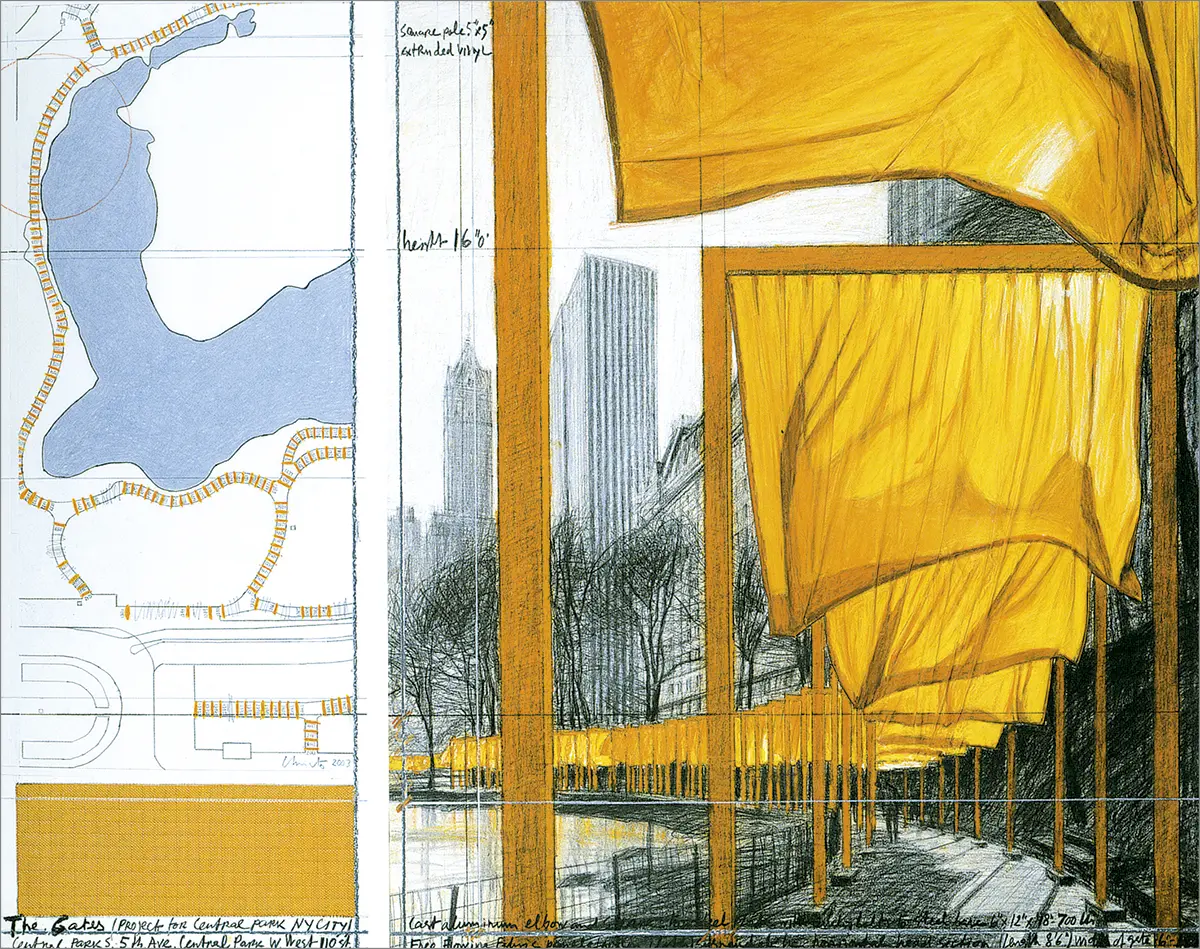
The foundation of Christo’s allure lies in the fact that we are engaged with his images long before they are built. His drawings and prints are the first encounters and what is wonderful about them is that they raise an intriguing question: What if...? What if this idea, fantastical in the extreme, was actually realized in the world? What would it be like? What effect would it have? Posing the question is at the core of his originality. His drawings and blueprints are enriched by the very implausibility of the projects they envisioned. But once a project is completed and exists in public space, the question dies. Now the answer has been given, concretized. It is here that one senses that something has been lost.
The Gates, like Christo’s other projects of massive scale, tend to be anti-climactic, because, in the end, questions are more exciting than statements. When the actual object exists in its very imposing scale, it is no longer a question but a statement, and while statements may be opaque, they are rarely mysterious. In this progression from concept to completion, the evocative becomes declarative. It’s as though in his wrapped storefronts of the 1960s, one could see through the wrapping of everything that lies behind. Wrapping large public buildings accentuates the problem, for everyone already knows what’s there long before Christo wraps them up. There is nothing mysterious about what’s in the package. This is in marked contrast to his earlier wrapped pieces that, like Man Ray’s Enigma, provided a smattering of clues as to what was inside, but refused to provide a definitive answer.6 Imagination was thereby engaged, not only because the method (wrapping) was odd within the accepted art language, but also because one remained uncertain of what lay inside. One could guess, one had possible pointers, but one couldn’t really know, and this lack of knowledge created an aura of mystery. In contrast, Christo’s wrapped buildings focus attention not on the mystery of the interior of the package, which is known in advance, but rather on the act of wrapping. The building is what it is. The point of the piece becomes not the mystery inside but rather the logistical questions related to whether it will or will not be wrapped, and whether it has been or has not been wrapped. The logistics can be impressive and interesting in their own right, but they are an altogether different set of concerns than those of Christo’s early career.
Today, Christo remains an endearing figure whose massive projects do no harm and whose integrity is manifest. There is a refreshing single-mindedness and perseverance in how he handles himself. He’s ecologically sensitive to the consequences of his projects and takes pride in the ephemeral nature of his undertakings, the brevity with which they are imposed on public space, and the fact that all his materials are recyclable. It’s an important principle with him that he bears the cost of construction and installation, that the mega-objects he constructs cannot be owned, bought, or sold, that no fee can be charged for viewing them, and that his spectacles are truly open to the public—massive numbers of whom may stop by to enjoy them before they disappear from view like a drawing on water.
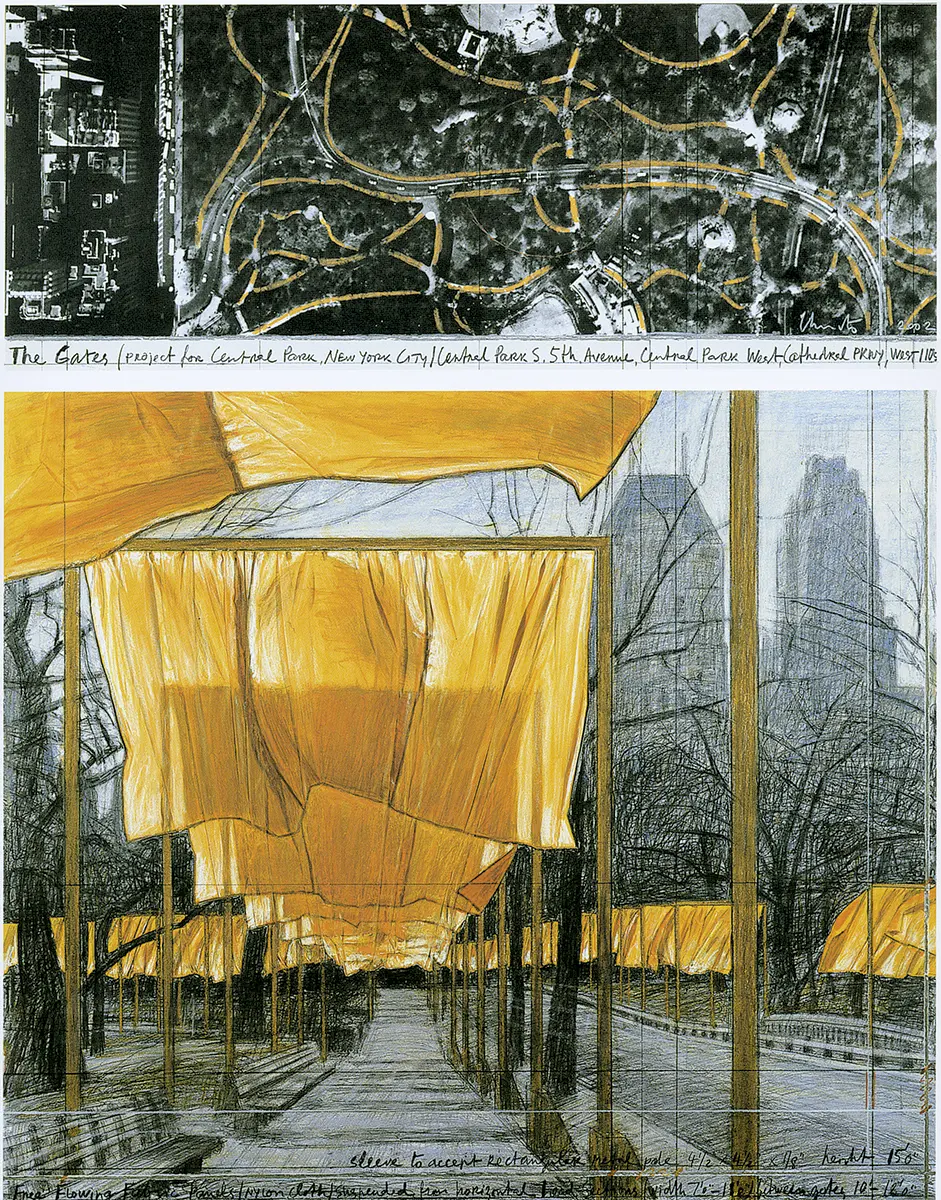
Part of the fascination of a Christo project lies in the statistics of construction, which become well known to the public through advance publicity, augmented by generous time spent after the project is installed by volunteers eager to answer questions. Millions of people now know that The Gates in Central Park consists of 7,503 gates, stretches along 23 miles of pathways, uses countless yards of fabric, and represents many thousands of hours of labor at an overall cost of $21 million. From the guides posted everywhere in the park, identifiable by staffs topped with tennis balls, one learns that Christo made 400 drawings that he hopes to sell for $30,000 to $40,000 a piece, for a total of $16 million. That leaves him $5 million short, much of which he is likely to recover from the sale of more ambitious spin-offs such as models, prints, and books. Altogether, one concludes that Christo will not make much of a profit, at least in the short-term, though one is inclined to think he deserves to, given the time he has invested in this project and the risks he took to get it approved and constructed.7
Christo’s fascination with spectacle drew me to reread Guy Debord’s Society of the Spectacle, where I found the following statements: “All that once was directly lived has become mere representation.”8 “The real consumer thus became a consumer of illusion. The commodity is this illusion, which is in fact real, and the spectacle is its most general form.”9 And, “The individual who in the service of the spectacle is placed in stardom’s spotlight is in fact the opposite of an individual, and as clearly the enemy of the individual in himself as of the individual in others.”10 Written in 1967, these may almost be read as warnings to Christo of the conundrums he would face if he went on to build his implausible monuments. Up until 1968, Christo had been a very good three-idea artist: oil barrels; wrapping; and storefronts. Once his illusions were concretized in public space, however, the question of implausibility was no longer relevant and all elements of the paper trail up to that moment changed character overnight. Whereas before they were interesting and valuable because they dealt with illusion, now they became valuable as mementos of a public spectacle. They were no longer meaningful in and of themselves, but only as representations of something else. Or, as Debord might put it, he lost touch with his own source while diverting his audience from engagement through pondering to engagement through consumption.
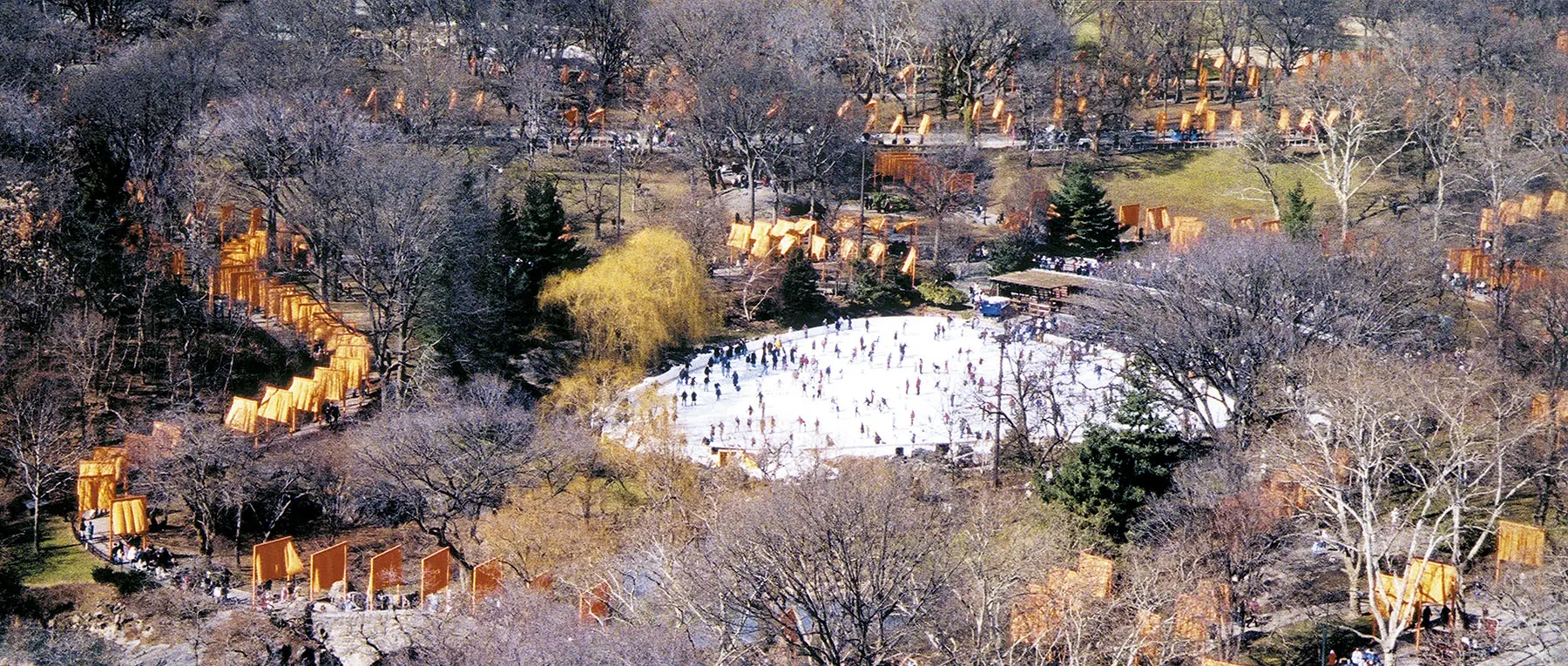
Before I saw The Gates, I had ruminated on these matters, so that by the day I went to see it I felt bad and perhaps unfairly prejudiced. Still, I was open to being proven wrong, for which I would be glad and happy, and arriving with minimal expectations, in fact, I may have been better positioned to appreciate the work’s virtues. On a Sunday afternoon with a clear sky and strong light, the conditions were optimal. I approached the park from the southwest and smiled at the Time Warner building on the far corner in which hung an interior orange drape that matched the color of Christo’s fabric, and on the glass doors of which signs announced: “Lincoln salutes The Gates” with the logo of the car manufacturer. From a distance, I could see that the park was already packed. With the Time Warner display on the one side and the crowds on the other, it seemed Commerce and The People were meeting happily at a huge party. To the eye The Gates appeared as an orange line drawing, snaking through the trees in several directions as far as one could see. The early drawings, it was now easy to see, had been a very accurate projection of the final result.
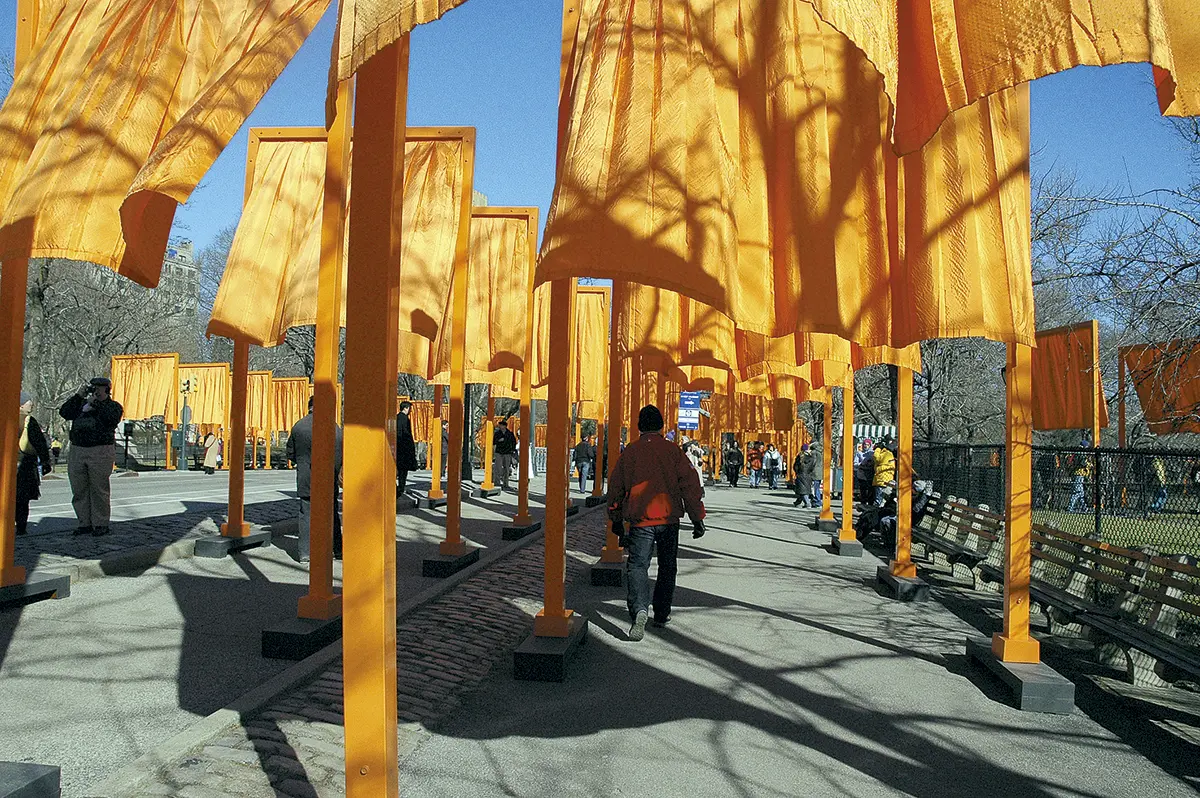
So, together with thousands of people, I walked along thinking I would feel something big—awe, or sublimity, or at least a child-like exhilaration. Any of these emotions would have transformed my skepticism into admiration. But it didn’t work. I gave myself perceptual orders like: Look at the patterns of the arches and the orange waving fabric; See the rhythm of shadows; Observe the light coming through the fabric with the setting sun. All these were valid observations, but no more impressive than what a fine forest might provide on a clear autumn day, and indeed something difficult to compete with.
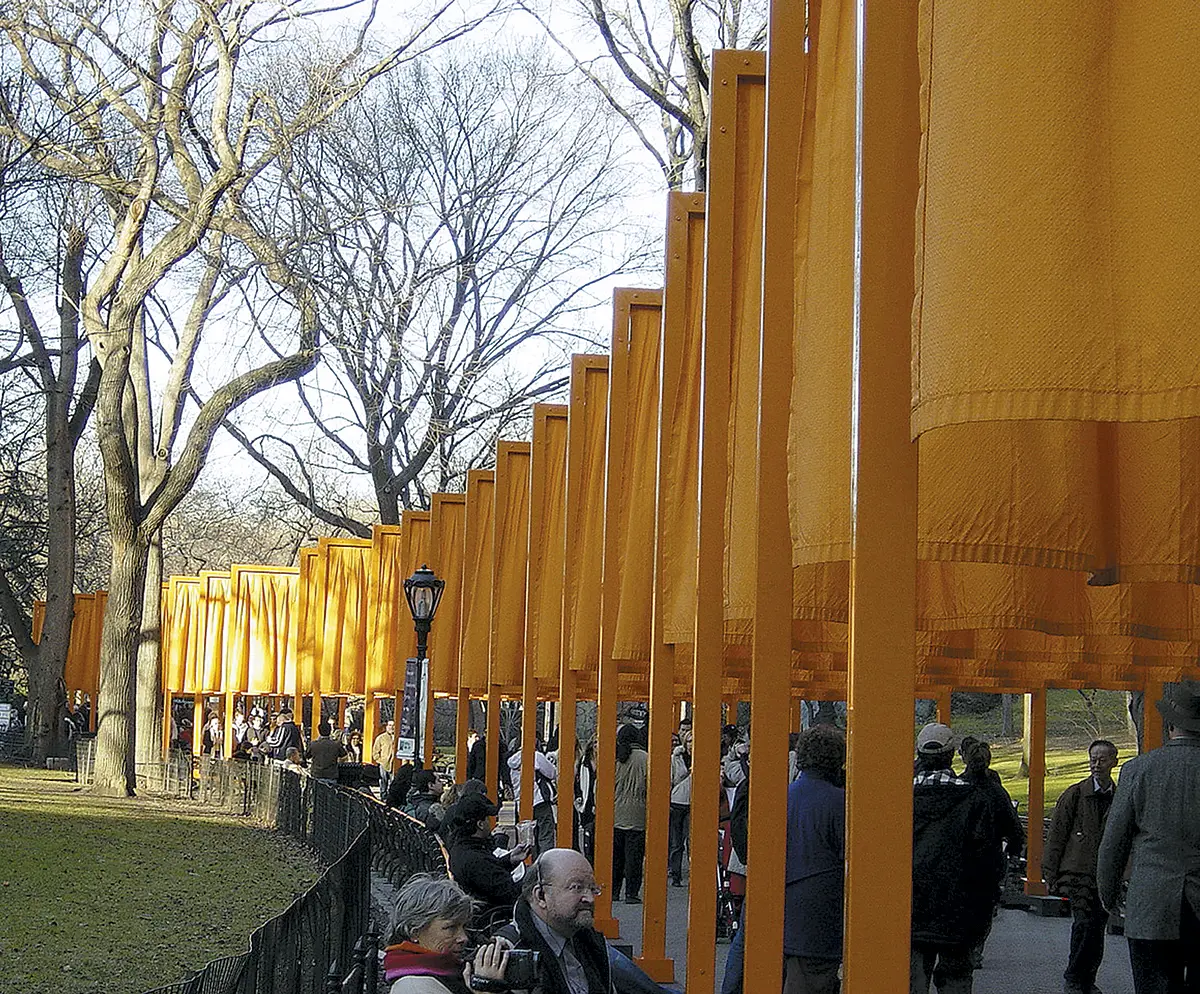
Then there were the people. The crowd seemed festive, as it would be on any promenade. It took more than a week of The Gates having been installed for it to be vandalized, a delay that for New York signaled proud collective ownership of the installation since the fabric can easily be reached with aerosol paint cans. The impression of historical importance had been achieved by means of continuous media coverage on television and in the newspapers. Every day for over a week, The New York Times had at least one article referring to different aspects of The Gates. Curiously, in spite of all the media attention the project had received, I heard very few comments in the park suggesting that people were moved by the spectacle. What seemed to interest them were the statistics, and the opportunity to be photographed with The Gates. Rather than an art experience, it was a tourist moment.
The guides who were there to answer questions also shared what they considered juicy anecdotes. I found out that early in his career Christo had sold a piece for $2,000, and later when he tried to buy it back, it was too expensive. A rich friend bought it for him, “and get this because it is a wonderful story—it recently it was sold for $2 million.” Seeing people walk away with swatches of orange fabric, I asked a guide where to get them. “From me,” he answered, “you have to ask a question.” I asked, “Can I have a swatch of fabric?” Offended, he said, “Come on!” So I tried again: “How tall are the arches?” “16 feet or 3 meters” and from a pocket in his specially designed apron he pulled out the piece of fabric signed by both Christo and Jeanne-Claude. Thanks to someone else’s question I also found out that the Christos came every day, and that at that precise moment they were somewhere along the 23 miles. Technically we were breathing the same air.
It suddenly dawned on me: we were all trapped in a mass moment of infantilization. It was yet one more instance of an assembly in the public square in which individuality is suppressed and one finds oneself conforming to a minimal standard of mental activity. Along the paths under the orange drapery, the comment heard most often was, “I don’t get it.”
I decided not to walk the 23 miles and
started to leave pondering the $21 million (half of both the amount that
President Bush initially offered the tsunami victims in South Asia, and the
amount that was spent on his second inauguration), and the orange color
invading the park as well as the pocket of my jacket. Christo’s fabric, so
clearly and indisputably “orange,” is not being called “orange” in the
publicity for the project, nor in most of the reviews. The preferred label is
“saffron.” Could it be because “saffron” elevates the project in some way and
hints at a dimension beyond the industrial finish of the gates? Orange is a
battle color in Northern Ireland. It’s the name of a British mobile phone
company. It’s an official color for construction sites, traffic guides, and
emergency services. Saffron, associated with Buddhist robes and exotic spices,
is so different, something above the ordinary, a little bit otherworldly. The
drapes probably had to be “saffron” to keep alive the mystery of the “What if”
question, even in the midst of a very concrete, earth-bound statement. Then I
read that Orange, the British mobile
phone company, is currently suing another company, easyGroup, on the grounds that “we have been unable to secure a
commitment from them not to infringe our rights regarding the color orange.”11
It may be only a coincidence, but it is one that illustrates the dangers of the
world of the spectacle.
The sycophancy of the guides raised other, deeper questions for me. Christo and Jeanne-Claude are admirable both for their faith in the project and for their perseverance over years in bringing it to fruition. It seems to be this faith and perseverance, more than any qualities of the result, that most impress his volunteers and his audience. The underlying arrogance of the Enterprise —taking over so much public space and public time— is simultaneously staggering and depressing. In some respects it is comparable, aesthetically at least, to a person of very little distinction but with lots of money deciding to become president of a country and succeeding. When, against the odds, this delirium achieves its goal without the quality to back it up, the witness is left with only two options: to accept on faith, or to reject and feel left out. Most people seemed to have chosen acceptance and, walking through the arches, many people signaled their faith by wearing something orange.
Looking at so many orange scarves and hats, I had a flash of insight. Had the crowd been a huge Hare Krishna gathering, The Gates actually could have worked. The corresponding songs and dance, the fake happiness, all would have brought the delirium to a complete and successful extreme. True, the result might have increased the number of acolytes of Bhaktivedanta Swami Prabhupada instead of those of Christo, but it doesn’t matter. This is all about spectacle, not about the personal following.
Edited by Selby Hickey.
NOTES
1. Man Ray made this piece in 1920 as an homage to the Franco-Uruguayan Comte de Lautréamont, whose image... the chance encounter on a dissecting table of a sewing machine and an umbrella, in 1874’s Les Chants des Maldoror, became a cornerstone of Surrealism.
2. The January 2, 1989 cover of Time magazine has an image of the planet wrapped in plastic and ropes.
3. The original proposal had steel arches that were 4.6 meters high rather than the current 3 meters.
4. Paul Carroll, “The Poetry of Scale,” Claes Oldenburg, Proposals for Monuments and Buildings, 1965-69 (Chicago: Big Table Publishing Company, 1969), p. 27.
5. As soon as there was a public interest in actually building his proposals (his Yale University Lipstick in 1969 was the first), Oldenburg seemed to drop his reservations. A follow-up question in Carroll’s interview about what would happen if they actually were built remained unanswered.
6. There is the allusion to the sewing machine in Man Ray’s piece, but not the certainty.
7. In fact, there are conflicting stories about the financial aspects of the enterprise. Sources other than the guides on-site claim that the drawings are being sold for amounts that range between $90,000 and $1 million. Still, other comments indicate that Christo would stop sales once the expenses have been covered. Some unsympathetic observers mistrust the $21 million claim and have tried to replicate the costs of production for the project. They arrive at only $11 million and speculate that Christo may have seriously overrated his hourly wage.
8. Guy Debord, Society of the Spectacle (New York: Zone Books, 1994), p.12.
9. Ibid., p. 32.
10. Ibid., p. 39.
11. Heather Timmons, “In a British Mobile Phone Suit, The Color of Money Is Orange,” The New York Times, February 19, 2005: C3.
LUIS CAMNITZER
Emeritus Professor at the SUNY College, Old Westbury.