
Coinciding with Mexico’s appearance as a guest country at ARCO, many Madrid institutions have presented, from a variety of perspectives, exhibitions of Mexican art. The Reina Sofía museum devotes two shows to Mexico: ECO, a walk through the current scene led by Oswaldo Sánchez and Kevin Power, and a show of works by Gabriel Orozco, at the Crystal Palace in Parque del Retiro. Both shows reveal the way in which over the past decade the Mexican art scene has asserted a flexible and versatile, reflexive and critical vision that is ready to build very solid ideas with common materials, which determines an austerity in sophistication, as well as attitudes that are attentive to physical and social space and its changing, fleeting conditions. On the other hand, what both shows make abundantly clear is the radical importance and influence of Orozco’s work in the Mexican scene, translated especially in an affirmation of critical and playful attitudes, in the importance given to the senses, the uses and meanings of things, much more than their shapes, and in the experience of processes as a work of art’s unavoidable, essential nucleus.
Usually, the Crystal Palace is used by artists as an experimental space, apt for installations and montages. In this show, however, Orozco has generated an exhibition space imbued with a metaphysical character, taking great advantage of the unsettling feelings provoked by its appearance resembling a large, empty greenhouse surrounded by the park’s trees. The show gathers pieces dated between 1992 and 2005, none of which has been conceived as site-specific for this show. On the other hand, although the show includes emblematic works such as Piedra que cede (1992), among others, it does not give the impression of being a retrospective.
On numerous occasions Gabriel Orozco has expressed the importance that his stay in Madrid in the mid-1980s had for his artistic development; it was a personal learning experience in dealing with objects and with a chance. Probably also because of that one would perhaps have expected an intervention in the Crystal Palace space, specifically conceived for it, including new pieces. But perhaps precisely due to that, because an option to include new stuff was within the realm of the predictable, the artist decided to present a very different project, with a disconcerting show that teaches us how to look upon reality “the Orozco way.” The truth is that this is the first solo show of works by Orozco in Madrid, and this exhibition closes the gap with intelligence.
That is why we are so far removed from a traditional museum arrangement: what constitutes the backbone of a full-fledged intervention in the space is the very mise-en-scène. The show is, to be exact, an installation, conceived and planned so that the museum, in a location that is not a museum, resembles something else without it being anything other than a strictly orthodox, yet nonetheless different, art exhibit.
Orozco seems to have turned his priorities upside down, highlighting the site’s exceptional, unsettling character in order to allow for a scenographic, itemized reading of the different pieces. Perhaps his insistence on the way of exhibiting is in part determined by the fact of not having a stable study, living between several cities and working in a very flexible manner, in situations of transit, and using everyday experiences to structure ideas and works.
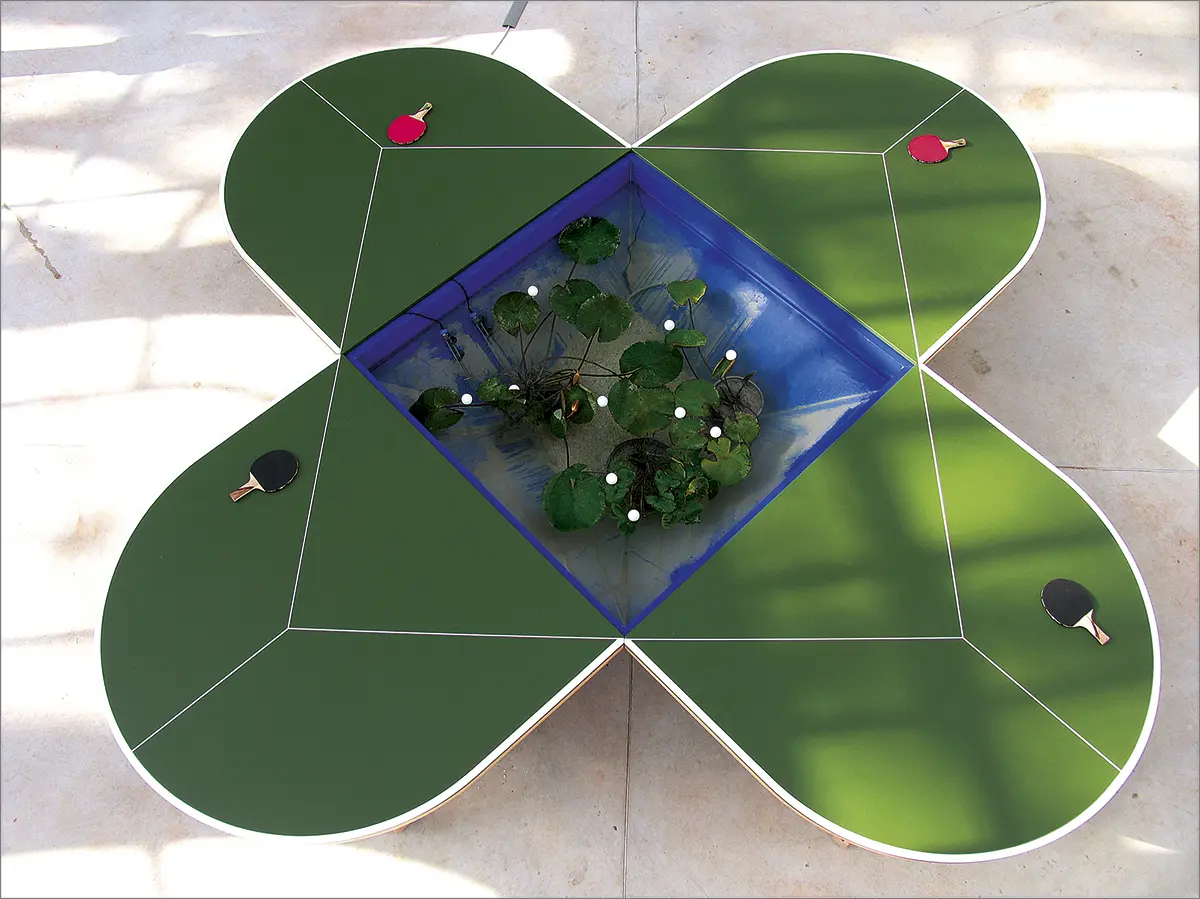
In reality, the show builds a space in the shape of a fantastical cabinet from which it is possible to point both the inquisitive character of the artist’s gaze and his visual agitation strategies or attitude. Around the space’s perimeter, alongside the large crystal windows, several small pieces that work as concise objectual poems, are presented at regular intervals and inside very similar display cases. Meanwhile, at the extremes of the large building, we find larger works that, like Oval con péndulo (1996) or Mesa de ping-pong con estanque (1998), mark the space as a place for playful encounters. Occupying the center of the exhibition area, asserting itself as a monument to the show itself, is Sombra entre aros de aire, presented in 2003 at the Venice Biennale. It is a wooden replica, in 1:1 scale, of the Pensilina conceived by Carlo Scarpa in 1954 for the Italy pavilion at the Biennale’s Giardini. Scarpa’s piece was a base on which various sculptures were placed: the architectural component assumed as a radical displacement. In Venice, Orozco’s piece, placed near the original and separated from it by a folding glass door, posited a mirror-like relationship of repetition and silence; in Madrid’s Crystal Palace it acquires a very different meaning: it adopts the pose of a fetish, assuming the proportions of a hollow, grandiloquent colossus, and it seems to be presented as a caricature of what we understand for architecture and for exhibition. This architectural presence transforms the old greenhouse space into a box, into a transparent and allegorical container: like the Caja de zapatos vacía Orozco presented in Venice in 1993, the game consists in transforming the simplest thing into the most complex one.
There is an element of play in all the works. Many of them are recognizable as games or take a game idea as their starting point, but the artist has changed the rules or established new ones for new games with found objects or site-specific objects. In a way, through these subtle variations in the rules of his games, Orozco seems to be inviting his viewers to reconstruct the meaning of their own instinct for play. Questioning both appearances and common sense. His pieces tend to come across as spaces or elements for play that need to be reinvented and outfitted with new meanings, but through an exercise of the body in which action and movement achieve a new dimension. A debate is established between movement as process and change, and stillness as contemplation and exhibition. His pieces are connected to each other through the unsolvable contradiction that at the same time unites and separates appearances from recognizable things, meaning from use, the visual from the manual.
At the end of the day, what Orozco offers is a lesson in simplicity, to unveil the complexity of his gaze.
SANTIAGO OLMO