
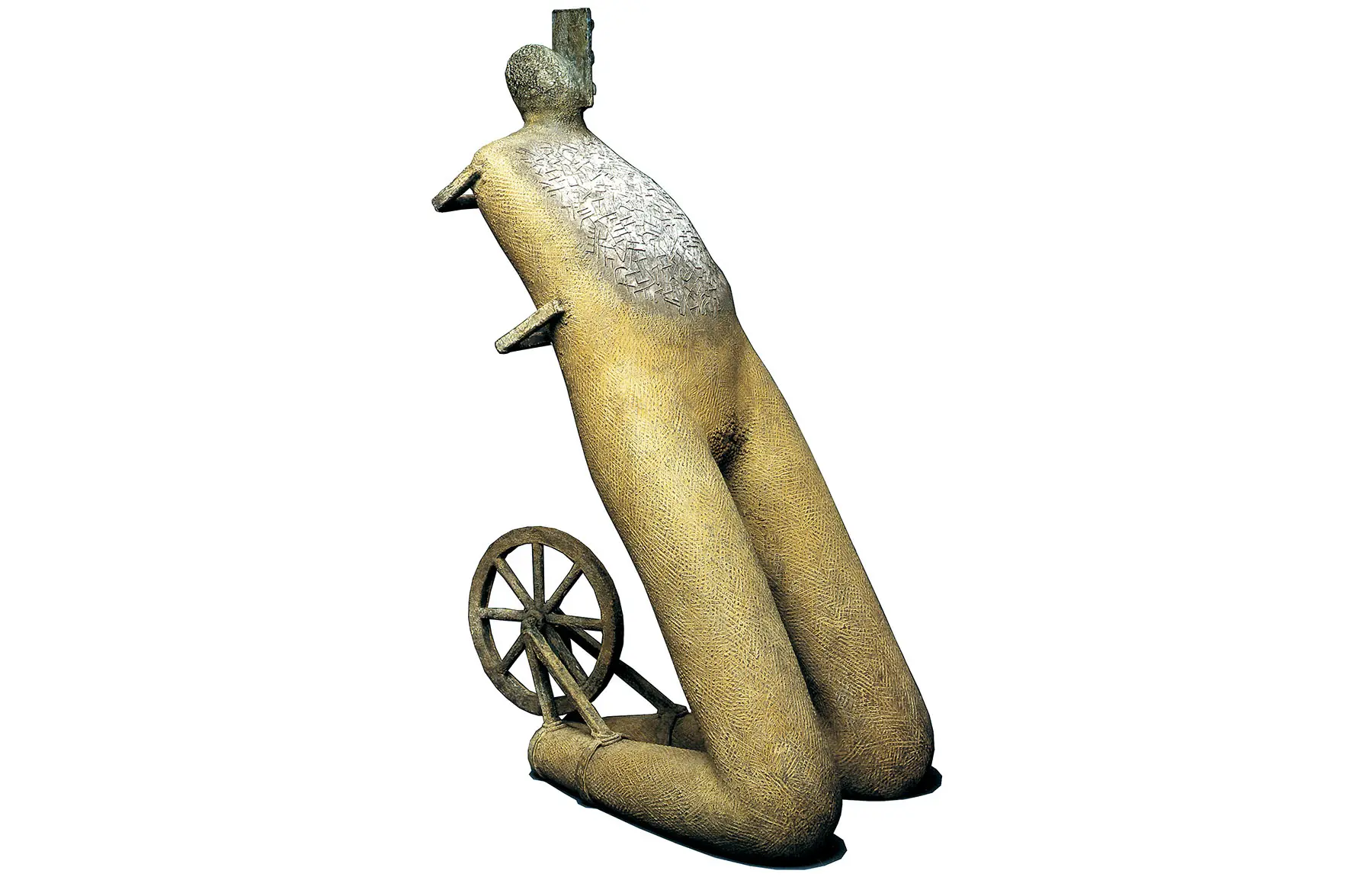
The ambivalent
draftsman who draws sexuality in a state of exasperation, with his
finger-penises and his nipple fruits, comes back now to one of his oldest
obsessions, one that already in 1959 drove him towards the path of sculpture.
These seemingly solid metal masks cover and protect a vacuum. That by opening their doors, by means of rough and explicit hinges, allow us to peek, as in Doored Chest 2000, into an ancestral tabernacle: that which is engraved on the hearts of men. While his love letters, some of them salvaged from flea markets, were glossed and adorned by his labyrinthine writing, now, in the mentioned piece, an original alphabet of angular geometry refers us to the origins. To the very beginning of the world.
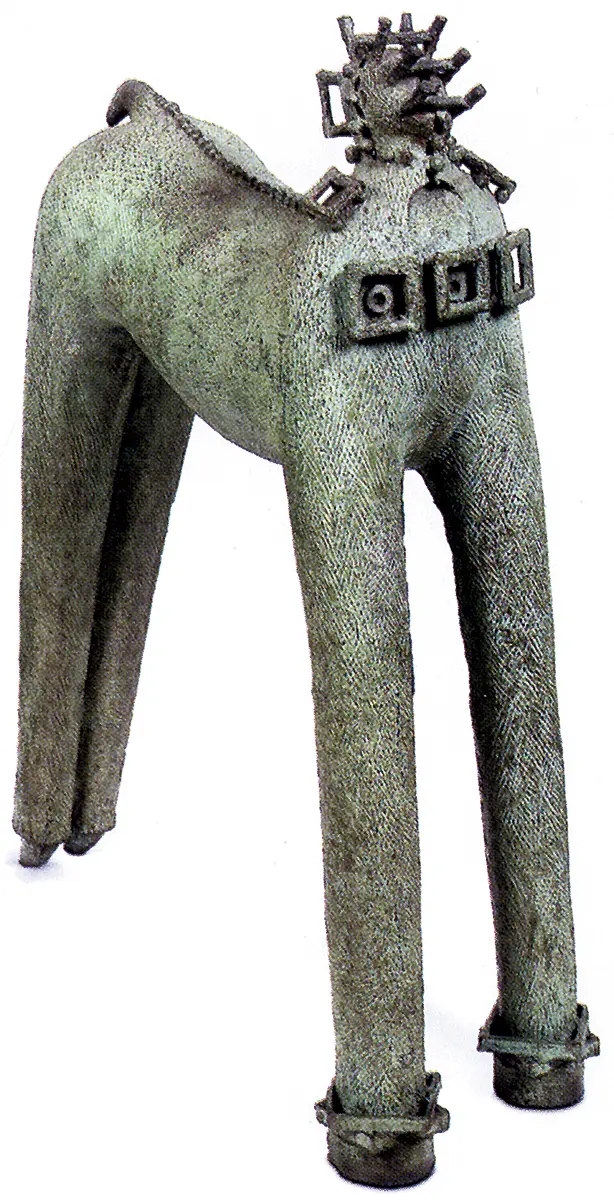
There is indeed something archaic in those torsos, planted in a space of their own, which can take us to Quimbaya ceramics or to a figure, also with a smooth torso, from the Cyclades islands. But there is also something precarious and defenseless in the Sebastián from 1993, with his typical arrows. The bronze in which Jim Amaral resolves his sculptures is in no way a guarantee of firmness and stability: it will be perforated, surrounded by energy orbits, tied down, or mended, or more explicitly, in Secuestro. Mujer sentada, dated 1996, we will see how the straps tense the helplessness of that humiliated body condemned to arbitrary immobility. Her face, a prisoner also behind a grille of horizontal bars, reinforces the importance of the piece, by looking towards heaven that with no doubt will take a long time to respond to her prayers. Yes, time, with its millenary patina of grays and greens, oxidized goldens, and blues, enhances the sensation of figures extracted from imprecise mausoleums or remote tombs.
Only that, unlike the Chinese warriors and their nervous horses, these helmets and shields, arms I spiral, and guard dogs seem to have been spirited away from the erosions of time and suggest their entrance into mythology’s circular orbit: in his titles, Amaral reminds us of Thyresias and Narcissus, the Minotaur and the disappearing swans of Indian mythology. Not to mention the sphinx and the fascinating photographic recreation he did in Chile, with dwarfs, as part of Roberto Edwards's Cuerpos pintados project.
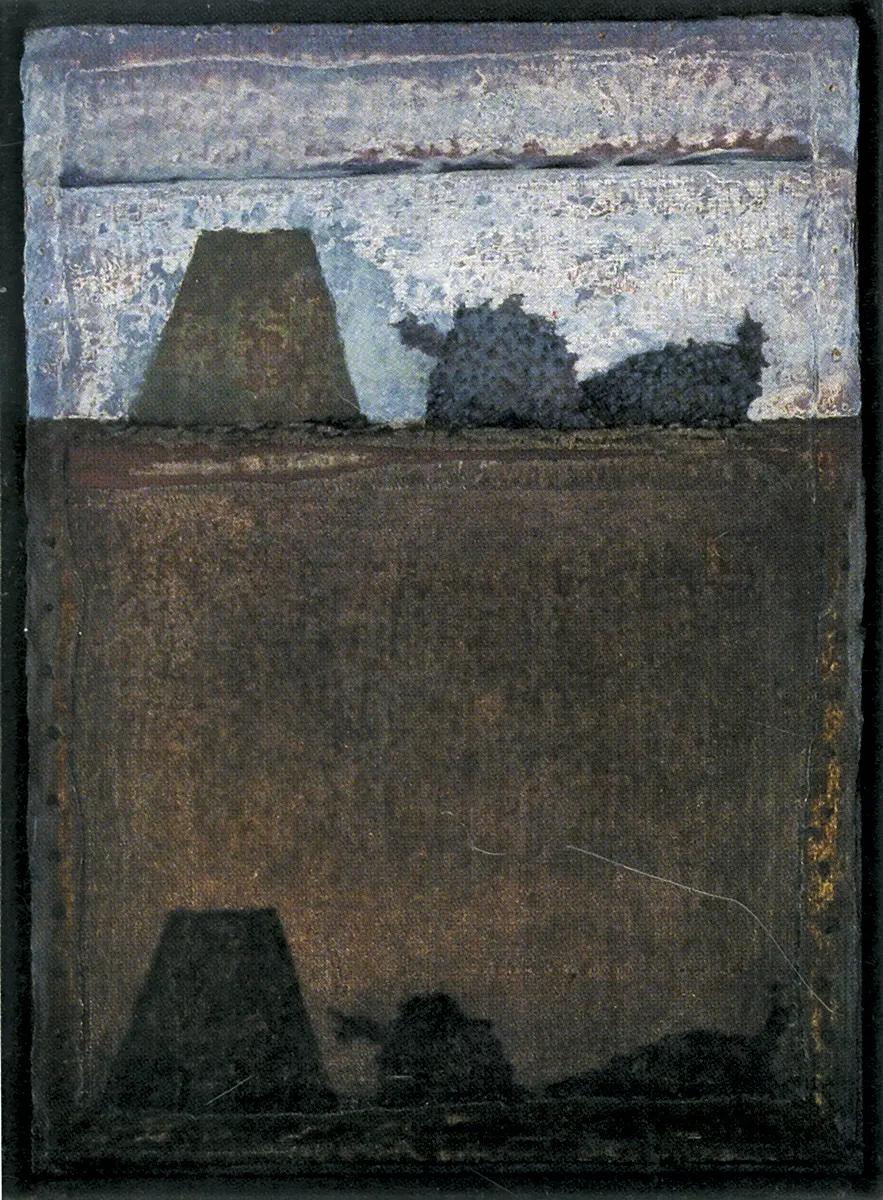
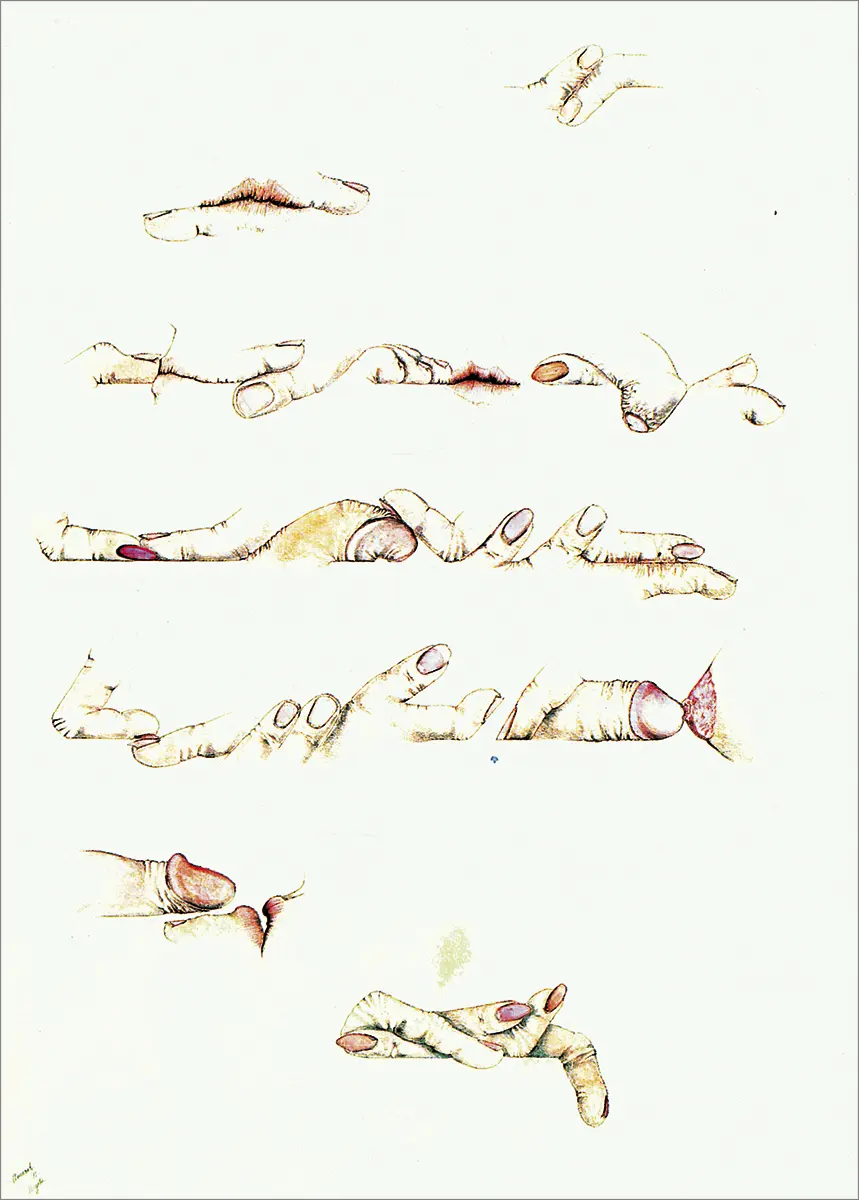
These satyrs, this chubby Bacchus with a purple penis adorned with the bow of a cheesy necktie demonstrate his dual ability to restore myth and show at the same time the questioning of all visual certainties. He had already seduced us with his landscapes of fingers and fingernails, phalluses and vaginas exhibited in a rhythmic sequence of variegated panels.
Only that the contained strength emanating from those thighs and torsos, in rough metal, remains the same sexual energy that explodes and circulates in his work as a whole, overwhelming and unstoppable, be it in those color cartoons of promiscuous couples joined in static copulations, dated today, or the unadorned man on a donkey, with an explicit penis, that opened his first individual show in 1964 at El Callejón gallery, and which now serves as a starting point for the long journey of his Transfirguraciones, the vast retrospective that with such dedication and intelligence Santiago Londoño has curated at Biblioteca Luis Ángel Arango.
He who scratched the skin in search of evasive pleasure now becomes volume and dilates his dimensions in an atmosphere that binds and constrains. That refers us, always, to the central loneliness that governs these creatures. Isolated, unique, with broken wings, a man-tricycle of 1992 may well allude to those unbelievable carts used by quadriplegics in order to move around, ad if Amaral’s entire world, proliferating in wheels, had remained trapped by the indubitable terrestrial weight of these stocky shapes, exposed in their captive frontality. We will thus see that both the poet ad the woman, in works from 1995, will be bound by straps, not only in order to break the plane but also to suggest punishment.
A strange world, then, of strength and helplessness, of loneliness and shields, of grilles and strappings, to emphasize the undeniable virtuosity of his métier. Because, as we inspect them up close, and especially as we touch them, many of these faces have ended up covered by a veil of tears. The solid cascade of metallic droplets covers the unexplored depths of their pain as contemporary piets that, deformed by helplessness, await the hand that will alleviate their orphanhood. We need to touch these bronzes of an agonizing green, with their guard dogs dressed in suits of nails, to access a sacredness of disappeared empires. Of extinguished mythologies.
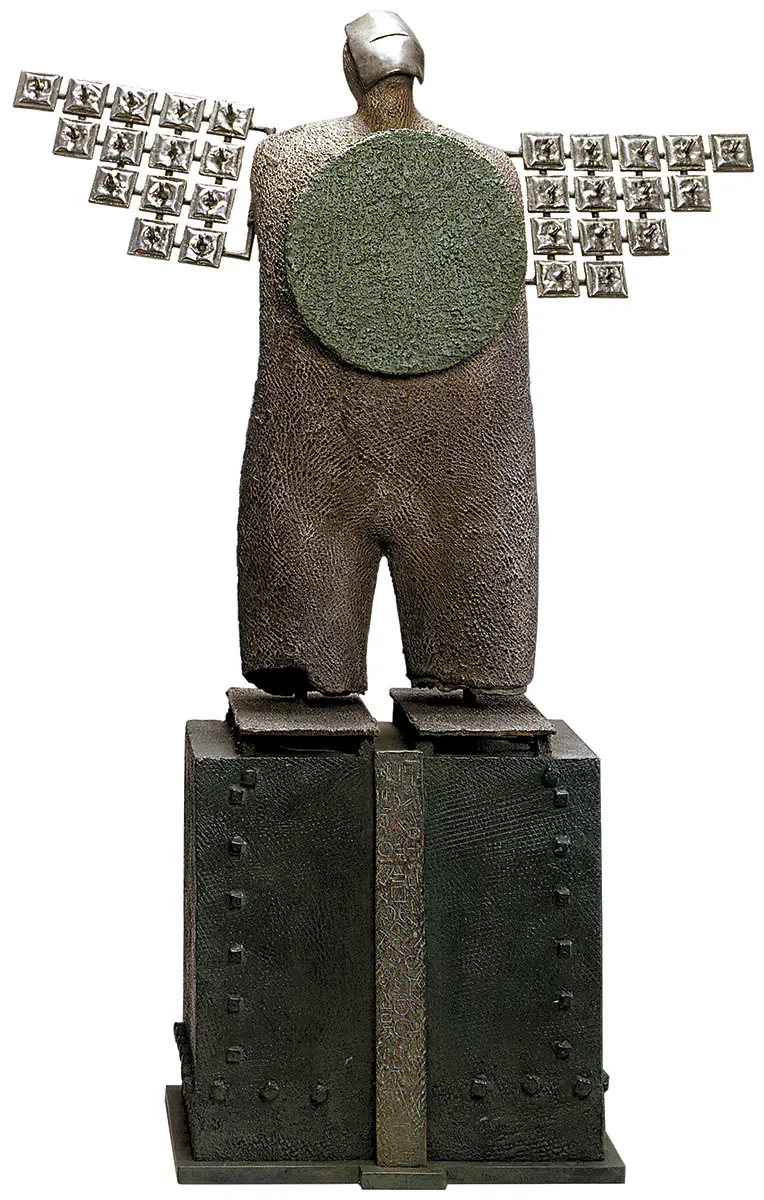
The energy and the ambiguity that fueled his art and drove him to express himself through that sexualized flora of disquieting bulbs, and through the equivocal displacement of those outlines of anatomical cross-sections of the brain, plethoric of fingernails and fingers, now exist under the imposed limitations of metal. Even so, these volumes continue to struggle to be freed from themselves Angels or swans, centaurs or victims of torture: the wheels of freedom can also be, as with the Inquisition, the torture rack. An instrument of pain, pleasure, or agony. For stretching matter and making the petrous flexible, thus carrying forward the infinite wheel of metamorphosis. The sense of touch, already manifested in his initial drawings on plastered paper, is perhaps the dominant sense giving order to his quest. But that touch, and that sharp gaze, also record a world in the throes of extinction. Frutos de duelo, from the 1980s, was the title of one of his most moving series, in dark hues and lugubrious perspectives. An elegy to that which is extinguishing, but the pain that rotted those fruits ended up redeeming them in the solitude of that contemplation over our final moments. A desolate planet governed by death, and which is to be found, Eros and Thanatos at once, on the double human face of its creative impulses. That is why, with his sculptures, we come closer to the terror of seeing that those warriors and guardians do not protect us even from ourselves. They watch over the terrible secret of the world we live in. A poor, unsafe, violent Colombia that attempts to render more humane, through art, a world of failures and impossibilities. Of physical and spiritual closures. The old sexual ambiguity is diluted now. Those eyeless, senseless faces are more expressive than any documentary photograph. The only thing left is the valuable and valiant testimony with which Jim Amaral, from all that pain, offers us dear roughnesses, insomniac vigils, mute dialogs, and that craft that, because of its uprightness and honesty, sustains his implacable vision: the one that punctures, with its metallic hardness, all lies, and gives us instead of the piety of its deeply embraced solitude. The solitude of new and necessary mythology for the crudity of this time degrades by a death entirely devoid of its meaning.
JUAN GUSTAVO COBO BORDA
Art critic and writer.