
Last March, it was possible to see three simultaneous exhibitions of works by Juan Antonio Roda1 in Bogotá: a retrospective at the Museo de Arte Moderno, a show of his portraits at the Sala de Los Reyes Católicos, and a unique exhibition of state proofs of his engravings at the Museo de Arte de la Universidad Nacional. The retrospective at the Museo de Arte Moderno made clear Roda’s vitality as a painter, that ability to transform a white canvas into a place in the world, a location, build with his references, his affections, and his energy. It was also an expression of “that strange awakening of the artist towards each gesture, towards each act,” as he put it in one of his numerous interviews.
However, I chose the exhibition at the Museo de Arte de la Universidad Nacional because, as I said, it is a very unique show. It presented the state proofs of engravings created between 1972 and 1978. An exhibition at the heart of the Universidad Nacional, which allows us to inscribe Juan Antonio Roda’s oeuvre within a contemporary thought and a never-ending debate about the teaching of art —if such a thing is possible— that attempts to make students into ethnographers of what occurs outside, in the streets for example, or, on the contrary, to make them into divers who explore the depths of their personal emotions. Already Roland Barthes pointed out a way to solve this dilemma when he asked for subjects aware of all their cultural influences and capable of administering them at will. Or Paul Auster, who suggests we meditate in one of his favorite lines: “The world is in my head, but my body is in the world,” a strange and powerful way of inviting the subject to negotiate between an inexhaustible, almost saturated field of references, and the often “impoverished” space he inhabits.
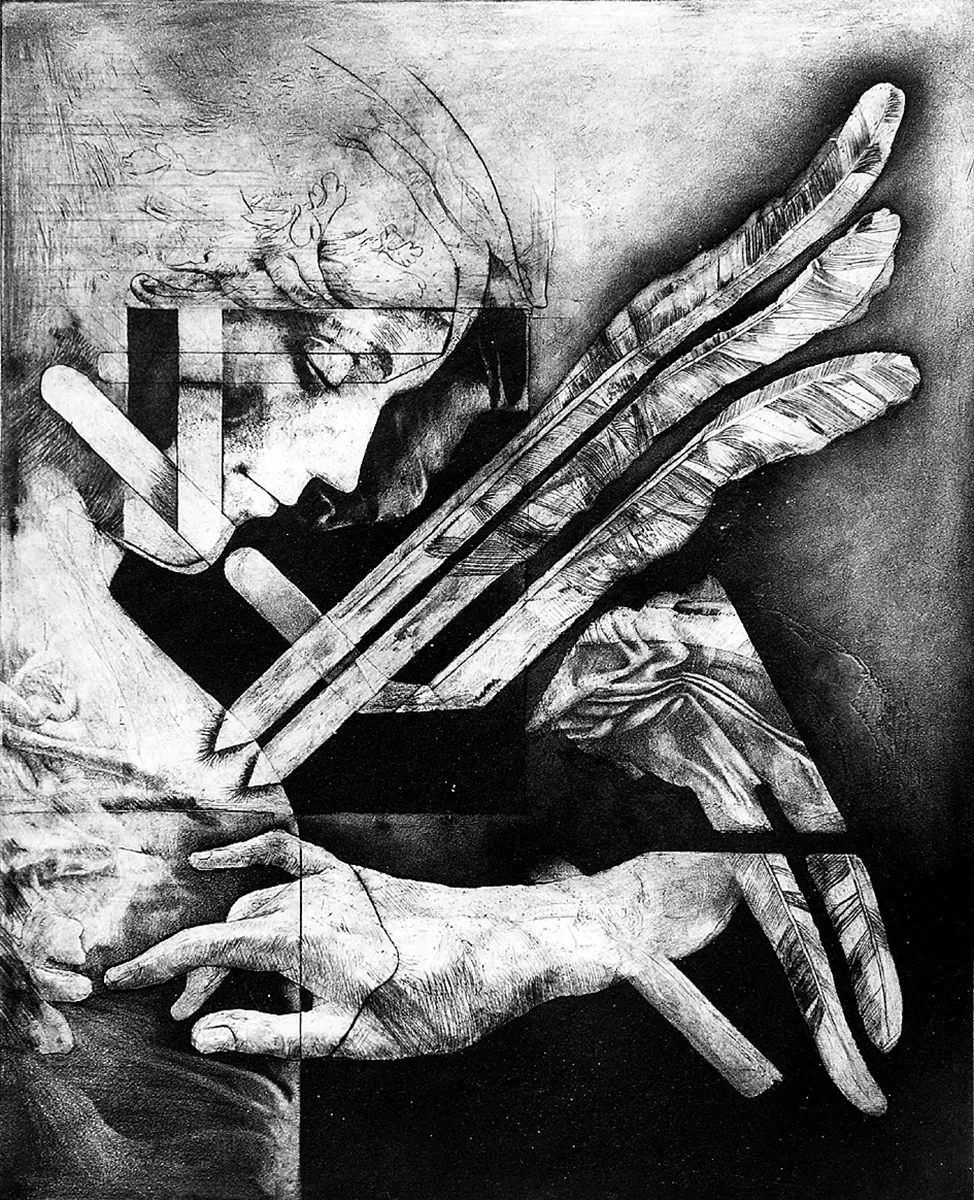
1972-1978: if we think about the dates of these engravings, they are undeniably an expression of the period’s way of thinking, and it can be summarized in one word: unfolding. While I walked through the museum galleries, it was inevitable to remember American artist Robert Rauschenberg, who decided to unfold his childhood experiences, the meeting points with his friends, or the news excessively accumulated in memory, on a series of panels in space. And the word “unfolded” meant at the time something like letting the contents of thought show through the paper, with references to small things of great interest, as a tracing of halting thought, an exercise, in the end, of freedom. “Homework, never do homework” was Susan Sontag’s advice for students; perhaps the only one would be to conduct an ethnography of their own consciousness and to rescue themselves as subjects.
I encounter these words by Roda: “Poetry is the impact of human beings upon things, it is a kind of spark that appears as we face reality and expresses life as it causes impressions; perhaps it is the arrival of a memory; it is an attitude of abandonment, an attitude of letting oneself be taken over by a line and a color.”
Perhaps for that reason, printing the steps in the labor of engraving, often so abstract on the plate, is to give value to each thought as proof as decisive as the final one. It is to transform paper into a field for the exploration of live, simultaneous metaphors, and, why not, to assign emotions a place. In El delirio de las monjas muertas (1973), for example, the face sometimes is a pedestal, sometimes it floats, and sometimes it is a flower. Also, the paper here is a field of references to the history of art, where we recognize Bernini’s Beata Ludovica, or interest for the qualities of the line, such as the one Picasso had at one time in his Suite Vollard.
1972-1978 are the years of a defense of “imperceptible human gestures” that started to occupy the place that belongs to space. The Barcelona artists that Roda knew in-depth, with Antoni Tàpies topping the list, discovered for us that the gesture, no matter how “street-like” it was, comprised a presence that had a life of its own. In these proofs, we recognize graffiti lines or imperceptible shifts in a gaze’s laugh or in the hands.
1972-1975 is also a period of the sign’s independence as a critique of rigid representations and —again— a quest for freedom, to place certain figures next to others in an unstable superposition; the freedom to explore floating meanings. And it was the time when the methodology employed by abstract expressionist artists reigned supreme, with always surprising results and with contemplative situations that could be erased suddenly, for that place to be occupied by light or shadows, the rhythmic tapping of a pencil, or simply the act of scratching the plate or paper. I can’t forget that suddenly the brain of one of the nuns is erased and a sign appears, an X, brought over from the universe of painting or from a street wall. The back zones in Laughter (1972) are slowly populated with energies.
But the 1970s were above all a time for artists to take positions in order to find meaning in society Amarraperros (1975) and Punishments (1978) are in the history of Colombian art the affirmation of the methods of an artist who, from an independently built observation point, watched over a repeated history of injustices in the exercise of power.
NOTE
1. Juan Antonio Roda was born in Valencia, Spain in 1921, an lived in Colombia from 1955 through his death in 2003.
NATALIA GUTIÉRREZ