
Almost fifteen years after the tribute of the large retrospective of her graphic artwork during the 9th San Juan Biennial (1991), Liliana Porter returned to this city with two projects: a large-scale mural for the Domenech City Train station and a one-person show at Petrus Gallery titled, Ciervo/Querido y otros raros encuentros.
On the earlier occasion, Shifra Goldman noted in her catalog essay that, despite her many technical explorations in the graphic arts, there was “continuity with the fragile refinement of Porter’s formative years in Mexico.” Today we have to concede this is a key feature of Porter’s artistic proposal, even if the media she employs are as varied as those on display at Petrus (painting, photography, prints, and installations).
Her terracotta mural for the train station, El viajero, takes as its point of departure Puerto Rico’s ambitious public art project, and in the pieces shown here, Porter develops a stylization akin to what has occurred in her prints since the 1960s, even those to which she added extraneous collaged elements. Such stylization is not formal —this might sound contradictory— but iconographic because Porter uses objects and figures that produce an image linked to the realm of childhood toys and picture books.
The scene that lends its title to the exhibition Ciervo/Querido (2001) seems to be a print extracted from a fairy tale. It depicts a deer on an elevated rock, on which some vegetation sprouts. The deer, black with white spots that harmonize with the leaves, points its muzzle upwards, creating a decorative image. The wordplay of the title is disarmed by the work’s beauty.
Danza (2004) is an entirely different piece. It comprises a photographic triptych representing three moments of a dance of a couple of formally attired little dolls. The sequence registers a 180-degree turn, and its disturbing aspect lies in the fact that the female figure has been decapitated. Although the combination of little dolls, so common in Porter’s work, is infinite —the artist has assembled innumerable humorous, intimate, and even risqué scenes— the female figure’s mutilation and the rotating movement (one is inevitably reminded of a wedding cake) give the piece a critical meaning.
Sequential movement —although it can be inverted, that is, the camera may rotate around the couple— denotes temporality. Porter has used this resource before, for instance in the classic Arruga (1968), a series of photoengravings also exhibited in the 1991 retrospective, that visually narrated the process of crumpling a piece of paper. The Danza sequence implies a representation of movement and photography serves as a support for its registry. In other words, it works as its re-representation. In this way, Porter retains the ambiguity of the interplay of representation that her earlier work possessed.
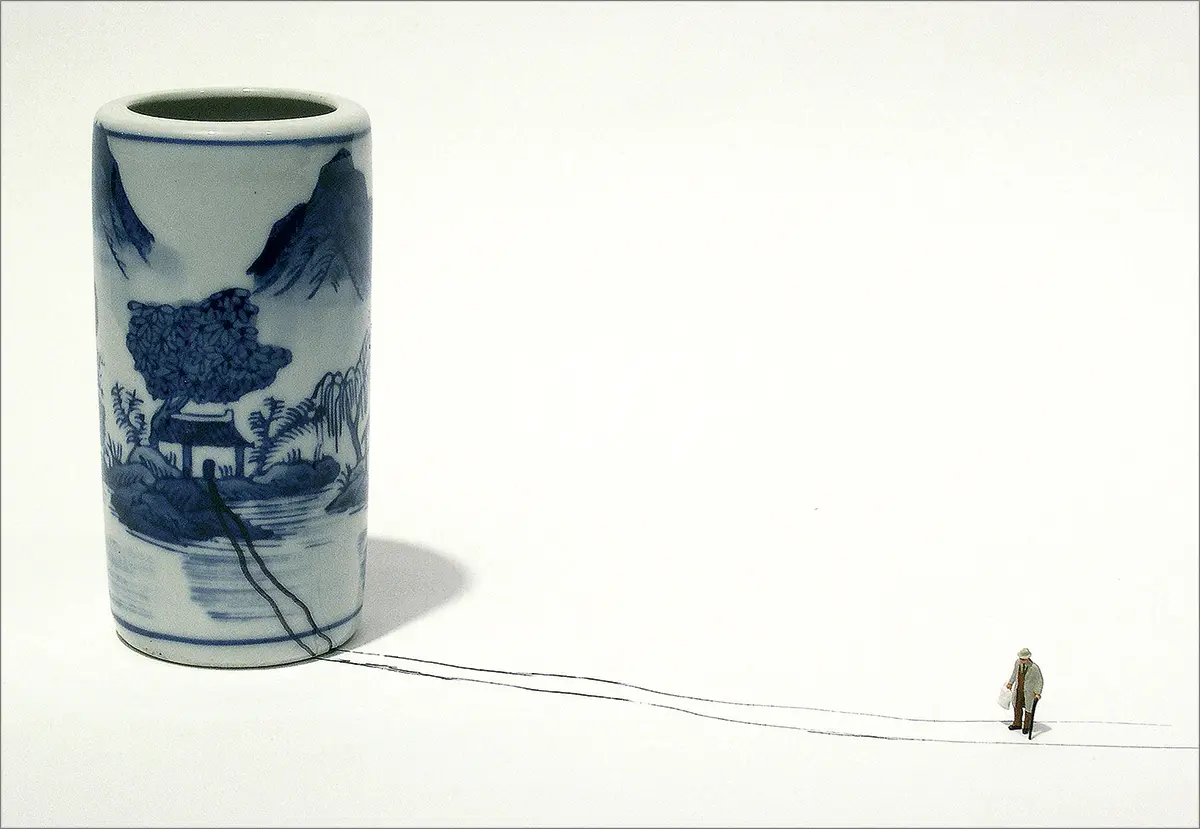
Illusionism is a key resource toward achieving the ambiguity between the real and the fictional, along with a refined delicacy. In Regresar (2004), for instance, Porter traces a line from the contours of a path drawn on a vase to the feet of a free-standing figurine. The line turns the arrangement of objects into a landscape by breaking the closure of the space of representation, in this example, between the vase and the figurine.
The “arrangement” of objects, in this case, toys, is an emphatic aspect of the work and relates to the English term “make-up,” as preparation for representation. On this point, Porter’s work is connected to Lewis Carroll’s, whose works she has cited in veiled allusions and with collages of texts. Both artists refer to the realm of childhood images in order to tell their stories, yet go beyond it in an explosion of meaning produced by their constructed situations.
Another fact links Porter to the author of Alice in Wonderland. Carroll was a practitioner of pictorialism, the tendency among certain photographers to mimic painting in order to add an artistic value that could not come from the camera to their photographs. Conceptual artists, who, like Porter, did not renounce certain traditional artistic values, have appropriated his methods, although their ideological background is completely contrary to his. The pictorialists hid the arrangements of their representations, while conceptual artists are interested in displaying them.
Liliana Porter belongs to this aestheticizing conceptual art tradition. The evolutionary, seemingly paradoxical line she follows from the flat surfaces of Arruga to the volumes of a painting in “flat” colors (for example, Red with Mickey Mouse), observes the same rigor of presentation to which pictorialism naively subjected itself. Her loyalty to the “fragile refinement” mentioned by Goldman along with her reflective fables about humanity and society have gained Porter great prestige in the contemporary art scene.
ELVIS FUENTES