Campos latinoamericanos, an exhibition of works by Miguel Ángel Rojas and Regina Silveira presented by Alcuadrado / Arte Actual, promotes a series of reflections about the relationship that contemporary art establishes with its exhibition places, with the immediate present, and with history.
This is the fifth show presented by Alcuadrado / Arte Actual, a “nomadic” gallery concept that finds different sites in the city with the purpose of “re-elaborating created spaces,” recovering the value of buildings, warehouses, and the city itself, as well as of “reinventing the space of art.” Campos latinoamericanos has been installed on the first floor of the old Bogotá Hilton Hotel, designed by architect Fernando Martínez and destined to serve as housing for officers of the National Police Force, which it never did. The building is now vacant. The first floor, designed to serve as a Grand Hall, was never finished. Used now as an exhibition space, it differs from the aseptic modern gallery, with its tall, impeccable, neutral white walls, appearing as a space loaded with connotation, a space with a character that is all of its own. Its dilapidated, half-built appearance, is neither silent nor harmless. Its unpainted walls, its exposed iron beams, and its uneven cement floor force a warning for visitors to walk cautiously, directly affecting both works and viewers, because ruins are in themselves an invocation to memory. The arrangement of Silveira’s and Rojas’ works emphasizes the site’s architectural structure: a concave shape is inhabited by the Brazilian artist’s long black shadows, while Rojas’ pieces occupy quadrangular areas that open, like niches, in the first and second floors.
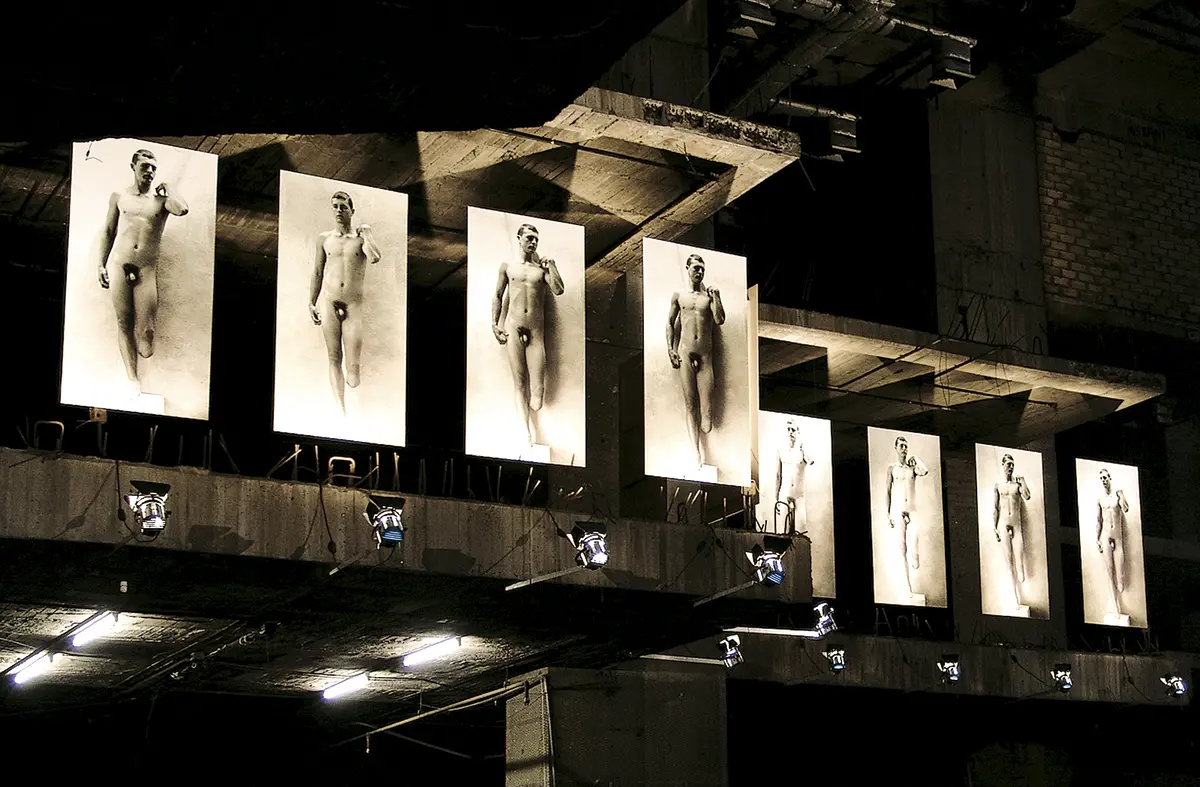
David is a sequence of twelve two-meter high photographs installed on the second floor, impeccably made, possessing all the attributes of beauty that since the Greek and the Renaissance periods have irradiated over Western culture. These black and white images, printed on color-photography paper, establish a dialog with the dilapidated site, with the bare iron beams and the rough cement walls. From the start, the man’s pose, the perfection of his body, and the handling of light allude to one of the paradigmatic figures of that old conception of beauty: Michelangelo’s David. But with this David, Rojas brings forth a sign of ruination in its beauty, telling a story of deterioration: one of his legs is missing a foot from the ankle down. A first reading refers to so many beautiful nude figures mutilated by the action of time, the armless Venus, the Discus Thrower, or a headless and armless Aphrodite, figures of Greek art that strut their incomplete beauty in the world’s greatest museums. But this David by Miguel Ángel Rojas is not a sculpture, it is the photograph of an actual man posing as such: standing on top of a pedestal, a figure that at first sight appears, thanks to the careful handling of light, like a carved body. This photograph depicts the nude body of a young and beautiful soldier, mutilated by one of those infamous anti-personal mines that have crushed the bodies of children, men, and women in countries where the tragedies of war are a part of daily life. In this contemporary David, the paradigm of classical beauty is enormously moving. This image is loaded with many contradictory connotations: beauty and war, creation and destruction, life and death. An image traversed by so many other images taken from the history of art, from its paradigm of beauty and maximum spirituality (remember that for Buonarotti, beauty has moral aspirations; his ideal of beauty is linked to an act of consciousness that aspires to the Good and to Truth.) On the other hand, it is also traversed by images from newspapers and newscasts that broadcast the “disasters of war.” It is traversed by newspaper chronicles, by narratives gleaned from the media and on the streets. This image of contemporary art as it harks back to the beauty of past times is signaling towards the world that makes it possible, a world in crisis where the human body is degraded and violated on a daily basis.
Precisely underneath these photographs, we find Quiebramales, an installation by Rojas using pencils stuck on cement plaques, carefully aligned. The audio of many children’s voices –part of this installation– takes us back to the world of school, to the playground, but the way in which the pencils are grouped links back to the structure of the mines. This mine-ridden field has its flipside on those education services that are scarce and inaccessible in Colombia. The video Borde de pánico shows a hand drawing on the surface of the city of Bogotá, as indicated by the manhole cover with which the video starts. The pencil moves along the pavement, and as it draws an outline it passes by indicia, blood stains, and urban textures formed by traces left by an incessant activity. The audio contrasts with the children’s laughter heard before, it is blunt and deep, like the dark, hidden area where it is installed.

Regina Silveira’s work has a less emotional character than Rojas’, her language is more conceptual, but not less sharp and effective. One of the subjects this Brazilian artist has dealt with more insistently has been the subject of shadows. Huge black shadows projecting a group of executives, or a man reading a speech, are printed on vinyl to create threatening and precise shapes, arms, and tanks basting through the gallery walls painted in white. Other shadows, shaped like Xs, crisscross over various pieces of an impeccably white china set, creating a place of censure and danger in the realm of domesticity.
One of the show’s most significant pieces is To be continued. Latin American Puzzle, where Regina Silveira also alludes to history, the images evoked by this region, the exoticism of female dancers, the image of Ché, Indian faces, animals from the rainforest areas, sharing the space with portraits of politicians, public personalities, and religious figures; images taken from newspapers, magazines, the movies, icons that circulate through the different mass media. These pieces, which do not end in a clearly decodable image, leave unfinished zones, blank spaces to be perpetually filled by the course of history as a historical narrative in progress that omits any legible articulation.
As Natalia Gutiérrez, author of the exhibition’s title points out, these two artists “have in common the construction of artistic fields defined by opposition to a complacent vision, and bring to the table pertinent ways of reasoning and perceiving. They outline a region of questions that are sometimes impertinent and for that reason invisible, and which these artists want to render recognizable in space.”
MARTA RODRÍGUEZ