
Pancho Quilici’s works exhibited at the Fundación Corp Group Centro Cultural pose new readings around a topic that becomes dense and profound in conceptual terms, and increasingly complex and elaborate in compositional terms. The artist achieves new and suggestive associations that transcend the domain of the visual and the plastic and project themselves into the expanses of infinitude. On this occasion, he has enriched his theme of harmonious cosmogonies with elaborations of three elements that are fundamental to his artistic language, properly explored in this proposal: the construction of a space-form, the ambivalence between the real and the virtual, the circle as a symbolic axis, concepts that become forms or forms that induce deep meditation and pleasurable contemplation.
First, through repetitive lines and figures, Quilici creates an order based on the geometric grid that multiplies and segments the plane, suggesting directions and superpositions that juxtapose into coordinates that are applicable only in the realm of the imaginary. The border between the real and the possible is amplified thanks to the resource of digital drawing, deployed by the artist with skill and sharp sensibility in his two, and three-dimensional compositions, and in his installations. Quilici, says María Elena Ramos in the show’s catalog, “brings into coexistence concentric forms and limitless horizons; he makes turns of orbits as if they were transparent veils that give continuity to what we see in the painting, and at the same time as if they were flat fragments of cut, discontinuous crystals, each with a particular irradiation and reflection…”.
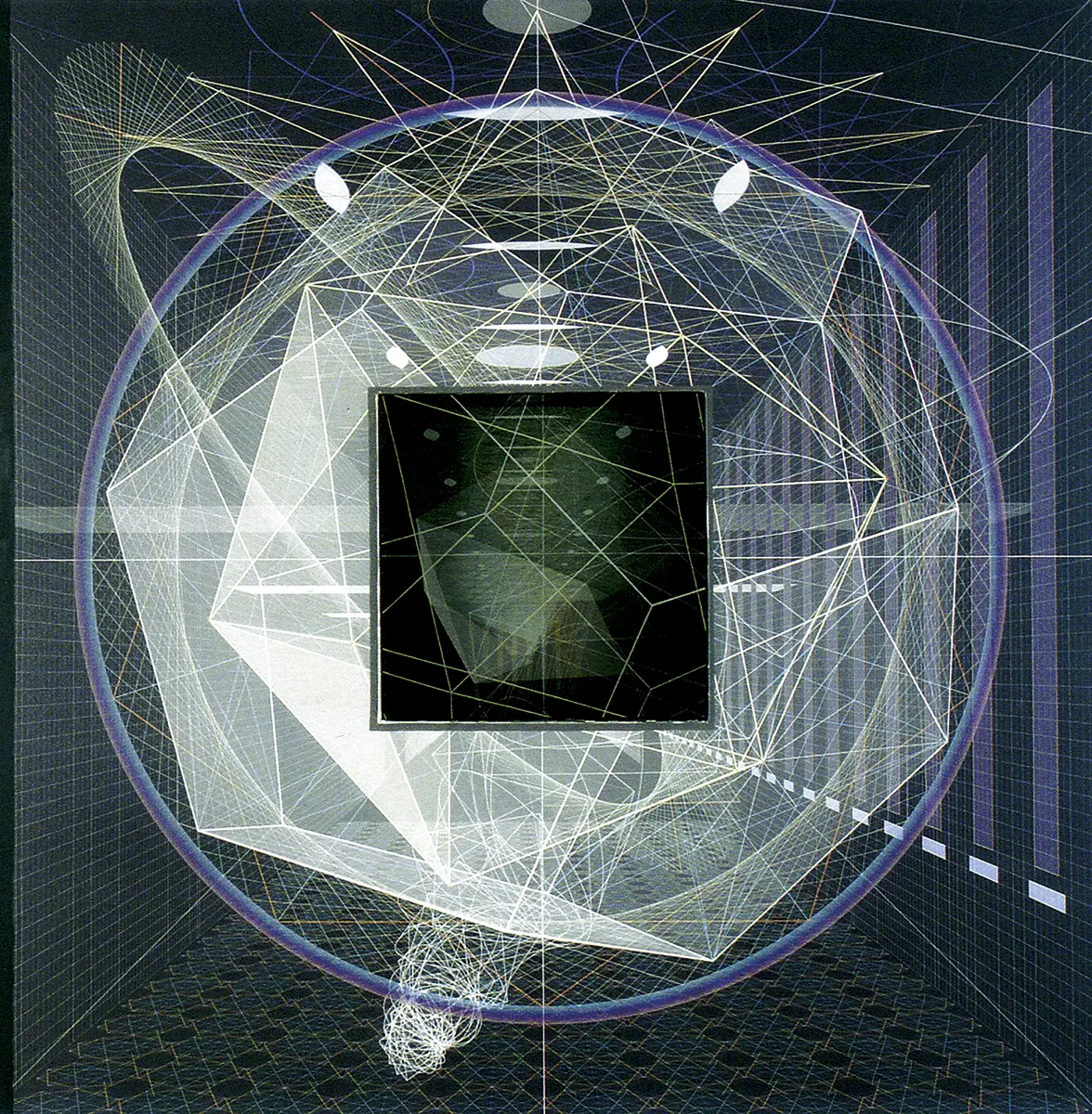
Panoramas and territories immersed in sidereal architectures comprise a kind of cosmic cartography that describes the existence of latitudes and meridians in unknown realms. A space that brings back —in the case of his landscapes— the rigor of Renaissance perspective in order to contrast it with another, one that seems to exist in a parallel world where the artist builds labyrinthine projections, unusual lines of flight, and rotating curves that dilute into infinite horizons. A dimension that expands, contracts, and launches into trajectories and whorls that grow beyond the plane. For Quilici, there is no vacuum; what exists is the plenitude of a universe structured in the magnitude of a space-form.
The ambivalence between the real and the virtual is posited in different ways, but the most salient of them is the digital printing of geometric figures on canvas and nylon, framed in boxes that are lit so as to unveil images with volumetric effects that seem to float in space, thus creating an ambivalence between two-dimensional forms drawn on the plane, and a three-dimensional vision accomplished by way of light effects, which generate feelings of unreality and bafflement that become heightened as we contemplate the works, as can be seen in Dodeca, from the series Trans-figurar, 2004.
The circle as symbolic axis: the rationality of the composition poses, nonetheless, a paradox, an unsolvable duality that refers us to two tendencies of opposite meaning. On the one hand, geometry is understood as that which is measurable, calculable, and precise, a way of representing space; and on the other, geometry is associated with mysticism, spirituality, and the divine. This quest is intrinsic to Quilici’s language since the artist enriches his discourse by applying intersections of circles, squares, triangles, hexagons, and ellipsoids that articulate into complex associations. However, the circular form becomes repetitive and claims a protagonist role in the work for itself, it invades it, dominating the composition, as in Axis-Ex Mundi, Estas mismas tierras, Un lugar inipse, or Un modelo abierto, all from 2004. Diverging or concentric lines, spheres, semi-spheres, domes, vaults, spirals, cylinders, and points derive from the matrix of the circle; even the horizon that his landscapes draw is a segment of the great planetary sphere that contains it. The circle is the way in which a point expands, and the point is the original form, the first contact, the genesis that originates artistic creation.
Quilici’s obsession with roundness refers to universal meanings that relate to the idea of perfection, time, cosmic circles, and celestial rotation. Other connotations link this form with the symbolism of the mandala, a geometric composition that represents an image of the world. The mandala produces spiritual elevation, and enlightenment, it helps us transcend and overcome imposed antagonism between the internal and the external, between the integrated and the unintegrated, the temporal and the atemporal, among other polarities. For the artist, the circle represents the principle of existence, of constant change and evolution; hence the idea of continuity and transformation is suggested by the term trans-cursos which Quilici has titled this extraordinary exhibition.
GLADYS YUNES YUNES