
Amid a strike by employees of the Department of Aqueducts and Sewers in Puerto Rico, artist Rafael Trelles inaugurated an exhibition of photographs that documented En concreto: gráfica urbana, a project of intervention in an urban space intimately linked to it.
This work, which originated following a process of internalization of the fundamental ideas expressed in the San Juan Graphic Triennial, on whose Consulting Commission Trelles serves, has meant a 180-degree turn for the artist, who was formerly occupied with easels and traditional painting. The intervention consisted of a series of impressions on walls and sidewalks throughout the city made with stencils and pressurized water.
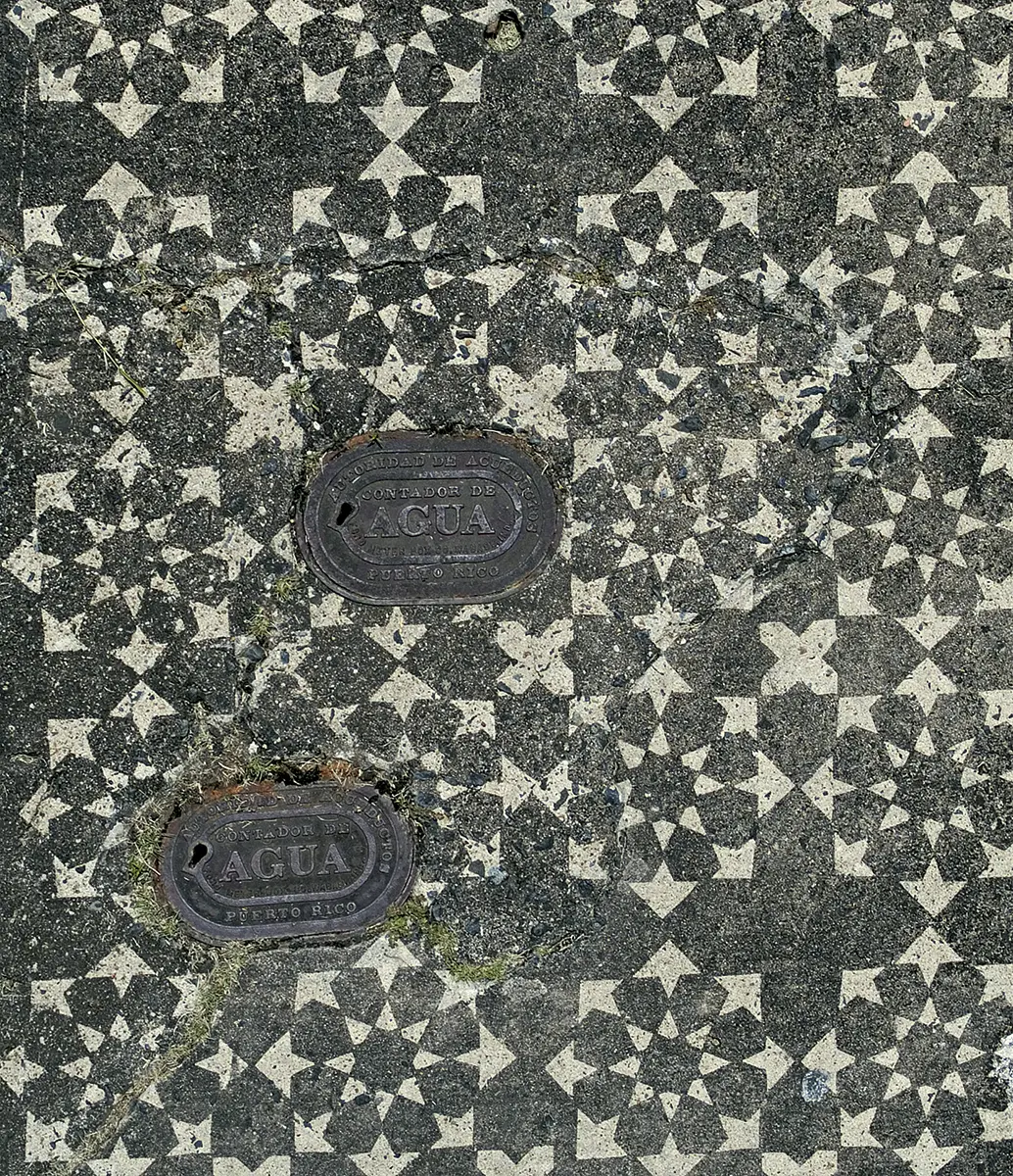
The force of water penetrates the stencil cuts and leaves the desired image on the wall or the ground to which it is applied by cleaning the accumulated grime. This new graphic technique has been wittily christened “aguafuerte” (literally, “strong water,” and also the Spanish term for plate or print etchings) by Antonio Martorell in the exhibition catalog, an allusion to the use of pressurized water. The novelty in printmaking terms, Martorell notes, is that this impression is a negative since it subtracts grime from the surface instead of applying printing ink to paper.
Riding on a pickup truck, Trelles traveled with his assistant to various parts of the city in search of grimy surfaces on which to print his images. He even went beyond that and worked on images in the context of the community. Undoubtedly, the most significant image was his modular design for Flor de muerte. It was based on the schematic shape of a revolver that arched to complete a circle, in the center of which Trelles inscribed the word, “NO.” The artist stenciled this design on the walls and sidewalks of violence-ridden neighborhoods.
Although Trelles has worked on some projects with a conceptual character, En concreto represents the mature attitude of reflection about art that has alternated, to its disadvantage, with his work in painting. Indeed, for the most part, his production has comprised a surrealist type of painting, characterized by neat finishes. It was precisely this inclination towards neatness that provided the key for his new project—literally acts of cleansing.
Besides his “aguafuertes,” Trelles also presented a series of drawings on walls in which he used nails to clean off the grime. One of these drawings provoked an interesting response because it brought to the fore the analytic nature of a large portion of what is known as “public art.”
Cristo de las jeringuillas is the image of a face besieged by syringes, which in the Puerto Rican context is immediately associated with drug addiction, a fundamental cause of violence and social decay. The reaction of certain street people, or tecatos, was to alter the prints because they felt it referred to them and saw it as threatening.
Outside the gallery, En concreto has the potential of becoming a community practice thanks to its simple methodology and the social implications achieved by its interventions. (Events like the Havana or São Paulo Biennials should consider inviting this young artist to carry out projects in their shanty towns.) Inside the gallery, it loses some of its strength, even though it retains the proverbial beauty of its images and the poetic reach of making art by cleansing, perhaps due to the aspect of photography that Roland Barthes likened to a death certificate.
The striking workers never learned of Trelles’s exhibition at the gallery of the University of the Sacred Heart, but Johnny Betancourt’s photographs brought us back to those events. One of the photos, reproduced in the invitation and on the catalog cover, showed the covers of street water counters. In the context of the protests by sewage workers, it was a curious warning of the “dehydration” of works born of water as they move away from their primary source: the city and its streets. But it also implied —and why not?– the relentless nature of a project based on the contemporary world’s generalized dysfunction, by virtue of which our society accumulates nothing but grime.
ELVIS FUENTES