
It would be an understatement to say that the attack on the World Trade Center on September 11, 2001, changed the history of the United States of America; 9/11 changed the history of the world. Ever since, the shift in political, social, and economic structures has been drastic and profound. The media has redefined itself as an essential source on which humans rely for protection, as both federal entities and common citizens have reinvented the term security, its implications, and notions. Terrorism was introduced into the everyday vocabulary, and fear is now a habitual sentiment within American society.
The art world, as may be expected, did not remain intact from the events. Visual elements acquired whole new meanings and new dimensions of symbolism and representation were born from the attacks of 9/11. Whereas the depiction of an airplane may have been regarded as innocuous at one time and point in history, the terrorist attacks changed the significance of planes, transforming them into unexpected weapons, where the whole aircraft works like a bullet.
In Miami’s Karpio+Facchini Gallery, Rolando Cladera presents the exhibit Landscapes of Asphyxiation, in which he redefines art’s traditional notion of the landscape by using imagery of airplanes and skylines. The Argentinean artist creates paintings that work as both memorials for the fear left by the 9/11 attacks, and as a macabre foreshadowing of the imminent threats that airplanes pose to the world. Nevertheless, there is an ironic twist in his works, for even though the conceptual importance of airplanes has grown symbolically, the decline in the airplane industry after 9/11 has been steady and alarming.
Although some of his paintings are untitled, all of them speak for themselves. Some use bright, vivid planes of colors to depict cities and buildings, while others are monochrome and mimic airplane blueprints. Such is the case of the painting A380, a white and black blueprint of the largest commercial airplane of Airbus—and the world. The blueprint is not made to scale nor is it an actual, technical blueprint, but the idea it encompasses is that of a professional draft: it focuses on the airplane’s structure and skeleton and outlines the design of the aircraft in a practical manner. Cladera’s decision to use the A380 model is not coincidental; the airline, which will be introduced in 2006, will have a 555-passenger capacity, becoming the largest commercial aircraft in the world. Although the artist does not provide any hint of the advertising campaign for the aircraft —built in Europe and not the United States— online publicity for the aircraft includes the logo: “The airline’s solution to the growing demand for air travel.” But how fast, exactly, is this demand for air travel growing? Cladera is quick to respond: another untitled oil on canvas is filled with data written in Spanish showing viewers the decline and plunge the airplane industry has taken during the past years. The chart, immaculately graphed and organized, includes the following information: names of airlines, amounts of layoffs, the percentage of layoffs to the total workforce, and certain particular observations for each airline listed. The numbers are astounding; for example, Delta has fired 15,000 employees, which amounts to seventeen percent of their workforce, the observation being that the airline has fired approximately fifteen to twenty percent of its employees.
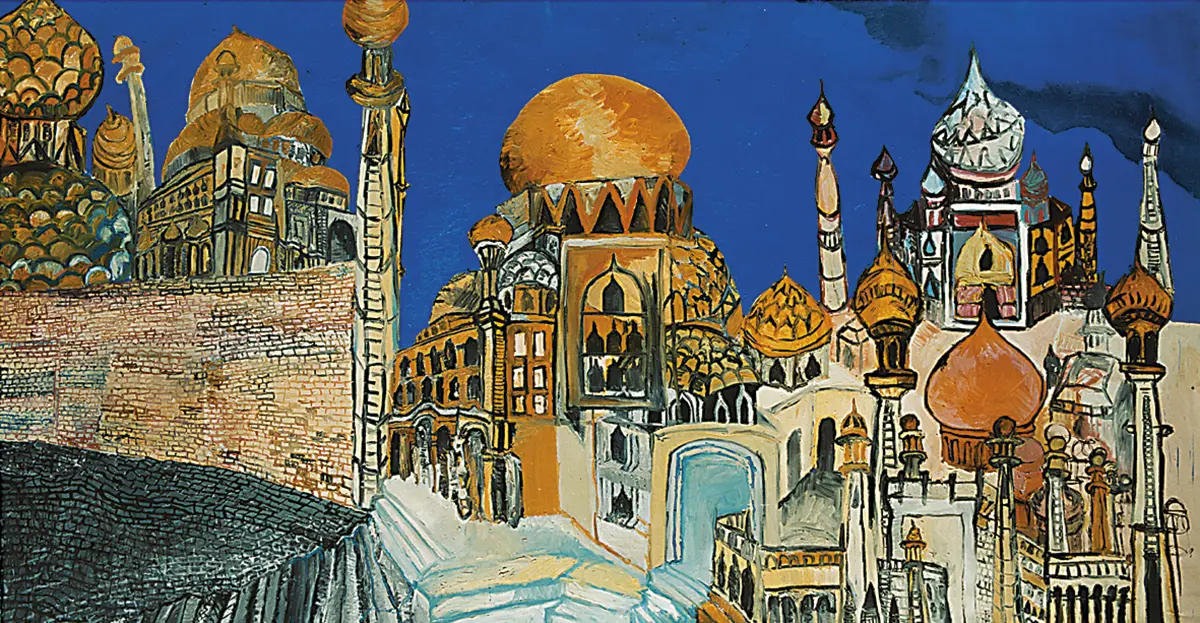
But Cladera’s ability to shock viewers does not rely solely on factual data. His aerial depictions of Saint Peter’s Square, the Taj Mahal, and even the Kremlin being threatened and bombarded all in one painting by one single airplane, are apocalyptic. The images are done in a crude, almost careless manner, with no attention paid to unnecessary intricacies and without any intention of doing naturalistic replicas of the architectural landmarks. The paintings allude to 9/11 and present hypothetical scenarios of pandemonium, evoking a profound sense of dread at the thought that such entities being destroyed is in fact viable. Cladera does not emphasize the number of lives that may be lost if such tragedies should occur; instead, he focuses on the moral and cultural value of buildings around the world. The real threat is the idea of the possibility of what many consider sacred and eternal structures being destroyed.
The paintings of worldwide identifiable structures under fire stress the idea that the United States is not the only place at risk. Nevertheless, Cladera zooms in and paints a close shot of the United States’ most critical and important target: the White House. An emblem of political, social, and economic power, the painting titled White House dissects the interior of the building, displaying each of its sections as though it were a dollhouse, making it appear vulnerable as the artist strips its walls, undresses its façade, and exposes the many tables, chairs, and bookshelves inside. By allowing viewers to see what lies inside the building he demystifies the glory and false idealization of the omnipotent presence of the White House; after all, we can only find shelves with books, chairs, and tables inside the vividly colored rooms. Furthermore, unlike the universal concept of tragedy and destruction brought by his painting of Saint Peter’s Square and the Taj Mahal, where the buildings are all gathered under one and the same sky, crowded together as if they were huddling from the lurking violence, the White House stands on its own in a red-colored canvas. And while the agglomeration of the previously mentioned buildings brings cultures together to experience fear or dread in unison, the singling out of the White House by itself in a separate painting may be interpreted as the current stance the United States holds on world issues.
Terminal brings closure to the exhibit and to Cladera’s devising of chaotic suppositions. The painting shows a peaceful runway and, like a man worn from a hard day’s work, an airplane searches for comfort in the hangars, at the end of the road. And while the concept of the terminal, in aeronautic lingo, equals a safeguard zone for any pilot, dictionaries define terminal as “leading ultimately to death.” Cladera poses the question: is this where the world is headed?
CARINA GALLEGOS