The first edition of SP
ARTE —International Modern and Contemporary art fair— was held from April 27
through May 1, on the site of the São Paulo Biennial (Brazil) in Parque de
Ibirapuera. It gathered more than 41 prestigious galleries from around the
country, with a total participation of more than 350 artists from the national
and international scenes, over an area of nearly 5,000 square meters, which
only covered the ground floor of the Ciccilio Matarazzo Pavillion. Joining
these galleries were booths specially reserved for foundations and not-for-profit
cultural institutions, such as Paseo de las Artes —which will soon celebrate 35
years of prolific and uninterrupted activity—, the Iberê Camargo Foundation,
the Leonilson Project, and the Contemporary Art Institute (IAC).
According to its organizer, lawyer, businesswoman, and collector Fernanda Feitosa, SP ARTE is a repositioning Brazil in the international art circuit, through the yearly celebration of a fair with these characteristics, which will gradually widen its interests and areas of expansion, during the first half of the Latin American arts calendar. The idea arose more than a year ago, after noting that Brazil, despite its strong tradition in terms of Biennials —São Paulo, Mercosur (Porto Alegre)— did not yet have a large-scale event, in the international art market, capable of generating a reciprocal and fluid exchange between galleries, artists, collectors, marchands, curators, critics, art historians, and the specialized press.
It was a risky, high-level effort, of course very carefully put together, with attention to the minimal details. The expectations both on the part of the organizers and on the part of the participating galleries and institutional spaces, focused on an even greater professionalization of the sector, reinforcing the bases for the education of new generations of viable modern and contemporary art collectors.
The inaugural convocation to SP ARTE confronted viewers with heterogeneity and pluralism of visual languages that are increasingly radicalized regarding the expansion of the term “work of art,” especially when one takes into account the richness of contents and poetics present in Latin American’s aesthetic expressions. And amidst that ocean of voices and poetics, a crisscrossing interplay of relationships was intensified to outline a vast panorama of 100 years in the history of Brazilian art.
In this first celebration of SP ARTE, the painting was dominant, with orthodox propositions and, parallel to those, unusual and new aesthetic statements due to the use of different expressive supports, generally in large formats.
Similarly, there were pieces that constitute medullar contributions from the masters of the avant-garde, characterized by their formal and/or conceptual purism, modernist furor, and continued experimental path. In this context, we can cite the pioneer works of Sergio Camargo, Alfredo Volpi, Hélio Oiticica, Lygia Clark, Abraham Palatnik, Jesús Rafael Soto, Julio Le Parc, Tomie Ohtake, Manabu Mabe, Arcasngelo Ianelli, Waldemar Cordeiro, Lygia Pape, Emiliano Di Cavalcanti, Cándido Portinari, Joaquín Torres-García and the legacy of his Constructive Universalism, alongside figures like Max Bill —co-founder of Bauhaus— and Joseph Beuys, the last Utopian artist of the Twentieth Century.

It is known that 60 percent of the Brazilian art market flows through the São Paulo megalopolis. For this reason, the city’s galleries had a central role in the inaugural edition of the fair, followed by their counterparts from Rio de Janeiro, Belo Horizonte, Porto Alegre, Salvador, Curitiba, and one gallery from Uruguay (Sur). On the other hand, we couldn’t help but notice that not one gallery from Argentina was present, although several of them were invited to join the project, which this year has a regional character but aspires to position itself, with time, as the most significant pole of interest in South America. Feitosa says: “São Paulo offers the ideal conditions to sponsor this event since the city already is Latin America’s main artistic center.”
The balance of the fair was highly positive in terms of sales and visits by collectors and by the general public, knowledgeable and neophyte alike, to reach a total of 10 thousand people.
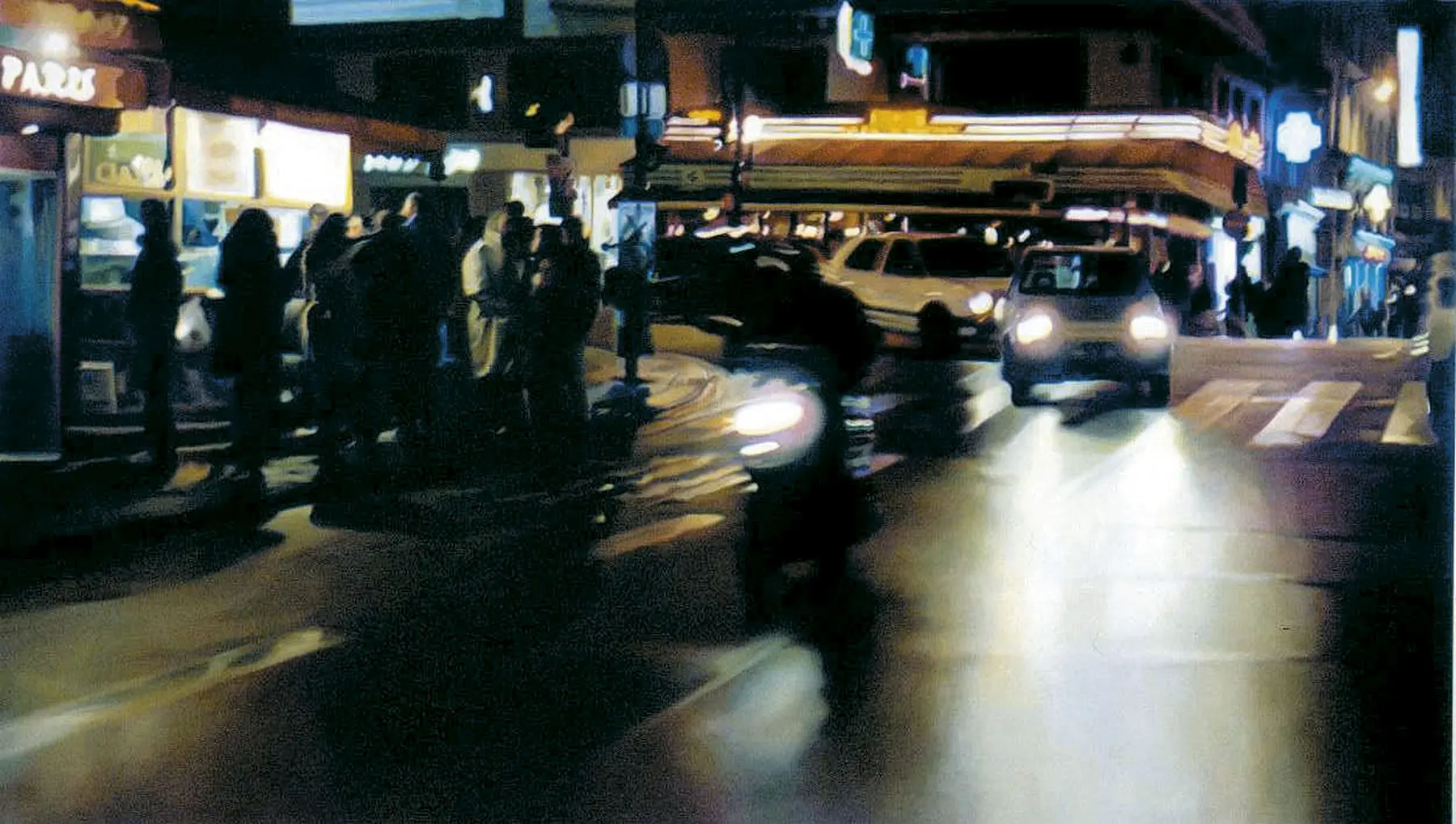
To focus on a summary tour of the booths devoted to the art of the present, Thomas Cohn Gallery once again offered its praise of painting as skin. On this point, let’s bring to mind Paul Valery’s famous idea that “skin is the deepest thing.” With its selection of artists, Cohn proposed new signals for a critical debate about the current status, validity, and vitality of this millenary expressive language. The highlight of his booth was Manto Sagrado (1983), a large pictorial object by the late, talented José Leonilson, hanging ambiguously on one of the walls like a ceremonial vestment and formless painting. On his part, Canada’s Kate Waters gave the urban night scene in her oleograph Rue Chauchat (2005), the vertigo of seductively unstable movements, rotations, and light flashes. With Network (2004), Britain’s Stephen Pierce reformulated, in a heterodox manner, the reach of oil painting, working on aluminum sheets loaded with a biomorphic abstraction of bright fluorescent chromatism. Completing the list are Cuban artist José Bedia’s giant canvases. Oscar Oiwa, Paulo Queiroz, and André Gomes from Brazil; and the hyper-realist pieces by Marco Stellato and Rafael Resaffi.
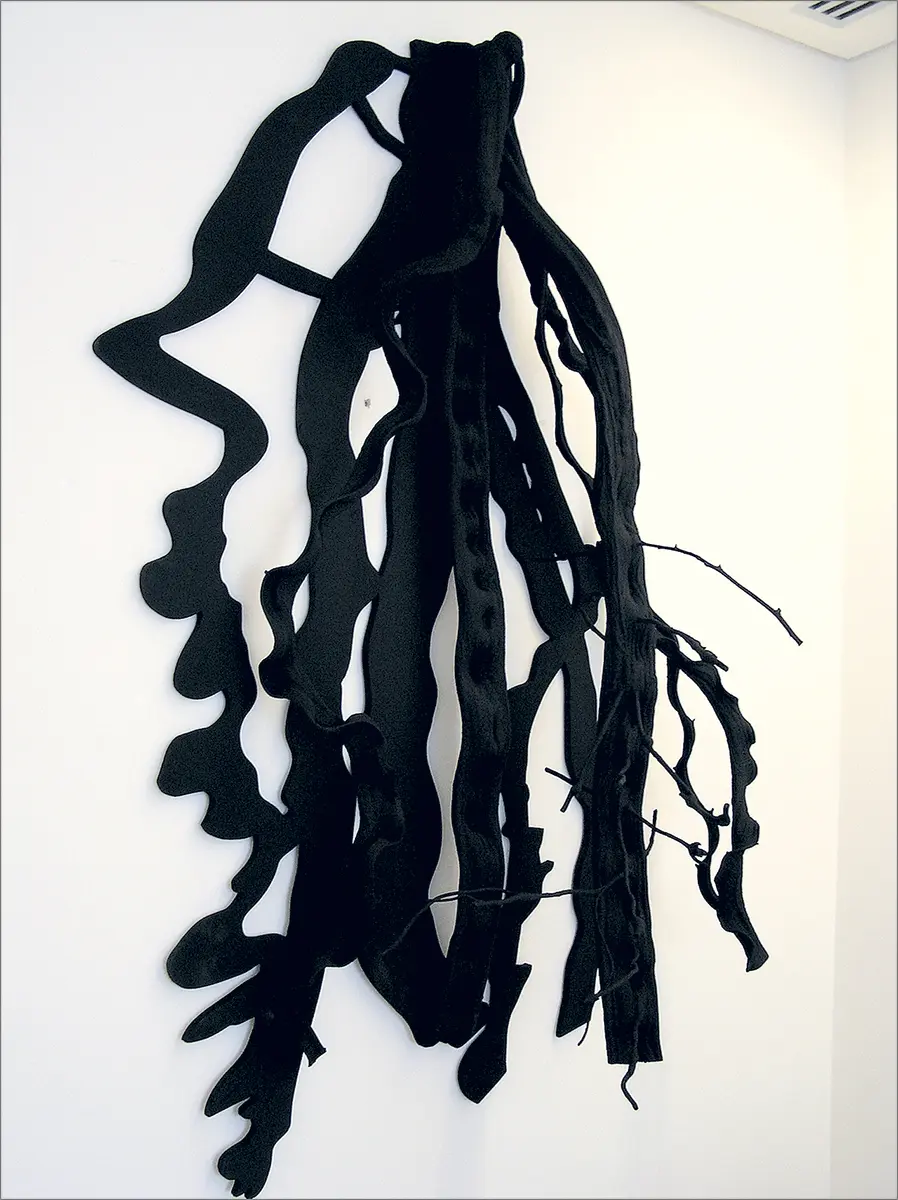
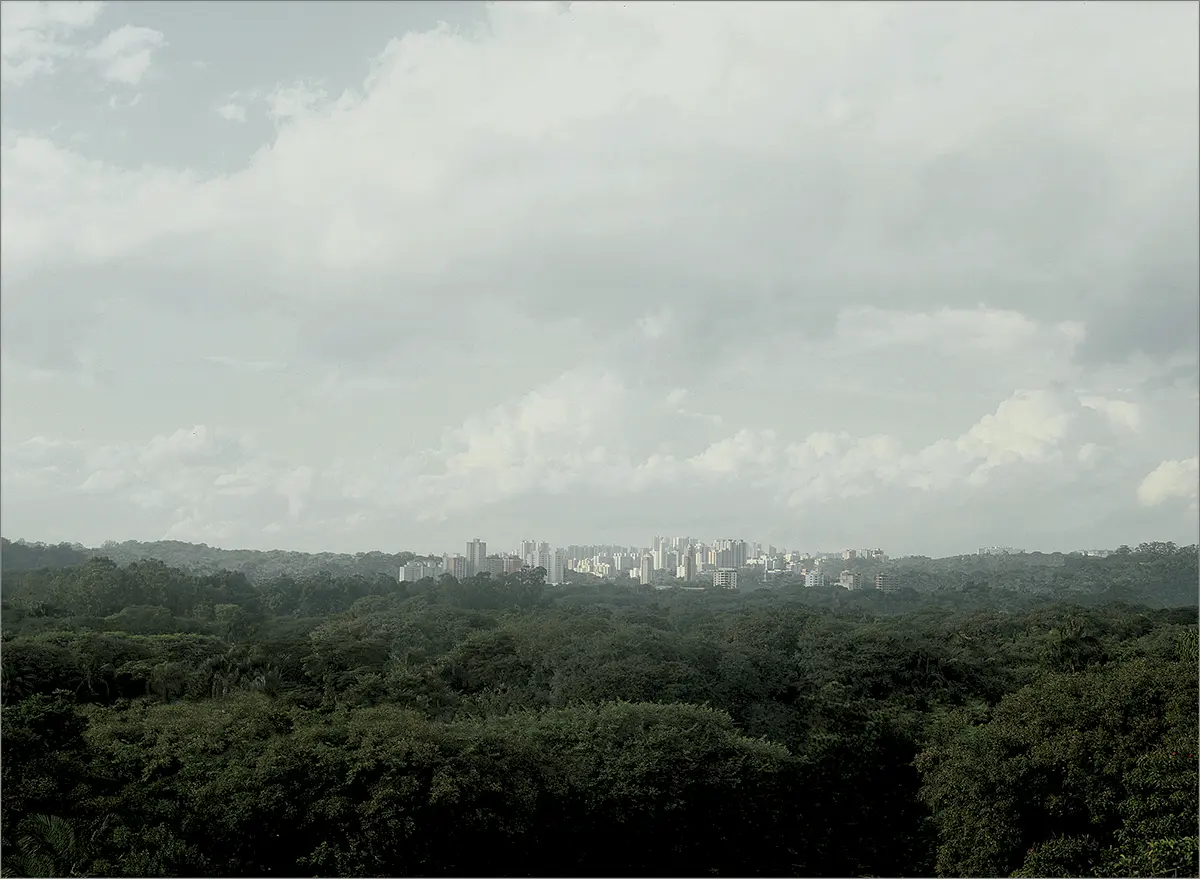
The directors of Brito Cimino gallery decided in favor of large-format works, regarding which the public was able to feel directly involved with the real or illusory space therein generated and to be at the same time inside and outside them, because we lack, precisely, a center, fixed references, a metaphoric verticality. For example, Butantá, a recent photograph by Caio Reisewitz, is a panoramic view of the Paulista beltway, rendered as an outsized neo-romantic projection, where the post-sublime is assumed as a large-scale parodic evocation of the image and, at the same time, of the artist’s ambulatory restlessness, which drives him to constantly photograph, following the method of creating open series that problematize the topic of the big city that overwhelms and absorbs what little virgin nature is left. Continuing with Pollockcow, Nelson Leirner’s immense object between the allegorical and the humoristic, covered with multicolor stickers, the way in which the artist used the posthumous homage as his axis, in a contemporary key, in a tribute to the creator of dripping and the pictorial all over. Here, an objectist and sculptorly Leirner resignified the Pollockian all over, covering a large wooden cow with stickers of an exacerbated polychromy. These stickers became a grid and a crazy mosaic of quotations and appropriations that emphasized a particular ultra-baroque and kitsch aesthetic, bringing to the fore his intentional horror vacui. In turn, Regina Silveira’s Reunión, from her Dilatables series (1981-2001), is a black mural installation in lacquered wood, placed on one of the booth’s ample walls. Playing with micro and macro scales, Silveira’s exasperating, gigantic, proliferating bi-planar silhouettes end up taking over the wall in its entirety. On it, a group of characters sitting at a table become monumental specters, cropped with a scalpel from a single block.
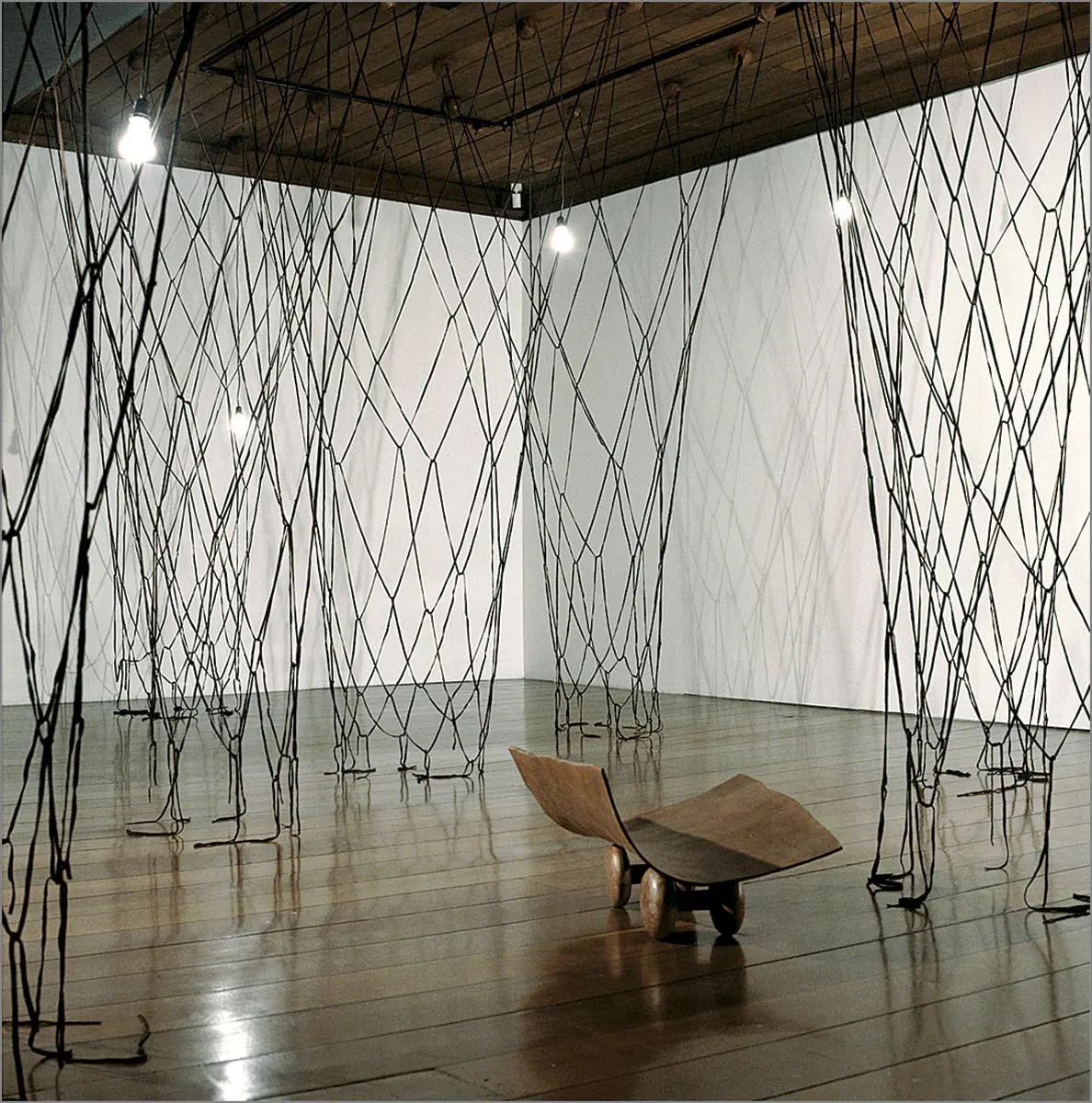
In the Nara Roesler booth, of special interest were the spatial and topo-specific projects presented by Marcelo Silveira, with his installation Bochinche (2003), executed in wood and leather straps, which generated a kind of opening for a shelter or enclave, with the use of flexible materials that are not traditional in sculpture but possess a singular sensuality and a morbid beauty. They originated on the ceiling and installed themselves on the walls and floor of the gallery.
In Sin título (2004), Laura Vinci did the same, with her batches in impeccable white marble, connected by fine transparent glass canules and arranged on the floor in direct, unmediated contact, with the gravity of the floor. With his 224 dominós (1999), José Patricio found support in the playful effects of the Op Art tradition. As a true bricoleur, Patricio puts together his rugs or mats using tiny connectable pieces, according to binary logic. These works can be placed on the wall, like murals, or on the floor, applied to supporting platforms.
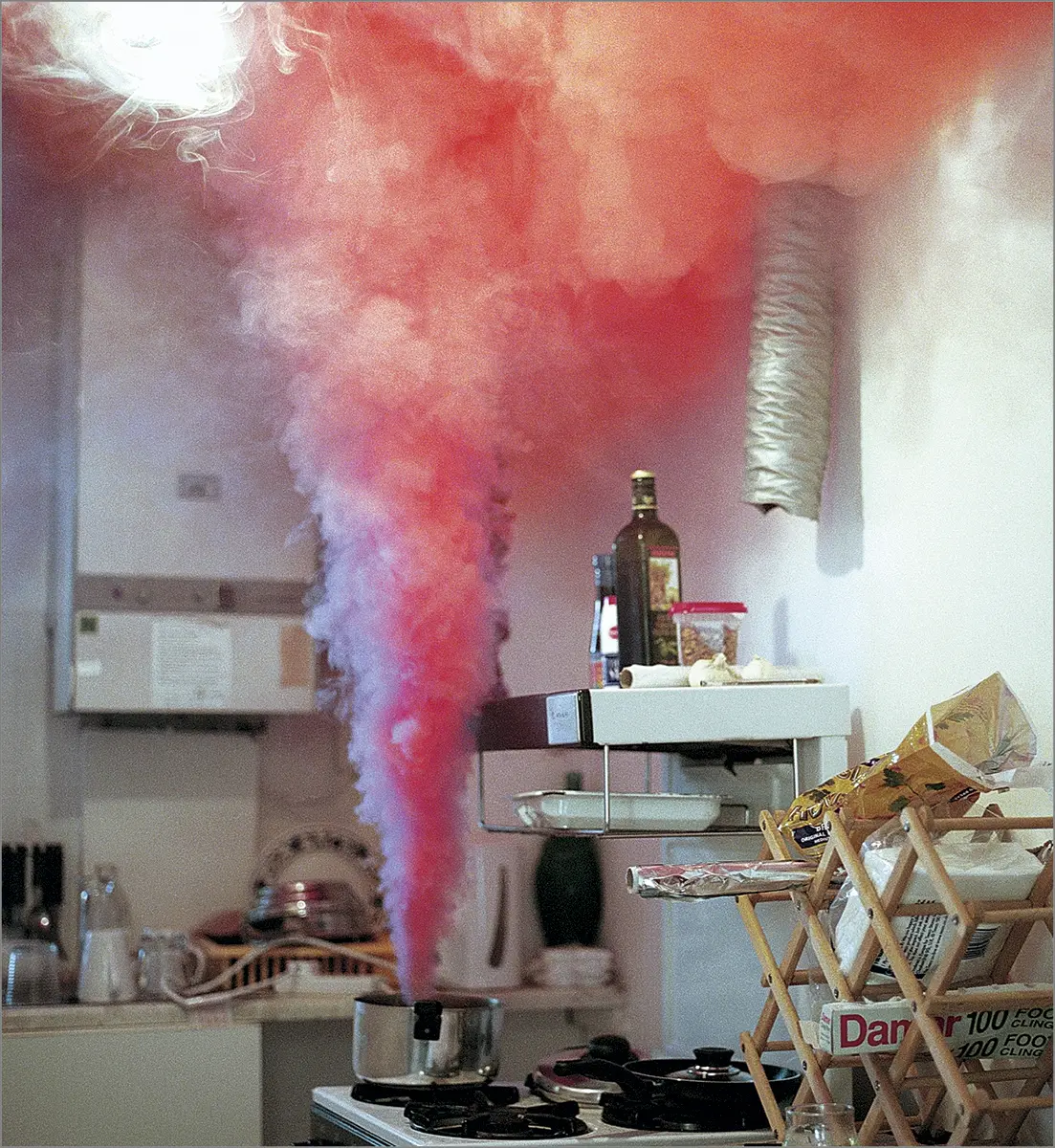
Meanwhile, the new gallery Galería Leme, projected and designed by architect Paulo Mendes da Rocha to attend to its specific functions and objectives —with only 6 months in business— presented a highly original overview of high-quality works by local and foreign artists. Among them, the highlights were Camila Sposati’s photographs, in particular Rescue smoke Pink (2003), where a shapeless mass of fuchsia-colored gas invaded the original iconography of the photographed scene, promoting a drift that is a crisis and staging en abîme of the iconic representation. In this case, it is a routine image, where a domestic kitchen is intervened by the magic of the shapeless, casual, and anecdotic. Another important artist selected by Eduardo Leme —director of the gallery— was Neil Hamon, with his series of anachronistic soldiers and guards, who live in the present in terms of the past or as active ruins. As an example we can mention Chris Tapster, Finnish White Guard (2002), intentionally turned to sepia to give it an artificial patina of frozen time. Hamon manipulates camouflage and hyper-simulacrum in his photographs. His works seem more real than the real. And in truth, they are painstaking stagings that question the documentary register of a photography shot, thanks to the complex visual sleight of hand to which they are subjected.
A special pride of place was given to Felipe Barbosa’s Multimarcas, built using soccer balls, at Casa Triángulo Gallery. Barbosa takes apart the pentagonal modules of the balls and uses them to build soft, bizarre-looking paintings and, at the same time, a variety of objectual propositions.
Baró Cruz Gallery, another new space, which emerged last year, presented works by Jack Leirner, the likes of Adhesive 33 (2003), done as an assemblage of stickers, acrylic, and construction level. This gallery also exhibits objects by Rubens de Espirito Santo, photographs by Michael Wesley, and works by Claudia Jaguaribe, among others.
Rio de Janeiro’s Theodor Lindner Gallery, inaugurated in 2004, came with a notable international roster. This gallery defines itself as the point of intersection for Brazilian and German art, modern and contemporary. Its booth exhibited an objectual multiple by Max Bill, titled Del triángulo al octógono (1938-1989), and several conceptual pieces by Joseph Beuys, from the 1970s and 1980s, including an outstanding photograph printed on a metallic support. Alongside these, there were two very large photographs by Heleno Bernardi, with post-images of abject and sinister objects of a strong visual impact, falsely anthropomorphic. These photographs exhibited effigies cloned from the supposed remains of live-flesh human faces. One of those works is Genioglossus (2002). On his part, Christoph Dahlhausen exhibited a striped photograph on aluminum, with bands of diffuminated colors, titled Sobre la cuarta prueba no científca de la existencia de la luz (2000). Some artists in this gallery’s roster are well-known figures in the international scene, like Walter Dahn, Carlos Cruz-Diez, Sigmar Polke, A.R. Penck, Julio Le Parc, and Yacov Agam.
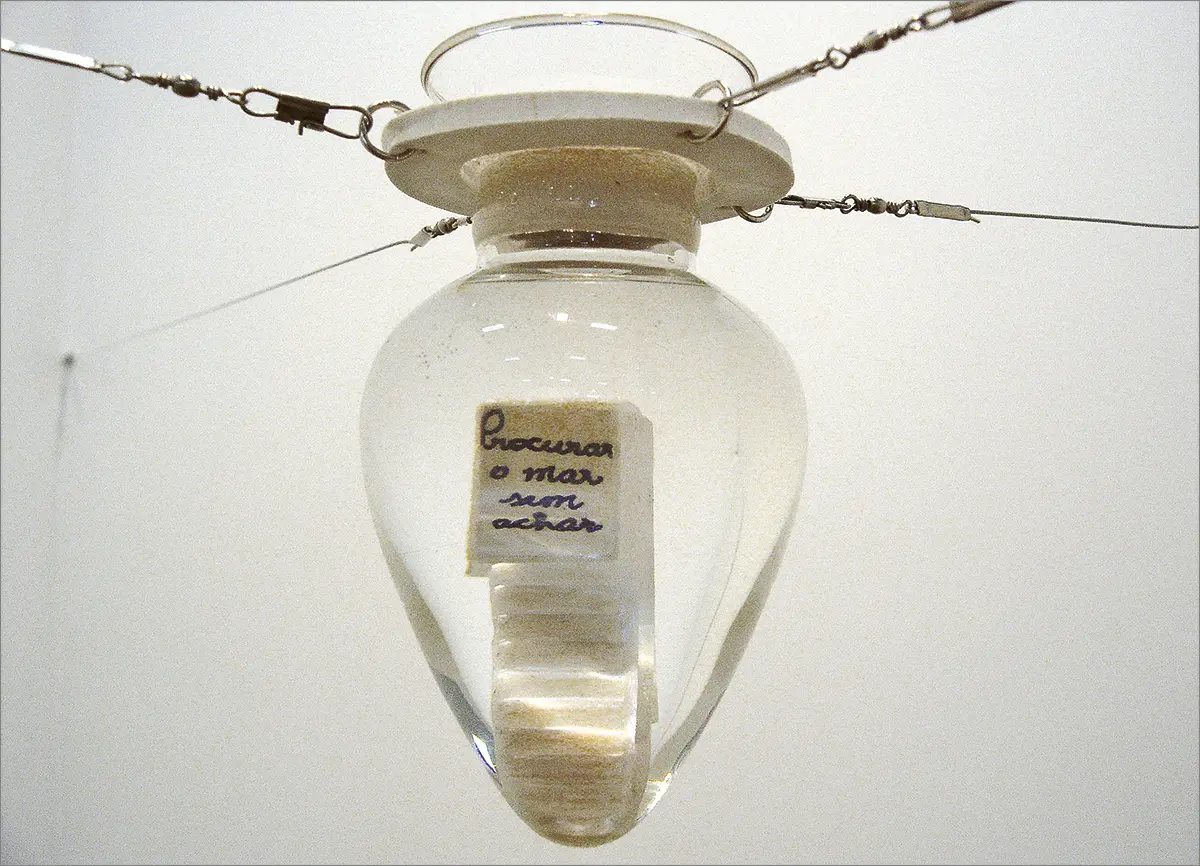
Léo Bahia – Arte Contemporáneo, based in Belo Horizonte, embraces the idea of divulging and giving greater visibility to the many national and international artistic practices. Its role is to consider the gallery itself as a laboratory of tests and experiments for the creators it represents. It focuses on the concepts of spatial occupation, analysis, and following up on its artists’ works in progress. From the selection on exhibit, the highlights were the works of Mónica Rubinho and Frederico Camara. The formerly presented Sin título (2004), is a hanging installational object of variable dimensions, with an edition of 3 modules, executed in glass, liquid vaseline, synthetic resin, metal, and China ink. The latter exhibited Instalación 1 (2003), an 80 x 60 cm photograph depicting a view of a constructive ambient piece inside a room with green tile-covered walls. The empty space is filled with an orthogonal assemblage of chromed pipes, metallic faucets, posts, and ropes hanging from the ceiling, of an evident post-minimalist filiation.
Dan Galería, founded in São Paulo in 1973, is characterized by its mixed profile, swinging between the modern and the contemporary. For this inaugural edition of SP ARTE, it selected historical pieces by Lygia Clark, Jesús Rafael Soto, Sergio Camargo, Alfredo Volpi, Cicero Dias, and Emiliano Di Cavalcanti. By Lygia Clark, we can mention Superficie modulada, serie B, núm 1 (1958), on wooden support painted with industrial inks. The proposal of figure/background reversibility, in black and white, is evident in this piece, which can also be interpreted as a cultured, highly dynamized revisitation of Kasimir Malevitch’s suprematism, due to its negation of color and its assumption of the antagonistic poles of a maximum concentration of light and darkness.
Paulo Kuczynski Art Bureau has been present in the Brazilian art market for over three decades, with special attention to the exhibition of works by established artists, veritable pillars of modernism, and its direct descendants. In its space we had an opportunity to see invaluable pieces by Mira Schendel, Víctor Brecheret, Cícero Dias and Emiliano Di Cavalcanti.
Berenice Arvani gallery, established in 2001, has an exhibition policy that alternates shows by artists who are well established in the national and international markets with contemporary and avant-garde Brazilian talents. Tomie Ohtake’s Sin título (1971), a monochrome painting in various modulations of the color blue, is a paradigmatic work that responds to the gallery’s spirit, as does Physichsomie, by Venezuelan kinetic artist Carlos Cruz-Diez.
Raquel Arnaud’s art cabinet specializes, since 1973, in the exhibition of sculptures, installations, drawings, and paintings that severely question and modify the relationships inside a physical space, including the work itself and the viewer. Clearly dominated by constructivism, its shows stand out for the differential assumption of that mutable and transitory topology and for its more up-to-date unfoldings and prolongations. Since 1990, this gallery represents the invaluable work of Sergio Camargo. Among the key figures in its booth at SP ARTE were Arthur Luis Piza, Anna María Maiolino, and Sergio Camargo.
Bergamin gallery, born in the early 1980s, was initially located in Rio de Janeiro, but in 2004 it moved to São Paulo. An interesting element is its thematic exhibitions, coordinated and scripted by a variety of curators. Among its artists are well known figures of the weight of Alfredo Volpi, Iberê Camargo, Frans Krajcberg, Hélio Oiticica, Lygia Clark, Joaquim Tenreiro, and Sergio Camargo.
CLAUDIA LAUDANNO
Ph.D. in the History and Theory of Art at the Universidad de Buenos Aires. Correspondant for ArtNexus and Rosario/12.