Agustín Bejarano
entered the Cuban art world like a hurricane. In 1987, his transfer drawing, Kate was awarded First Prize in the
Encuentro Nacional de Grabado, presented
at the Museo Nacional de Bellas Artes in Cuba.1 That event, like
many others of the 1980s, had an important effect on the art world; many
borders were destroyed and significant breaks were made with the stereotypes
and vices of a tradition that was questioned and revitalized.
Bejarano, who was at the time painting, drawing, and engraving with strength and fervor he retains to this day, was among the first Cuban artists to transform printmaking into a three-dimensional act of installation,2 as evidenced in his series Huracanes, presented at Castillo de la Real Fuerza in 1989.3 Initially, the hurricanes were a reflection about identity. His central consideration was the relationship between Man and Nature, and the conversion of the latter into an art object. At first, he dealt with the excesses of both on the basis of a language of informalism that was at times lyrical and sensual. For the artist, the hurricane became more than an atmospheric phenomenon; it was the symbolic expression of the acceleration and the violence of contemporary life. In Bejarano’s hurricanes, we find the fury, the violence, and the force of those storms that the Caribbean, as a geographical area, so often experiences. The beauty and power of movement and sensuality gained ground and in his exhibition, Corte final manifested an eroticism that was not at all exhibitionistic or obvious.
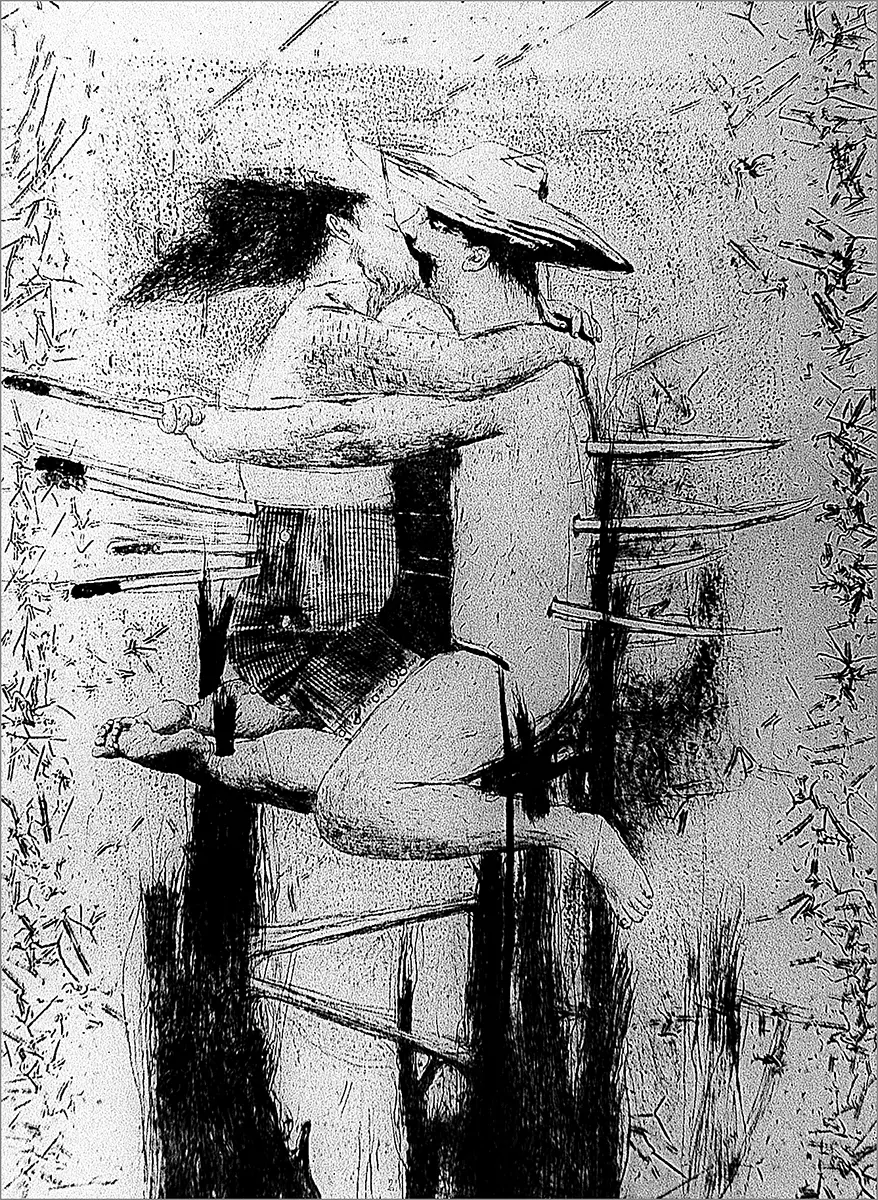
The artist developed a new technique from 1993 to 1995 with Brisas del alma, in which he took maximum advantage of engraving on plastic and punching with sewing needles, enabling greater detail. Bejarano portrayed himself in the works, often with his wife, who assumed the role of both woman and mother. Even though many of these were marked by the influence of his personal life experiences, with emphasis on intimacy not devoid of drama, his vision was not divorced from the collective.
In some of the canvases presented in the show Tierra fértil4 and in his engravings on the plastic of 1994–95, the figure of the Apostle began to appear as a recurring element. Martí, his head crowned with a peasant hat, emerged —painted or drawn— in the artist’s habitat; his representation varied between techniques that were somewhat close to illustration and the light but the playful tone of caricature. Wisely, after skillful handling of irony and in an obviously humorous vein, the artist avoided posed figures and gravitas, both in painting and engraving, and instead offered the Apostle as a dear friend and support for the most critical moments.
By 1995, Bejarano’s work was at a propitious juncture for substantial transformation. That year his series Voluntad de silencio was shown for the first time at Nina Menocal Gallery in Mexico. It displayed a maturity of concepts, much more neatly defined from that point on, about the representation of the city (and of society in general), as well as of conventions that would go beyond their inscription on traditional genres such as the subjects of still life, historical portraiture, and landscape painting, with a more explicit openness towards the public and context.5
His skill as a painter was enhanced in the works of this period, while he continued, with a greater expressive charge, to develop his printmaking oeuvre. Recognition of this was the prize he received at the 11th Latin American and Caribbean Print Biennial held in San Juan, Puerto Rico, in 1995.
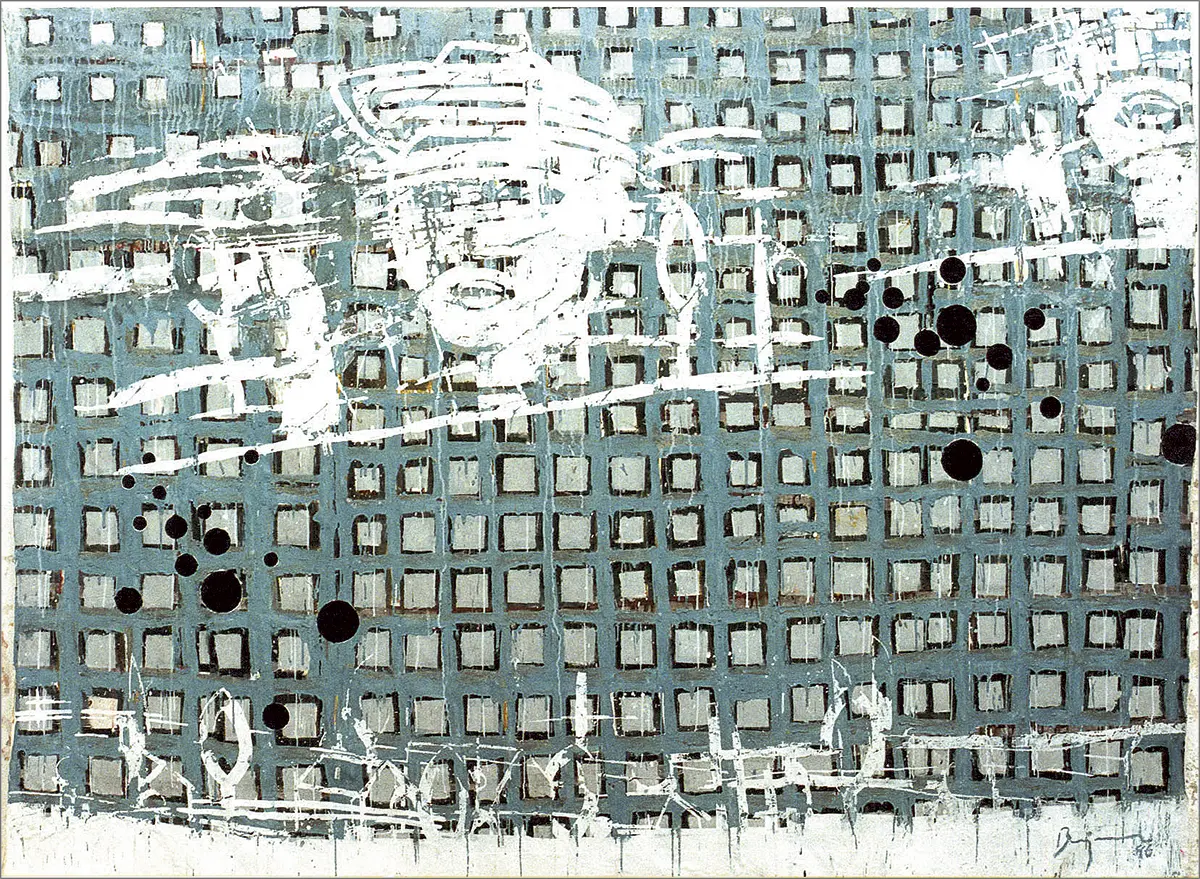
With Tierra húmeda6 —a play between gestural abstraction and figuration by means of notable dissolves— some of the previously noted elements would start to detonate. There is a return to the earth as magna mater, but above else a return to Man, to his origins and essences. The Earth is beginning and end, but she is also the giver of life, the “earth of our insides.”7 The dripping, scratching, and texturing was not gratuitous; not even his rejoicing in dreams and myths, almost in the manner of a child who returns to the place of his birth and observes everything with penetrating eyes, was unfounded. This was also the occasion when the artist contrasted his place of origin with the urban world in which he was inserted.
He took pains to describe and discern the essence of the city dweller and the spirituality of the peasant indissolubly tied to his land. It is precisely the spirituality of the latter that lets us see that El adivino is a highly regarded character, just as El Brujo is feared, while Aire del sur is recognized and named in the labors of the land; in the same inexplicable way, he feels the Nubes bajas. He also noted the decomposition of values that are accepted as secular and the overwhelming spiritual impoverishment of the urban setting. All of this connected clearly with the subject of “the individual and his memory,” the topic of the 6th Havana Biennial, where Bejarano was invited to be a part of the segment titled Rostros de la memoria.
Marea baja reinforced and expanded the content of the previous series in terms of meanings and forms. Although he exalted their place of origin, he also noted the exodus of rural populations to the cities. Marea consolidated and, at the same time, insisted on a reformulation of what was previously stated with representation that refused to abandon the abstract but left a prodigious space for the figurative.
In 1997 Agustín Bejarano won First Prize at the Salón Nacional de Grabado with a trilogy executed on plastic (Harakiri, Plantas e insectos, and La conquista). His show El hombre inconcluso, presented at Tokyo’s GAN gallery in 1998, was the result of that achievement. This show is significant for two essential reasons. First, it gathered a large selection of his prints dated between 1993 and 1997, a wide panorama is seen for the first time in this way and took them abroad. Second, it featured the international debut of Angelotes (1998). These large-format paintings were influenced by Pop Art and were in tune with the artist’s interest in contradicting the way in which angels had been represented in the history of art. His angels are androgynous beings, for the most part, messengers sometimes luminous and protective, sometimes cunning and treacherous. They are presences that boast of their power as aggressive hunters or their strength as warriors.
Parallel to his Angelotes, Agustín Bejarano continued to work in printmaking on plastic with the series Las coquetas.8 This series was the outstanding vehicle for Bejarano’s sophisticated craftsmanship. The model for these works was Bejarano’s wife, who symbolically embodied the artist’s observations about a tradition that represses women and objectifies them.
Paisaje y naturaleza muerta and Anunciación were painted in 1999. Bejarano’s approach in Paisaje was phantasmagoric. Elements from stylized china sets—which parodied those brought over from Europe and used by the nineteenth-century bourgeoisie in Cuba—shone from within and also contained a series of vistas: miniatures of landscapes, furniture, architectural references, and even portraits. An atmosphere of decay due to the weight of time hovered over these works, which revived, in an organic but unusual way, the subject of the classic still life. In his annunciations,9 although approaching a biblical subject, Agustín Bejarano moved in a different direction and evoked the Middle Ages, as well as a Renaissance spirit, without falling into quotation or appropriation.
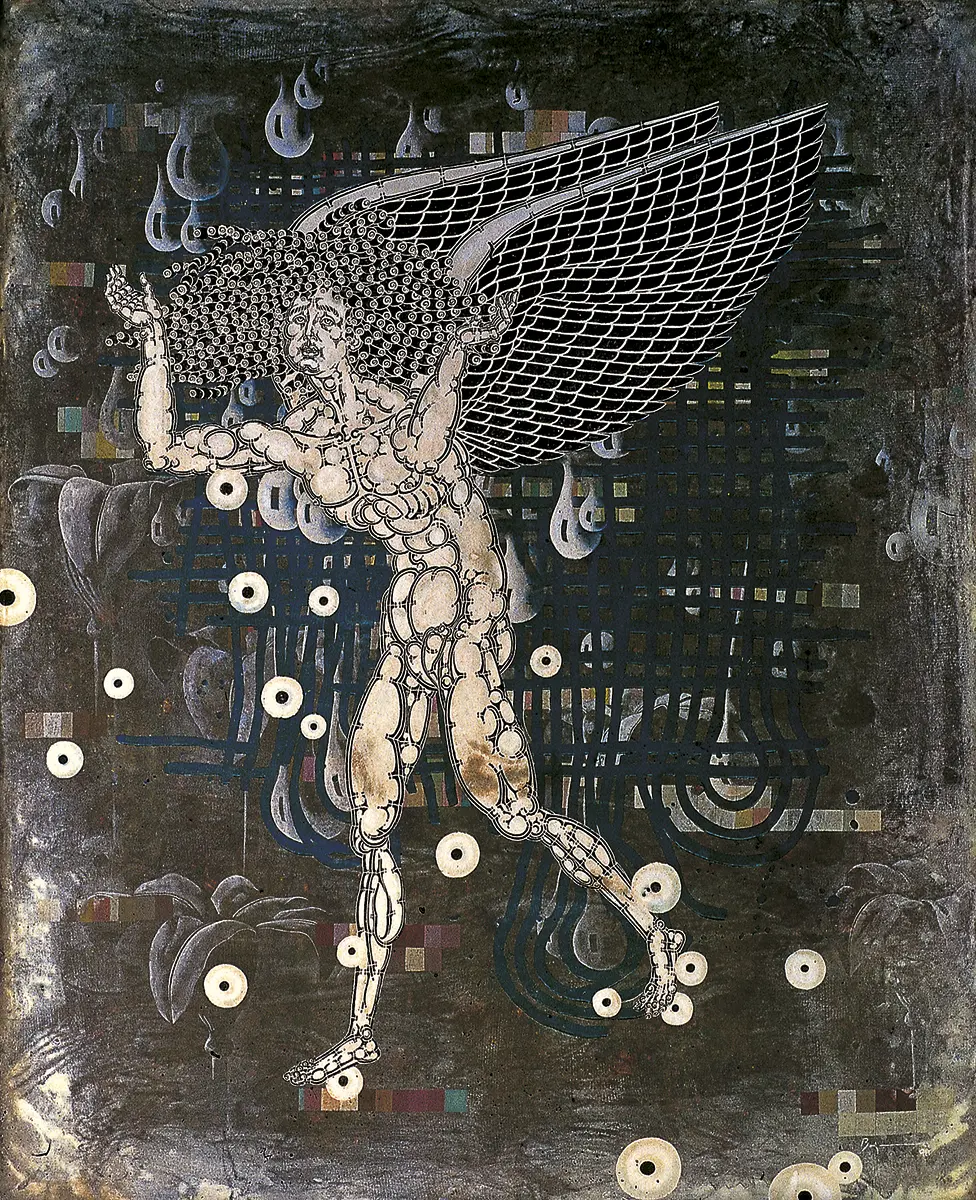
Bejarano has clearly been an artist who does not seek stylistic unity. His lively interest in revisiting subjects already profusely present in the history of art is also apparent in his series Cabezas mágicas. Presented at the Havana Club Foundation, in Havana, it was a kind of resurrection of the subject of portraiture, of portraits abstracted into represented, invoked types: generic abstractions (Tejedora de mano, Pescador, Rostro de muchacha),10 fictionalized faces that recreated anonymity and, at the same time, multiple street figures.
In 2001, New York’s Elkon Gallery presented, in a show titled La belleza y la fuerza, a piece titled Imágenes en el tiempo III.11 This canvas belonged to a series with the same title, which the artist started in 1997 and revisited the same year of the New York show. Martí emerged once again with an irrepressible force in Bejarano’s discourse, in painting, and in prints. If initially, his allusions to the Apostle focused on his imaginary, on the political figure, and on the citizen with whom the artist had “shared” his intimate spaces, at this point, it was the hero who was reborn from a vision that exalted the sacred and the epic though the praise of his exceptional spirituality. The artist was able to offer us the most human profile possible of a paradigmatic being and transcended local references in order to expand to the universal.
Everything that Bejarano had produced as an artist up to that point was consciously filtered and transformed into a legacy within this series. The greatest resonance for Bejarano the painter was in the modeling of his figurations. His intentional recourse to sienna, ochre, and sepia hues; the interplay of intensities, not only in the background but on the whole surface of his canvases; and the crackle-glazes and glosses highlighted the textural and resulted, on the one hand, in reinforcing the course of time, and, on the other, in intensifying the strength of the nexus between Man and Land. The symbolic value that other elements contributed to this aspired to “unite Man with everything that is, has been, and will be, and not with the fashions of the day.”12
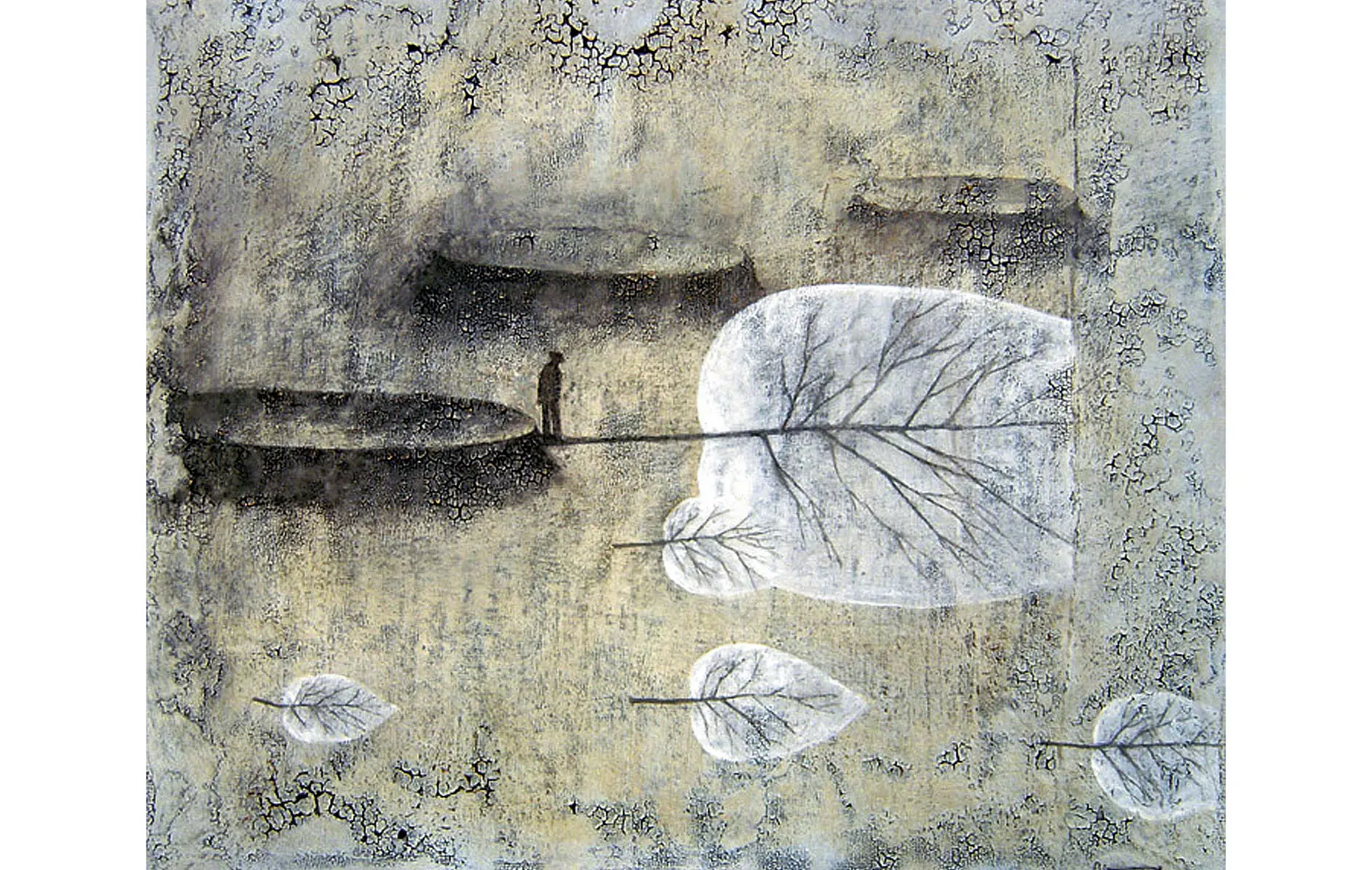
Agustín Bejarano’s most recent series, Los ritos del silencio, is committed to the same spirituality that sprang from Imágenes en el tiempo and from its very essence and was brought together at a time when definitive separation was difficult. There is a man in Los ritos del silencio, and he is portrayed in the way in which Bejarano assumes portrayal should be carried out. His portraits deconstruct the genre and the subject of representation at the same time. After a generic abstraction, Man emerges undifferentiated. Each piece is a metaphor for thirsts, needs, anxieties, solitudes, dreams, and desires. Bejarano denounces these scourges and makes their perpetuity clear, all the while dissecting the spirit of the here and now from its very core. Aridity takes over what might have been benevolent landscapes but are instead a place of vociferous sterility.
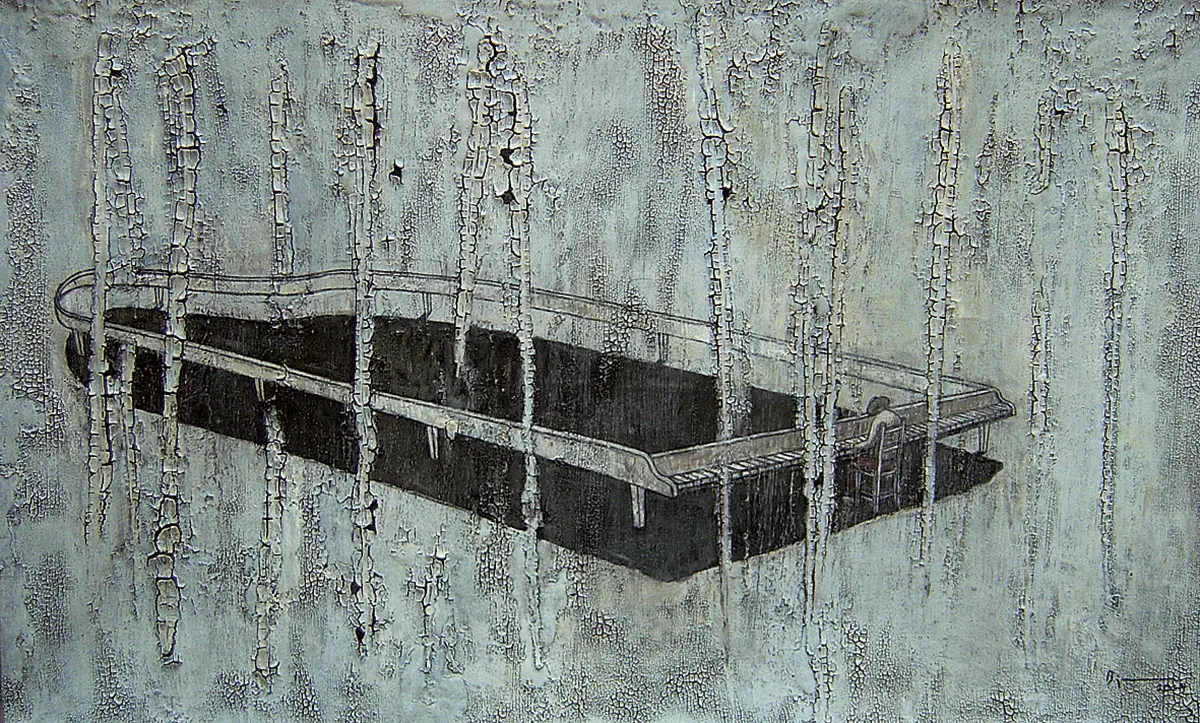
Bejarano used large, medium, and small formats for these silent rituals. His representations refer to “tiny” beings (on which the whole weight of humanity seems to fall), wearing hats and often outfitted with huge wings; they are placed atop scaffolds and staircases to establish also an intimate relationship with the desolate and austere landscapes —of a philosophical lineage that is close to Zen— where craters and abysses, the shadows of the city, and ghost towns with desiccated trees are routine.
His pictorial resources create a desolate, supernatural atmosphere where his characters’ spirits are quieted and absorbed by an omnipotent superior force that inhabits them. It is the force that some equivocally might call submission to fate, but which is simply a reflection of the challenges of existence expressed in the dispute that takes place between silence and emptiness.
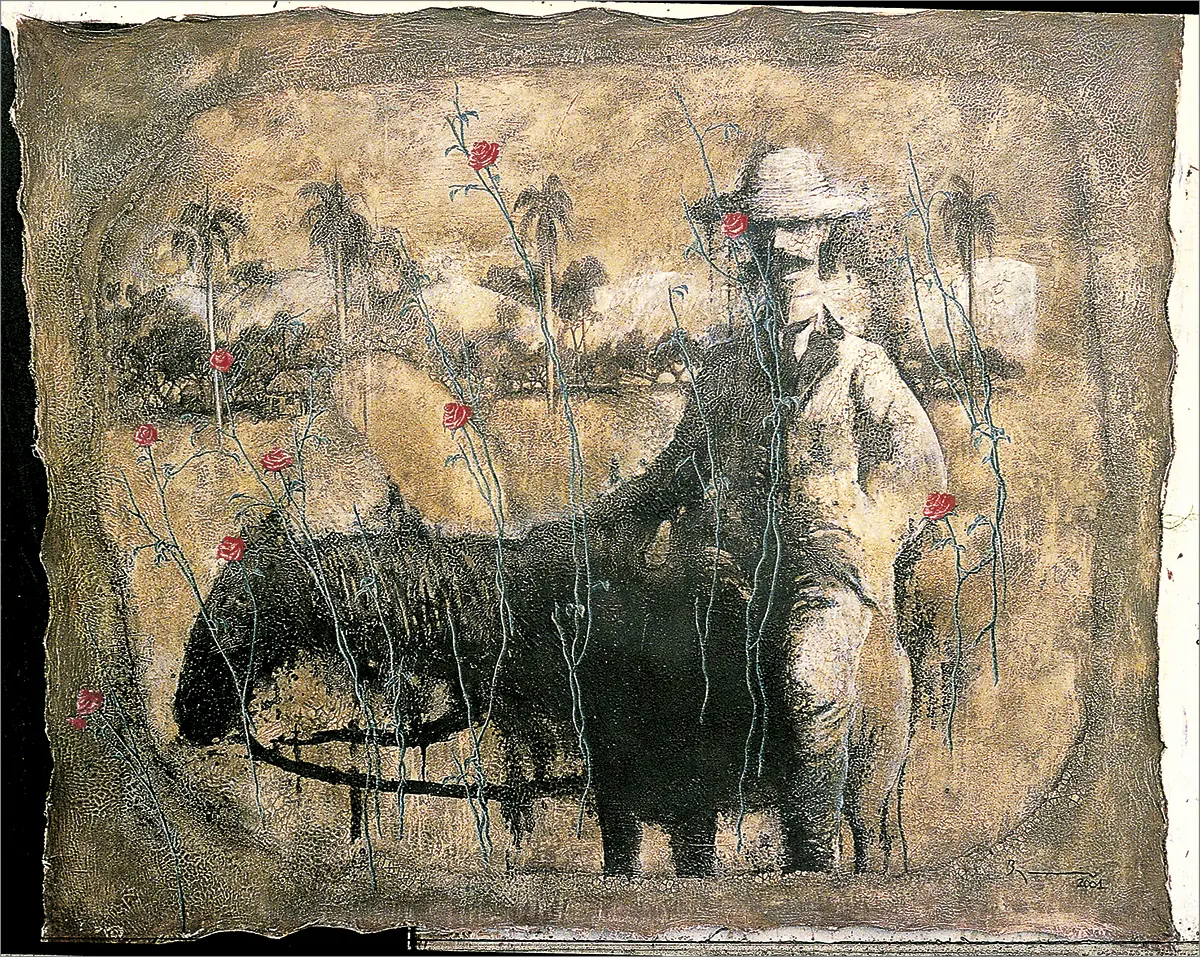
The selection of humble, common characters in the midst of everyday events with the upheaval of an absent voice acquires a special meaning. These men of simple appearance are not placed by chance in Bejarano’s landscapes, but are the tension-generating vision of the human drama; of the struggle for our dreams, hopes, and passions; of each fragment of life itself as it agonizes within the limits imposed by circumstances.
These rites are a test of strength and their protagonists possess a sacred stature that does not ask for clemency; they are a sign of dejection but under no circumstance a sign of defeat. This is why Bejarano chose men untouched by frivolity, pure in their very essence and in the essence of their labor (fishermen, farmers, utopians); they are men who carry their truths on their backs and even from the profane seek piety in interior enlightenment, in meditation, whether in letting go of time, in dilapidated docks or rustic scaffolds, or by unpredictable currents of water at sea, on a river, or in dreams.
The silence that accompanies them voids tears, anger, sadness, fury, frustration, and hate, and keeps the roar inside itself until it quiets down and finds the proper path to its crossroads. This is why most of these paintings are ordered around a center; there is no room for chaos in these landscapes and in these meditations of men that fall silent but continue to search while they abandon themselves, temporarily, to nature.
Landscapes are places of communion for people who seek to wake up, abandon all self-doubt, and resist the most intense tensions in order to reach the enlightenment of self-awareness. Undoubtedly, Bejarano’s intimate adventures and travels are here. There is a sustained prayer within each breast. I distinguish the actors in Los ritos del silencio as worshippers at the feet of silence, who are no less eager for answers because of that.
Men and places converge in the infinity of a nature that is more symbolic than naturalistic, and complete in the effects of its light or in the densities of its darkness. The act of silence is the ritual, and the universe is its landscape. Their copulation inundates everything and neutralizes emptiness, and the minds of those who fall silent become a window between outside and inside. It is precisely at this very instant that the inner beast that has at some time or another possessed every one of us, is annihilated. Los ritos del silencio13 constitutes the moment of greatest synthesis in Bejarano’s oeuvre. In it, his pictorial action becomes clear and austere; it is transformed into a space where the return to an anthropological memory whose protagonists are the peripheral inhabitants of almost inextinguishable ghettos and barely whispering alternatives, expounds at length.
To enter Agustín Bejarano’s poetics presupposes that we do not consider his many transits hastily and do not fall into the trap of discriminating between his series or periods, because in the configuration of his discourse the violence of the unexpected does not exist. Instead, a peculiar metamorphosis and continuous intermixing take him from one place to another with a conceptual and morphological coherence marked by the legacy of its own exercise.
In order to be able to adequately discern the discourse Bejarano has constructed, we need to abandon any stereotypical view, any view that alludes only to the aspect of his work linked to constant formal mobility and change in its most superficial value. To understand his oeuvre is to go beyond the assiduous experiment and the decontamination of that which has been established as cliché. This allows us to distinguish the substratum of his practice —and also it's Surface— its continuum, the meaning of which resides in the mortar of history in self-referential perspective, in the journey from private or intimate to social, and to the context of the primordial.
The lived and the everyday is nutritional substances in his work. The way in which he embraces them has gradually imbued his symbolic production with the ability to transcend the time and space in which they were created, even if they were born within the borders of a given social and human nature.
The artist has been able to carry forward, in the middle of his very different proposals, a seamless aesthetic ideology through his investigation of what is sown inside the collective. He has taken us to see Martí’s feeling of the land as a world, of the land as humanity in its entirety. The figurative and the abstract, or semi-abstract, have been the formal resources supporting his judgment around the contradictions that exist between progress and tradition, and the marks they leave on the social body.
Bejarano’s work is not beyond the influence of the convulsions of contemporary society, and in his multiple juxtapositions of time and memories of very diverse natures, he has preferred not to be complicit with a contemporary world where true spirituality is scarce and seeks to bring modern man’s crisis and helplessness to the foreground.
The ecumenical man that Bejarano has decided to depict in solitude and abandonment has traversed and broken his own limits through prayer, supplication, and meditation; silence is reiterated as an echo. Something intense and unnamable arrives, falls, and permeates with its density the place reserved for that voice that wants so desperately to be heard. There are revelations here, stolen away by silence. An intense rain might be falling down, but time is something else: a fine, imperturbable mist in its forward flow. All the weight is on man’s chest, suffocating him; nothing breaks it, nothing liberates it. Man is forever under the eternal rain of days.
* This article is an abridged version of a longer, unpublished text of the same title.
NOTES
1. The title alludes to a hurricane of the same name that hit Cuba in 1987.
2. The most salient example in this sense is Vida, 1989, a sculptural installation. Transfer and acetate, 200 x 500 cm.
3. Bejarano graduated in 1989 from the Instituto Superior de Arte, Havana, with a specialization in printmaking, and opened the Taller de Grabado de Camagüey in his native city. He was the director of the Taller for many years.
4. The title of this show comes from one of the pieces included at the Havana gallery in 1994. Tierra fértil, 1993, oil on canvas, 130 x 151 cm, depicted the body of José Martí as an island.
5. This period corresponds to his series Voluntad de silencio, 1996 when the artist was living in Monterrey. The same year, under the same title, a part of the series along with a sizable number of prints from the series Brisas del alma was presented at Nina Menocal Gallery, in Mexico.
6. Tierra húmeda is a series created between 1996 and 1997. It was partially shown for the first time at the Centro de Desarrollo de las Artes Visuales in Havana, Cuba, in August of 1996, and later at the Lausín & Blasco Gallery in Zaragoza, Spain, in 1999.
7. José Martí, “Ciegos y desleales,” Patria, New York, January 28, 1893: p. 27. From Obras completas Volume II, Politics and Revolution, Digital edition (Havana, Cuba: Centro de Estudios Martianos, 2001).
8. The series Las coquetas comprises 10 pieces done between 1998.
9. Agustín Bejarano began his Anunciaciones in Cuba and continued working on it until 2001. The series has hardly been seen in Cuba, and only a small portion of it was presented at the Pequeño Espacio gallery of the Consejo Nacional de Artes Plásticas de Cuba, as a parallel event to the 7th Havana Biennial in 2000.
10. We must note here that within the show Cabezas mágicas, Bejarano presented Metáforas de la salvación, which comprised 7 pieces (the number of days of the week) that, in the manner of a comic book, told the story of a dream José Martí had. This was a fantasy of synthetic symbolism that made reference to founding ceremonies, and actions of singular impact in the formation of our nationality.
11. Latin American Art—La belleza y la fuerza, The Elkon Gallery, Inc., April 25–June 2005, New York, USA. Agustín Bejarano was the youngest artist to be included, along with 16 painters, among whom were Diego Rivera, Wifredo Lam, Roberto Matta, Rufino Tamayo, and Fernando Botero.
12. Marguerite Yourcenar, in Matthieu Galey, Marguerite Yourcenar—Con los ojos bien abiertos, (Buenos Aires, Argentina: EMECÉ Editres, S.A., 1982), p. 39.
13. The series Ritos del Silencio was first presented in a one-person exhibition of Bejarano’s work at the Servando gallery in 2003, parallel to the 8th Havana Biennial. In 2004 it was exhibited at the Villa Manuela Gallery of the Unión Nacional de Escritores y Artistas de Cuba (UNEAC) under the title Meditaciones, and more recently as Ecos, at Nina Menocal Gallery, in Mexico.
CARIDAD BLANCO DE LA CRUZ
Ph.D. in Art History. Curator and art critic. Specilaist from the Centro de Desarrollo de las Artes Visuales, Havana, Cuba.