
Ana Patricia Palacios’s recent exhibition is a tell-tale sign of the multifarious nature of painting today. Her New York show titled Double Singuliers was generally a critically well-received show. Some works, however, were more successful and seemed to embody the premise of the exhibition while others appeared to be unresolved. The gist of the works focused on her investigation of an “individual’s identity stressing difference, solitude, and isolation through the depiction of figures and couples in seemingly banal and absurd situations.” Her paintings and works on paper ostensibly explored these fascinating themes, but it was not quite clear how the exhibition collectively conveyed the show’s endeavor. The works certainly articulated a pathos that was existential and imparted the notion of solitude and isolation well. Difference and identity were a little less tenable in some of the works as a result of the sparseness of her aesthetic, but her modus operandi is quite refined and sophisticated in its ability to say a lot with the barest of means.
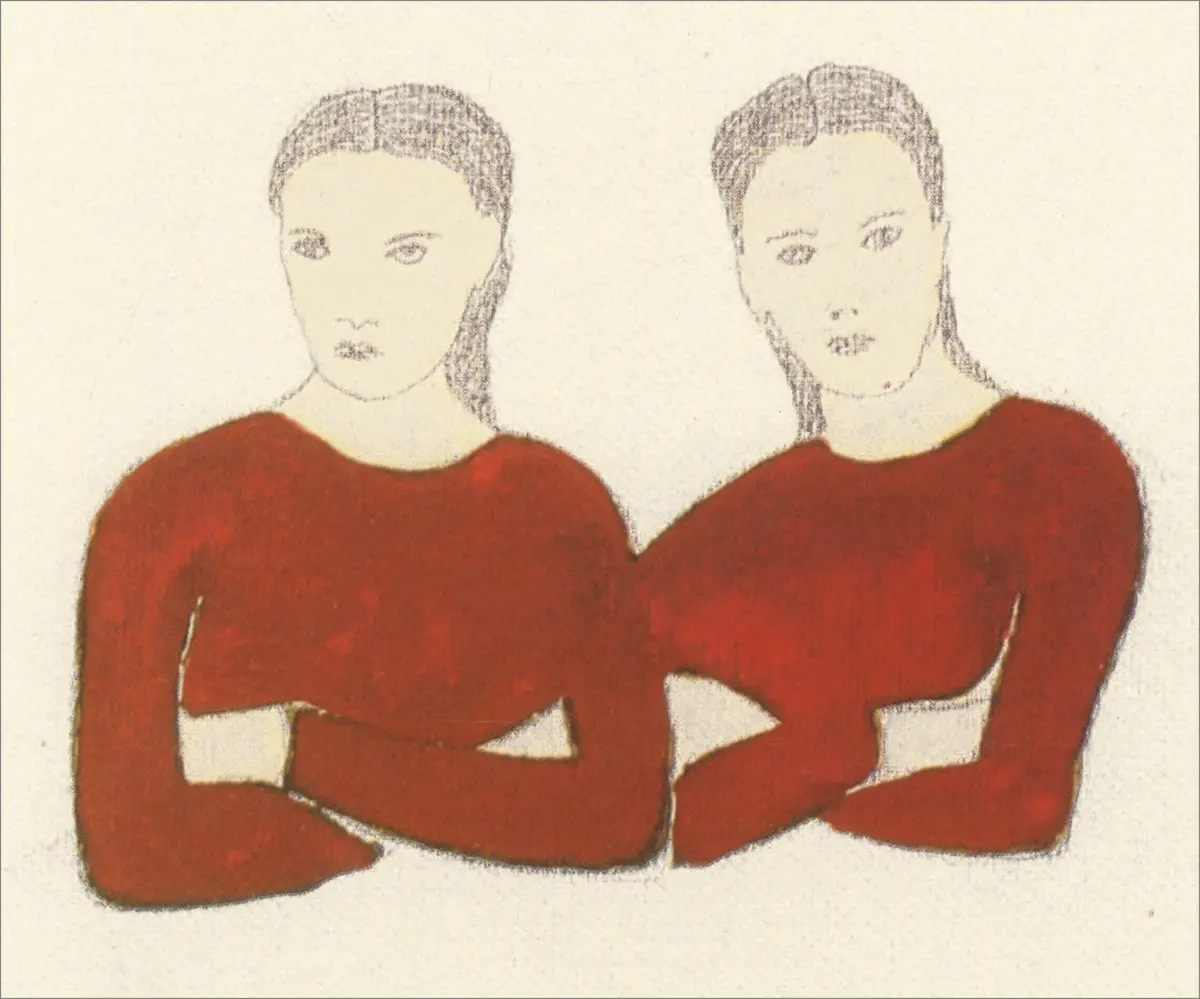
This is not to imply that the works were not engaging, for there are some that underscore Palacios as a post-figurative painter. What does this term mean and how does it apply to her pictorial strategies? One could state that like the term postmodern, which rejected post-war modernism’s insistence on medium specificity and technique and dissolved high art and popular culture, and media differentiation, as well as combining stylistic elements from the past and recycling them into a contemporary sensibility, the post-figurative painter deploys all the signifiers of traditional figurative painting including portraiture, genre, as well as history painting in both its secular and religious guises. Palacios’ iconography, though simple, was effective through her isolation of the figure suspended in pictorial space. Here, figuration struggles between representation and tinges of abstraction through the blurring of figure/ground dynamics. The demure approach to her articulation of the figure is evidence of her strength as a painter who engages, with finesse and aplomb, contemporary discourses about painting through her post-figurative approach. Not only does Palacios seem to recycle paintings from the past, but she also pilfers from contemporary visual culture: film stills, fashion photography, photojournalism, and the pulp, graphic novella.
Antecedents in Palacios’s work include, for instance, not only historically important figurative artists such as Egon Schiele, but also Alice Neel, as well as the contemporary painter Tony Bevan. Like Schiele, Palacios’s delineation and austere control of line have a tendency for undulation where the figure slightly abstracts just enough to let the viewer know that this is more than stylistics since it is about a reconfiguration of a tradition through a conceptual spin on painting. But her conceptual take on figuration is as much about materiality as it is about the image. Most conceptually oriented painters put an emphasis on the sign. Palacios is also as interested in the sign as she is in the materia of painting as a signifier in and of itself; she is sort of like Lucio Fontana or even Robert Ryman, albeit they are purely abstract painters.
This is also the case with Palacios’s use of color. Color, for Palacios, takes on an opacity that transmits the phantasmagoria of some of her work. In Untitled (Woman on the floor) (2004) for example, the figure of a woman on the “floor” is only alluded to in its subtitle. While the woman seems to be posed on the ground and she is foreshortened and there is a strong sense of modeling in the formation of the figure that hints at perspective, the absence of three-dimensional space in which the figure is placed creates tension in trying to read the work by the literality of its title. In one sense, it is very reminiscent of Manet’s Dead Toreador (c. 1864); the painting depicts a slain bullfighter who hovers in space like an apparition because of the monochromatic background in which he is placed. Palacios’s post-figuration emits this same sort of spatial incongruity resulting in pictorial affectation; coupled with an absence of context, her paintings are dislodged into a nether world that opens them up to a rich, multiplicity of interpretations. Palacios has an uncanny ability to mesh what ostensibly is a simple, yet refined and formally engaging painting technique with themes and narratives that are open-ended as they are emotional, psychologically compelling, and intellectually stimulating. It will be interesting to see how she will dovetail on these strengths of hers in the future.
RAÚL ZAMUDIO