
The convent-like architecture of the current Gallery 12 at Centro Cultural Recoleta, with its narrow cells linked together, seems to have been explicitly chosen to mark the elongated trajectory of Ana Tiscornia’s show. Entering the hall, viewers will be forgiven for thinking that the show’s title, Noticias breves (Brief News), contains an element of irony. The news might be brief, but the arrangement of buckets overflowing with balled-up, crumpled newsprint —containing a great deal of information— is abundant, and these are the elements that, at first glance, capture our attention. In this proliferation of buckets and in their content one can find a meditation on the world of information and its excesses. That universe of generalized information contains events, wars, violence, marginality, poverty, much more than what we can properly process. Its excess and its nonsense can be knocked down, but there is no avoiding them.
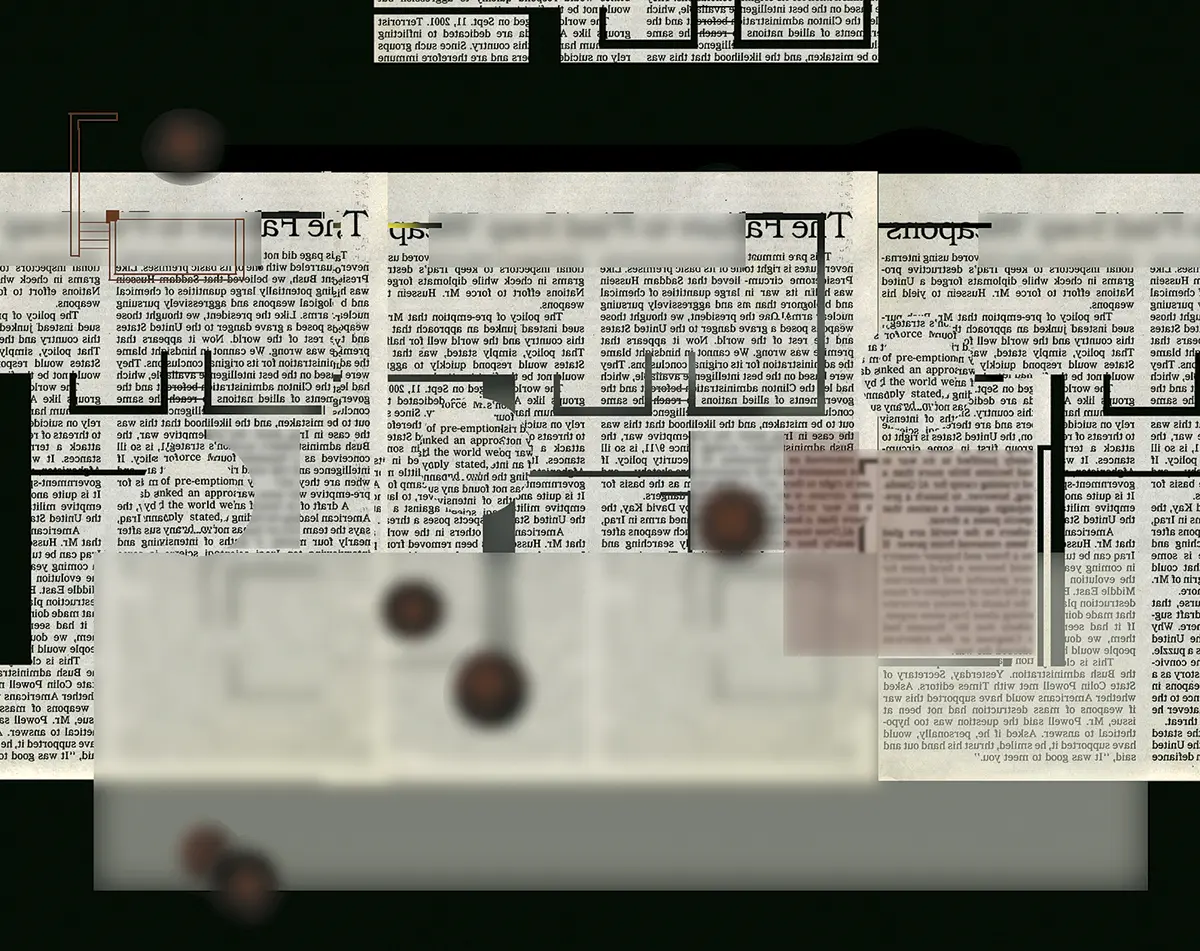
Higher, at another level of sight, there are pieces of branches and the fragments of a small house, elements that bring us closer to a real and natural world but are nevertheless truncated. Up to here, viewers can feel a kind of destabilization, a slipping underfoot. Desolation and uncertainty seem to be the mark of a large portion of the show. What Tiscornia seems to propose up to this point is well expressed by Gianni Vattimo: “Think of Being as an event, as a configuring of reality that is particularly attached to the situation of the epoch” (Introduction to The Transparent Society), that is to say, there at the crossroads of our time. An element of catastrophe hovers over the installation, but is muted in the same way in which we are used to sharing our existence with tragedy in the contemporary world.
And, finally, the show takes us to a series of small architectural plans that hang, like paintings, on a wall. The sudden change of scale is highlighted. It is there, in those small virtual spaces that the show’s sign seems to shift. There is a hermetic quality in them; the author’s method and her narrative don’t escape us: “...the graphic absurdity of an architectural drawing that refers us to the non-built space inhabited by those who have no home, or the destroyed space where those who lost their home life...” We interpret these small plans drawn from the recovery, in the artist’s memory, of the inhabitable space of a homeless person in her city, or the imaginary construction of the house of someone who has just lost their real home in the Iraq War, as the “site” of a positive sublimation. They refer to both imaginary and real places, to the spaces of inner intimacy of the human being who lives on that street or who lost his home in the war. Although the graphic arts, technology, or advertising can lay down their standardizing tricks, here, in these plans for geographic non-places, we can interpret the intimate, private aestheticizing of a personal, unassailable, and poetic place, of those who have been swept by the violence or the marginality decreed by those who possess power and richness.
MERCEDES CASANEGRA