
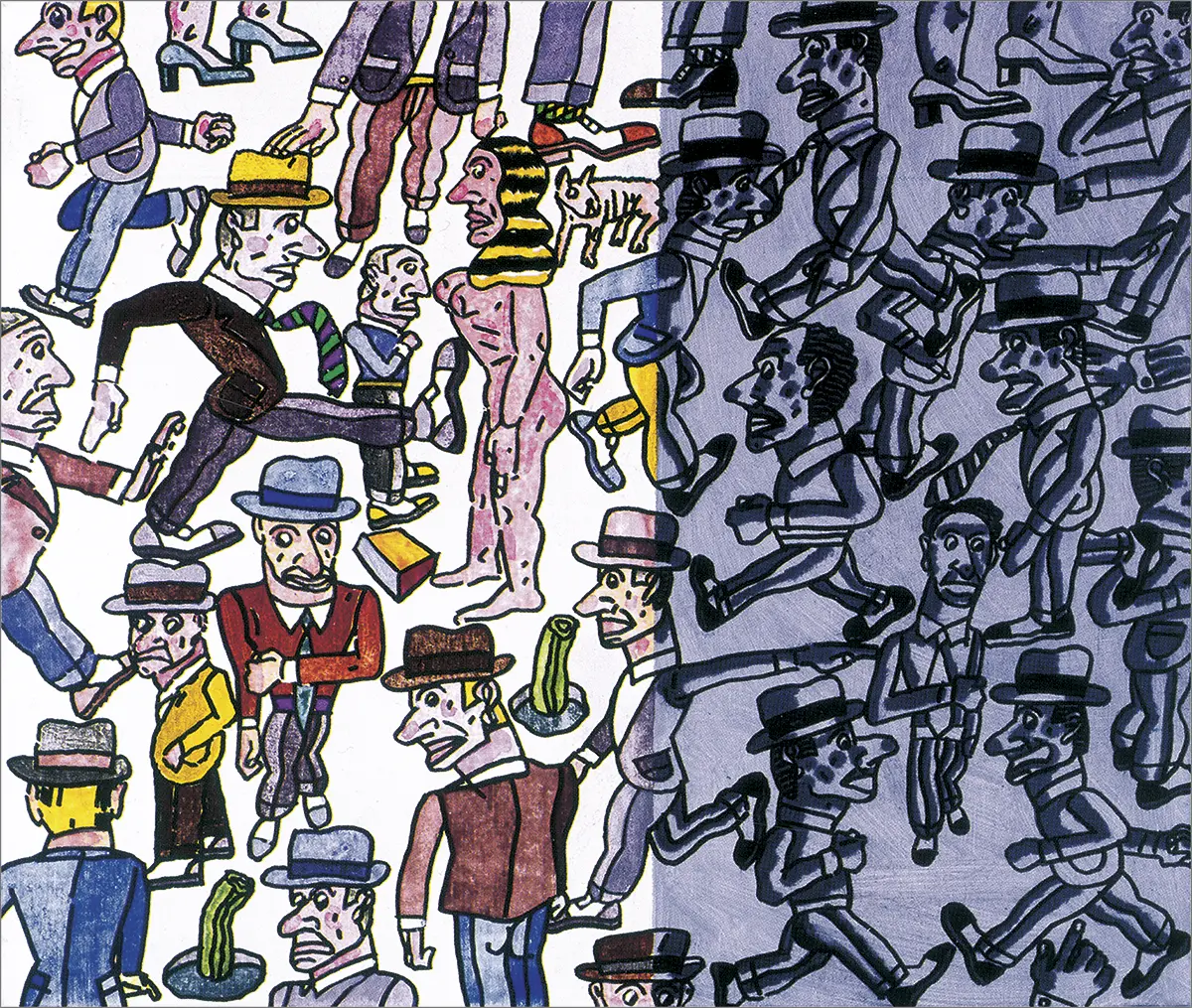
Frantic multitudes, disoriented dogs, overflowing houses, light, text, and movement: this and much more is the work of Antonio Seguí (Cordoba, Argentina, 1934). His most recent show in Mexico, held at the Pablo Goebel Fine Arts gallery between November 2004 and January 2005, comprised thirty recent works. This long-active artist can still surprise us with crowded compositions and metaphors.
Seguí’s work has always been distinguished by a mixture of humor and irony, and his characters possess a style of their own. The artist once spoke of having been nourished by the comic strips, political cartoons, and many other elements of popular culture he drank up in his native Cordoba, which undoubtedly became the inspiration for the development of his satirical style, a style that, while playful, is not banal or simplistic but charged with an intense background.
One of the great contradictions of our time is illustrated by these densely populated paintings: the closer we seem to be to one another thanks to the technological developments that facilitate communication and point toward a shortening of distances, a simplification of processes, and a shift in ideologies, the more isolated we become, cloistered within ourselves and distant from those around us. Seguí’s characters move fast, each in his or her own direction, clashing or piling up in their attempt to get there as quickly as possible.
Nothing expresses the idea of the postmodern era better than a multitude whose members are more individualistic than ever; even in works with fewer elements distance plays a role. In Pareja, for example, we see a man to the left, a dog in the center, and a woman carrying a handbag to the right. All of them have their backs turned toward us in a lively, colorful environment, yet there is no contact, no interaction for the couple, who also refuse to establish contact with the viewer.
There is also contraposition of elements present in the mixture of atmospheres and themes with whatever occurs in the piece, as if the painting expressed two moments of a single scene, contrasting a kind of somber and unsettling moment with a warmer —albeit no less confused— one. Alongside “pessimistic” titles such as Paisaje torturado, El sol no sale para todos, and Desasosiego, there are titles like Alegría-Alegría, and Como una fiesta, where no one is smiling too widely; on the contrary, they all seem to be muttering something under their breath, as if whispering a curse.
It is in Seguí’s ironic gaze that the power of his work resides since the interplay of pessimism and mockery allows us to reflect on what happens to us as individuals and as members of an unhinged society. The perfect frame for these contradictions is, of course, the city, a subject that has motivated the artist since the late 1980s: the city’s bustle, being lost in that universe of concrete and people, disappearing among the masses of those unending streets, where one is forced to become part of a whole that moves forward whether it wants to or not. Seguí is not only an excellent, world-class Latin American artist, but he is also all the individuals he has assembled in his works in his passion to create and bear witness to the existence of an everyday world filled with things to see.
ISAURA RUIZ