
Panamanian artist
Brooke Alfaro has described painting as his “most intimate and genuine form of
expression.” Nevertheless, in 2000 after two decades as a painter, he left his
canvases and turned to video art. From the seventies to the nineties he had
shown his paintings in numerous exhibitions, to great critical acclaim and
commercial success. Then, to the surprise of the collectors who followed his
painting career, at the end of the twentieth century, Alfaro presented his
first video at an international biennial and from then on, has been dedicated
full time to this new medium. It was a drastic change: from prosperity and
recognition as a painter to the bottom rung of the ladder as a video artist.
Years earlier, even before he began his career as a painter, there had been a precedent for video in Alfaro’s life. As a young man, he had practiced with a Super-8 camera in an effort to create a movie, but the difficulties of the medium, which at the time seemed expensive and tedious, led him to abandon it. He would not try film again until he was over fifty. Curiously, and in spite of his creative nature, painting had also come to him relatively late in life, not until after he had finished his university studies. In keeping with his conservative family’s standards and his traditional education, these began with Law School and ended at the University of Panama’s School of Architecture.
Nevertheless, Alfaro longed for a life focused on creative expression more than a profession, and this led him to decide to study painting. He attended courses at the Art Students League in New York for several seasons over a period of three years. There, he learned to paint in an academic manner —he held a deep admiration for Velásquez— although he also explored a variety of styles ranging from impressionism to abstraction. He dedicated many hours and intense effort to learning the craftsmanship of painting, seeking to perfect his ability to draw and handle color, refining his powers of expression until he could imbue each character in his compositions with “a bit of his soul.” He returned to his country in the early 1980s and over the following years created a great number of drawings, pastels, and canvases, quickly becoming one of the most sought-after painters in Panama with numerous invitations to represent his country in international events.
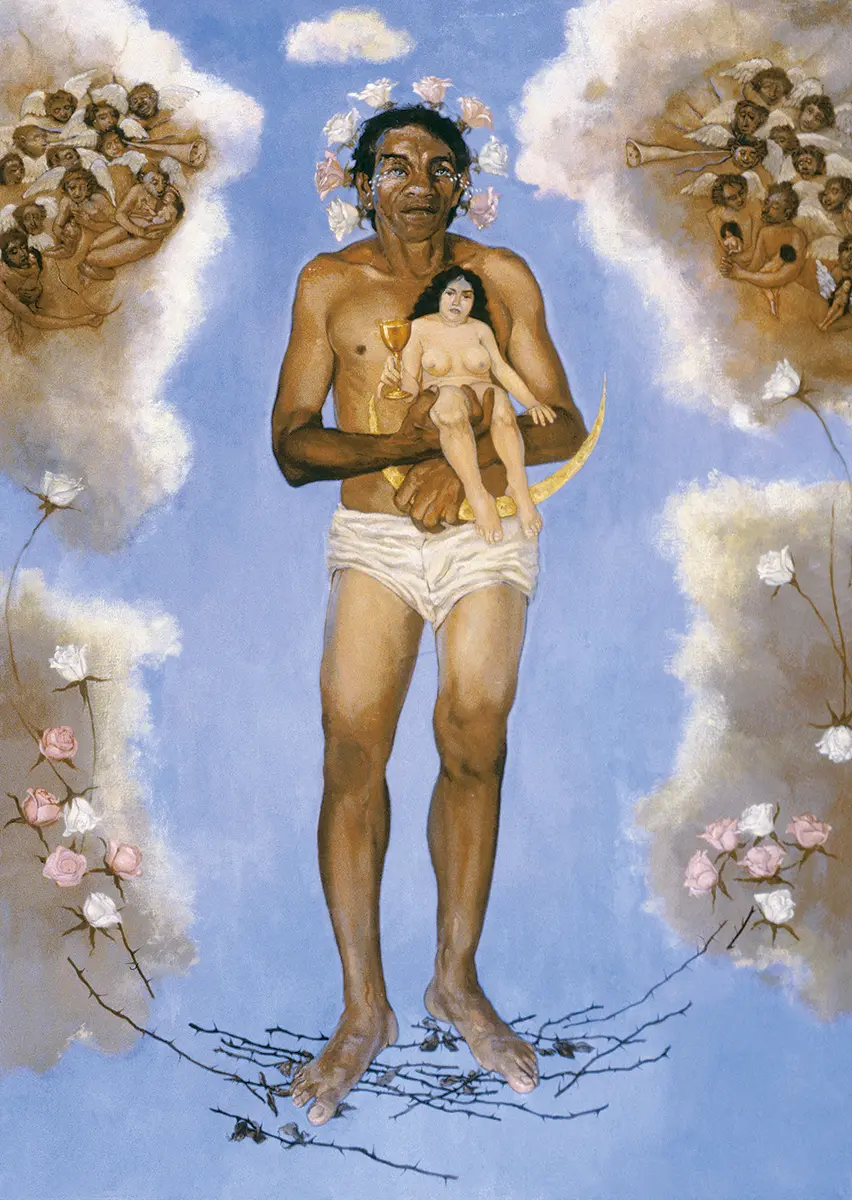
From early on Brooke Alfaro’s paintings were characterized by a sharp interest in human beings. Initially, he depicted female figures in a manner both romantic and poetic, later broadening his treatment to create surreal and fantastic visions of all of humanity with its religious obsessions and erotic passions, political attitudes, and ideological postures. With the incorporation of a rich and personal iconography and a fantastic sense of reality, Alfaro has always painted perturbed figures in visually and psychologically ambiguous scenes that challenge the observer. For years he painted imaginative and irreverent compositions peopled by common men, as well as dogs and priests, everyday saints, mestizo virgins, and saints of his own creation. In his paintings, Alfaro employed irony to mock the ecclesiastical traditions and social mores that characterize life in Latin America, while at the same time, with an almost virtuous pictorial technique, he echoed the baroque style of colonial religious art and popular images.
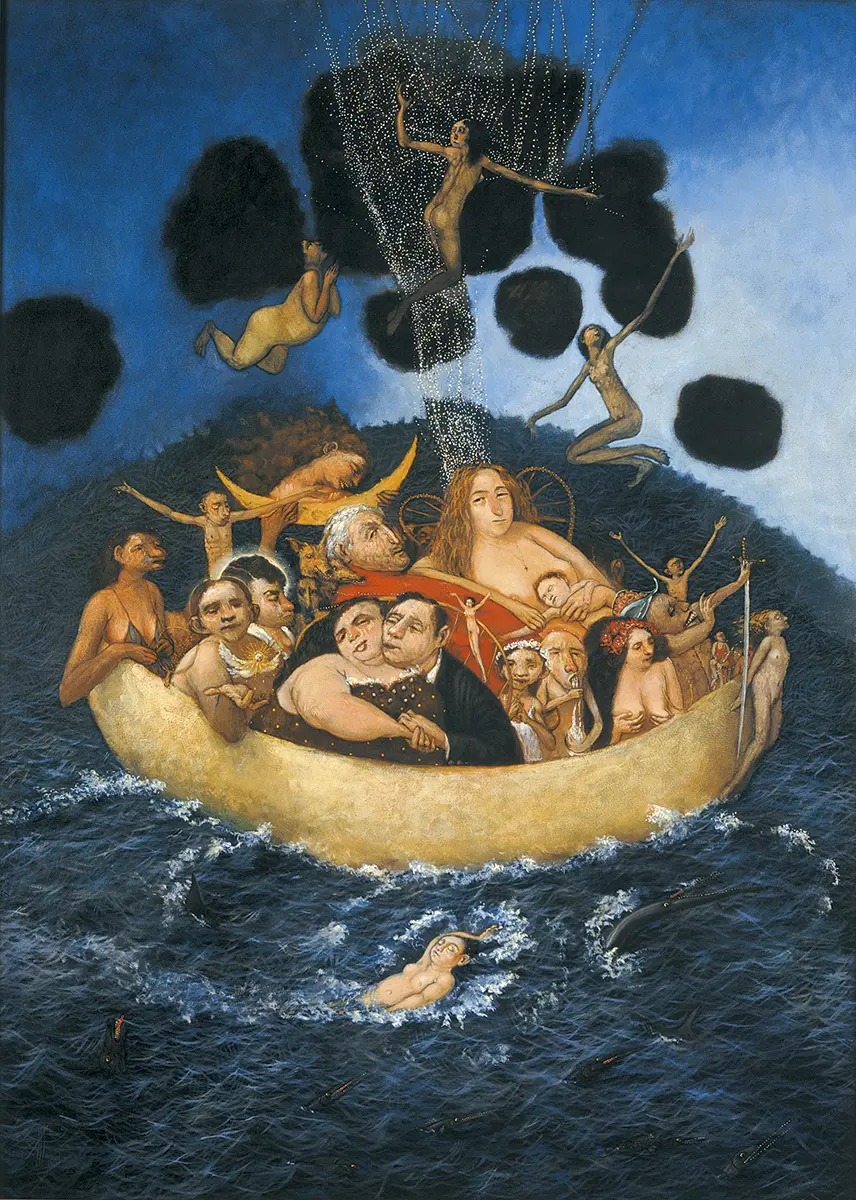
Although Alfaro based his figures on models he found among his neighbors in the Casco Viejo (Old Quarter) of Panama City, where his home and atelier were located for many years, over time he transformed and deformed his characters in works that were ever more audacious. During the period of the political crisis and toward the close of the dictatorial regime in Panama at the end of the 1980s, and even after the beginning of the democratic period, he painted images of false heroes, military figures, and corrupt officials as groups of human beings or animals that seemed to have escaped from a nightmare. He even painted the experience of the U.S. troops’ invasion of Panama on December 20, 1989. Over the following years, he delved into increasingly radical and distorted interpretations of humanity with images of single figures or compositions in which overwhelming tropical jungles or turbulent seas worked both as backgrounds as well as protagonists. In works reminiscent of Bosch or Brueghel, Alfaro represented human weaknesses, such as hypocrisy, pride, and pretension. Toward the end of the 1990s, the levitations, bodily disfigurations, and the incongruence in the proportions and dimensions of his human figures had reached a climax in his paintings in which, as Ricardo Pau-Llosa well described it, “far beyond violated laws, implausible narratives, and discarded myths, lies an encounter between the various worlds that belong to our individual and collective subconscious.”1
Alfaro sublimates repressed passions in intensely descriptive paintings but above all, he presents a personal vision of the evils that characterize our society, a theme toward which he adopts an irreverent, and even aggressive, posture. In a similar manner, his videos produce a strong initial impression on the viewer because of the way in which extreme realism is employed to tell ambiguous stories that the viewer is forced to complete and that simultaneously protest against the social injustices in today’s world. The generalized melancholy of his painted models is transmuted into the absolute misery of his filmed characters who similarly come from poor neighborhoods and are presented in all their difficult —and yet poetic— realism.
Alfaro made his first video when he was invited to represent Panama in the Second Iberoamerican Biennial in Lima, Peru, an event that promoted the inclusion of works that broke boundaries. At the time, Alfaro produced, in collaboration with Panamanian photographer Sandra Eleta, the installation entitled Comanche (1999), which incorporated photography, written text, video, and sculpture that was based on the figure of a homeless man who lives in Panama City.2 The video shows an alcoholic and drug-addicted man who walks along the streets of Panama City making pseudo-political speeches to non-existent audiences. In the installation, the artist contrasted this demented man with expressionist busts (made of mud and cement) that imitate the typical statues of the heroes of Independence that one sees in the main squares of most Latin American cities. The video was born of Alfaro’s desire to document this eccentric and uninhibited character, whom he followed for three months, initially filming his walkabouts and later initiating conversations with him. The product was a seven-minute video and the beginning of a new chapter in Alfaro’s life.
Comanche provides an example of the subject that would dominate the artist’s future video production: the people in Panama’s oldest neighborhood who live in the most pitiful conditions, with huge deprivations, and are completely marginalized from society. Alfaro feels at ease with these humble and simple people and his neighbors in the Casco Viejo care for him as well.3 Their relationships clearly relate to Alfaro’s obvious and constant need to break with the complacency of the bourgeois scheme in which he was raised. As the models for his paintings, his videos show perturbing characters that he finds beautiful and through whom he seeks to shock or even repulse his audience.
Alfaro’s videos are to a great extent the product of intuition rather than experience with the medium, a situation reflected by the crude honesty of his works. For some videos, he writes the script, chooses the music, and then tells his actor-neighbors what to do. In others, the characters are doing their own thing and Alfaro works in the manner of a voyeur, taping their words and actions for scenes he later manipulates or reinterprets at his computer. This was the case with his second piece, titled Clik, clik, toc, toc (2000, 14 min.), which shows a man—who is singing calypso a cappella while he cuts another man’s hair in a manner so rough one fears he may cut into his client’s scalp. As part of the continuum that characterizes Alfaro’s video production, this piece incorporates film and audio cuts from Comanche. Clik, clik, toc, toc was first shown in Costa Rica as a video installation with a monitor on a pedestal surrounded by clippings of black hair on the floor.
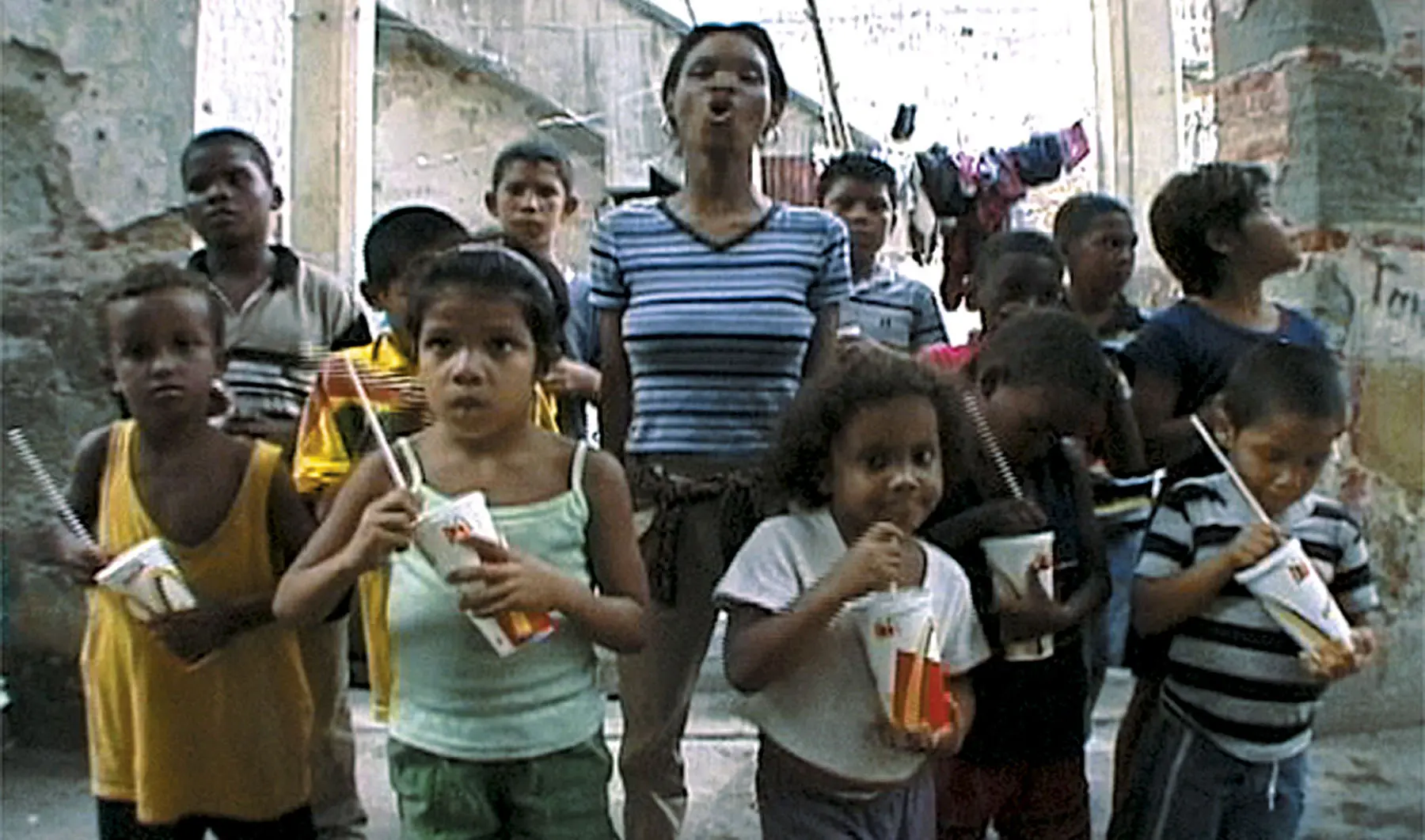
In 2002, Brooke Alfaro represented Panama at the Venice Biennale with the video Aria (3:20 min.), a stunning work in terms of both its visual and auditory components and which was also filmed in Panama’s Casco Viejo. Aria begins with an extended panoramic shot of the sky viewed through the broken roof of a building in ruins, the camera descends slowly in a spiral along corroded, sensuous walls to the sound of a feminine voice singing in a manner both classic and out of tune that imbues the scene with a sense of spirituality. A scratchy, rhythmic, and undecipherable sound contrasts with the operatic voice while we observe the destroyed interior of a once-elegant residence, now a condemned structure that offers precarious lodgings to eight underprivileged families. The viewer’s anticipation reaches a climax when the camera arrives at the bottom of the tower where we see the singer, a humble woman, surrounded by a group of needy children who are making the mysterious sound by sliding their straws in and out of the plastic lids of paper cups from McDonald’s. In a decrepit space and amidst absolute need, Alfaro manages to transmit a sensation of beauty that is both architectural and human.4
Aria marks a watershed in Alfaro’s video work because it achieves a fluid blend of subject and medium in a piece that communicates a message of deep social and political connotations and does so with touching simplicity and a refined sense of esthetics. The video shows the manner in which pictorial maturity has provided Alfaro with a powerful foundation for his work in film, in spite of the enormous technical differences between the media. Moreover, Aria succeeds in a manner that transcends Alfaro’s local environment, as proven by the numerous international prizes it has received, including the first prize in the First Competition of Video Creation “Inquieta Imagen” (“Restless Image”) at the Museum of Contemporary Art and Design in San José, Costa Rica; the Third Visual Arts Biennial of the Central American Isthmus in Managua, Nicaragua (together with another video, Yuri); and the First Video-Art Competition of Latin America and the Caribbean organized by the Cultural Center of the InterAmerican Development Bank in Washington, D.C. The work also received Honorable Mention in the international juried show VIDARTE 2002 in México, D.F.
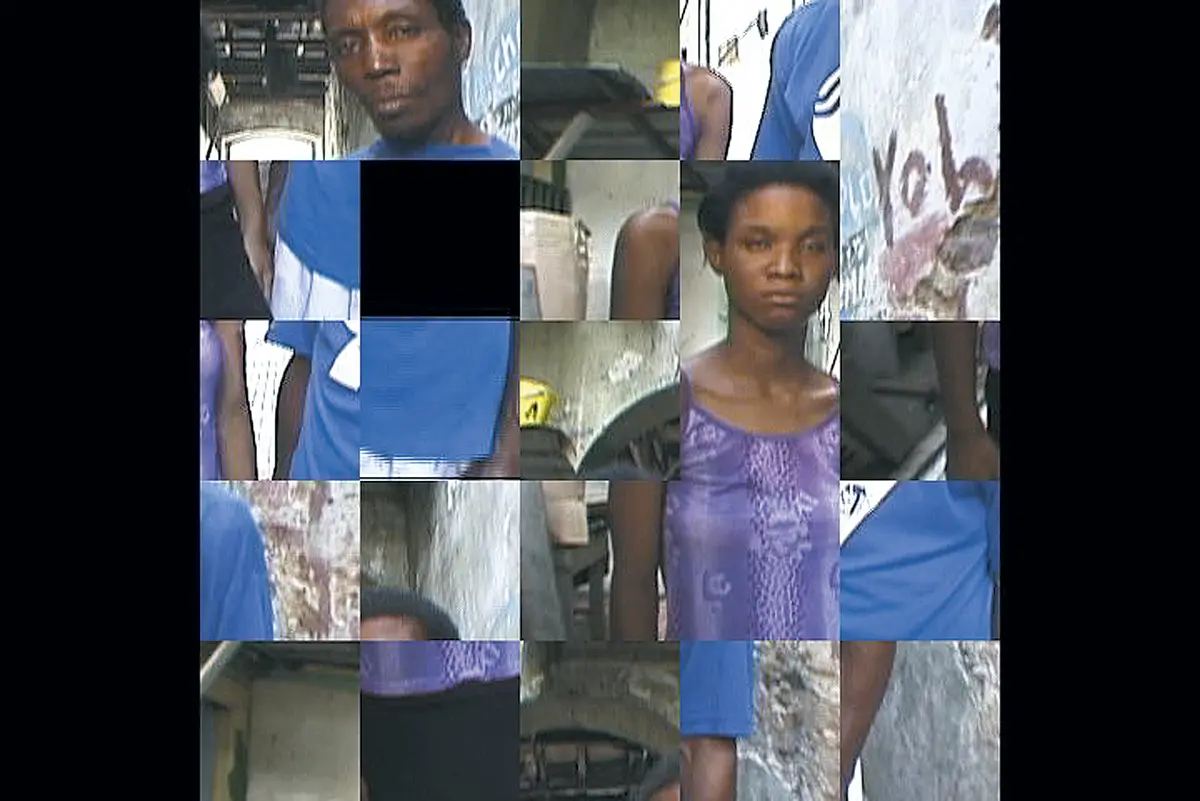
The young “soprano” in Aria is also the leading lady in another video by Alfaro entitled Creisi Blu (2002, 2 min.) in which she and the barber from Clik, clik, toc, toc appear singing—in their own way and with invented lyrics—a seventeenth-century choral piece. The image is divided into sixteen squares that change position one at a time as in a puzzle, with one square always remaining blank. The pieces move continuously for as long as the song lasts and it is precisely on the last note that the squares achieve a position that displays the complete scene. Both the game and the song create a sense of expectation and innocence, which is broken when the final image reveals two apparently very poor people, much removed in time and place from the refined world the audio anticipates. Creisi Blu won an Honorable Mention in Sixth Panama Art Biennial in 2002, where it was presented in a small darkened space in which where the only light appeared from the tiny video screen (presented in reverse projection) that required the visitors to come very close to it.
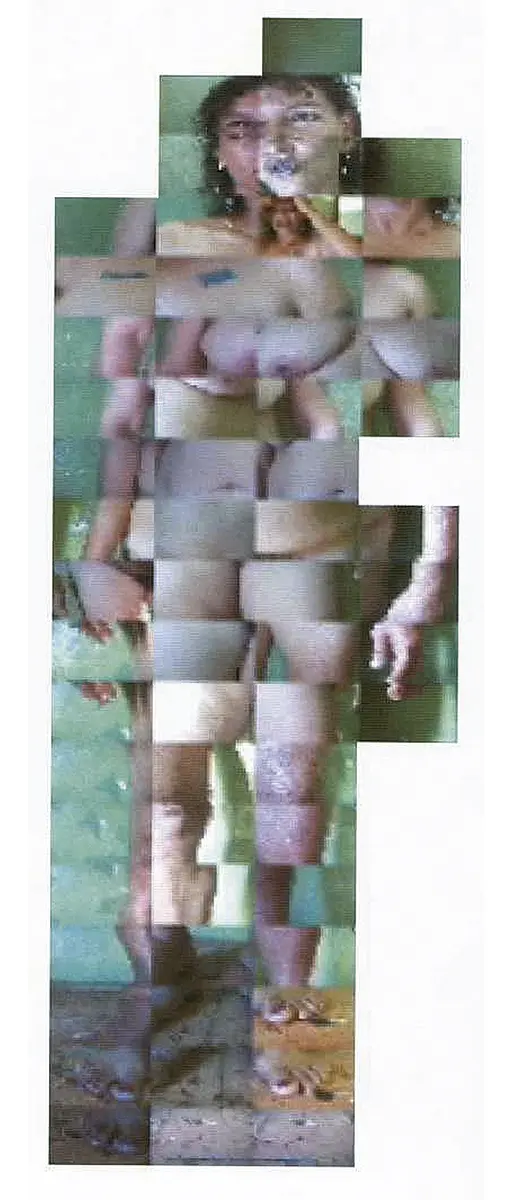
The Sixth Panama Art Biennial was also the site for the debut of Brooke Alfaro’s video Yuri (2002, 2:47 min.), whose only protagonist is a homeless prostitute that the artist met while filming Comanche. In a dark room, Alfaro confronts the viewer with the image of a life-size naked woman—Yuri (whom the artist also called Rosa to protect her identity)—whose body appears worn by time and marked with tattoos. The screen is divided into a grid of squares reminiscent of some of David Hockney’s photo collages, employed here with different effects through the incorporation of two valuable components: sound and movement. In the video, Yuri narrates a personal story related to her experiences in a women’s penitentiary, describing the attraction she felt for the younger inmates. Her testimony describes a crude life, one which is hard to fathom, through a personal reflection that makes the viewer increasingly uncomfortable. For Alfaro, the way in which the woman reveals more and more about herself and the disturbing intimacy of the video are two of the most important achievements of the creative process that brought this work to life.
The technical process of Yuri is intrinsically tied to the content mainly because of the way Alfaro divided the woman’s body into many small compartments, each of which is filmed separately and later joined by the computer. This laborious process served to generate a disconcerting effect because every part of the body moves in a manner somewhat different from the others, achieving multiple and dynamic situations, all slightly off-register. It is a body in pieces that illustrates a disjointed existence, as much on social as on emotional planes.
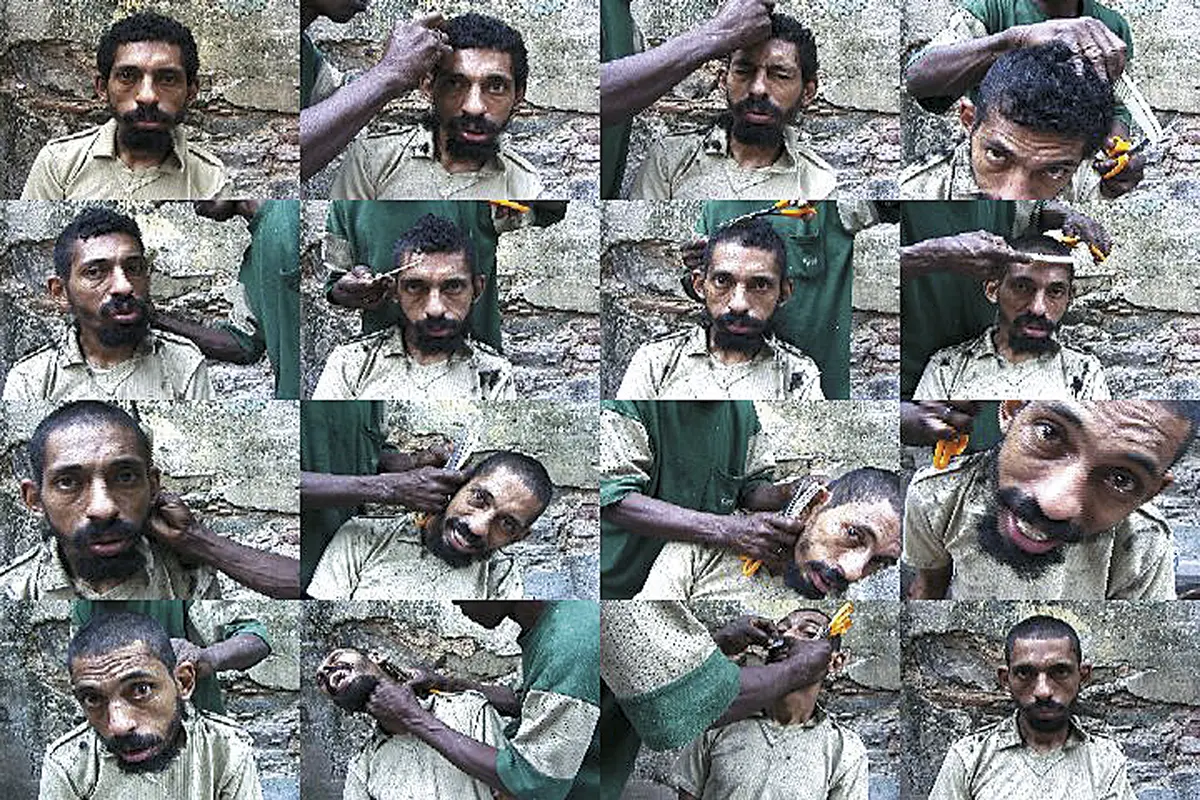
In the video Cortes (2002, 20 min.), Alfaro again employs a divided screen, in this case into sixteen rectangles, in which five men are seen getting haircuts from a neighbor (the singer in Creisi Blu) in the outdoor patio of what once was a grand home but is now a rundown space. Each one of the “clients” tells stories of their personal lives, most detailed accounts of crimes they have committed or experienced. These are scary confessions of dark adventures that they report in monologues, in the easy tone of an ordinary conversation. Their statements entail a certain amount of humor and yet reveal a world of poverty and crime that is the product of deplorable socioeconomic circumstances and provide an amazing view of the life of low-income Panamanians. As in some sort of game, the audio in Cortes follows its own rhythm emitting —from various sources— a sound that happens to coincide with one of the sixteen images, in such a way that the observer is compelled to search for the rectangle from which the voice emerges. Through the audio, the video “makes evident the morbid curiosity that we feel when confronted with the crude nature of a reality that is only accessible to us through the yellow press.”5
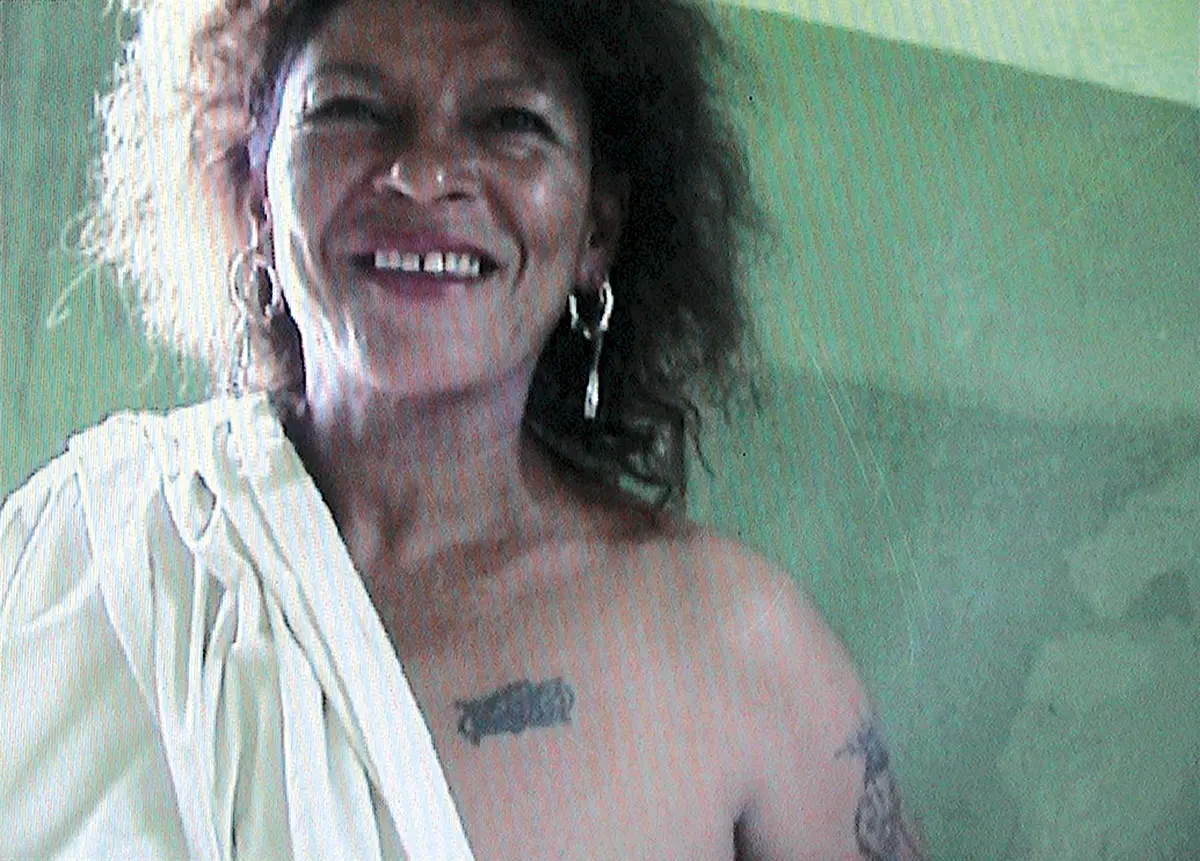
The horrors of life on the streets are also echoed in the roles played by Yuri in Alfaro’s videos Buscando and M, produced in 2003. In Buscando (4:45 min.), initially entitled Buscando a alguien (Searching for Someone), Yuri is presented frontally and partially covered by a white sheet that makes us aware of her nudity and the marks on her skin. She starts speaking without looking directly at the camera, describing the manner in which she would like to die and creating a fantasy around the idea of searching for someone who could kill her in a cruel manner. She suggests that she could be taken to the outskirts of town, stabbed, and cut up into pieces, an impressive and grotesque image that would be published in the newspapers on the following day, in such a way that everyone would know she had existed. In her fantasy, this lonely alcoholic prostitute who lives and sleeps on the streets describes her death as an apotheosis, her one and only moment of fame. Listening to her inevitably alarms the viewer who is made to feel like an intruder into the intimate thoughts of this woman so battered by life, who still has the spirit to describe a grandiose death. The video ends with a final shot of Yuri in bed, her eyes closed, licking her lips, already immersed in another fantasy.
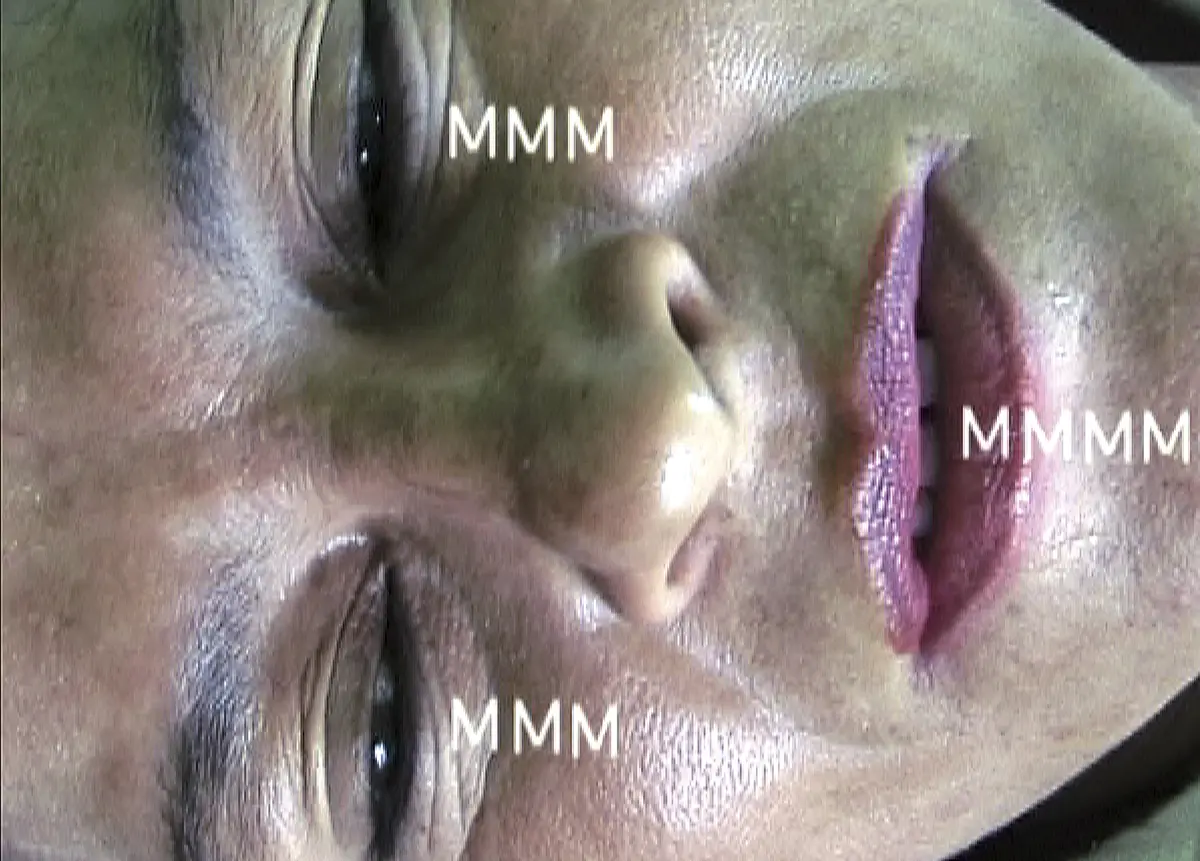
In M (2003, 10:40 min.) Alfaro superimposes letters and words onto the video images and the action to introduce a different level of narration and interpretation. According to Alfaro’s own description, M “represents a day in the life of a prostitute who, absorbed in her memories of a man, reveals her wants and needs in the solitude and intimacy of her room.” The video begins with an overhead shot of Yuri naked in the shower. Over the tiles, one sees the letter “M” which later turns into the world moments. While she washes and touches herself, the words yes, hand, and faucet appear on the screen in white letters, and while she dries herself, one reads towel and glamorous, a word loaded with painful irony since what we see is a life completely devoid of any glamour. As she leaves the bathroom, she walks down a long hall to a room in a low-class hotel, simply furnished with a bed, a chair, and a table that is missing one leg.
The character’s movements and the superimposed words lead us through a depressing parody where this pitiful woman adorns herself with lipstick, uses red nail polish to paint dirty toenails, and takes swigs from a bottle with no label. She looks at herself in a mirror while she makes herself pretty for a man who is present only in her mind. She rearranges the few pieces of furniture in this miserable room while the words here, find him, bed, bump, imprisoned, and precious appear on the screen. In the second part of the video, we see her the day before at the window of the same room, telling us that her husband is in prison and that he has left her alone when she needs him in so many ways. Later, we hear a classical cello concert, while the camera pans to the fan on the ceiling, and later to Yuri in bed satisfying her anxieties, in the company of visual representations of ahhh, more, and mmmmm. She gets up, wipes herself clean, and the last shot reveals a tattoo over her breast that records the man’s name: Edward.
In these videos, Alfaro explores feminine sexual and psychological intimacy through the acts and confessions of a rough and hardened woman whose innermost thoughts he has managed to explore. What his videos do not show is the intense labor and many months the artist invests in developing the human relationships until he achieves an amazing level of trust with his “actors.” Many of them live in subhuman circumstances on the streets or in the ruined, roofless old houses that provide the background for some of his videos, the decaying spaces where the artist discovers special architectural and historic beauty. There is no doubt that the city of Panama, in particular the areas of great poverty, plays an important role in Alfaro’s oeuvre.
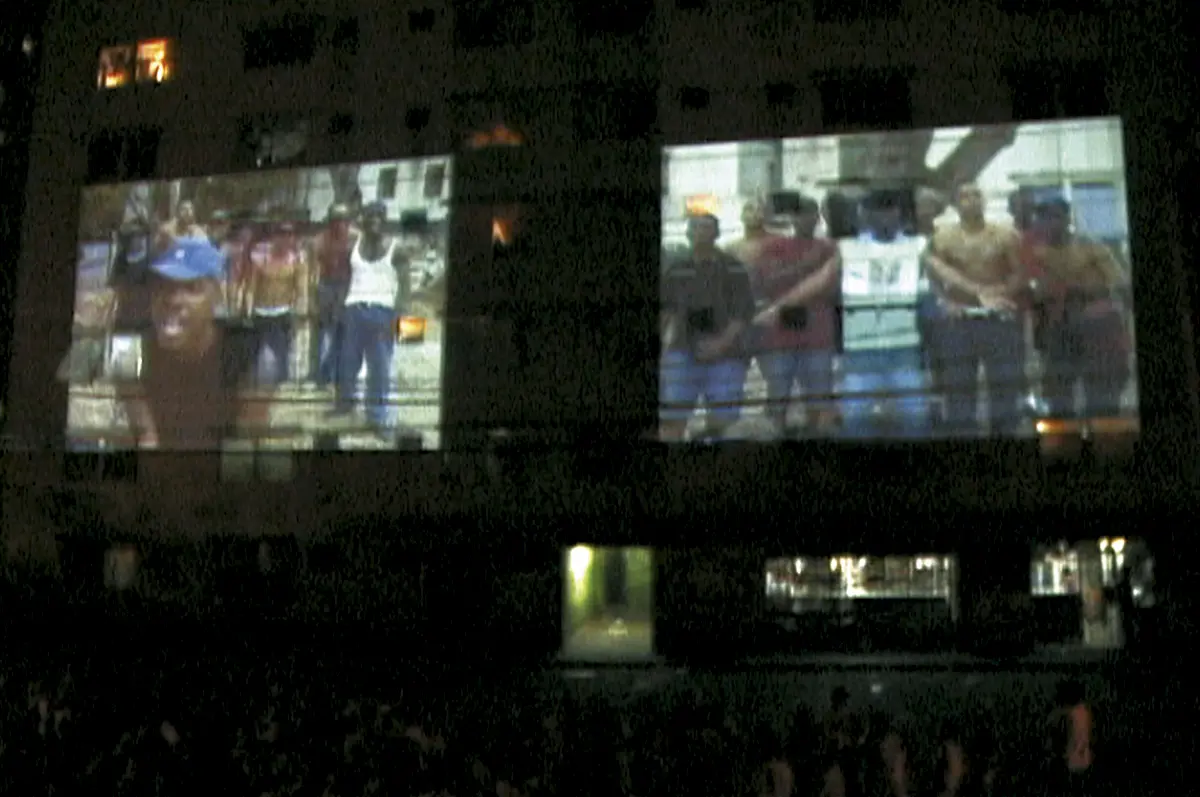
The initial preparation for the video titled Nine (2003, 14 min.) took more than a year because Alfaro proposed to create a work of art that would include two enemy gangs from the neighborhood of Barraza, one of the most dangerous areas in Panama City. The project formed part of an event called “Multiple City” in which artists, both Panamanian and foreign, were invited to create works related to the city of Panama and produced within the urban environment. The process of getting close to the members of the gangs known as “The Palestinians” and “The Band” —whose members literally hate each other to death— was necessarily a slow and careful one, beginning with a tense first meeting and many months later arriving at multiple sessions of filming.
Nine refers to the name used by the gang members for their favorite weapon: the semiautomatic nine-millimeter pistol. In Alfaro’s video, the two groups of young men appear simultaneously moving to the beat and singing the words of a popular song by Panamanian rap musician “The Roockie” (sic). The scenes were first projected at night against the walls of a tenement building in Barraza and thereby achieved a moment of harmony between the rival gangs that would have been absolutely impossible in real life. The projection of the videos was witnessed by a great number of the neighborhood’s dwellers as well as by visitors who felt —correctly— that they were outside their habitat. The situation produced a combination of anxiety, suspense, and expectation that peaked when the audience reacted to the video with applause and shouts of euphoria. Alfaro had created a piece that truly fulfilled the mandate of existing “with, and in, the city,” a moment in which the artist, the rival gangs, the neighborhood, and its inhabitants all formed part of the artistic experience.
Although Brooke Alfaro is considering the possibility of returning to painting, during 2004 he continued to create new videos such as The Contest (2.55 min.) and My God (4:20 min.), works that still include characters from Panama’s Casco Viejo—a poor woman with nine children and two unemployed fishermen, respectively— and employ a new conceptual approach. While using the voices of his protagonists to emphasize the devastating poverty that envelops their lives, Alfaro introduces an ingenious and ironic twist. He propitiates fantasies by telling them that they will receive the cash prize from the international competition to which he is sending the video he is filming if he wins. For the first time, the artist-voyeur has a part to play in his own video. What has remained the same is Brooke Alfaro’s ability to provoke reactions by mixing tragedy with humor and reality with illusion, in his videos as much as he does in his paintings.
NOTES
1. Ricardo Pau-Llosa, Brooke Alfaro: When our Worlds Meet, (México: Galería Ramis Barquet, 1997).
2. Monica Kupfer, Comanche An Installation by Brooke Alfaro y Sandra Eleta, Second IberoAmerican Biennial of Lima, Peru. (Panama: Fundación Arte y Cultura, 1999).
3. Aixa Jirón, “Brooke Alfaro y su arte inmortal,” La Prensa, November 24, 1991: 34B.
4. Monica Kupfer, “Aria: Brooke Alfaro” in Archipelago of Images, ed. Irma Arestizábal, II LA Pavillion, 50th Venice Biennial, (Venice: 2003), pp.68-69.
5. María J. Monge, “Articulaciones y disyunciones entre el arte escandinavo y centroamericano,” Conexarte, online magazine of the Museum of Contemporary Art and Design, Costa Rica, www.conexarte.com.
MONICA E. KUPFER
Ph.D. in art history, art critic, and curator. President of the Art & Culture Foundation and Founding Director of the Panama Art Biennials.