Muerto en Vida, an exhibition of works by Cuban painter Carlos Luna (1969) was inaugurated on January 22. For this individual show, the artist chose to work with Leonard Thachmes Gallery, in North Miami. The show comprises five pieces, a small but careful selection of recent works by Luna. One of the works was conceived as an a12-piece installation.
Carlos Luna lived for several years in Mexico (1991-2002,) and the influence of this country extends over his personal and family life to aspects of his work. Many of the works exhibited here are executed on amate paper, one of the most common support in Mexican folk arts.
As further evidence of Mexico’s weight in Luna’s work, we can mention elements that are characteristic of Mexican culture and go beyond a specific material, such as his treatment of the death. Luna has appropriated so significant a symbol as the human skeleton and uses it as a repeating element in two of his works: Papito Guapería and La Sospecha. This solution of repeating one motif is characteristic of folk art in general.
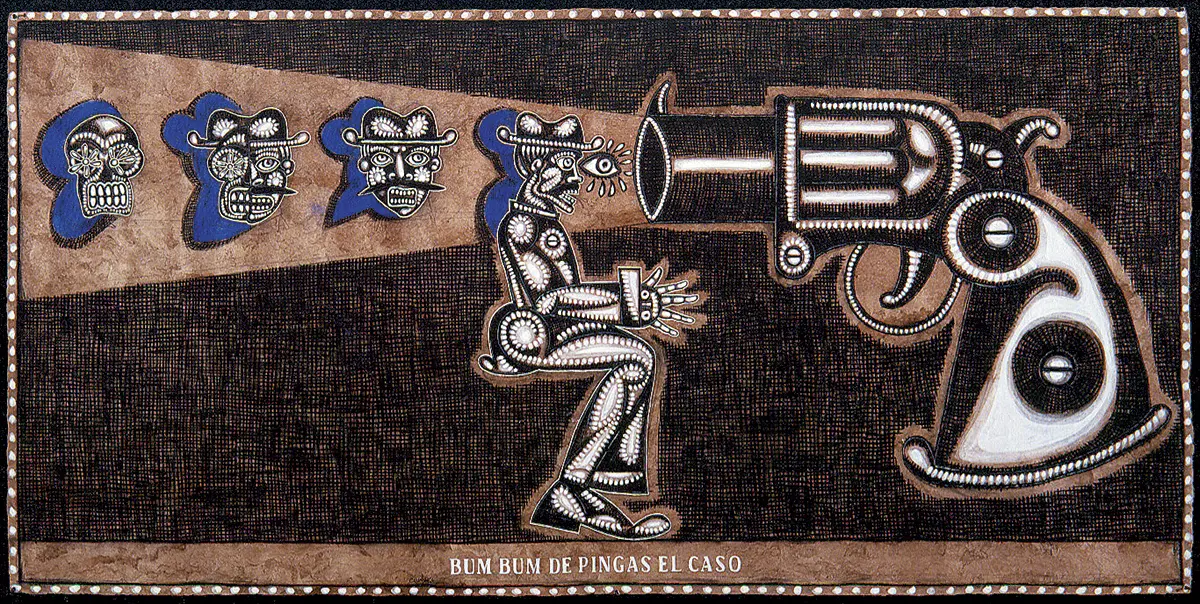
The assimilation of folk culture elements from the two countries where the artist has lived is undeniable. Among his assimilations, we can mention the work of Mexico’s Posada, both at the formal and the thematic level. Formally, the thick black lines Luna uses to outline his figures; although Luna uses a bit more color, he chooses it sparingly, at least in this exhibition. In terms of its themes, let’s keep in mind that Posada played with the issue of death, an integral part of Mexican culture. Luna deals explicitly with the Guajiro, which can be said to have an importance in Cuban culture similar to that of death in Mexican culture. The guajiro has appeared frequently in Cuban literature and art and is a prominent element of Cuban folklore. Here the artist adds a very personal element to it, ironic humor.
The irony is a Cuban characteristic, what Fernando Ortiz would call el choteo, the double-entendre, a constant joking. This “relaxed” attitude has allowed Cubans to survive difficult circumstances. It is an important component of Cuban culture and has fostered interesting movements, like buffo theater. This sense of humor can be observed in the work of several artists of what is known as the 80s generation in Cuba, to which Luna belongs.
Luna incorporates into his work other elements that are inherent to both cultures, such as superstitions, words, and above all the well-known machismo. As a social code, machismo is reflected in different facets of life. In this case, we are presented with its love-related facet, associated with virility. Luna chooses keywords and postures that refer to this element in the behavior of a specific group, implying a position regarding life supported by a folk philosophy.
Often Luna uses symbols that can be identified in his work. Among them, are animals, and in the specific instance of this show, roosters. Roosters are symbols of virility and masculinity in the animal world, intolerant of the presence of others of the same sex in their territory, a meaning that is reinforced by Luna and transposed to the human context with the use of phalluses. Sexuality is very explicit in his work, manifest not only in his use of phalluses but in other ways also, among them sensuality and eroticism.
Another topic in Luna’s work is exile and the condition of traveling without return. For Cubans, leaving the island is the highest exercise of freedom. In works like Sueño Guajiro and Dale, Dale, Vuela, Luna plays with this idea from the point of view of a guajiro and uses the plane as a symbol of and physical means to travel. The issue of exile has been extensively reflected in Cuban painting and literature. Although it is not the sole exclusive topic of contemporary Cuban culture, it has indeed had a determinant weight in the last 40 years, and we can say that it has been intensely illustrated as the basic condition of a large and important segment of Cuban artists.
IRINA LEYVA