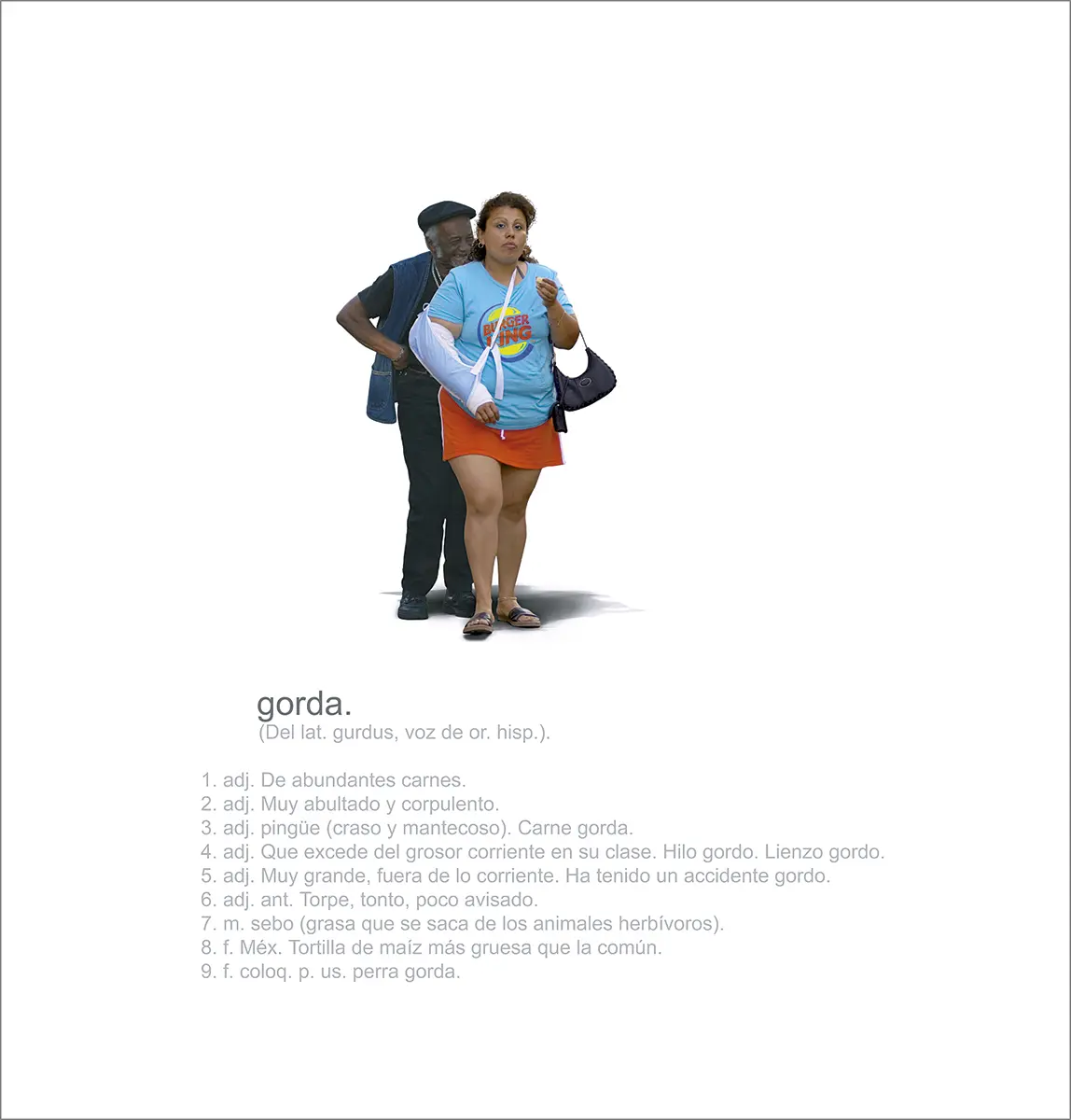
The interplay of words and things in the work of Carlos Ruiz Valarino subverts the similitude between them in order to create a relationship of contrasts and marked discomfort. Ruiz Valarino’s exhibition at the Museum of Contemporary Art in San Juan, titled Puertorriqueño(ña), opened last October and included 14 large-format digital photographs showing individuals alone or in groups, in a white space devoid of landscape or geographical context, similar to the matrix of cyberspace. One word with several definitions accompanies each photograph, like an entry in an illustrated dictionary. Nouns like gorda, trigueño, gringo, boricua, and pronouns like él, ellos, ellas, alongside their definitions at the bottom of each image, are like captions and serve a different function than that of the visual clues used to situate figures in traditional landscapes. The nouns and pronouns under each figure work towards the contraposition, amplification, and disarticulation of any meaning we can imagine being represented in the photographs.
A review of the words attached to the figures in Ruiz Valarino’s digitalized photographs will allow us to explore old concepts long rooted in our subconscious. Just like images, the visual legacy of which can be preserved in iconography and transmitted from generation to generation, words possess a legacy that allows us to observe the evolution of meanings and connotations. The noun gorda (fat woman) appears in one of Ruiz Valarino’s photographic “canvases” under the image of a woman wearing a blouse on which the name Burger King has been printed. According to Alex Grijelmo, the negative value of gordo as a noun is connected to the original Latin gordus, pre-Roman in origin, which meant stolid and dumb. The figure of the woman in this photograph, distant from current beauty standards, illustrates the connection between fatness and certain kinds of food, and certain judgments that are made about the character of those who cannot refrain from indulging their gluttony. The history hidden behind each word adds semantic strength to the plethora of associations that emerge between image and word in this series of images.
That notwithstanding, the most significant element in this show, from the conceptual point of view, is not the artist’s interest in conjoining images and words, but his desire to show us a visual typology of Being that fails to give fundaments to any essentialism of identity. The boricua meta-subject of traditional art is confronted in this show with the hybridism described by manipulated digital images and their relationship to the linguistic signifier and signified. Ruiz Valarino questions the relationship between words and things we have inherited from pre-modernity, listing definitions that are, in the end, incapable of limiting and adjusting the identity of language. The epithet “boricua,” associated in one of the photographs with the female image, appears limited to the specificity of one gender, one age, and one “race.” The image’s singularity is opposed to the concept’s pretensions of universality. The glossary of epithets, nouns, and pronouns with scientific and objective pretensions, which should ensure a faithful and precise correspondence of words to figures, reveals language’s inability to fix that which is individual and mutable. Pronouns like he, she, they, establish different relationships and are placed between the subject and some “other,” which in turn are interchangeable according to who assumes a given position. The “he” of the image accompanied by that pronoun is the artist, who, photographing himself, appears as if being photographed by “other.” In turn, this “other” can assume the position of an “I,” depending on who is articulating the utterance.
The relativity of speech positions between subjects subverts identity as defined by essentialism and rationalism. The specific qualities of each subject/example in this large-format photographic dictionary reinforce the idea of a fluid, changing identity, in some cases built into the image using the resources of digital manipulation. Identity becomes through change, at times assuming the identical, at times the alien. This is why the images in this show —the couple formed by two men, or the trigueña who is not criolla and the criolla who is not trigueña— question the old taxonomies of Puerto Rican art. The subjects in this series: the gringo, the trigueña, and the gay couple, among others, overflow the limits imposed on the canonical image associated with early, and mid-Twentieth Century art archetypes by the art of Ramón Frade, Óscar Colón Delgado, Rafael Tufiño, and others. That which is “typical,” that which is “pure,” as fixed by the artistic conventions those artists exalted in painting and printmaking, are rendered strange in this family album, and disappear to be replaced with the contemporary micro subjects variety and hybridism. The heroes of Puerto Rican “epic” history, as represented in local art, are replaced with the subject/mass, plebeian, and particularized.
The absence of landscape is a salient feature of these works. The landscape, décor, or background that served early-Renaissance painting as a way of anchoring figures in an illusory three-dimensional space, also used in the Nineteenth and Twentieth centuries to build the concept of national identity, disappears as a pictorial/photographic conventionalism. What takes its place in Ruiz Valarino’s work is a homogeneous vacuum, a blank, pristine desert similar to a digital matrix. Place, history, nature, and culture are replaced with an a-historical “space” devoid of temporal or spatial coordinates, which can be understood as a critical comment on the uniformity of the globalized world or about the artificiality of kitsch landscapes, the domain of mass tourism that is here subverted by its absence.
The strategy of choosing not to outline space using natural elements like trees, mountains, and clouds, or cultural elements such as architecture, intensifies not only the ambiguity of the figures on the white matrix and the definitions that accompany them, but it also appears to be a critique of the belief on a shared national geographic location. The disappearance of the local scene turns those figures into uprooted subjects located in the white space of the photographic surface, the site of simulated images. There where simulacrum reigns, what transpires is an epistemological hesitation between the fictional and the real, and between the real and the hyper-real. Ruiz Valarino seems to be telling us that our world not only co-exists with the visual and linguistic representations we make of it, but that it also competes with them. Following this logic, it would seem, given the ubiquity of images, words, and signs, that images, words, and signs had overtaken the immediacy of the material world to such a degree that all we perceive is their simulacra. Representations for a kind of network that is perceived by human beings as closer to the natural world, and as simulacra threaten the distinction between truth and untruth.
The artist eliminates landscape from his compositions nevertheless, he suggests light through the projection of shadows. Shadows do not indicate the extension or the limits of the space these figures occupy; as a projection of them, as signs of the volumetric body, they just assure us of their three-dimensionality, leaving their trace on the absence of the world. Ruiz Valarino does not formulate mimesis or simulacrum in which nature is an artistic value; he posits a reflection on nature as a social value.
Those shadows, also show the artist’s intervention in manipulating his images, signs of an ad hoc creation for a space that has nothing to show, rendering eternal a presence that is consolidated in a photographic shot. These shadows are possible thanks to the blurry light; yet, as projections and additions they are the only clue as to any possible source of light; otherwise, the bodies themselves would have to be the ones producing them. In Carlos Ruiz Valarino’s world, shadows intensify an ambiguity that is in itself intrinsic to the relationship between words and things.
These confirm Jean Baudrillard’s notion that there is nothing to be seen in most contemporary images since they are devoid of traces, shadows, and consequences. In this regard, Baudrillard points out that “the most we can sense is that something has vanished behind each image.”1 Carlos Ruiz Valarino’s art in the vacuum of digital space articulates some of those vanishings with eloquence and shows them in the plenitude of the image.
NOTE
1. Jean Baudrillard, La transparencia del mal. Ensayo sobre los fenómenos extremos, Barcelona, Anagrama, Colección Argumentos, 1991. p. 23
INGRID MARÍA JIMÉNEZ