
Year Zero for François Boucher, an exhibition that narrates history in a different way. The history of the Bogotazo. The history of the assassination of Jorge Eliécer Gaitán on April 9, 1948, is what many historians consider “year zero” because it was then that violence took over the streets of Bogotá, becoming an evident, and seemingly irreversible, fact.
However, this show does not deal with facts. Clearly, for historians, “facts” depend on the point of view of the narrator. Facts, in the end, are an ideological construction; there are as many possible “facts” as there are interpretations. This show, in my view, deals with the saturation of interpretations about an event. The saturation of photographs, discourses, of seemingly unimportant details adds to a kind of ideological noise that we ultimately inhabit today as if inside a cloud, without any clarity.
François Boucher’s maturity and experience with the images and sounds of the mass media, with their cacophony, are important in this show. The reason is that they allow the artist to go beyond April 9th and to reveal the paradox of living in “time zero,” between remembrance and forgetting, between awareness and unconsciousness. The “time zero” we live in, with thousands of ideas per second that end up shrouding and anesthetizing subjects without any of these stimuli capturing their interest. But at the same time a “time zero” for the subject who forgets significant moments that could reveal, for instance, the permanent conditions that have resulted in the reiterated violence in our country.
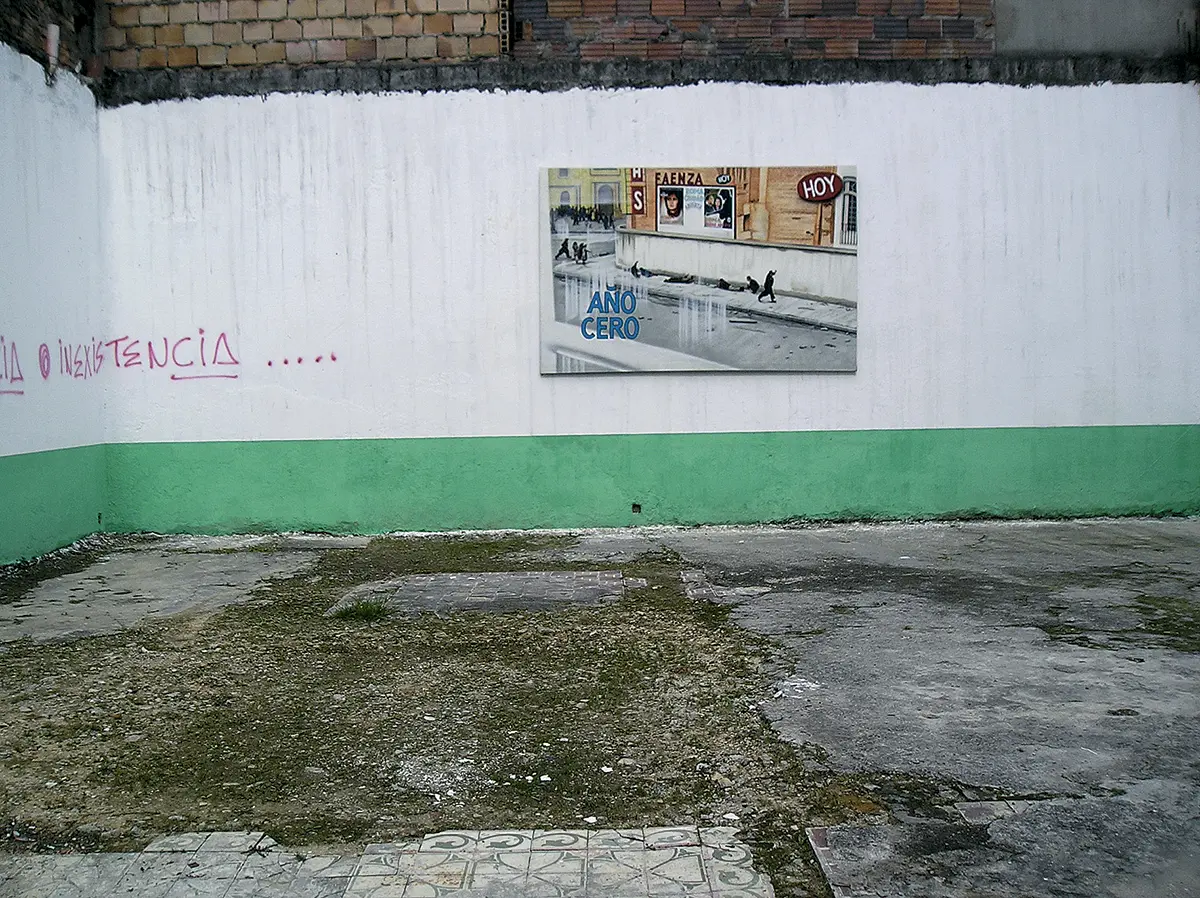
Boucher arranged in the gallery space sensations, photographs, and objects, in order to differentiate some indications of that “noise: produced by the saturation of interpretations. For instance, the viewer entered the space with an “ambient sound,” dialogs, and music from a soap opera on the subject of the Gaitán assassination that was broadcast some years ago. On the walls, are photographs of the actor who played the part of Gaitán (he looks so like Gaitán, people still stop him in the streets to salute him with devotion.) On a corner, there was a pile of posters with the image of the leader, with his hand raised, but in grayscale, as if fading into oblivion or into memory, it is impossible to say; what is true is that in this space we witnessed an ever more “rarefied” parade. On the walls and on the floor, Boucher “left,” with a certain abandonment, a series of objects: a ¿fetish? Necktie, a shoeshine boy box —who can say how street violence is experienced by people?—, and commemorative dates. In truth, these were numbers, 1922 and 1948, engraved in stone, but so small and defenseless that the “year zero” of history could be the beginning of something or of nothing as if the sum of interpretations (for new generations) were unable to mark a clear path. These historical dates in carved stone cubes, far from acting as pedestals, reminded me of that ready-made by Marcel Duchamp where the viewer literally trips over a coat rack installed on the floor.
Boucher, however, does not leave the viewer so alone. If upon entering the space you could feel that dates like those of the Banana company massacres or the Gaitán assassination did not belong to you and did not define your way of seeing or feeling, after walking through the show a different discovery was made. In a thirty-minute video —we can call it a mini-cinema— Boucher reminds us that art is an archival technique and that as such it exposes what one wants to make visible, often with a repeated impression, but it also hides circumstances that, as invisible layers, contribute to the construction of time. In this video, the images with their own movement let us see, behind the “facts,” the structures of economic power woven around the production of bananas, which, remain there as an optical unconsciousness, and which the work of this young Bogotá native who is a namesake of the Eighteen Century’s most deep-cutting ironist, attempts to reveal.
NATALIA GUTIÉRREZ